When Learning is Trauma: Elizabeth Takyi, Lois Letchford, & Lisa McCarty
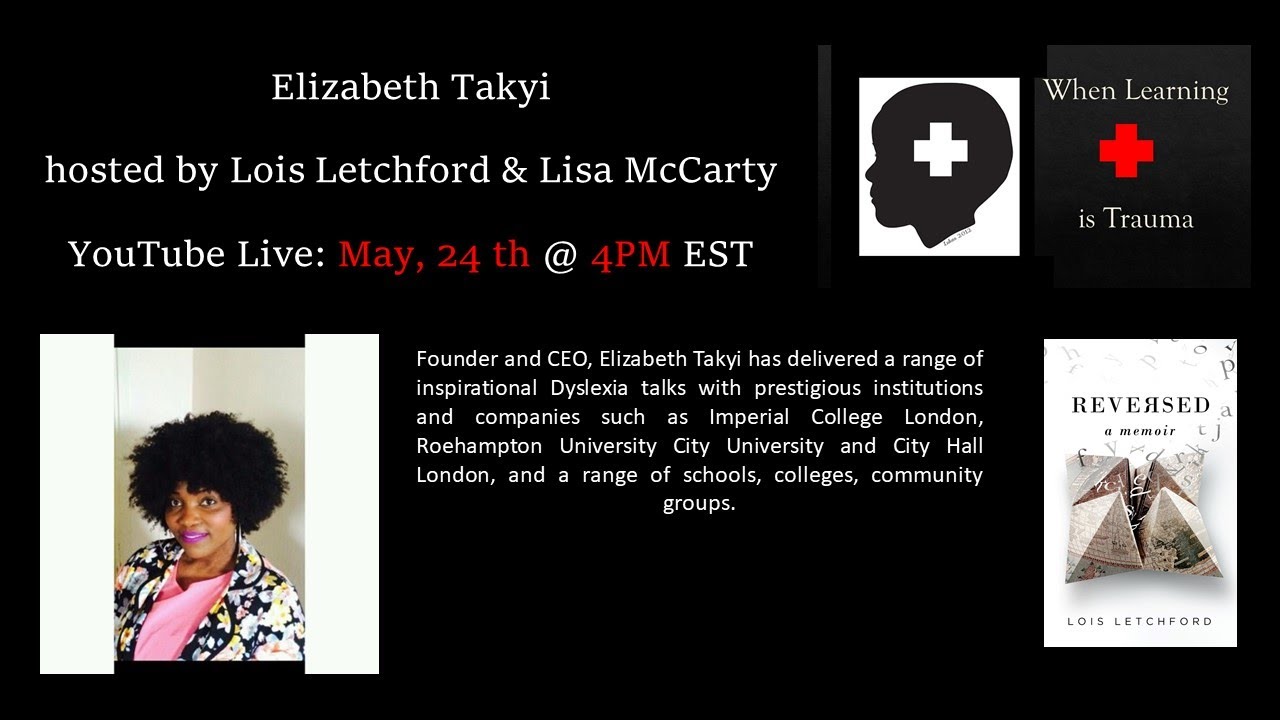
Elizabeth Takyi, founder of A2I Dyslexia, shares how undiagnosed dyslexia and punitive school practices caused lasting trauma, and how speech-to-text software and her public-speaking skills helped her become a university graduate. She now runs free assessments and support programs for Black dyslexics in Lambeth, pushing back against teachers' lack of training and the damage of being labeled lazy or naughty.
Chapters
Good day.
What's that? Yeah, it's not what I want. That's for you. That's for you.
Lawrence, you didn't send me any questions. Are we just having a chat?
Uh, yes, it's, you know, it's, um, sharing your story. You're right, I haven't sent you any questions. It's sharing your story of going to school.
Please write. Please write.
And you know, being traumatized in school is the message I want to get across.
Oh wait, no, don't, don't.
Yeah, backspace one.
Yeah.
Elizabeth T A K Y I. Tachi, Tachi, Tachi.
Yeah, got it.
And if you want, if you want, you can break it down by spelling it. Yes, how you hear it. Just spell it how you hear it.
Yes.
What's happening?
What the heck? It's—
I know, but I'm going to have to do something. All right, we're gonna have to do that again.
Yep, we've just got to set this up. So we changed the picture and all of this first time.
Your mouse is going in 10 miles an hour. Ten MBI.
No, that's all right. I'll try it.
Pardon?
That's supposed to change the picture. Picture five. No. What do you add? No.
Um, no, no, no. It's it B E T T A K Y I. What happens is on the picture for YouTube, it takes up last week's picture and not. Today's? Yeah, and so good, and that's the standard one. Do you want any links you want us to put up? A2I Dyslexia you want up, don't you?
That's fine, yeah.
Could you send it to me, please? Ah, now with it.
You know, I don't know how to do that. I'm not techy at all.
Oh, don't worry. Okay.
It's easy to search up, right?
Yeah. It's the only—
I'll quickly do that. Yeah, where are we going here?
Uh, trauma and desktop.
I mean, you know what I can do, um, Lois?
Yeah, I can—
you don't have to share it right now. I can share it later on. Yes, from the YouTube channel.
That's right.
Well, what I'm going to do is I'm going to put in the link.
Yeah, trauma.
Yep.
And May-June. That'll be it. Yeah, just and that one.
This one? Yeah. Now you want to go aid at higher dyslexia really quickly?
Where will it show? Where will it be showing?
At the bottom of our link today. There it is.
Oh, so it's not. It's not going to show on our website.
Control C. Well, I'll send it to you.
Yeah, I'll just get it off. I'll just go back to YouTube.
Yeah, no, what I'll get you guys through is on, uh, we've put it in there now.
Look at that.
What is it?
It's there.
What, what is it?
A to I dyslexia.
Yeah, what is it?
It's her website. It's, um, Elizabeth's website.
So Elizabeth's B-E apostrophe S Elizabeth's website.
Web site. Let me go back to Elizabeth's website. See, all these beginning bits take a little while to work out. Ah, there it is. Yeah, okay.
Now you saved it.
Now we've saved it.
Ah, hello!
All right, I'm gonna quickly get a—
oh, the tab, the other computer, which I haven't got.
What?
The other little thing, tablet, where they talk.
Yeah, I'll deal with that when you actually go live. I need to get this done first.
Okay. Hello, Lisa!
Hello, can you hear me?
Yes!
Sorry, I totally forgot.
Did you see my message this morning or not?
Well, I saw that— I know, I just saw the invite and I happened to be doing something else and I was like, oh, I'll get to that in a second.
And then I was like, oh shoot. I sent you something that I thought you saw at 7 o'clock when I woke up.
No, sorry. And I got up a little late because I worked last night, and I just like— it was totally off my radar last night and this morning. So I apologize. So I quick got myself like semi-together.
Good on you. Well done. Well done. Now, you haven't met Elizabeth?
No, but she sounds so familiar to me.
It's this one.
Yep, let me turn my fan off so that doesn't distract us.
What do we want?
Video?
Tofu. Just wait, Chris. Come on, wait there. I think you need to restart your computer.
Not now.
Yeah, I know, not now. Come on.
That's not Elizabeth's website, that's the YouTube.
Why would I be sending TOEFL?
Okay, we're here. Elizabeth, Elizabeth, I'm saying to you, I'd like to just expand your bio a little bit. I've got you the founder and CEO of A2i Dyslexia You've delivered a range of inspirational dyslexia talks at prestigious universities and institutions. What else do you want me to say?
That's fine. That's it. That's very dyslexic-friendly for me. That's enough. You don't need any more. You really don't need any more.
Lisa, Elizabeth and I connected last year or the year before. I can't remember when.
2020, I think it was. It was the end of last year.
Because Nicholas— yeah, Nicholas was, um, talked with you, with us, didn't he?
Yeah.
And, um, and then I spoke to Elizabeth and found out her story, and her educational story is horrific, you know. And we just— and I want to get it out to as many people as possible that we can't treat children Like this. That's the message we want to get, and it leaves lifelong impacts.
You don't have to lean so close to the camera.
Don't have to lean so close to the camera. I'm getting in trouble here. I've got this virtual background. I've got a new camera because the last camera died. So I've got a new camera and a virtual background to save me putting up my poster Elizabeth, would you talk so we can do a sound check, please?
Hello everybody, my name is Elizabeth Tetchy. I'm speaking from London. I'm the founder of 8YA Dyslexia CIC.
Does that work, or do you need to talk a bit louder? This is coffee time for us. This is early.
Is it? What's the time there now?
Well, it's 10 o'clock.
Oh, in the morning. Oh, hi. Hello, Lisa.
Hello.
Hello.
Hi, Elizabeth.
How are you?
I'm doing well, thank you.
Wonderful.
Lisa is a mental health nurse, so my question to you, Elizabeth, will be, how come you didn't end up with her services? So are we doing all right, Isaac? Don't have to move so far forward.
So we are live now, or is this part getting cut out?
They'll cut this out and we'll start again. Elizabeth is sounding muffled. Okay. Is that better, Isaac? Talk again, please, Elizabeth.
Hello.
Toffee's getting his headphones.
That's— I think that's clearer to me.
Okay.
And you did a good job moving your bike.
One minute. Ah, we have another mic that might work better.
Yeah. Now, where are you in London?
Wimbledon.
Oh really?
Yeah.
You're ready for the influx?
No, I don't think they're having it this year.
Wimbledon?
Yeah, I don't think they're playing it this year.
Really? They're doing the French—
Pardon?
They're doing the French Open.
Oh, I don't know, I don't have a clue. I hear it from my window, but it's such an expensive sport I can never afford to go to it, so I just Block it all out.
I went in 1980, 1980 or 1981, and I paid, you know, £2 and stood up all day.
Oh dear, that sounds like a long time ago.
It was a long day, but it was an incredible day of tennis. And you're right, it's the only way I could afford to go. And we stood on court number 1 because that was the only court we could get into when we arrived for the start of play. And we just kept moving forward. And you don't go to the toilet, you don't drink, you don't eat, you don't do anything but watch tennis.
Exactly, exactly. I've been invited a couple of times through some of the work I do. I've given a talk there before. Um, you know, you just kind of do what you've got to do and just leave, really, isn't it? I cannot— I try to name it. It's not—
it's great.
It's not my favorite sport, but it's great. Yeah. Yeah.
Well, you know, it's— I, I'm now into it because Elizabeth— because of Ashleigh Barty. That's what I'm saying, is number one, the Australian girl. So I'm enjoying— Lisa, enjoying that. Lisa, can you talk please?
Yes, good morning. Can you hear me? How do I sound? Am I muffled?
That sounds good.
I do have sinuses, so I'm like muffled to myself. I was just running, but I do not have COVID.
We've had you know it's spring here, so everything just goes poof. All green, green, and the cottonwoods blow everywhere.
I think what we'll do is you can quickly edit this out after after before I come get you. We'll deal with that later. Copy and paste and then just go live from there.
I couldn't do this without support, technical support. I just would make a mess of it from beginning to end. You have support, don't you, Elizabeth, to do this? Um, yes.
No, someone does it all. It's not me, no way. I'm, I'm, I'm the person that just— I just talk and go. I can't deal with technical stuff. It's just, it's just Like, my attention span is quite light. It's all right for about, like, when I know what I'm doing, but otherwise it's like, get someone who's great at doing that and just get me to talk. I'm happy talking.
I actually recognize that I can't comprehend most of what I read in, in this. You know, they say they send you to a helpline and I can read it and it just, I just lose it. I literally just lose it. We right?
So Lois, are you back in, um, are you back in Australia?
No, we're in the US still. You know, my husband is now 61, or is he 62? He's 62. So we, um, you know, we— he's not going to move now.
Hmm.
So we'll stay here and we— I don't know what's going to happen after that because we— I could end up with 2 children on 2 different continents with grandchildren on 2 different continents.
Do you want me to do it?
Yeah. Yeah, and, you know, I want to be around because it's, you know, having children is— it's traumatic and you need more support than what we, we realize.
Is Lisa all right? Lisa, you're right.
Oh, I'm just coughing a lot from, uh, yeah, allergies.
Maybe I'll put my light on because it's getting quite dark in here.
Ah, has it been raining a lot?
It's been raining all week.
Yeah, that's— I struggled with that in England. I really did.
All right, I'm closing out of Spotify because you don't need that. We're closing out.
Yeah, close out on everything that you don't need. Yeah, close out on all of them. Close out.
Yeah, let's close out of that. It should be fine for now. Yeah, wait, Ctrl+V.
And we didn't put any hashtags on it.
It's fine, you can do that afterwards for the premiere if you want. All right, okay. So remember I said you want to earn that number because you'll be premiering this, so yeah, make it seem like you've already watched it. I think that's done.
Posting, taking a minute to Post. Reload site, it's telling you. Ah, there we are.
That's so much better, isn't it? Yeah, better lighting.
It's my— everything's going slowly on my computer now. That's all right, we're posting it now. We post it to Facebook, we post it to Twitter.
Yeah, screw it, let's start talking.
Welcome, welcome to When Learning Is Trauma. Welcome, Lisa. And today we are talking to Elizabeth Tatchey from London, from Wimbledon, London, and I am absolutely delighted to have her with us. Elizabeth is the founder and CEO And of A to I Dyslexia, and she has delivered a range of inspirational talks on dyslexia to prestigious institutions such as Imperial College London, Roehampton University, and City Hall. Thank you, Elizabeth, and welcome.
Hello, thank you, Lois. Thank you so much for this opportunity. I feel really privileged to be here today. Hello, Lisa.
Good morning, morning.
Good morning. It's obviously morning there; it's afternoon here.
Yes, and we have to talk to you now because you this afternoon in a couple of hours' time you do your another series. Tell us about that series to start with.
Also, it's H.Y. Dyslexia Live Show. So we speak to dyslexics across the board on different topics. So this evening's session is on dyslexia and ADHD, or the other way around. In fact, she's got ADHD severely rather than dyslexia and ADHD. So it should have been— in fact, that's really typical of my dyslexia, it should have been the other way around worded, but it's worded dyslexia and ADHD just to even confuse you more. So that's 7 o'clock this evening, and we do that live on Facebook, and also we do it on all our social media channels. Yeah.
7 o'clock? 7 PM London time.
Yeah.
Which is only in a couple of hours, isn't it? But we— I have you here because I wanted you to tell your story of learning, of growing up. You can— so start at the beginning.
Okay, you really want me to start from the beginning? Do we have all time? So where do I begin? So I was diagnosed with dyslexia, um, about, I think about 18, 19 years ago. It could even be, it might even be 20 years ago. Um, but I didn't know I had dyslexia when I was growing up. Um, I was born in the UK and my parents took me to Africa in Ghana when I was 2. Um, so most of my primary school education was based in Ghana. And of course, I remember my nursery days— not nursery, but the primary school days. And one of the things that really stuck out for me was always kind of more or less being second to last in tests. And I wouldn't really say we did— we probably did do exams when we were, you know, in primary school in Ghana. Exams here, exams in Ghana, it's completely different. Yeah, but you will sit some sort of test at the end of every academic year. And one of the ways that they would celebrate the success of people passing, well, they'll have like an assembly and everybody's names will be called. And you can imagine whose name wasn't called to come up to the front. There were a few of us, I can't remember most of them to be honest, but there were like a few of us that were left behind. And I still remember up to this age um, not being called to the front to get my certificates.
Yeah.
I just kind of put it down to, look, I'm just not very intelligent, maybe, is how I put that. And both my parents would not have known about dyslexia or dyspraxia or dyscalculia at the time, which is the 4, and visual stress, which is the 4 things I, I have as my condition. And, um, of course it was tough because one of the things that do in Ghana, for example, is that first thing in the morning, the teacher will walk in the class and there's something called dictation. Now dictation is asking you to spell a certain word on the spot.
Yeah.
Asking you to add up certain mathematical sort of whatever it might be on the spot. And some people were brilliant at it, you know. If the teacher come in and say spell necessary, they'll just spell it. Spell, I don't know, today, they'll spell it, you know. And they'll go around in the room to ask individual, um, pupils to spell. For me, that was a struggle.
Yes.
So one of the punishments was either you get caned or you get punished.
Yes.
And one of the punishments was, um, for example, you might go out and weed the garden of the school, or you would, um, you know, clean, clean the school or clean the, you know, the stones around the school. You basically, your task was to do something because you failed. Um, And that was it for me at school, and it was really traumatic, to be honest with you, because I'll be honest with you, one, I wouldn't have known about dyslexia, and not even my teachers would have known about dyslexia. So it was what it was, as wrong as it may sound now, that's all they knew, to be honest.
And I can imagine, I can imagine weeding the school gardens would have been far better than sitting in school, and definitely better than the physical punishment of caning.
I know, but yes, in some extent, yes. But the saddest part was the whole school would know, yes, that you were the last one, because that's kind of some of the punishment you get. So everyone was like, you know, she's been naughty, or she couldn't spell it, or she couldn't read it for whatever reason.
And it's not even— it's not even the punishment, but it's the shame.
Yes, absolutely.
Everyone knows I can't do it.
And then you get called names and all sorts of things, you know, like all sorts of names. And I wouldn't even want to, you know, um, mention some of them live because it can be— it can be very embarrassing, it can be very traumatic. And if you're not careful, you, you leave that school and still get to my age and you're still called that name as a nickname because that's what people know you for. Um, so fast forward, at the age of 11, my parents brought me back to the UK And I remember going to secondary school here. Again, my teacher in the UK would not have known about dyslexia, nor would I. So I kind of failed drastically, to be honest with you. I didn't catch up. I was one of the— in the bottom set of the school. Yeah, yeah. So that's, um, that's, that's a little bit of the journey.
Yeah.
Um, so of course, you know, when I came to the UK it wasn't so much that type of punishment, but it was like, you know, you've got— I got put into the bottom set.
Yes.
Um, I'd be really distracted. I didn't want to be there, to be honest with you. The most enjoyable time of school for me was break time and home time, you know. Um, obviously I didn't love my creativity subjects. Like, those days we did sewing, we did, um, typing, PE subjects, cooking. I loved all those hands-on. I'd love it. Academics, your maths, your science, your literacies and that, you know, I don't want to be there. So I became really, really destructive, if I have to be really honest with you.
Yeah.
As a result, I left school at the age of 16 with no, absolutely no qualifications, but I was determined to make it.
No qualifications? And could you read?
To be honest, um, could I read? I just didn't do it much, to be honest. I don't really— looking back now, probably baby books. When I say baby books, like young people books. Yeah, rather than proper books, you know. And I'd use my fingers to kind of follow it all the way along and just kind of made it work, really.
Could you fill out application forms for jobs?
Um, when I was 16, I mean, I'll tell you what, back in 1986 you could have walked into a shop and said, look, have you got any vacancies? And you got the job. So it wasn't, you know, it wasn't really that difficult. Application form would have been a big, big deal, but you just got the job. And then, you know, they'll probably ask, what's your address? And they'll take your addresses down, right? Um, and who you are, and that was it. But if I did— I remember maybe 16, 17, 18, if I was going to fill in an application form, I'd have to take it away. It would take me— it'd take me a long time to do it.
Yeah.
Right, and then there'll be— and of course we used to hand-fill them, there was none of this computer stuff, so there'll be loads of mistakes. Cross out, start again, cross out, start again. But, um, you know, one of my gifts is, is, um, you know, I'm a great public speaker and I can talk till the cows come home, and that's how I think I managed to, to get by. You know, I'd get the job at the interview and then I've got to perform.
That, yeah, and that's the strength, isn't it, to be able to Cover up really well. It's, it's your strength. You can do it. You can talk.
Yeah.
But you're, but you're lacking the skills that you need to do the job.
Yeah.
Yeah.
And that's what you found even when you went to work, wasn't it?
Absolutely. Yeah. I mean, I, like I said, I'd go for the interview and I'll get the jobs. And if they're not computer-based or sort of admin-based, then it was great. I got on with it. You know, those days, if you worked, I always used to go for jobs like public-facing jobs, so dealing with people, which I absolutely love. So, um, as a receptionist working— I went for jobs as a receptionist working for different, um, organizations, and I really, really, you know, I loved my job.
Yeah.
But when it came to promotion, it's like, you know, for example, um, I got a job working for Yorkshire TV back in those days as a receptionist, and, um, I was at the reception front directing people where to go booking meeting rooms, but all these things were kind of handwritten, and the switchboard stuff, and I really loved it. And I remember my manager at the time said, look, we're going to promote you. And I said, no, no promotion, because it involves all that—
Something else.
Yeah, you know, like writing things. I didn't want to be involved in any of that. Um, you know, when I say to you I have no qualifications, back then they're like unclassified and E's and F's and Not very good, to be honest.
Elizabeth, how have you coped with this trauma and drama of your early life?
I'm going to be honest with you, um, Lois, it has been a complete nightmare, um, because things like name-calling and not being able to read it right or be able to spell it right can be very, very frustrating, you know, and I don't know that I have forgotten my childhood. It's still there. I still remember it. But one thing that carries on pushing me and keep going is the fact that, um, there is hope, you know. And I keep doing that and hoping that, you know, I'm one of these people that once I start something, I will not stop till I succeed. Yeah, until I've got it right. Uh-uh. I will say to you, right, okay, I'll get back to you maybe the end of the week. You might not get it today. but I'll come back to you and I'll get down. And that's purely because of the modern technology that we have with speech-to-text and Dragon and, um, ClaraRead and all this technology that we've got for dyslexics to be able to move one step further.
Yeah, so we do need to— sorry, Lisa.
No, I just wanted to clarify what— how old were you when you had the diagnosis of dyslexia? When you understood that, did you say?
I was 32 years of age, and I'm a little bit older now, a lot older.
Um, I'm just curious, so when you were going for these jobs, especially as a receptionist, like not quite understanding maybe what that was, was there fear of, um, your skill set?
Um, to be honest with you, I mean, if I can sort of brag a little bit, if I can do that. Yeah.
Yes, of course you can.
Yeah, I'm a bit of a talker and I'm a people's person, to be honest. Everywhere I go, I gravitate to people, and, you know, it's— I'm a bit like Marmite. It's either you like me or you hate me, to be honest, you know.
Well, let me, let me rephrase that a little bit. So were you ever afraid of getting a job, afraid of what they may ask you to do if that was a weakness that you had?
Absolutely, absolutely. I mean, you know, if, if, if my boss got me to write something. I'll be really honest with you, back in the '80s, '86, like throughout my sort of 16 up to the age of maybe 22, 23, 24, 25, the kind of jobs I went for, I can honestly say to you there wasn't that much admin tasks involved.
Yes.
You know, I was a receptionist at, you know, a, a television, uh, company. Hello, how are you? People come turn up. Okay, you're looking for someone, direct them and they go. you're picking up a phone, you're taking messages, but it's not messages where it's complicated messages. It's like John called, can you call him back kind of thing, you know. And I just loved it. I absolutely loved it.
Um, I, I tend to see people who, um, you know, they don't understand where they're— why they have the weaknesses that they do, and they seem to almost become paralyzed to find a job or to even try to get into the workforce because they are So, well, traumatized by their schooling and what they feel they can't do. Did you ever feel that?
Absolutely. That's now. That was me 5, 6 years ago. This is why HY just lets us set up, because when everything went computerized and it was like, look, you want a receptionist job, great, but you'll have to obviously use the PC, you know. Yes, you're gonna have to send messages, you're gonna have to respond to emails and those kind of things. And my, my, even though I went back to uni and I studied, I studied, um, human resource management, and it's paper-based, you know, it's all admin.
Yes.
And this is when the problem started because I thought, well, I'm not going to be able to do that. And if I am able to do it, and I did get all the technology that I need to support me, it's, um, you know, like open-plan offices. You're talking in your Dragon while somebody else is talking about what they watched last night on BBC 3 or whatever it might be.
Yeah.
And, you know, the days when we had individual offices, great, and everything's open plan, and it became a real challenge for me.
Yes.
So I'd get the jobs and then I thought, you know what, I'm not going to be doing this, and I'll leave them. So I kept hopping jobs, which wasn't a very good thing.
Yeah, yeah, yeah. And that's— we have a question here, and that's what it said: what inspired you to start your organization? And you've just said it, haven't you?
Absolutely. So I my degree, like I said, I left school with very low qualification, and I know some people have asked me, so how did you get into uni then without the GCSEs? I got into uni as a mature student because I had work and work experience behind me. And yeah, I did, I got into uni and I went to study human resource management, and when I finished, I got a job, a really great amazing job, and I loved my job to bits. But if I have to put my hand up and be honest, I kept making mistakes.
Yeah.
Um, and I'll be honest again, I didn't disclose my dyslexia because I've— at the time I had 2 children. I had to get a job to, to look after my kids. Looking back now, I wish I did disclose my dyslexia because it would have really helped me.
Yeah.
So, um, just before, when a job got really, really complicated for me, I then decided to actually tell my line manager, and she just didn't understand Yeah, what help I needed. So what help do you need? I said, I don't know, you know, I just want to be able to do it like everybody else.
Yes.
Um, and of course, you know, the, the, the— it was a very big UK organization that I used to work for, and then they did kind of try eventually to, to support me. But by this time, my confidence was gone, my self-esteem was shattered completely.
Yeah.
The, the, um, what I had to go through to be able keep my job, I just thought this ain't gonna work. So yes, I left again, you know, I kept leaving. And, um, sometimes when I left, I ended up back on the, um, on the benefit system, which I'm not proud of, to be honest with you. Um, and then I just decided that, look, maybe I'll go into teaching because then people understand dyslexia in education, you know. So I went back and did my postgraduate, um, certificate in teaching. When I say people understand, if, you know, you've got students who've got dyslexia, yes, you may have teachers who might have dyslexia. Yes, it's one of those industries that I have found there's more understanding to do specific learning than in a corporate industry. Yes, in the corporate world, maybe.
Yeah.
Yes. So, um, I then went back and I did my postgraduate in further education, and I studied, um, hair and makeup artistry, which is very creative. Um, when I finished my postgrad, I went and taught at a a local college for one year, and, um, that's when my passion started thinking, well, actually, all these students in this room that are so creative, once they've done their courses and they're finished and they're going to the real world, yeah, what support is there for them, um, in the community as a dyslexic, if they did have dyslexia, if any of them did? Very creative, and I did meet quite a few people that had dyslexia. So a penny dropped, and I thought, well, actually, I'm looking for— when I was looking for help, I couldn't find it, so I'm going to create one. So I set up HY Dyslexia with literally no money, and I'm talking about like, I don't know how much, if I said £1.25, if you would understand what that means at all.
Yes.
But, um, you know, I made myself some business cards from, you know, it was some bit of money that, um, I had from my social, is what they call it.
Yeah.
Um, and the business cards were done, and then the little flyers were done for like £10. Vistaprint, £5 each. Yeah. And then what I did, I just kept networking. I was networking and networking with— there's a local network organization called the Wandsworth Business Chambers. I joined them and I was just networking. And, you know, you find it— I find it wherever I went, there was someone that had dyslexia, someone who knew someone who had dyslexia. Now let's be honest, dyslexia's got spectrum.
Yes.
You know, I've met people who can't can't identify the letter, the alphabet A, and I've met people who write books. Yes, so it's a spectrum of it. And from that time, we just, you know, got recognized, and there is no— there was no local support in my local area, and people just kept coming. And this is where— this is where we are now, 5 years later. Yeah. Yay, Elizabeth!
It moves me to tears.
What does A2I stand for?
Aspire to Inspire Dyslexia.
And you're doing— you're certainly doing that because, you know, you're telling the story of so much to overcome. I mean, and finding your strengths, finding what you can do, and then you're right, and, you know, getting support as you do it. And getting support in organizations, I think, is an enormous challenge.
Absolutely. In the UK, we're really blessed. There's something called Access to Work for people with disabilities. I mean, dyslexia is recognized as a form of disability. So there is support out there. Anything that's a barrier to work, there is support that you can apply for, for Access to Work, and you can get the support you need, equipment to support you in your work, to do the work you need to do. I mean, don't get me wrong, I make it sound so easy. There are days I come to my desk and I just sit and I think, oh my goodness, where'd you begin? I mean, I'm making it sound easy, but it isn't, you know.
Yes.
And sometimes I get complete— like, I don't even know where to begin. But I make a list of things to do, and then even if it's 1 or 2 or 3 things that I've done in the day, I just tick them off and that's it, it's done. Yeah. Um, because if I wasn't going to work for me, wherever I went to work, if anybody did employ me, I don't think I'll last long. One, they wouldn't understand how I work. Two, they would find me very complicating. I always am quite a complicated person.
Yeah.
Um, and you know, it can be a challenge. So I thought, I'm gonna create my own. So here we are, 5 years later. Yeah, supporting this Leicester community. But what was very interesting when I was looking for help I didn't really find anyone that looked like me. I didn't find many Black people with dyslexia. So that was also like, well, hang on a minute, you know, I'm looking around and all the role models, they're not— they didn't look like me.
Yes.
You know, we're looking at Richard Branson and your Jamie Oliver, and I thought, actually, nobody looks like me, so maybe I don't even have this condition. I don't know many Black people have got dyslexia. And then obviously when I set this up, there's loads. I mean, representation really does matter.
Yes.
And now, you know, there are loads of people, you know, that I have found, like Whoopi Goldberg and Will Smith and Benjamin Zephaniah and Steve McQueen and all these people that, you know, have got dyslexia and made it.
Yeah, you're absolutely— you're right, you know, we do need role models that look like us. And, you know, one of the contributing factors, I believe, in learning to read is lack of children not seeing people in books that look like them and doing things that they do. The literature is not culturally appropriate for culturally, you know, it's white, it's middle class, and it's female.
Absolutely.
And if you don't fit that, and I think in the African countries, you know, it's almost colonies because they're still using an English curriculum. They're not using their curriculum, one that comes from their country. But that's another story altogether, almost. But, but you're right, we do need, you know, we do need to see people that look like us, which is why I wanted you to share your story.
Thank you.
Trauma happens everywhere.
Absolutely. And the trauma doesn't stop, by the way, Lois and Lisa, it doesn't stop because I'm older and And dyslexia hasn't gone away, you know.
Yes.
Um, it never stops. So I mean, I, I'm quite lucky I work for myself. So if anybody's watching right now and they work for a company and you're really struggling, it can really have a huge mental health impact on one. Anxiety, the, the trauma, the panic, the worry, the not being able to do it, the shame. Yeah, it can have a really impact on one. And I know when I was stuck and my back was against the wall, I had my fair share of like mental health issues that I just thought, how the hell am I going to get beyond this? But I couldn't get any lower than that. I had to pick myself up and come up. Not everybody can do that, but for me it was, you know what, I'm gonna go on this journey. It's make or break. What can I— what have I got to lose? It's either we make or we break. And we break, I dust myself off and pick myself up and try again. But I can speak like that because I'm somebody that's very resilient. I mean, a lot of things I've been through, I can pick myself up and do things that I have to do. It doesn't mean I don't go through the mood swings and the low moods and all that. I still have that now as I'm speaking to you.
Yeah.
Because, um, there are simple things that I'm trying to like spell. Like today I was trying to spell available and couldn't spell this word available. And I'm like, God, this is really driving me crazy. And even if I put it in Google and Google's spelling it, I don't recognize it. Google's spelling available for me and I'm like, Google, that's not right, because words just don't look right to me. Yes. So, you know, if I sit here and say to you that I'm at a place where everything's perfect, I'm lying to you because it isn't. Yeah.
Yeah.
Elizabeth, did you have support by your family?
Right now, for example, my parents would not have understood dyslexia. I'm going to be really honest with you, and not even up till now. My mum, who's 81 years of age, she still doesn't get it. She still doesn't understand the condition dyslexia. It's only recently that my siblings have actually hooked on. When I say recently, since I started my organization, they've kind of understood it.
Yeah.
And then I remember one of my siblings actually said, oh, that goes to explain why— she kind of used the word naughty, you know, why you were so naughty when you were young. But yeah, I, I, you know, call me naughty at that time because yeah, I wasn't gonna do it. If I can't engage and can't do it when I was younger, nothing would get me to do it. I'd be like, I'm not doing it because I'm, I'm using all my— I'm using my brain, I'm using everything, and it's still not coming out.
Yes.
I can't get it on paper.
Yes.
So, you know, the frustration. I can imagine young, young children, you know, the frustration that comes out of you because you want to spell it, but it's not coming out. How do you put it on paper?
And you can't, you can't access it.
Please. Sorry, um, Louise.
You can't access it either. You know, you're coming up, you're trying really hard to access this word and this writing, and you're coming up blank. And that's frustrating.
Yeah, yeah, yeah.
Now, Xena has said, how did you know you weren't seeing the same words as your peers in classes before knowing you had dyslexia?
I always knew something was wrong, Lois. Is it just Lois, isn't it?
Yeah, yeah.
See, that pronunciation's even a problem for me. I always knew something was wrong. I always knew it because And my peers will be doing it, and I'll be sitting there either twiddling my thumbs or chewing the end of my pen or just doodling on a page, just scribbling things on a page and looking out the window all the time. And if the teacher said, well, Elizabeth, get on with it, it's like, no.
Yeah.
I'm not going to be getting on with it because I don't know what I'm supposed to be getting on with. And because I hadn't had the diagnosis, there was no support in place for me. No one gave me the help, but I knew something was wrong. I honestly knew something was wrong from, from when I was young, you know, because someone, you know, I pick up a book or my parents would give me a book and, and this is no lie, I'll look at it and just fling it to one side because I won't be reading. I look at the pictures, then fling it. So if, if my mum said, what have you read? I'd be like, yeah, no, I don't know what I've read.
Yes.
I've looked at the pictures, so that's what the pictures say, this and that, you know. I think we're so lucky to have the technology we've got now. I can speak on my phone, I can talk to my Dragon, my ClaroRead. Well, I don't talk to my ClaroRead, but it does it for me. Speech-to-text, mind mapping, all those technology out there has made me who I am today, because if we didn't have those, I'd still be the Elizabeth in 1970-something. Yeah, I don't want to give my age away.
Yeah, um, Xena, another Xena has commented, I relate to that idea. I'm not sure what that idea is. Feeling like you would need to do it all yourself in respect to being like everyone else despite having neurodiverse challenges. So that's Xena commenting on your work.
Mm-hmm.
The need to do everything yourself. You know, one of the challenges is not only do some people have challenges physically reading and writing, but then the social skills, which has been your strength, are a problem. And, and that has to be dealt with too.
Yeah, you know, I mean, I'll be very honest with you, to, to read anything, I need total silence. I can't have a pin drop. There can't be no noise around me. So that's why I went back to say an open-plan office, how is that going to work? Because phones are ringing, people are calling, people are coming in and out, you know, queries. So for me Obviously with all these lockdown and pandemic, it has been total silence, and I work better that way.
Yes.
And that's some of my— that's part of my strategy. You— I can't have music in the background, I can't hear a pin drop, nothing. And then I can work that way. But even that is just 3 things tick off the list. And I just wanted our listeners and our viewers to know that it's not, you know, if anybody says, look, you're lazy, it's not about being lazy. It's got nothing to do with laziness at all. In fact, there's been times when I've sat and cried because I can't put up paper.
Yes.
You know, or I get really annoyed with myself because the task I gave myself, I didn't finish it. I only managed to finish 2 or 3, you know. Um, although, you know, and, and, and as a result of that, I'm working very long hours to finish my task because I am one of these people, until it's done, I'm not leaving.
it.
And that can have a huge impact on one's mental health, you know. I mean, Lisa's the expert in this, you know, constantly. And I think I've got words OCD as well. If that word don't look right, I'm deleting it, I'm starting again, I'm deleting it, I'm starting again, I'm deleting it and starting again.
Yeah, yeah.
So, I mean, you know, people that work in a mental health remit will say anything you do repetitively You might need— I don't know, Lisa, is that— do you need help because you keep repeating the same cycle?
Well, I, I would see that as different. That sounds a little bit more like perfectionism that's coming from your early trauma of trying to prove yourself in the classroom. I wouldn't necessarily see that as OCD, but again, there is a spectrum to that as well. But I think a lot of people get labeled Incorrectly when they're younger, especially as you mentioned, being naughty, not wanting to do the work, especially if they're surrounded by people that don't understand it. And so what advice would you give to a parent listening perhaps who has a child that's maybe just not doing the work, getting in trouble, is seen as a behavioral problem? What would you say to that parent that has a child like that?
Well, the first thing I would say is that, um, for example, we all— I mean, Lois and I know, you might know as well, Lisa, that dyslexia is genetic. Now, I know that my dyslexia is genetic, and I know that I got it from my mum, and I'm saying that live on air. She told me no, it isn't, but it is, because a lot of the things she does is how I do it, to be honest.
Yes.
And any parent who's watching right now, the first thing I would say is Well, first of all, just have patience for that child. That's the first thing. The second thing I want to say is please go and seek help. Don't think, oh, Johnny's not doing it because he, he's lazy or he's silly or he's being stupid, for example. I want to use that word because sometimes you get, oh yes, you know, Johnny's silly or he's not catching up. Go and get the help. Speak to the school teacher. Speak to the teacher. If the teacher finds that Johnny's not learning or Mary's not learning in class, then you, you go and get help. Because if you don't, the repercussions of it—
I know.
It's devastating. And I, and I, you know, I speak— a lot of friends of mine say, look, with your journey and your story and to be sitting in this chair today, I think you'll get 1 in 10 that might break through. because I wasn't going the right path. I could have ended up in it anyway. Could have either ended up in Peru, I could have ended up in, in the wrong circle, I could have ended up anywhere. And we all know statistically the amount of prison inmates that have got dyslexia and so forth, and mental health as well. So if, if the child isn't engaging, I would say speak to the school teacher, speak to the SENCO. We call them SENCO in the UK. I don't know what you call them in America. Um, um, and get the help, you know, get the help. There's some people would say, oh, I know some people are ashamed, and some people will know actually it's not dyslexia, it's just, you know, Johnny's not catching up.
Yeah.
And I would say you've got nothing to lose by doing the assessment, going for the assessment.
Yes.
And from the assessment, it's either yes or a no. If it's a no, you know that it's not specific learning difficulty, i.e., dyslexia, um, ADHD, or whatever it might be. But if it's a positive test, then I wish I got the help from when I was 6, 7, 8, 9, 10.
Yes.
I think my life would have been completely different.
Yes.
You know, it's only the last maybe 18, 19 years ago, however many years ago I got diagnosed.
Yeah.
It's when I've actually— I'm trying to catch up on Everything I've lost. Yeah, yeah, you know, over, over 20 years of learning and everything, I'm catching up now. And I wouldn't want any parent or any child to go through what I went through in terms of education.
You've said it all, you know, Elizabeth. I mean, you know, we want parents to be patient with children and recognize, I think, behavior is a cover for something else that that's going on. They're not getting it. And then the seeking of help, which is huge. And you're so right, it's— if you don't get it at the beginning, then it's what else do you miss out on? I mean, it's not even higher-level learning, it's everything you miss out on. And you miss out on so many milestones that are normal for other people, and your path then becomes very tenuous. Who you meet, who you don't meet, but, you know, persistence, your persistence. And then I think I would say that's the only thing that got me through is persistence. But without that persistence, you know, you—
I mean, I normally say, yeah, I say dyslexia. I mean, we know we talk about dyslexia being a strength, dyslexia being a superpower. We talk about all those things. Now there's two ways. It can either make you or it can break you. And I've had both things, you know, where at one point you just think like you really just have to keep— I mean, I pray, so I have to keep praying and hope that things will turn around. Or you just may not make it, you know. And when I say you may not make it, I'm talking about, you know, everything right now, Lois, that we, we do Everything is in a form of writing, whether it's WhatsApp, whether it's Twitter, whether it's Instagram, whether it's what we're doing now. Everything involves writing. Yeah, but if you can't do any of that, you are left behind.
Yes.
Um, one may say, well, you speak to your phone. Great. Sometimes I speak to my phone and it doesn't give me the spelling I want it to give me. So, you know, you, you've, um, you've got to seek help and don't be ashamed. It's Not anything to be ashamed about, because if you don't go for the right help and support you need, then your self-esteem and all that would just go out the window and your confidence is shattered.
Yeah.
And you don't want it that way. Yeah.
You know? Yeah.
Elizabeth, you've said so much. And we've had Xena talk and she said, thank you for answering. Thank you for answering. I would— I love how you speak. with such strength and openness. I mean, that's fantastic. And Chris Chase says, what would you do for smaller schools without the necessary tools to teach kids with learning disabilities?
Wow, that was a bit of a long question. You have to break it down. Okay, so break it up for me.
What would you do with—
what would you do to teach kids with Right, now to be honest with you, I'm talking from my own experience, and I also want to say to the listeners and the viewers, I am not a dyslexia expert. I don't have a qualification in dyslexia. I live the condition. So for example, and from the, you know, the work we've been doing, the only thing I can say is that when in smaller groups, you know, children need to be taught in smaller groups, I think that's the way I learn best, if it's in smaller group and one-on-one. Now I know schools don't have that time, you know, to teach each child one-on-one, but that's one way. And also my diagnosis, and parents have come from diagnosis from A to Y, has been beneficial because then you get the right tool to be able to study in class. So that's— if that's— I hope that's answered the first question.
Yes.
Now, the second bit of it, because it was too long for me to take it all in.
Well, well, your answer was exactly what the academic literature says. Smaller groups, more individualised instruction. And it was about if you're in a smaller school without the necessary tools, what do we suggest then?
To be honest with you, if you're in a smaller school without— do you see, I've forgotten already. You see, my short-term memory is very bad. My short-term memory is absolutely diabolical, and that's the honest truth.
No, I want it— to me, it's not your short-term memory, it's we haven't made the question relevant to your brain.
Well, yeah, go on.
Oh no, I was just going to say, at least Yes. In the United States, one of the problems that we have with the school system is that people in the school system are not trained very well in what these conditions entail. So a lot of the kids in the school system— and one of the reasons I asked about the behavioral question is that the teachers, having not been very well trained in these conditions, see the child as a behavioral problem, and they put a lot of effort into trying to correct Correct this behavior without realizing that the condition that the child has in that setting for learning is causing that problem. But since the teachers themselves— and no criticism to teachers— I mean that they're not being trained in what these conditions are. So when you talk about tools for helping these kids, part of the problem is they don't have the training to recognize exactly what the problem is and then how to help them. So most schools can have a short, you know, smaller classrooms, but that's not always going to help the individual if the teachers don't quite understand the nature of the problem. So I think we're still stuck there, at least in the United States, trying to get that.
We are the same in the UK. I did my teacher's training, I did my professional teacher's qualification, and I remember on the specific learning difficulties bit, we spent about— this is absolutely no lie— about 12 minutes on an essay that was presented to us. And so, how can you tell if this person's got dyslexia? And I could look at that essay and think, of course they have, because the Bs and Ds and everything, it just reminded you of me.
Yes.
When I was writing. But if somebody was sitting in that class and they didn't understand dyslexia, and they're going to be a teacher, qualified teacher, they might have to— I mean, in the UK, what they have to do is go and pay privately to do a top-up.
Yeah.
And that can be very costly. Yes, it can be very costly.
That's part of the larger problem that we're having here is that there's no real understanding of what these kids go through.
But what we're seeing is this is not one country's problem, but it's an international— every country has a similar problem. The teachers are not being trained adequately. And, you know, there's so much coming out of various countries in Africa about dyslexia.
Mm-hmm.
And they're recognising now, hey, it's here too. And who's dealing with the training? And I spoke to a teacher I was working with and I said, what have you done on learning disabilities? And she said, we did one assignment. One assignment. What's that? 3,000 words. Maybe 5.
I mean, yeah, there isn't, there isn't. And I mean, I would definitely, I definitely agree with, um, Lisa that if teachers' training, within the package of the teachers' training, I know there are loads of specific learning. I mean, you've got autism, you've got dyslexia, you've got, you know, special education needs. It's a long list.
Yes.
But I read, I think there should be a module talk on all those. Otherwise, what is the point?
Yes.
You know, and if it affects 1 in 10 with dyslexia— my maths is not very good, but I know that if you've got, you know, 20 to 30 children in a class, yeah, um, maybe one of you can work this out for me. And if one or two, that's— yeah, you know, one or two will have dyslexia, and what's going to happen with those? Yeah, unless sometimes the parents go out their own way and they get private teacher and they go for the private assessment and then they come back to the school and say, look, I need help. I mean, in that way, the school's obliged to help that child.
Yeah, it still doesn't go well.
I mean, we've got similar— I must admit, the UK is quite good at recognizing specific learning and giving them— I'll be really honest with you. Yes. Um, you know, some schools have got what they call them learning support assistants that will work on a child on one-on-one. Yeah. Um, It's something that, if I have to be very honest, we're quite lucky to have, um, you know, um, some support. Not everybody would get the support, but, you know, sometimes it's who shout the loudest get the help they need.
That's, that's what happens.
That's always the case.
Yeah.
I feel like it's also necessary for the psychologists, um, to have this information to help the kids with the frustration levels and the anxiety, the depression that oftentimes comes with this. And especially with COVID there's so many kids that are, you know, really dealing with a lot. I feel like it's just necessary information, not only for the teachers but for the support staff in the schools and everybody to learn.
Absolutely, absolutely. And I totally agree with you, Lisa. Yeah, I mean, I agree there should be some sort of support out there. And I mean, for example, we've been given a grant with— for our, um, organization to support children from the age of 12 and it's an open age, and we are giving what we called study skill support for people with dyslexia, dyspraxia, and all the other conditions as well. So that's for free, and we will serve the whole of London. And so if anybody's watching and they're in London, do get in touch with us. We're also giving— we've also been given funding from a charity called Black Thrive and Black Thrive Lambeth. Black Thrive Lambeth. So we are giving dyslexia assessment free to Black Lambeth residents with dyslexia and specific learning difficulties. And of course, we've been given grant again with European Social Fund. If anybody's watching and you're based in London, we've got a programme or project called Create Your Future with Dyslexia. We have the lovely teacher Emma who teaches that, and that sort of— it talks about dyslexia in itself and confidence and assertiveness and time management and how to kind of be an amazing person with this condition. And again, there's no cost for that. It's for free.
Bring it to America.
That's next. We've been funded to be able to provide that. So we know that with our organization, because it's a community interest organization, community interest company, so we're based in the community, and we know that it's not everybody that's going to be able to afford—
Yes.
To tap into our services, so we've got a social arm, and that means that we can serve the community that struggle to pay for dyslexia services because it can be very, very expensive.
Yeah.
I was one of the very fortunate ones that got help and support at uni. If I hadn't gone uni, I wouldn't have even known I had dyslexia.
Yeah, yeah.
Elizabeth, this is phenomenal. Where can our listeners find you?
Okay, so, uh, um, listeners can find us on our website, it's www.aforapple2indiadyslexia.org.uk. And honestly, if you go on Google Google and type A to I Dyslexia, we pop up, we're the first to come up and you can, you know, you can look into our services.
Keep going, we have a link in the description of this video too, to A to I Dyslexia, so click on that. Keep going, what else were you going to say?
So we, obviously we cover 3 areas and that is, and I even forget what we cover, so I have to go get the brochure to tell you what we cover because my memory is so So the 3 areas we cover is education, employability, and startups for dyslexics. Now, these 3 areas I've spoken about— if I can put it to the camera—
Yes.
Were the 3 areas that really I struggled with. You know, education was just not for me, but at the moment I'm sort of thirsty for more, and I want to learn and go back and do my master's, and I want to do my PhD, and I want to do all those things because I believe I can. And, you know, and I want to do that because I want to also inspire the next generation that you can still have this condition and still make it. It's very possible. Um, I mean, you know, when I had the interview with Lois and your son, he inspired me. He's done it, you know, with the help and support in place. Obviously wasn't easy. So that's the 3 areas that we cover. Now, the education is obviously— I've spoke about studies skills. We support children out of school, after school, and we do dyslexia assessments, we do screenings, we talk about dyslexia and confidence, dyslexia and mental health. So we have experts in our team that do that, and I just wanted to say to our viewers and listeners, I don't have a qualification in dyslexia, but I can tell you I have the lived experience of dyslexia.
Yes.
You know, um, sometimes the lived experience— I'm, I'm speaking from a place of help because I know what that's like, and I want to encourage parents to please go for the help for your little ones, because the longer you leave it, the worse it gets. Because dyslexia, you don't grow up and dyslexia disappears. It stays with you.
Yeah.
And also to say that it's not just dyslexia, it's not just something that affects us education, it can affect every part of your Your social life. For example, I get lost everywhere I go. I can't find directions are a problem for me. And someone will tell me their name and 2, 3 minutes later, what's your name again? You know, we're not just talking about, yeah, something that happens in the classroom. It can affect you in your relationship, in friendships, family, because people don't— if they don't understand what you're trying to say. Yeah, because sometimes I want to convey something, but what I want to say it's not what I mean. Yes. And it's very difficult.
Yes. Yes.
And please don't be ashamed.
It's—
no, don't be ashamed or feel like it's something that you're ashamed about. Because if you can get the help, you can spread your wings and you can fly as high as you can. You know, and it's just getting the right support and help.
Elizabeth, this has been another phenomenal interview. I absolutely love Everything that you have said today, everything. You know, you've got so much to offer, and we just need to keep sharing. We cannot let our children be traumatized, but through an institution where we expect them to attend.
Absolutely.
So, so thank you. So I have to thank my son and his buddy for Isaac and Chris for their tremendous support, because without their technical expertise. This show would not go on. And please smash the like and subscribe, subscribe button and hit the bell for notifications and share the channel with friends and family and with all who dyslexia so they can benefit from hearing our stories and books. You can find me on Twitter, on Facebook, on LinkedIn and Instagram, and my website is loislatchford.com and on YouTube. Lisa, what else have you— where can we find you?
Well, Facebook, LinkedIn, here on Mondays, and I just want to encourage everybody to look up the A2LI dyslexia. I'm really excited about that. I really am. This has been fantastic. I thank you, Elizabeth, for speaking with us today.
Thank you for having me. It's a pleasure. Thank you so much.
Can you mention your book and your website?
Oh, my book is Reversed: A Memoir. It is now available on audio, so you can listen to it on audio to see my journey. And next week, I hope Lisa is ready. Lisa and her son Evan will be talking with us. So thank you. Links are in the description for the whole, um, YouTube video. For my books, for my audiobooks, and for all of A to I Dyslexia as well. Thank you.
Thank you very much.
Thank you. Bye.
Cheers. Bye-bye for now. Lovely to speak to you.
Thank you, Elizabeth. Thank you, Lisa.
Keep up the good work. Bye.
You too. Yeah.
Bye.
Oh, very good.
You need to remember to put your book in there.
It's, you know, yeah.
So you haven't stopped streaming yet. End stream. You need to end stream before you do anything.
More from Lois


Overcoming Adversity: A Dyslexic Learner's Journey to Success | When Learning is Trauma #shorts

Redefining Success, Beyond Grades in Education | When Learning is Trauma #shorts

Turning Awareness into Action for Dyslexic Learners | When Learning is Trauma #shorts

Why Dyslexia Goes Unnoticed: A Systemic Issue | When Learning is Trauma #shorts

The Long-Term Impact of Unrecognized Dyslexia | When Learning is Trauma #shorts

The Heartbreaking Reality of School for Some Kids When Learning is Trauma #shorts



