When Learning is Trauma: Joe Brummer, Lois Letchford, & Lisa McCarty
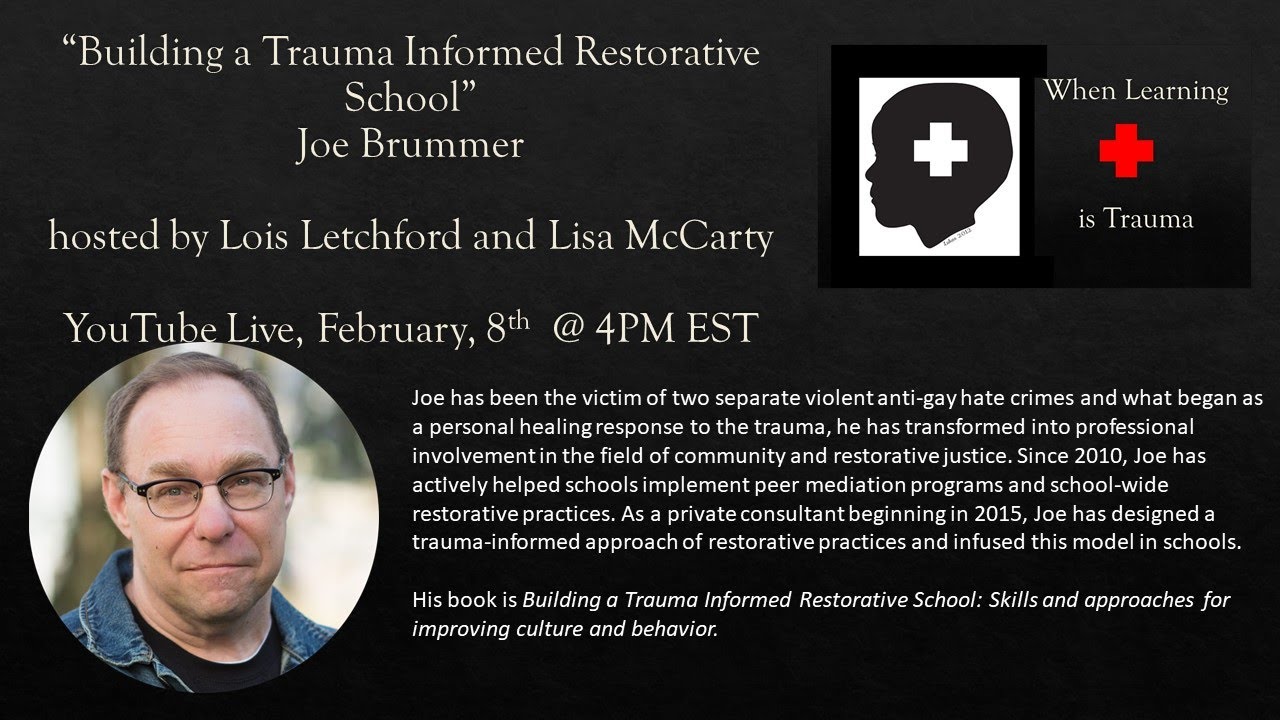
Joe Brummer, a trauma-informed restorative-justice consultant, and school nurse Lisa McCarty argue that U.S. schools' punishment-based discipline model feeds the school-to-prison pipeline. They call for reframing discipline as relational ecology: building healthy relationships instead of using rewards and punishments. Teachers need training on trauma and marginalized learners' hidden needs.
Chapters
Hello, I'm Lois Letchford, author of the book Reversed: A Memoir and a Literacy Problem Solver, here talking today to Lisa McCarty and Joe Brummer. Joe is the author of Building a Trauma-Informed Restorative School: Skills and Approaches for Improving Culture and Behavior. I'm going to let him introduce himself. Lisa is a nurse, Working at Penn Foundation. But Joe, welcome. Will you introduce yourself, please?
Sure. So I am a consultant in Branford, Connecticut, but I'm working throughout the country and, and other countries if they'll pay me, doing work around restorative justice, mediation, Conflict resolution, and hopefully all done through a lens of trauma-informed and the principles and guidelines of trauma-informed, including— because you can't really do trauma-informed work without acknowledging that racism and homophobia are also traumas. And so when we say a trauma-informed lens, we're including in that that we're also talking about equity.
Thank you. That's, that's a really good start and a really good place to start. Can you tell us what brought you to this point?
It's a long story that started back in 1990. I was the victim of a gay bashing. I got severely beaten up and it changes the way you— it changed the way I saw the world and it made me really curious just why people do stuff like that. Like, it's not in my makeup to do things like that, so why would anyone do that?
Yeah.
And so I started kind of playing around with the ideas of violence and nonviolence and and what it means to live nonviolently. Um, in 2000, um, I was leaving a Providence, Rhode Island nightclub with friends and was gay bashed again. Uh, this time I was body slammed to the ground as I was leaving a club with friends, and I hit head first and then shoulder second, so I snapped my collarbone and Again, it's this idea of like, just why do people do this stuff? And so I spent— it just kind of put me on this path of becoming a mediator and trying to do some peace work. I became a nonviolence trainer and started going into schools and teaching Kingian nonviolence. I spent some time in India studying nonviolence. Like, I wanted to understand How this stuff happens. And in the midst of all that, I also started working in schools because I worked at a mediation center. And so they said, oh, go into the school and set up peer mediation programs. And so I was in schools teaching, you know, 4th and 5th graders and high school students how to become mediators and do peer mediation. And we set these programs up, and at the same time, I kind of watched the other stuff going on in the school. And I was like, wow, a lot of behavior classroom management stuff is really just conflict resolution.
Yeah.
And at least from my lens at the time. And so I started offering— I hated the way I heard adults talk to kids.
Yeah.
And so I went to a principal once and I said, let me train your staff in nonviolent communication. We'll just see what happens. I said, you don't have to pay me, just, just, I will come and do it. So I did, and the staff loved it, aged and up. So I went back and I kept going back, and then the story of my entire career looks just like this. The assistant principal at that school left and became the principal at another school, and the first thing she did was call me And bring me there to train her staff. And then the assistant principal of that school went to another school and brought me there. And now it's, you know, 5 or 6 years later or whatever it is, 7 years later, and, and here I am in more schools. And that's exactly how it keeps going. I, I keep getting invited to more and more schools, um, because of schools I've already been in.
Yeah.
And somehow all of that led to, let's make a training manual. That became this, this book. And that's sort of where I am now is, is trying to, you know, package up the implementation of restorative justice, mindfulness, equity work, trauma-informed schools work, nonviolent communication, like wrap all this stuff together into an implementation. That is just not so overbearing and burdensome for educators. And so here I am.
Because what I mean, I'm reading your book now. I can't say I'm reading it, I'm studying your book now, and I'm making notes as I go through it. And what struck me is how much information teachers need really to even enter the classroom. On, you know, just all of the things that you're talking about, they're not add-ons. That should be fundamental to the teaching process. Because it's not— talk to me about that.
I think, you know, they— there's this gap that happens between— and I've heard different numbers. 15 years, 30 years. There's a gap in between science figuring out some really cool new stuff and then seeing that stuff put into action. And this is one of those things. It's like the science is telling us loud and clear that behaviorism is a fail, that it's not only not helping our kids, it's actually hurting them. The schools in our systems are entrenched in behaviorism.
Yes.
Tokens, rewards, punishments.
Yes.
Except, you know, and Lisa, we were talking about this before we started, we went live, is that, you know, oftentimes the kid that's most traumatized and embarrassed by their behavior is the kid with the behavior. And so each time they get in trouble, We act like we don't want to behave.
Hmm.
And what does that mean to a kid who's trying his hardest not to talk in class, not to get up, not to kick his foot, not, not to drop his pencil again? He's trying. He doesn't have the skills yet. He's just not there. And so here we are consistently every day embarrassing this kid by punishing him, calling him out, For something he really—
he— Totally.
Many of these kids just don't have control because it's not motivation that's in their way. And so until we start catching up with this science, our teacher programs and our teacher preparedness programs aren't teaching about trauma. They're not teaching about restorative practices. They're still— they're not teaching classroom management.
Yeah.
In some places. And so teachers are coming in and then they're like, I love math, I'm gonna teach math. And I'm like, you don't teach math, you teach kids math. And so you can be excited about teaching math, and with that you're gonna have kids in your classroom and some of them are hungry, they didn't eat today. Some of them are tired, they didn't sleep sleep last night, and so they're going to be cranky and have anger problems because they're tired and hungry. Some of your kids are coming in and they're really on edge and stressed. Some of your kids are coming in and paying attention perfectly, they just think you're boring. All of the above can be true in a classroom.
Yeah.
If we don't sort of prepare teachers for that, they're excited about teaching math and science, and then they get into a classroom and go, wait, I have to teach kids. Kids come with baggage, like, I didn't eat today, or I forgot my pencil. And where, where does our attention go other than trying to control those kids? Yeah. Versus understanding where their behavior is really coming from and that they're not in trouble, they're in struggle. Yeah. And that changes Everything about how we, we see what's going on with them.
Well, Joe, I think you had mentioned something on a YouTube video that I watched, um, where you said that the teachers need to have a relationship with these kids, um, and that, uh, you know, you wouldn't— you, if you were having trouble with a spouse, you wouldn't send your spouse to someone else to fix your relationship problems, which I thought was pretty interesting. We send the kids to the principal, or we, you know, send them to the office and say, here, fix his behavior, without looking deeper into what is the problem between the teacher and the child. What's child's underlying problem. I thought that was pretty interesting, that they need that relationship. But then people say, well, we don't have a lot of time. And I get that teachers are busy. They have a lot of students in the classroom. But if you don't have that relationship, you really don't have— you're going to be spending more time trying to, you know, go— you're on this hamster wheel of things just not working well. Yeah.
Yeah. Teachers, I mean, I got that whole thing from an assistant principal I know, Jeff Kenyon. And, you know, he showed up in a circle with me and he's like, look, why are adults sending us their behavior problems expecting we can fix them and then send them back with an apology?
Yeah.
It's like we send the kid out of the room. to a third party, the principal, the assistant principal, the dean, and we say, fix this, and then send them back with an apology. But the problem is the relationship in that classroom, and that assistant principal can't fix that relationship. And so what we need is a building full of relationships.
Yeah.
And so, uh, Dorothy Ventering and Kathy Evans, who wrote The Little Book of Restorative Justice in Education. They talk in their book about what they call relational ecology.
Hmm.
Like, what is the health of the relationships in your building? And when you have a healthy relational ecology, it means that students have healthy relationships with themselves and their curriculum and their teacher. They have a healthy relationship with other students. There's a healthy relationship between staff and administration. There's a healthy relationship between administration, staff, and parents. That's a healthy school when you have that healthy ecology of relationships. So relational ecology. When we're really tracking and paying attention to the quality of relationships, The more relationship-focused we get, the more trauma-informed that school will be.
Yeah.
And the reason for that is because we get hurt in the context of relationship, and we have to heal in the context of relationship. And we don't expect teachers to be therapists or counselors. We expect you to be a teacher. But I expect that when you're with this kid or this child, that when they're behaving in funky ways, that we don't see that as deliberate. We don't see that as a child trying to— like, I, I have literally met teachers that think their kids stay up till 1 in the morning trying to think of new ways to piss them off.
Yeah.
Except we know that's not how kids operate. Kids are less, you know, they're a little more spontaneous and in the moment than that. And when kids are struggling, it's not because they don't want to behave. That's a motivation problem. Kids don't— they're not— it's not motivation that's the problem. And so when you pull out the punishments and the rewards, they kind of fail because they're the wrong tool in the toolbox. But if they're the only tool you've got, rewards and punishments, well, everything is going to look like something that should be rewarded or punished. Except there's a problem here. When it comes to behavior, which is skill-based, punishments and rewards only motivate kids to use skills they already have.
Yeah.
You can't motivate them to do something new.
Yeah.
Doesn't teach that. But here we are with, you know, school discipline systems which I, I even— that should just be trashed, but we're far from that. But even schools with these discipline systems, they're, they're based in behaviorism. They're based in punishing this behavior and rewarding that behavior because they think that's how behavior works. And even though the teachers themselves and the administrators and the counselors know that doesn't work, they all tell you that doesn't work. As soon as the kid's misbehaving, why is he in my class? Yeah, they go to the principal's office, they come back, why is he back? Yeah, it's like we're embedded and entrenched in that punitive system, so we look for a pound of flesh.
Why do you think that is?
We look for kids to be punished.
Why do you think this is— why do you think this is our go-to way of doing things? Just because it's what we've always done? It's just the easier— like, as a parent, it's easier to just yell at a kid for not, you know, picking up their shoes or whatever, as opposed to really taking the time. So I would just imagine maybe that's on a larger scale with the teachers. It's just, it's more time-consuming to form relationships. I don't know how you would—
I think there's more than one answer to that. Like, if you go back to— I think I want to say it was Alfie Kohn in his book Unconditional Parenting. So you'll learn that I'm like a book junkie. And I have this weird ability to remember stuff and like where I read it. Yeah, not really good. Some stuff I read and I can't remember where did I read this? But this one I remember. Alfie Kohn, in his book Unconditional Parenting, talks about why parents use punishment in the first place. Like, we all know it doesn't work. Some of us don't want to, you know, yell at our kid at the grocery store or any of these things. Why do we do it? And there's a whole list of reasons. One, you're right, it's fast, easy. It's fast, it's easy, and it's what we know. So we're always going to go back to what's convenient.
Hmm.
And until somebody breaks us of that cycle.
Yeah.
We also have to acknowledge our entire— every system around us is entrenched in behaviorism.
Yes.
It is entrenched in these punishment-reward systems.
Yes.
You, you get rewarded buying the right gas at the right gas station. You, you get reward— like, we— you go to work and they give you a written warning, and then, you know, or a, you know, a suspension, like It's all, even in our jobs, we're living in this entrenched behaviorism. But the problem with it, again, it's just misguided about what really kids need. And so we go to what's fast, what's easy, but it's also our structures.
Yeah.
And so part of doing something different isn't just learning new ways of doing it. It's unlearning all of this embedded Yeah. That we don't even know we have.
Yeah.
And one of the reasons that that shows up is that we have equated in our minds and in our systems that punishment equals accountability.
Yeah.
Despite this fact that that's absurd. Punishment thwarts accountability. What kid is going to be honest with you about what they've done and how they've done it when they know what you'll do to them?
Yeah.
And so right off the top, punishment distorts accountability. Who's accountable for stuff?
Yeah.
Like, I'll be, I'll be as accountable for as little as possible when I know what you'll do to me if I'm more accountable. If I say I messed up, look at what you'll— oh my God, what will you do to me if I mess up? I'd rather lie and pray I get out of it.
Yeah.
Hence punishment teaches kids to lie. And so, so until we change those structures, We're going to keep falling back to them because that's what we know. That's how our system is. And somehow we've got to unlearn that accountability is punishment and find new definitions of accountability.
What I've written down from your book is punishments do not teach thinking skills.
You know, that's right from Ross Greene's playbook. Like it's right from Ross Greene's playbook, which is pretty much where I got a lot of that thinking.
Yeah.
I mean, I was this close to thinking like that before I got introduced to The Explosive Child and Ross Greene's work. And then I was like, oh, this makes perfect sense. And it clicked.
Yeah.
And if you add that to the sort of trauma-informed model, you add that to an equity model, you add that to sort of mindfulness and our ways of being, This all just makes sense. And so why wouldn't we teach kids these things as early as we possibly can?
What struck me about reading your book is, you know, our society is based on the punishment model, which is why we've got, what, how many people in prison? And the whole mentality, and even not even the prison, but the steps towards it. 3 strikes and you're out. You know, all of the whole society. So it's not just school that we're breaking down, but it's, it's a whole mentality with— that's, that we're— that's embedded in our brains. Is that right?
So our criminal justice system Crept its way into our education system. Yes. Almost like a, you know, Martha Brown in her book Creating Restorative Schools, she calls it the perfect storm.
Yeah.
That over like a, maybe like a 30-year stretch, it's probably more than that, but over a 30-year stretch, we did a bunch of stuff. We introduced zero tolerance policies.
Yes.
And most of that was in response to It goes all the way back to Nancy Reagan's War on Drugs. Just Say No. Yeah, part of the Just Say No campaign was that there was going to be zero tolerance in schools for drugs.
Yeah.
Now let's just point out for something at the timing. One, War on Drugs, Nancy Reagan. Um, who were we going after on a War on Drugs? So we came with zero tolerance policies and really strict criminal justice responses to what should be addiction and mental health issues. Now, flash forward to 2020, 2019, when we have an opioid epidemic. It's an epidemic. We have, you know, why was there a war on drugs back there? And now it's an epidemic. And the only thing different is the people we were targeting to arrest. Basically, you know, the epidemic of the war on drugs started to affect home people, and that now it's an epidemic instead of a war and criminal. But you introduce zero tolerance.
Yeah.
Keep cropping along. Then we introduced community policing that oftentimes came with— which community policing is awesome, but it also came with a theory called broken windows Now, broken windows policing was this bizarre philosophy that if you come down really hard on small stuff like graffiti and, you know, loitering, that you'll cut down on big stuff like gangs and murder and drugs. Fail. Total fail. Yet we brought that into schools.
Yeah.
That same broken windows policing mentality brought into schools. If you come down hard on hoodies, And dress code violations and, and tardiness to class, that suddenly you'll prevent, you know, school shootings. That, that's literally what people were thinking. So we had the Safe Schools Act, No Child Left Behind, all of these, you know, up-and-coming laws and policies that got put into place that criminalize children's behavior.
Yeah.
Even using that language.
Yes.
There. Yeah. In one state, I'm not naming any states, but we'll say in one state, they literally borrowed their code of conduct, which is legislated. So you didn't just break, you know, a board of ed policy. Their board of ed, their code of conduct is legislated by their legislature. So if you break it, you broke the law. And teachers are mandated to report that. Than if you, you broke policy. Which means if kids fight and a teacher's like, I'm not going to report this, they can get fired. Well, kids fight. And sometimes you split them up and you say, what's going on here? And you teach them how to work out conflicts. There's absolutely no reason that that one needs to be— that's, uh, you know, why, why is this an offense you should lose your job for? Again, we borrowed that criminal justice language.
Yeah.
Even they call them Tier 1, Tier 2 offenses.
Yeah.
This is out of a criminal justice playbook.
Yeah.
So basically we brought in these criminal justice models into schools.
Yeah.
Added them with zero tolerance policies, added them with things like No Child Left Behind, Safe Schools Act, no weapons. Even if almost every weapon incident that I've ever been a part of in a school, the kid brought the weapon to school for himself. In other words, to hurt themselves, not to hurt someone else. What do we do with those kids? We punish them instead of mental health, instead of, you know, care and support. And so, you know, it's kind of a broken system.
And it doesn't help that resources are so sparse that they Cut down on you know the very personnel that might be able to help the school psychologists having nurses there, and yeah, I see how the the policing of everything has become the focus as opposed to the child and what is the issue or the problem. We I work with a lot of dyslexia groups, and I have dyslexia in my family, and one of the issues with those children are they struggle to learn in the traditional. you know, school setting. And so you have the kids that don't want to go to class because they don't want to sit there and feel like failures and feel stupid. And then they, they fault the kids for being lazy or not being on time, or they don't want to go to class, and then they punish them for not wanting to go to class instead of looking at the fact that their reading scores are so low and they're not keeping up. And the school systems tend to have a lot of behavioral plans for these kids as opposed to educational plans. And unfortunately, the parents, you know, we argue and we fight for these kids and we meet such resistance over this. And my question is, how did you get this information? Are these main school, mainstream schools that you do workshops with? Are these like alternative schools?
Wow. I have done both at this point. And so I started going into schools in 2005.
6.
Mhm. And knew nothing about school culture and climate and what was going on in schools. So I was sent into schools as a volunteer to teach Kingian nonviolence. And so I, I started getting a feel for like how schools run, um, and then I moved to Connecticut. So I left that volunteer job and ended up in Connecticut. And a couple years after I moved here, I took a job as the associate director of a community mediation center. And part of my job was to go into schools. And so I started off in New Haven Public Schools and then worked my way into Hartford Public Schools and Meriden Public Schools and had— and just kept, you know, so now I've worked in a handful of districts throughout Connecticut. Then I've also worked with schools in Ohio, Washington, Maui. Yes, they paid me to go to Maui. It was cool. But I mean, worked in various mainstream schools. I think I've only worked in one or two alternative schools that were part of those districts. And then I've done some work with technical high schools and vocational schools, each having their own different sort of And now as the book is coming out, I'm talking to way, way more school districts across the country about like, how do we set up these kind of infrastructures?
Yeah, I'm just amazed that you could get that information into the schools without the resistance that we as parents find with all of this. I, I just like, how did you do that so easily? And that's amazing. Yeah, and I got a very necessary answer for how that happened.
If you'd asked me even, even 10 years ago, if you'd asked me, you know, in 2010, could you see yourself with a career being an educational consultant? I would have started giggling and laughing. I would have been like, no.
Yeah.
Um, I didn't like school. Uh, like, like a lot of young gay kids, I was bullied relentlessly about being too feminine or too whatever. Uh, I didn't like sports. Like, I mean, I was, you know, I liked Broadway, blah blah. I, I got made fun of a lot. I got bullied a lot. So what did the last— even, uh, something people don't realize about trauma in schools, schools have a smell.
Uh-huh.
Like a very distinct smell. And I smell it in every building I go in. It's a mixture of like, like sweaty kids, lunchroom food, and, and like disinfectant. It's a very weird smell. But it doesn't even matter what state I go into, they all have this similar smell.
It's interesting.
And for me, the first couple times I, you know, back in 2010 when I first started going into schools because I had to, I would smell that smell and I'd be like, oh God, why am I here? And because I just hated schools. And so it's, it's funny how you just end up somewhere, and now I I look forward to going into schools and working with administrators and teachers and educators. Who knew?
Does that work?
Does that work?
Help you to heal? It sounds like, it sounds like some of your experiences were hard. Yeah, I don't like your life. That's, that's incredible.
New associations.
Right.
So yeah, that's, that's probably very true.
Joe, what stopped you from self-destructing?
Um, I think a couple things are, you know, I think for anyone that's lived through trauma, there are a couple things that stop you from self-destructing. And let's not assume I didn't self-destruct a few times.
Right.
Yeah. Or that I wouldn't still, you know, I think mental health is, is more fragile than we like to pay the respect to.
Yeah.
And so, like, our, our well-being is like, deserves respect. And it's fragile. It's like, you could wake up in 15 minutes from now, you could get news that will sink you depressed as hell.
Yeah.
And sad. It's like, it's, yeah, it's not Not that hard. And I think for me what was important is I had a really good system around me.
Yeah.
And I would think even at the times where I was at my worst of being really depressed or really like trying to figure all this stuff out, I found systems that would help me and people that would like help me out. I have to say, at least for the last 21 years, I credit what hasn't been self-destructive, I would say my husband. Yeah.
So it's finding—
Having that support system is amazing.
Yeah. Finding a supportive relationship that values you. Yes.
I think I've learned more from that. That kind of unconditional love is unbelievably healing.
Yes.
Yeah.
We have a question from Chris, and it says, I completely understand the smell you're talking about. It's even more intense if the building is old. What advice do you have for students that are just ready to give up?
What was the last part of that question?
What advice do you have for students that are just ready to give up?
Oh, I think giving up is always that option that hangs with us. Like, again, it's one of those things you should respect. Like, giving up is an option. You could absolutely, um, or you could find supports. Like, that's, that's always like, go find your supports. And they are And it might be those people that you're pushing away right now are actually the people that will hold you up. And so I find that we have this uncanny ability as humans to have supports that are absolutely there at our service, and we will do everything to push them away. And so I might— that would be my, like, go find your supports.
Yeah.
Even if, even if you have to pay for them.
Yeah.
Go find them.
Yeah.
And trust me, insurance pays for that.
Yeah.
Um, there's, there's— even if you don't feel like you're depressed, I think going to therapy and finding mental health support is really important. Just awesome.
Yeah.
So yeah, like, no, no shame at all. Like, it's not— it's— look, if you had a cold or a flu or a funny mark on your face, you'd be right at the Yeah. But suddenly, like our insides don't feel well, and we're like, "I'm fine." Yeah. Max, go to the doctor.
Yeah.
Just be fine. Go to the doctor.
Well, Joe, you had mentioned that some of these workshops you've done where the participants have broken down and started crying when I guess you're you know bringing some of this to light, and we kind of forget that teachers—I mean—they're under an enormous. enormous amount of stress, especially with the COVID these days. And I would, I would think they too need some support. But can you tell us a little bit about the experience when the teachers come to some sort of realization that, that this has happened in their own, their own classrooms?
I think anytime we wake up to stuff, there's a little bit of shame, embarrassment. That our past and previous behaviors weren't perfect. And I think that's just part of growing. And so I think for a lot of teachers, it's the realization that they've had students in the past who really needed them and they didn't know how to support them.
I feel that as a parent.
And the sadness that comes with that.
And I, we were talking about this. I feel that as a parent. because I didn't realize some of the struggles one of my sons was having. And I fell into that, you know, oh, you just have to do it, and he's not doing it because he doesn't want to. And it's hard to live with that. But, you know, I have to say, well, I didn't know what I didn't know. And I have to forgive myself and heal. And I think that's true for teachers too, especially when the parents are so involved with the kids these days. And everybody seems We don't have to be butting heads all the time. Like, we've all have— we all have to find that relationship and take care of one another to help educate these kids. And so we can all get what we need, but it's not easy.
Yeah. And I think that's what happens when we take a few steps back. And so that's what happens in my— I think in the workshops that I've done where teachers and parents as well take a step back and they go, wow, I did a lot of punishment. And in some cases it's parents. When we talk about— although I, I've come to a point where I won't talk about capital punishment anymore, uh, or corporal punishment, uh, especially in my work. I won't argue with people about it in my workshops anymore.
Yeah.
It's ridiculous.
Yeah.
It's like flat earth theory. Like, I'm sorry, no, we're not having a flat earth discussion in my workshop.
Yeah.
And I just consider any conversation about corporal punishment at this point to be like ladder theory. It's like, really, really, all this research against spanking and hitting, and you want to argue if it's done the right way? There's no such thing.
Yeah.
And so it just doesn't exist. It's a ladder theory. But a lot of times what people do is they come to a workshop, they start really examining how do these ways of being with children impact them. And when you realize as a parent or a teacher, Or even a youth worker that some of the tactics and strategies that you used to teach discipline actually didn't teach at all what you thought they did, and what they taught was something really bad.
Yeah.
That's— that brings on some serious sadness for people. And so parents, teachers, I, you know, sometimes parents who are teachers, I I've had many people in workshops just, just really feel that embarrassment, that shame. Um, and, and I think it's healthy that that happens because it means they're growing. Yeah. And, and I feel those things even as I'm learning this stuff because I'm constantly learning. Um, I think that's always going to happen.
Yeah. Well, also mentioned that like the administrators, and it takes Everyone to sort of be on board with this support system, because if teachers aren't being supported, and oftentimes they feel they're not, you know, it's, it's not just the teacher and child relationship. It's not just the child and parent relationship. It's not just the teacher-parent relationship. It's, it's got to be all the way up the chain. And I would imagine you do workshops, or you spoke about this, that it takes everybody. To have that culture in the school.
Unfortunately, what's happening with restorative justice in schools is that it's being, it's being adopted as a behavior, as a behavior focus. Yeah. And so all the conversations about it are behavioral when what we need to be talking about is this isn't behavioral, it's relationship. You don't bring restorative justice into your building to deal with behaviors. You bring it in to foster relationships that don't produce those behaviors.
Yeah.
And so it's more about the prevention of problems, not a new alternative to— I mean, it's being sold as some sort of alternative discipline.
Yeah.
And, and that's the farthest from what this work is really about. But that's, unfortunately, that's what a lot of school systems are looking at. I think they have a need in their school districts to solve disproportionate— and this is where it starts to get like irritating for me— they're trying to solve disproportionate, uh, discipline data. Yeah.
Yeah.
That's basically saying that, you know, a Black student is 3 times more likely to be suspended for the same behavior as a white student.
Yeah.
What? Wait, let's stop for one second. We're trying to make that more equitable. How about you just get rid of it altogether? That punishment, that suspension isn't good for a white child or a Black child. So stop trying to make it more equitable. Just stop doing it altogether. Because it's not helping any child to suspend them, to punish them, to shame them. None of this is helping them. And so if we want to change those, you know, if you want to change that, the way you do that is to restructure the relationships in your school, not reshape your discipline That, that will come as part of this, but the focus needs to be on really changing the relationships and creating and maintaining relationships, not, not having some alternative to something that's terrible in the first place.
What struck me about your book is you talk about a community. And you're asking the question, what sort of community do we want to live in? And that's the question that I've been asking, and I don't think it's getting much airtime. How do we change that?
Yeah, that's, that's the— what is that, the $64 million question? I thought you said $64,000. I don't remember. It was a long time ago.
Must be billion now.
It's a big question. And I think that where we are right now is the wake-up call. I hope it's the wake-up call that this hyper-individualized culture that we have created, where everyone's success solely on their own efforts is just— it is literally destroying us little by little. And until we sort of go back to the idea of community, that, you know, that taking care of the other people in your community is taking care of you. Yeah. Until we get that back again, what we're living in, this not my problem universe where even our neighbor— like, do we know our— how many people even know their neighbors anymore? That, like, that seems to be a thing of the past. Yeah. And so at what point do we start to become communities that again Relationships. When do we start having relationships that, that isn't the old lady, that's Mrs. Smith who lives on 4th Street? Like, when does that come back?
Right.
And there was a thing going around for a while there for, for students that made me crazy. It was this bulletin board I saw them putting up in schools, and sometimes it had like a Harry Potter theme to it, but it had all these mirrors on the, on the bulletin board, and it said, meet the person responsible for your success, your drafts, your cur— your this, your that. And I was like, oh, horrible message. So the kid's supposed to stand there and see themselves and be like, you're the person responsible for everything. One, that's the wrong message to send a child because that's super overwhelming. But 2, that's not how we succeed. We succeed in community.
Yeah.
We succeed because we have a team. We succeed because somebody's there to pick us up when we fall down.
You—
we survive in communities. And when our communities aren't strong, you have crime. You have people who feel left out. You have inequities. Yeah. And that's where we are right now. Hyper-individualism. Everybody's out for themselves. I'm not paying for their healthcare. I'm only paying for my healthcare. I don't care about them. That's our mentality. That's gonna kill us.
Yeah. And the loneliness that you mentioned, there's a lot of research and a lot of talk about how important being, um, in a community is for us as human beings. and people that are lonely, people that are marginalized, especially these kids in school who aren't fitting into that mainstream whatever. And they really do feel ostracized. It doesn't help that everybody's on our phones, and you could make arguments for social media being as part of that. But I think you're right. You know, a lot of teachers will complain that the No Child Left Behind has also really made an impact when they're only after the test scores. to prove how good they are, as opposed to, you know, the kindergartners playing together and learning how to cooperate with one another. They're sitting them down and drilling them with facts and figures so that they can pass some test somewhere. And I think it's all lost. And how do we get that back?
And it's— I mean, we're still in that stuck test, No Child Left Behind place. When it comes to like, listen to us now. Here we are in quarantine and all we keep saying is kids are falling behind. Yeah, behind what exactly? Tell me what we're behind. Your made-up statistic about where they should be? Yeah, yeah, they're not behind. They're still learning. They're learning how to survive a pandemic like the rest of us.
Yes.
And in fact, some of them are doing it way better than, than we are. Yeah. And so we have these weird false notions about education.
Yeah.
And about children. We're working off 100-year-old, 150-year-old science to try and raise 21st century children. Like, at what point do we stop and go, well, this isn't working? You can't tell me that you want well-behaved, controlled children. who are super inventive and, you know, creative and innovative. Yeah, that— you can have one but not both.
Yeah.
So either you have kids that are willing to break the rules and test the system so they can be creative and innovative.
Yeah.
Or you have kids that follow all the rules and don't break outside the rules because they're the rules. Well, they're never going to be innovative because that involves a little rule breaking.
Yeah.
So tell me what you want from kids. And until we decide— until what, you know, until we decide to change the focus of education into creating little workers and instead create brilliant minds, which is hugely possible, that are creative, that are amazing, that can name their feelings— until you do that, nothing These things are not going to change. Yeah, which sounds so depressing when I say it. Sorry.
Yeah, we've got to bring this conversation up somehow. Come on, Lois.
Well, we've got a question from Xena. How do you effectively pick yourself up? And then she goes, talks on. I agree it can kill us, the hyper-individualism and loneliness, but what if we need to be on our own in order to spread our wings and find that support?
Yeah, I mean, I wish there was a magic flowchart to hand people. And what works for one person might not work for someone else. Again, I think there are structures around us. that we're afraid to tap. And usually because, you know, vulnerability— was it Brené Brown? It's vulnerability. Like, it takes a lot to ask for help.
Yeah.
And to have those structures. But if we don't ask for them, we don't get them. Yeah, that's again vulnerability. It's like, ah, crap. I mean, if I want to get better at this, I have to be open Yeah. And say I need help. And well, that's rough. And I have to admit, for the first— I will definitely say for the first 10 years that I tried to like do that on my own. I did seek mental health care off and on through my 20s. Everybody's 20s are kind of a wreck. I've yet to meet anyone over 30 that thinks the 20s were great or wants to relive the 20s. Um, uh, so those of you in your 20s, remember that. But this idea that, you know, the way we pick ourselves back up is go, go find somebody that— it literally, even if you have to go hire a coach to do it, find anybody that will be your resource and your sounding board.
And that, that's going back to finding a community, isn't it? Or, and if you can't find it, you've got to create one.
Yeah, I like what Lois just said.
Gay men have known how to do this. It's embedded in our system to go, because so many gay men are kicked out of their houses. Yes. Or disenfranchised. So we know how to just go out and form a new family. Yeah, that, that's just a skill I think that we're forced into learning as gay men. That's interesting. LGBTQ in general. Yes. I'm amazed at how LGBT folks are really, really good at going off and finding ways to create community and to create friends and to create family. Um, that's often why gay people say to each other that we call each other family. Like, you know, I've You know, we think someone's gay at the grocery store. We're like, you think they're family? Yes, like it's a family. Yeah, yeah, go, go do that. You don't have to be gay to go find family. Go, go, go out and create family. Go out and create community. And I get that there's, there's an added part to that, that when you feel that down, it is hard to Some people, like, you know, you want me to call people and talk to them? I get that. I still get that. And the answer is yes. Yes, I do. Even if the only words out of your mouth are help. Good story.
Well, I wish that there was a better— we do a lot of work with the dyslexic community, and oftentimes these folks either don't really understand what the problem is, and they're surrounded by adults and others that don't understand it either. But sometimes they really struggle with being able to communicate their feelings or what's going on. And, you know, it's really frustrating for these kids who are surrounded once again by people that don't quite understand that. So one of the reasons we do this work is to bring the attention or, you know, focus on these things so that educators come to understand what the real problem is. And but it's not just kids that have learning difficulties. It's anybody who tends to feel ostracized or marginalized. And so I guess like maybe in some way you're lucky that you have this way of being able to connect with others. But I think it's important once again for the educators to be sensitive to these other kids that may be struggling silently. And I think that's where your work is so important, it sounds like, to give these educators that toolbox, if you will, to understand it.
And it— I think it is just that, a toolbox that hasn't existed before, especially for kids with disabilities.
Yeah.
And I mean, I, I come from a family of dyslexics, although I'm— I, I don't have dyslexia, but my brother does.
Yeah.
Uh, my, my father does. My— I think 2 of my nieces, but I know definitely one of my nieces. And so that's, I've seen, I saw my brother trying to get help in school with reading and not getting it.
Yeah.
And because people just thought he's a behavior problem.
Yeah.
They didn't say, wow, maybe he's frustrated because he can't read at the level we want him to.
Yeah.
And so, you know, how do we get kids the help they need when, when they're asking for it, we misinterpret Their words. Yeah. We say, oh, that's a behavior problem. Yeah. Or you know that that's he doesn't want to work. He just doesn't want to do the work. Yeah. I hear that from teachers today. Yeah. These kids just don't want to do the work.
Right. Well, that's why your work is so important. And what is the name of your book again?
Do you have it right there? Yes, we do. It is called Building a Trauma-Informed Restored. Skills and Approaches for Improving Culture and Behavior.
I'm going to— thank you for doing all that work, Christian.
I'm going to add to that. I think it's a great book even for parents, just, you know, to read it with the mind, because we parent the way we have been parented, and, and it's trying to break that cycle. We've got another question. So in these COVID times, we should point to someone on Facebook or social media. We should, yeah, and try to find family community. I guess that can work here and now. I appreciate how the LB LGBT find family. That's a comment, not a question.
It's a happy comment. I like happy comments.
It is finding community and it's creating a community and that bigger question, what sort of society do we want to live in? That really struck me because that is a question that we have, I think it's been either shoved under the carpet or ignored and no one has been asking what sort of society do we want to live in. 50 minutes has gone by. Joe, would you like to give us a final comment?
Um, yeah, wash your hands, wear a mask. I need everyone to stay home because this will be over faster when you all do. I guess my final— like, I never thought I would ever utter these words, but buy my book.
Yes, do.
And I realized Here's the thing I realize now as like a first-time author is telling people buy this book isn't because I make money off it. Like, I literally do not make anything off this book. Like, the percentage I get as a royalty is very small. And so not that I have a problem with that, I'm cool with it. But when I say buy my book, it's because I work so hard to write it. Absolutely. I just want to know people read it, you know? So I'm not asking you to buy it and read it. I just want you to read it. I don't care if you borrow it from a friend.
It's important to get the information out there. And you're also on YouTube, and, um, where else can people find some of your work?
Uh, they can find me on Twitter, which is just my name, @JoeBrummer. Uh, they can also find me on Facebook, uh, which is the same, Joe Brummer. I think my Facebook is Joe Brummer 1.
They must be— ah, that's why I didn't find you this afternoon, Joe Rumer 1, because it wasn't your picture and I thought I can't put that up, so I had to take the ad out.
I, I do have a Facebook page called Joe Rumer Consulting.
Ah, okay.
I just— I'm guilty of not posting to it too often.
Oh, I, I just find, you know, the, the whole social media thing is, is time-consuming. Are you on LinkedIn?
I am on LinkedIn, and, and there I am, there under the very official name of Samuel Joe Grummer.
Ah, I'll find you and friend you.
I, I am actually on there.
Perfect. Joe, it's been a fascinating discussion. I have really appreciated all that you have brought to the trauma informed classroom and parents. And I think we have so much to learn and so much to be aware of, of what children are going through. And we want children to be thinking, not just to be punished and get over it. And that's the quickest and easiest and best way because we have said so. So, you know, so thank you for spending this time with us. And please buy a copy of Jo's book. Please buy a copy of Reversed and read it. Look at the videos. And you'll find me on Twitter and Facebook and LinkedIn. And Lisa, where do we find you?
You'll find me, well, on here and on Facebook.
And next week we're actually talking to Lisa about her work. So thank you for being here, and I thank my son Isaac and his buddy Chris for all their work to put this on, because it would not happen without them. And without their support. So thank you, thank you very much, and we look forward to seeing you next week.
Thank you.
Thank you.
More from Lois


Overcoming Adversity: A Dyslexic Learner's Journey to Success | When Learning is Trauma #shorts

Redefining Success, Beyond Grades in Education | When Learning is Trauma #shorts

Turning Awareness into Action for Dyslexic Learners | When Learning is Trauma #shorts

Why Dyslexia Goes Unnoticed: A Systemic Issue | When Learning is Trauma #shorts

The Long-Term Impact of Unrecognized Dyslexia | When Learning is Trauma #shorts

The Heartbreaking Reality of School for Some Kids When Learning is Trauma #shorts



