When Learning is Trauma: Matthew Sisan, Lois Letchford, & Lisa McCarty
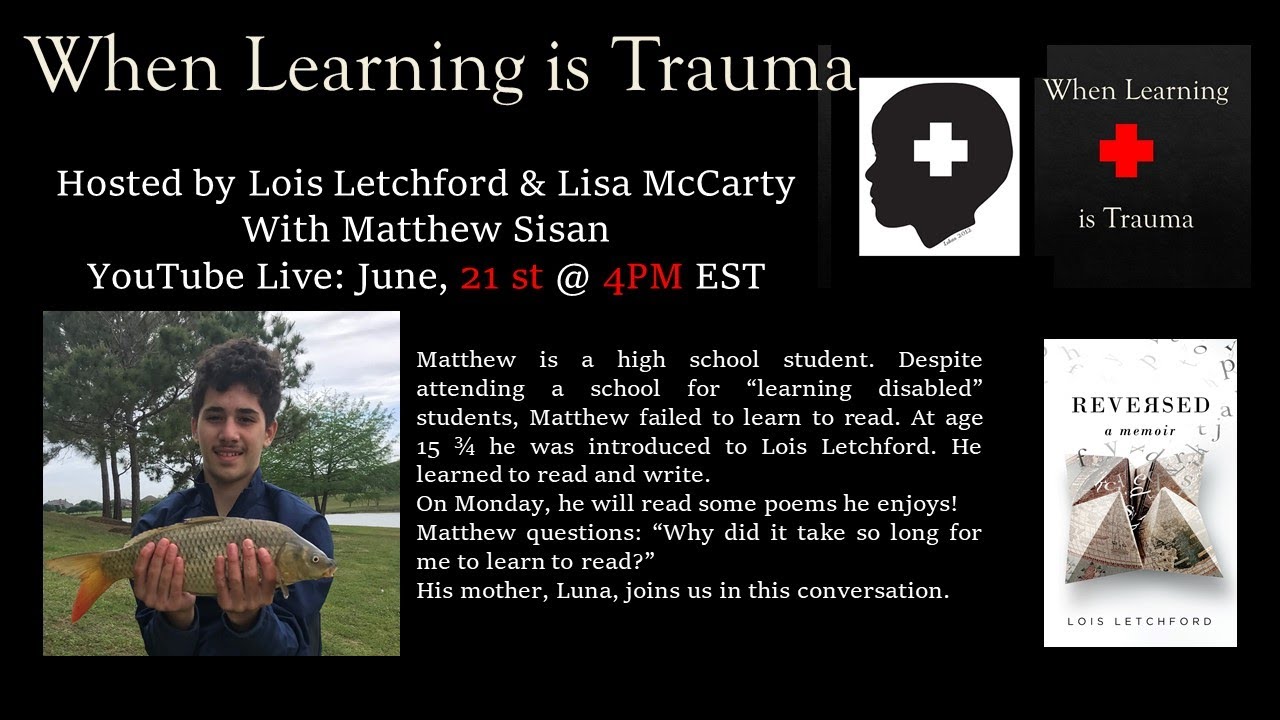
Lois Letchford and Lisa McCarty talk with Matthew Sisan about his dyslexia and how school made it worse. Matthew reads his own poems and describes the teaching methods that finally helped him learn, while his mother Luna shares what it took to get him real support.
Chapters
Welcome to When Learning Is Trauma. I am Lois Letchford, author of the book Reversed: A Memoir. My co-host is Lisa McCarthy. Lisa.
Hello everyone, good to see everybody again.
I'm delighted to be back, and this afternoon we have my current student Matthew, uh, and his mother Luna Sisson, and I am delighted to have you both here. From Houston.
Houston, Texas.
Matthew and I met nearly 12 months ago.
Yep.
When Luna called me up and said, my son is not reading. And this year, I think we have had so much fun with reading.
Yeah.
What do you think, Matthew?
I think, I think we had a lovely year.
Ah, that's a wonderful thing to say.
Lots of progress, right?
Sorry?
Lots of progress.
What has made it so good for you?
Learning how to read.
Yeah, because I think I wrote on our, on our website You know, why did it take me so long? That was the big deal. It has taken so long to find the fun and enjoyment of learning. So what would you like to tell us that has been so good about this year? What did we do, Matthew?
We, we read poems. We read a We read a book called Aliens Ate My Homework.
Yeah.
And then we read The Diary of a Killer Cat.
Yeah, those were fun.
Would you like to begin by reading a poem for us?
Sure.
You've got them there ready to go?
Yep.
What one are you going to read first up?
A Certain Lady Kangaroo. A certain lady kangaroo was once an awful growl. She pestered everybody she knew and fussed about her pouch. My pouch, she sighed. My pouch, she cried. My pouch used to pout. The things I try to keep inside and press them falling out. My makeup kit, my grooming needs, my toothbrush and my nail brush, my credit cards and my worry beads, my tissues and my tail brush. That certain lady can't Tried sealing it with snaps, with tape, with twine and globs of glue. With staples, drains and straps, with put— paper clips and wire strands, bobby pins and paste, rivets, rope and rubber bands. but all were just a waste. Today that certain lady kangaroo looked charming, calm, and chipper, for she went to a tailor who equipped her with a zipper.
And you've also read that one with, you know, quite a lot more expression on YouTube, haven't you?
Yes.
Why is that your favourite, Matthew?
Because of the kangaroo, the things that she tried to keep inside her pouch kept on falling out.
It's just silly, isn't it?
Yes.
It really is just so, you know, so funny. And do you remember, what did we do with that poem?
We, we did the scene. It was the same poem, but we changed it into like Matthew's poem.
We changed the wording to fit your style.
What did that do for you?
It felt really great. Making up a poem about me.
What I remember was I would go to sleep at night with this poem going through my mind. A certain lady kangaroo, you know, um, had— was once an awful grouch. She pestered everyone she knew and fussed about— and then it came to reading skill, wasn't it? So she fussed about her reading skill. Instead of things that falling out. And then she cried, my pouch, my pouch. And what kept going through my mind was things persist in falling out. And here was Matthew in grade 8 with learning just falling out of his brain. And that's what struck me and made, you know, the learning— the poem stick for me.
Right, he really— he related to it because everything for him was the same.
Yes, and everything's going in and no matter what you're doing, it's not sticking there. And what I remember was how we learned about the makeup kit and the grooming needs. Do you remember how we learned that, Matthew?
We, uh, put pictures in the shoebox and then we pulled them out as we read them.
Were they just pictures or was it your mother's actual Makeup kit.
My mom's actual makeup kit and everything.
And the grooming needs and the worry beads and all that.
That was fun.
So the learning became fun. Luna, from your point of view, what happened? What was it like before? What's happened since?
Yeah, well, when he was in middle school, the 3 years he was there, he just didn't really get the proper support for reading. He just, he was bored with it, I guess. It didn't interest him and he just wasn't getting the right help. So he wasn't, he wasn't learning how to read and they just were saying they were providing him with the right material and the academic and it just Academics, it just wasn't working and they just weren't seeing that.
Yeah, I can only imagine as a mother what you went through.
Yeah, it was very— I, I think with the series, like it says, when learning is trauma, I, I think not only does the student get traumatized, we all do in the family and I've carried on such a heavy burden for so many years worrying about this and wondering when is he going to learn how to read. He's just getting older and older and the schools aren't doing anything about it. I just— you just get so bitter, I guess, towards a lot of things and you just don't know what to do.
Or even where to turn.
Yeah. I mean, you depend on the schools to help your children learn how to read, and they're not doing that. And we've tried different reading programs and spent lots of money on that, and it helped, but he needs so much of it, so much reading intervention, that you, you need hundreds of thousands of dollars to To get anywhere. And yeah, it was just, it was just a lot the past 3 years when he was in middle school. But last year, of course, was much different. You know, you've incorporated a lot of different learning styles and techniques with Matthew, and he's just taken off with reading. He understanding the language, and that's what they weren't realizing, that he was having difficulty with language as well.
Yeah.
Not just the decoding, read the words. And yeah, so it was multiple of things, but they were just focused on— I'm not sure what.
Luna, was this a private school or a public school?
When he went in middle school, it was private— I mean, public school. However, however, he went to a private school for 2nd through 5th grade, and that was a specialty school for like students with dyslexia or any kind of learning disability, and he didn't make much progress there either, so it was very disappointing.
Yeah, that's interesting to me.
And it was—
that's surprising.
Yeah, it was a top school for kids with learning disabilities.
Yeah, we've had a little bit of trouble in a specialty school that my younger son is at. I find that, you know, that it's much better than the public school in a lot of ways, especially socially, social-emotionally, but I find that not every I don't think the teacher really understands the nature of the problem even still.
Right.
One of the reasons we do all this is so that we can get that word out there so that more parents will look into some of these issues that the kids are having and why.
Right.
Because I think that it's still like they still expect my son to be able to do the same things that other kids are, are doing naturally, and it's It causes a lot of frustration, you know, for my son for sure, and also for— it's exhausting, like you said.
It was the same for Matthew too at the private school. They, they, you know, each kid has their own disability, but they never really kind of catered to like what Matthew needed. Yeah, it was taught one way, and a lot of the teachers just didn't understand. What he needed. And they would just kind of be frustrated with him, and he would sense that. And he would come home every day, I would pick him up, and he would just complain, and he was just not, not happy. I never really realized how, I guess, how, how unhappy he was there.
Yeah.
But he did make friends. Like you said, it's easier for him to make friends because the kids are more like on the same kind of disabilities and kind of thoughts as he is. So he did make more friends at the private school than he did at the public school. Yeah.
And it sounds like Matthew's more of a dynamic learner, and that's what my middle son shared when we did his interview a few weeks ago, and he said that school wasn't really interactive And it really caused a lot of problems that he didn't really, he wasn't really thriving in an environment that was very linear, very, you know, one-dimensional. And it sounds like some of the things, I know what some of the things that Lois does with her students, and it really gets their attention, but it also allows them to learn in a way that's better for them to remember, but it also reduces that anxiety. And we always talk about the fun of learning, and I think that when you're in a school system that's doing things very one way, it's not fun if you're not getting it.
I can do a plug for our next series because this is our second last week, but The next series, we are speaking to Dr. Mary Helen Immordino-Yang, and she works with brain science.
Oh, okay.
And what her research shows is the power of learning when emotions are happy.
And it's—
she's saying it's not an optional add-on extra. In fact, it's the opposite, that you need that emotion to be happy and content to allow students to access memory. So I, I can't wait to speak to her about her research because what I know about Matthew was when your stress levels are high, the chances of learning and remembering and recalling immediately are reduced. Right.
When he was in the private school and even in middle school—
I'll ask Luna, I'll ask you just to move. Ah, that's better. Thank you.
A lot of times the teachers would, I don't know, if Matthew did something, he would either laugh or he would do something. They would always, I don't know, they would always call on him. They'd always kind of punish him and he would always get upset. They would either Send him to the principal's office saying he's causing, you know, conflict in the class, he's causing too much commotion and whatnot. They just didn't really know how to, you know, handle the situation. They would more likely escalate it by sending him out the classroom or bringing the principal into the classroom to try to control the situation, and that would just even, you know, furiate him even more. And just not want to listen to the teachers and not want to do anything for the teachers because he just would be so frustrated with what they're doing. And they don't realize that. They just think he's just being defiant. He just doesn't want to listen or he just doesn't want to do what is asked of him. So it's just negative.
Luna, we've had a comment from Xena and Xena said, I feel 100% I 100% feel that if you're in a better emotional state, like feeling happy or excited or comforted, learning can be so much easier, but especially happiness, excitement. And I, I think what worries me from, from my point of view is when you don't learn at 7 and 8 and 9, the learning for everything just drops off and you don't look smart.
Right.
And that worries me because it just compounds. Everything compounds.
Right.
Years and years of buildup and not being able to be independent. He relied a lot on the teachers helping him to read because he just didn't know what he was doing on his own. And that caused him to be more frustrated too because he saw all the other students working and doing things on their own.
Yeah.
And he just always—
you're not getting it.
So that always kind of hurt his self-esteem even more.
People ask— Zena's asking fantastic questions. My problem is now she's put a pronoun in there, and I'm not sure what the pronoun refers to because we've passed that point. But she says, did the teachers do that often at the school you were at? Like, did you see the same thing happening with your friends or Classmates, teachers laughing, putting them in the hallways, etc.?
Um, do you want to answer that? Like what happened when you were at private school?
Matthew, and just move so you're right in front of the camera so we can see you. Ah, beautiful! Thank you.
You were at the private school, you remember you would always think that they would always be picking on you?
Like every time I'll do something with the classroom, like they'll always have like fun and stuff, and I try to join in and I get in trouble for it. And I'm like, but everybody else, everybody else is having fun, but I can't. Yeah, I get sent out of the classroom for something that they did.
Yeah, so you were taking—
it was like the whole class and And then he would, you know, he's like, oh, they're all having fun and laughing, and he would chime in or whatever. And he seemed to always think that, or he would always be the one isolated and be sent out or called on.
It's like every day I go to the principal's office and it's something I didn't do.
Yeah. Yeah, I can only feel with you because my heart breaks. That we, we treat you without understanding.
One day I was like, maybe you should just keep me in the principal's office since you sent me there every day.
Yeah, I should just go there from the beginning.
Just sit there all day. Yeah, not worried about anybody.
It's almost like they didn't want to deal with him in the classroom, it seems like. And it was just easier for them to just send him to the principal's office instead of handling his learning issues themselves.
Matthew, could you have expressed what was going on, or could— would you have just closed up?
Well, I'm just like, I was just so used to them sending me to the principal's office, I was like, I don't care anymore.
And no one would have asked you to say, can you— can we talk to you? Can you explain what you're feeling or thinking?
No.
Yeah.
Nobody's ever asked him.
Well, my friend— my friends stood up for me sometimes.
Right. You know, because I think you could have been— you're very much like my Nicholas in that It needed a special set of circumstances to teach him to read. But if he had stayed in school and someone would have spoken to him, he would have just frozen.
Yeah, that's kind of what Matthew did. One, like, what the instance he was talking about, his friend, another child was kind of doing something to him and his friend stood up for him. And the principal came to speak to Matthew about the situation to see what was You know, going on, and he just immediately thought he was in trouble. So he like he froze, and he just didn't know what to say and explain what really happened. So until when he came home to tell me what happened, I in turn called to the principal and talked to her and told her what really happened and explained the situation. So he just, you know, he always just kind. Kind of freezes up and doesn't always know what to say when somebody, you know, a principal, a different administrator or something, yeah, that he's gonna talk to, just more afraid it seems like, doesn't really know what to say.
Xena says, wow, I can't believe those teachers were even allowed to be teachers. I'm so sorry, Matthew, that's truly awful. And I think that's, you know, it is, it was.
Yeah, and for them to be in a specialty schools, I don't think they were really qualified. They just— I think the school sometimes just hired teachers just to have teachers. We got the short end of the stick.
You know, going back to Nicholas, Nicholas's acceptable label is 2nd percentile speech-language impaired. That's, you know, his ability to understand and comprehend language at that time was really low. And I think Matthew in a way is, again, so similar. And we just write those kids off rather than saying, what else do we have to do?
Right.
And that's the problem. And that's, you know, because of my experience, that's why I can come in and say, ah, this is what we have to do.
Yeah, your techniques are, you think outside the box like everybody does. They're more inside the box and it's always do It's always just what they see on paper, what type of evaluation Matthew fits in, instead of seeing what he needs to learn how to read. It's always about what kind of evaluation is best, but—
Yeah. Have you got anything you want to add, Lisa?
Well, I just was thinking, I'd love it if the schools, the teachers, the administrators, the principals could understand that these kids have this language-based, I'll call it a weakness, and that they tend to get pretty anxious, especially when they're feeling under pressure.
Right.
And the more under pressure they're feeling and the more anxiety they're feeling, the less able they are to express how they're feeling, and they do tend to give up. And, you know, I've seen that with my son where when he's trying to express something to a teacher, and I'm trying to get him to advocate for himself to tell teachers what he needs, the more upset he is, and oftentimes, again, they're very anxious in these environments, the worse it comes out, and then the more anxiety that produces.
Right.
And a lot of times the kids actually get into trouble when they're trying to relate a story. Maybe they've gotten into a thing with another student, they're trying to explain it, and then they'll be accused of lying, Because it's not coming out the way they're trying to get it out and the frustration that that causes and then they shut down. And yeah, so I don't know, some of this story was resonating with me.
Yeah, that happened quite a bit. Matthew just, he would kind of give up on saying what he wanted or how he felt or whatever because he always felt He felt like they always picked on him in a sense, by sending him out of the classroom or by not helping him. Say one teacher in middle school, he would always ask her for help and she'd go like, oh, one minute, I'll be there in a minute. And he's like, she would never come. It would take forever for her to come. And he was in a SPED class, so there was only like 3 or 4 other students.
So he'd feel like a real outer?
So it was just like he'd get tired of waiting and he would just not get the help and then he wouldn't do his assignment because he didn't know what to do.
Yeah, and he wasn't understanding it.
Yeah, and he wasn't understanding it.
Matthew, would you— sorry, would you like to read another poem for us? Because I know this is your time to shine and say how much you love learning and some of the things that we have done.
Okay.
What one would you like to do?
The catfish.
The catfish? Why the catfish? What do you catch, Matthew?
Lots of different kind of fish.
Ah, in your local lake. Okay, wait, can I ask you to move right in front of the camera? Can you see you? So, ah, perfect. Otherwise, I think I'm talking to my parents. And I see half the face of one and the other half of the other. Thank you, Matthew.
The catfish, far, far more fish than cat, prefers a fishy habitat. It swims beneath, beneath a stream and does not care for milk The catfish cannot meow or purr. The features neither claws or fur. It only has one simple wish, and it's to catch a rare mousefish.
Well done! Well done, Matthew! You put in a lot of work for that. That was brilliant!
Thank you.
That was a new one, wasn't it? One we haven't done much work on. So that's fantastic reading. And what did you like about this one?
It reminds me of fishing because I like to fish sometimes and there is an actual fish that's called a catfish.
So it's that catfish. playing with words again, isn't it? The playing with the words and the thinking about all the odd stuff.
Yep.
About, you know. Ah, very good. Have you got another poem? I know you've got another one that you wanted to read to us.
One more, hey?
Yeah, one more.
What was this one?
The Last— the Court Jester's Last Report to the King.
Fantastic. Love it! Way to go!
The court jester's last report to the king. Oh sire, good sire, your castle's on fire. I'm afraid it's about to explode. A hideous lizard has eaten the wizard and the prince has turned into a toad. Oh sire, good sire, there is woe in the Shire. The fierce trolls are arriving in force. There are pirates in court. Monsters and ogres are in court. And a dragon have melted your horse. Oh sire, good sire, the tidings have dire. And a giant has trampled the school. Your army has fled and there is bees in your bed and your nose has gone off.
April Fools.
You know, as I read that, everything I do is a double-edged sword. Because you start then to think, and I've got your words in front of me, why did it take it so long for me to learn to read because you can do it. There's no reason why it couldn't have been done when you were 6.
Right, right.
Now that's— Lisa, what have you got to say?
I feel like it's such a relief that Matthew is reading finally and he's reading text messages, he's able to text, you know, his friends back and read things off the menu, read what movie he's watching, and not always have to just ask us for help all the time. So it's just, it's been wonderful.
And as you said, do homework by himself.
Yeah, yeah, he can do his homework by himself.
That's really good.
We're trying to undo Yeah. A lot of the learned helplessness that my son went through. So I don't know if that's what you're experiencing or if Matthew experienced that, but we're just trying to get my younger son to a place where he can— and he's working on it, he's doing better— where he can know that he can do the work. I think that was part of the problem that, you know, you mentioned when Matthew was waiting for a teacher to help him, and my son would do that. So now it's It's like he's got to be the one, he has to trust in what he can do, but it's taking a long time to undo some of that damage.
Yeah, it hurts their self-esteem quite a bit. It's hard to undo that. And the teachers, thankfully this past school year, he went in person to school, so he was able to get the attention and the teachers were, you know, understanding. He had 2 male teachers that were really great and understanding with Matthew, and they just helped him out tremendously. And just, he felt really comfortable, and they always helped him when he needed the help. He didn't have to sit and wait for half the class period or whatever to get help.
Yeah.
Yeah, so he, he really had a good year.
That's fantastic. Mindset is huge.
Yeah. Can I help these two? And just get that confidence back.
Yeah. Matthew, would you have advice for other children who are struggling? What would you say to them?
Just, I'll be saying, oh, I'm going through the same thing. Just don't worry, worry about it because it's gonna happen again and again, and the teachers really just probably won't really care. And I was just— and I just walked away.
Well, would you want them to keep asking for help, or what would you—
I would just say, you know, just try it on your own. Because if you try to ask, you're going to wait for like the whole— like a whole year just for the teachers to come.
Luna, what advice would you give?
For the students?
For the parents, for the parents maybe, because you've been in their shoes, you've walked there.
Yeah, I would say to just keep being persistent. I know a lot of the schools, they expect you to just not say anything and not give your input, but they don't like it. But I just would say, just keep fighting for your kids because sooner or later somebody's going to listen and somebody's going to show that they care. I mean, I had advocates come with me to all our ARD meetings and You know, the schools didn't seem afraid of anybody really, but, you know, they wanted us to really push it to the next level, which was hire lawyers and stuff, but we didn't really want to go that far. But I would just say to just keep being persistent and always just talk to other parents and find out information because there's a lot of people that know a lot about different avenues of schools. and how to get around things and find support, because a lot of times you could find support out of school for your children.
That's huge because it was you reaching out to me that made the difference, wasn't it?
Yep.
And having the confidence. Well, you know, it's not easy to reach out to an unknown stranger anyway.
Right.
Yeah, and watching, you know, your interviews Just different things about dyslexia, different things about learning disabilities, and it's just the more you listen to, the more you come across, the more you understand better ways to help your child.
Yeah, yeah.
And that's why we decided to do all this, because the more the word gets out there, and I find it really super important that these kids kids understand that there's nothing wrong with their brain.
Right.
I think they get that wrong message. I think we say disability and then that gets planted like, oh, I'm disabled, there's something wrong with me. And I think that when it comes down to it, it's actually a teaching disability. I hate to be so rude about it, but it really is. It's the way in which these students, they learn a little bit outside of what's required in our traditional school setting, and we've got to find Find that thing for them because it's super important for them to have confidence, and no reason why they shouldn't. Find their strengths. What are they better at doing? Are they hands-on learners? Are they dynamic learners? Are they visual learners? Whatever it is, find it and help them with that.
Yeah, I think they shouldn't even call it a disability. I mean, I feel like Matthew has this disability because, like you said, Lisa, it's from the teaching And in the years of it being built from kindergarten, I mean, even at kindergarten he wasn't reading on level, but they still moved him to first grade, and then by the end of first grade he still wasn't reading on level, and that's when they retained him. And we had no idea he even had a learning disability. I didn't even know what that was.
Yeah, yeah.
Until the following summer. school year, he started failing by the— and by Christmas time, the first half of the year. And I said, what is going on? This doesn't make any sense. He's repeating. He should be doing well. He should be succeeding. And he wasn't.
Yeah.
And I said to the school, isn't there anything you can do to test him, evaluate him, see what's going on? And they did. And that's That's when we learned that he had a learning disability. But it is, it's just years of him not knowing the material and not building on from year to year like a lot of the other students do. They add on what they're learning, they retain what they're learning, and he just—
He didn't.
He went to school just to go to school. It was like there was no rhyme or reason for why he was going to school. It was just—
Yeah, and it's one thing to be diagnosed with a learning disability, but if the educators don't quite understand how they think, they just suffer more of the same failure. And that's another reason why we got involved, or I got involved, in all of these dyslexia groups is so that we can get the information out there. And we actually had a special education teacher when my son was in middle school who said— she told an untruth and said that she knew what dyslexia was, or that she was— sorry, that she was trained in dyslexia, and I knew she wasn't. I had also asked her how many other students other than my son were dyslexic, and she said, well, none that I'm working with right now, which is That's statistically really not possible. So I knew it was because she didn't understand what it was. And then once we had a meeting with all of her peers, I asked her again where she had this training in dyslexia. And she said, well, she got very embarrassed. She said, well, I didn't have training, but in one of my classes they mentioned it. So a lot of special education teachers, and not all, like some, some do understand this. And that's great. If you're, if you're a student that has a teacher that understands this, you're a lucky few, but most special education teachers don't get this training, and that's the problem. So you can be diagnosed, but now what? If you don't understand what that is, how are you going to help them?
Right. Yeah, because a lot of the districts, they just, they're stuck on certain curriculum that they just have to follow whatever the District buys.
Yes.
And then, you know, a lot of times the advocate will say, well, for Matthew, you know, he has an individual— individualized education plan. And she's like, well, where's the I for individual? He's not getting that. He's not getting the support he needs for—
Because they don't understand it. That's the— that comes down to the biggest problem.
It's And I said, what if it was your child in Matthew's situation? Would you accept that he's reading on this level? And they would never answer. They would never make a comment. They just knew what they were capable of doing and knew how far that they could push parents and just They just did it because they had the thought they can do it.
This is the paper that I read years ago and still sticks with me, is the deficit theory, because the moment a child doesn't learn, they turn around and look at the data on the child and say, well, if only, or he can't, if, you know, and that list goes on. And the more you go down that track, the The less chance the child has of learning to read.
Yeah.
And that's—
while their self-esteem is being killed in the process, and that's where the trauma comes in. You know, these kids don't want to hear that they're not trying. They don't want to hear that, you know, that there are behavior problems. They don't want to sit in a classroom where everybody else, or most of the kids, are getting it and they're not, and then only to have that come back on them that if they wanted to do the work, they could.
Yeah.
And we had an example of a child who was, again, in the lowest reading group, and his science teacher said, well, he's just not paying attention. You know, he wasn't keeping up with what they were— he was supposed to be reading. And then the science teacher said, well, if you can't read, you can't do science. And we were like, you know, that's— they have strengths in other areas, but he has to be able to read to be in this class. It's not that he can't learn, but he was struggling with the reading portion of this. And like, the lack of understanding across the board was incredible, but it was the kid that was suffering the most because his self-confidence, his self-esteem, he felt like, well, I guess I'm just a loser then, I guess, because everybody's telling me that. And that's where this trauma comes in, and that's what we're trying to stop.
And what— and the trauma, not only to the child, but to the family. You know, it extends, it doesn't stop with one.
No, it doesn't. Because it's, you know, every day I would, you know, have Matthew, let's read, let's work on this, or let's— and it would always be such a struggle because it was hard for him. And he didn't want to be at school all day and then come home and have to work on it.
Repeat it.
Yeah.
Just keep doing the same thing over and over and still just keep struggling. And it just, it was very difficult. And it's just a heavy burden that you always have to just keep worrying about it.
I am impressed with you, Luna.
Why?
That you were so persistent, that you, um, I'll come back to that. That you were so persistent and that trying to help him and you didn't blame him in the evening.
Yeah.
You know, that you accepted him for what he was and you kept advocating. You kept advocating.
Yeah, I couldn't— I kept saying to myself, it was a lot of times it was hard and I just would say, I just don't want to do it anymore.
Yeah.
I don't want to keep having this conflict with him all the time. Pretty much I just want to give up, but I would then say to myself, I can't do that. This is my son. Yeah, if I don't fight for him, then where's he going to be in 5 or 10 years' time?
And that's—
And I just— yeah, that just kept bringing me back to reality and saying, I don't care what I have to do or What me and my husband have to do to keep helping. We just have to keep doing it and, you know, he's gonna get there.
And how strong Matthew is for not giving up.
Yes.
Because obviously you didn't. That was wonderful reading and I really appreciate you sharing that. And it's, it's hard, like, to not give up. That's, uh, that's pretty strong.
We've got another one more comment, a couple comments. Chris Blashwa has said, what would you say was the most difficult moment of high school for you so far?
What was the most difficult about trying to find friends and, uh, um, keeping up with the schedule, keeping up with it, keeping up with the schedule and keeping up with Yeah, and, and they say, I'm glad to hear that you never gave up, Matthew.
And Xena's saying the same. So we are all proud of you and all that you have achieved and for never giving up.
Yeah, he's had much better opportunities too at high school that is making him feel like more of a student, you know, like he joined the FFA FFA, the Future Farmers of America, and he raised how many rabbits?
5.
5 rabbits.
2 died.
3 lived. You did well.
And you have to show how many. 3.
Right.
So they had like a big show, like for the rabbits, live auction, livestock show.
Well done!
He did really well. He really enjoyed it, and then he joined the wrestling team this past school year.
And what do I see? I see smiles.
He really enjoyed that too because that was a lot of hard work and determination, right?
You know, what you're saying and what I'm hearing and seeing is the long-term struggle that we all face. You know, the parents, the child, everyone. So thank you for sticking at it. Thank you for being here today. Matthew, thank you for reading and sharing your story.
No problem.
And, you know, we're with you. We're not going to let you fall behind.
Yeah.
Have you got any—
yes? Because there's just great people like you, Lois, and Lisa who are You know, always just trying to be persistent too and keep getting things out there. And I feel like, you know, with people like you never giving up on students like Matthew, because without people like you guys, I think they wouldn't be anywhere. They would be— they would be stuck. And it's just hard to come across people at the school districts, you know. To get them there, to make them successful, because isn't that what their jobs are, right?
Yeah. Zena's saying, I missed that you were in high school. He did high school, grade 9, grade 9, grade 9 last year. And congrats on the rabbits, and that's awesome. I'd love to see— I love to see you smiling about joining clubs, Matthew. You know, this is our fan club. Who are just fantastic, Xena and Chris, and often there's another one here. So I'm just delighted they're listening, and thank you very, very much. Lisa, have you got one last word to say?
Well, can I give you a plug? Am I allowed to do that?
Of course.
I mean, this isn't really an advertising moment, but— or an advertising video, but you're doing tutoring, and my youngest son worked with you a little while ago, and I remember when I had to go to work, so when I came home to see what it was that you guys worked on, he said it was actually fun, and I almost hit the floor because reading for this guy is never fun. And the fact that he was working with you and, you know, having fun, I thought that's something special for sure. So I'm just putting a plug out there If anybody's interested in tutoring, talk to Lois because it makes a difference.
Yeah, the same for Matthew. We, the first, I mean, I think just not until like a few months ago, I would sit beside Matthew during his tutoring sessions to help him and stuff. And we finally allowed him to be independent because we thought he was ready to do He can do it. Yeah, he's doing great on his own with Lois and he's loving it. And it's a relief for me too because that's one less thing that I have to keep.
That's huge, isn't it? That you don't— yeah, I mean, what surprised me was that it actually didn't take long to get Matthew to read.
Yeah. And we understood what, what the real deficit was and where, where the issue was. And you just have to help him navigate and figure it out and realize what he was— what he wasn't able to pick up before.
And we're writing the next book on our story, aren't we, Matthew? I haven't stopped, but I've got to get money for an editor. And we've got Xena saying, is there a poem or book you're looking forward to reading, Matthew?
Mm-hmm. I want to read—
Is there any book out there or poems, Matthew?
Not that I think of.
Okay, we've got the dragon poem book to read, haven't we? We've got a few of those. Yeah.
Yeah.
And we've listened to all of the Diary of a Killer Cat series.
Right. Yes.
And we'll find more.
A lot of the following up, the poems by Shel Silverstein. Shel Silverstein.
Yeah.
We've been reading a lot of those as well. So, I never thought he would be interested in poems, which, you know, he never came— I think In schools, a lot of the schools never really introduced poems.
Yeah.
During his day of schooling. So he liked them a lot because they were short and he could understand them and he could read them because it was not pages and pages like a book is. It's just short and to the point. And he really, he really took to that because he liked Things that he can be able to just read quickly and not hours and hours.
Bite-size, not plateful.
Bite-size.
Oh well, thank you, thank you so much. Thank you for our listeners. Thank you, Lisa. Thank you, Luna, and for Matthew. And I'll talk to you again soon. Ah, next week, next week's guest. I've got to do my other bits, haven't I? Next week's guest is Hillary Jacobs Hendel. Now, in the past, we've spoken mostly to parents or students or people with dyslexia. Next week, we're talking to psychologist, author, and educator— let me get it— psychotherapist, author, and blogger, and educator on trauma. And her book is It's Not Always Depression. And she will talk about strategies to deal with all sorts of things from, uh, from what she's saying, a new practical wellness tool that connects us to our rich emotional world. So we're looking at solutions for what we're doing, and next week will be our last week for a couple months, and then we'll replay all the other ones. But thank you for Isaac and Chris.
You're welcome.
Hit the like button. And the subscribe button. Because without Isaac and Chris, this wouldn't happen. They do all of my technical work for me.
They do a great job.
My book is Reversed: A Memoir. The audiobook is available. Please buy a copy. It's available on my website and on Amazon. And it's in the description below. Description below. I got that right. Well, thank you, thank you, thank you very much. And we'll talk to you soon. What about making this a podcast? Sorry? What about making it a podcast?
Aren't you doing that?
Eventually.
Thank you. I'll talk to you soon.
Bye.
Bye everyone. Nice to meet you, Matthew.
More from Lois


Overcoming Adversity: A Dyslexic Learner's Journey to Success | When Learning is Trauma #shorts

Redefining Success, Beyond Grades in Education | When Learning is Trauma #shorts

Turning Awareness into Action for Dyslexic Learners | When Learning is Trauma #shorts

Why Dyslexia Goes Unnoticed: A Systemic Issue | When Learning is Trauma #shorts

The Long-Term Impact of Unrecognized Dyslexia | When Learning is Trauma #shorts

The Heartbreaking Reality of School for Some Kids When Learning is Trauma #shorts



