Bill Gurley on how to know if your idea for an Internet marketplace is a good one
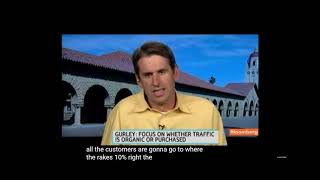
Bill Gurley explains why organic user growth matters more than paid marketing for internet marketplaces. Google, Skype, and OpenTable grew organically and proved more valuable long-term than Groupon and Pandora, which relied on paid acquisition.
But what else? When you're looking at these profit free companies that are hard to value on a sales basis, what are you looking at to create a value around a company?
Yeah, growth is a big one. One that, one that I think people really should focus on is where especially for these Internet businesses is whether traffic is organic or bought. Any company that's been heavily on marketing to drive people in, that's just a far different value proposition than someone who has a product that's so good that everyone comes to it. Google never ran marketing ads, you know, in its day to get, to get big. Skype never ran ads. OpenTable never ran ads. LinkedIn doesn't run ads. People that are having to spend heavily on marketing are basically renting or borrowing customers. I don't see any reason why a company that's heavy on marketing, we get the same kind of multiple as someone with an organic customer base.
And you see both Groupon and Pandora spending money in marketing. Groupon, amazing numbers. And the, and the, the value of those customers, I mean that's another one that's, that's hard to figure. I mean Groupon is essentially a two year old business. They say their customers stay with them an average of four and a half years, which there's no way they can know is that I find the group.
Yeah, I find the Groupon story fascinating. I'm a former Wall street analyst and when I picked up the Groupon S1 I almost like went back in time. I just wanted to be an analyst because it's such a fascinating read. The thing that strikes me about the deal business is that the value to the customer is a direct function of the rake of the platform or the margin the platform maker takes. So it's a bit like a casino in that way. In other wor, if you had a casino on one side of the street that took a 50% rake and another one on the other that took a 10% rate, eventually all the customers are going to go to where the rate's 10%. Right. The offer as a product is a direct, you know, it's a direct function of that rate. That rake is embedded in how great that offer could be. So if we see a Facebook or a Google offering a much lower rate to participate, I think it's inevitable that they have better offers.
More from Lorenzo

Netflix founder Reed Hastings explains why “family” is a bad metaphor for your startup

Netflix founder Reed Hastings explains why “family” is a bad metaphor for your startup

Stripe founder John Collison explains his product principle of “talking up to the user”

Stripe CEO Patrick Collison shares the tactics he used for finding product/market fit

Stripe CEO Patrick Collison shares the tactics he used for finding product/market fit


Sam Altman explains his two biggest mistakes when he started investing in startups

Naval Ravikant on Elon Musk: “The great entrepreneurs are always willing to start over”

Jeff Bezos explains Amazon’s process for expanding into new products like Kindle and AWS




