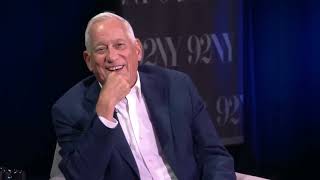
A short YouTube interview excerpt in which Walter Isaacson and an interlocutor reflect on whether childhood adversity fuels great ambition. Isaacson cites examples (Einstein, Leonardo, Steve Jobs) and then focuses on Elon Musk: running away at 17, emigrating to Canada with about $4,000, founding Zip2 and X.com (which became PayPal), using proceeds (~$100M cited verbally) to fund SpaceX, and displaying an unusually high appetite for risk (Peter Thiel: "addicted to risk").
Questions this video answers
17
About $4,000
Zip2 and X.com (the latter became PayPal).
"Numbers like 100 million or so" (verbal estimate).
"Musk is different. He's addicted to risk."
Chapters
I sometimes wonder whether having a lot of demons from childhood gives you a lot of drives. You and I, with all due respect to both of us, are basically observers in this world of people doing really weird and wild things.
We're not trying to fix anything.
We're not trying to blow things up. I've never tried to get a rocket to Mars. And the question is, do you have to be demon driven to want to change jobs? I mean, I look at every one of my characters. Einstein, growing up Jewish in Germany, not happy. Leonardo, he's growing up illegitimate. His father won't legitimate him. Gay, left handed, distracted. And he goes from the village of Vinci to Florence and has even to his deathbed. He's still doing the deluge drawings. He's still tormented. And I go down there. Steve Jobs, adopted and actually rejected by or not accepted by the first adopted family, you know, feels abandoned, but chosen. So as Obama says in his memoirs, I think every successful person is either trying to live up to the expectations of his father or live down the sins of his father. And in his case, he said it's both. Well, that's true of Elon.
So this is the ingredient, the necessary unhappiness.
Well, I don't know. You and I had these happy. It didn't amount to much.
Well, but it's true. But it's true that you and I don't have the impulse to change the world.
We are more comfortable. Like Hawthorne writes about being the detached observer.
That's right. That's completely true. So with this talk about a little bit of how Elon Musk escapes this.
Well, he runs away at 17. Like everybody. Ben Franklin runs away at 17, Einstein runs away at 17. You and I went down to some Mardi Gras party or something and Einstein's running away, his palms are sweating. And he escapes by leaving South Africa, which has been very violent, and comes to Canada at first with about $4,000 and eventually goes to Silicon Valley after going to Penn and starts a couple of companies. One is a zip two, which is like Google Maps but before that. And the other is a really interesting one, x.com and it was a financial payments app that also had the social network attached. It becomes PayPal. They oust him. He wants to keep it called X.com and he wants it to be an everything app, right? This is what drives him 22 years later to buy Twitter, turn it into X.com and make it a payments app.
At what point in his career or life do people start saying this is a really unusual person who's going to do really unusual things.
I think I couldn't figure that out from the story. Yeah, I think his first two companies, which are Zip2 and then what we'll call PayPal, both are successful and they both make them. You can probably remember the numbers like 100 million or so, which is a lot of money. And instead of buying an island or buying a yacht, he wants to keep putting his chips on the table. So with all the PayPal mafia that he's having a fight with, he decides he wants to send a rocket to Mars. And they keep saying, what are you talking about? He says, well, if we don't become a space faring civilization, human consciousness may die out. And they say, hey bro, you're going nuts.
This is where he becomes different from everybody.
Correct. And this is where everybody, Peter Thiel, I talked to him and Reid hoffman, that whole PayPal mafia, they say suddenly once he had a couple hundred million, he decides to put it all into trying to get a rocket to Mars.
So this is a different risk profile than most people.
Peter Thiel said that most great entrepreneurs know how to calculate risk. And he said Musk is different. He's addicted to risk.
Yeah, that's the difference that he's willing that the next thing is as valuable as.
Exactly. And he wants to always up the game. And now he's still doing it. I mean, he didn't have to buy Twitter and now after buying.