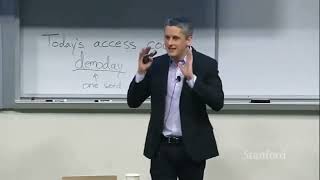
Short video segment in which Aaron Levie (Box founder) advises startup founders to "start with something insanely simple": build a single, narrowly scoped use case that solves a widespread problem, resist the instinct to pack many features, and use the initial simple product as a wedge to expand into other use cases over time. He emphasizes that maintaining simplicity is an ongoing challenge even for mature companies.
Chapters
Start with something insanely simple and then focus on expanding it over time. When we got started, you would have looked at our technology and you would be like, that is the stupidest thing I've ever seen. All it does is you upload a file and then you access the file. And it was that simplicity that was actually why it was so disruptive. Because all of those vendors thought that the problem was we just need to jam in as many features as, as humanly possible into one piece of software. And that was correlated with our value proposition. That was sort of how enterprise software companies operated. We said, actually the fewer features, the simpler set of functionality in one place is actually going to be our value proposition. If you were in classic enterprise software, you would have looked at our product and you would have thought it was a toy, essentially. You would have been like, that is never going to serve enterprises. It's not going to serve regulated businesses. It's not going to serve complex workflows. It's not going to. And what they didn't recognize was that was just the start. That was just our day one use case. That was the day one thing that we were trying to solve. The instinct and the tendency, and this still happens today, like at our company 12 years later when we've learned this, I think so directly, you still have this tendency. Anybody in this room that goes out and brainstorms like, how can we build a big enterprise software company, you're going to brainstorm by listing out lots and lots and lots of things. You're going to list out lots and lots and lots of features. But that's not actually how you're going to be successful. You're going to be successful by nailing one use case that just happens to be a use case that everybody has a massive problem with. If you can nail that one use case, that becomes essentially the wedge to then use to expand out to all the other use cases that you want to go and solve. You have to resist the natural instinct, which is that more functionality, more powerful software is better. And really make sure that you're focused on one thing that you're going to do better than Everybody else. Again, 12 years in, we're still having to relearn this over and over again. The amount of product meetings that I end up in, where we have to be like, we have to remove that feature, we have to hide that thing, we have to make that simpler. It never goes away. Even when you're bigger, you still have to make sure you're really, really focused on keeping things dead simple. And almost deceptively simple in what you're actually going to go and do for the customer. Because it just turns out that in these cases, having less functionality gives people way more opportunity than go use your service. It's counterintuitive, but the more functionality you have, the more you're going to narrow the set of customers that ultimately are going to be able to sort of make sense of your product and want to use your product. So that's very.