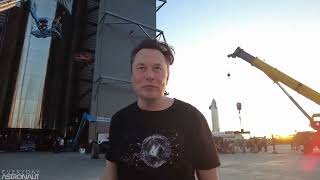
Transcript of Elon Musk describing a five-step algorithm for running companies: (1) make requirements less dumb, (2) delete the part or process, (3) simplify/optimize, (4) accelerate cycle time, and (5) automate. He stresses assigning clear personal ownership for requirements, avoiding premature optimization, and gives an extended example where removing unnecessary fiberglass mats on the Model 3 battery line solved a production choke point.
Chapters
The sort of five step process first, make your requirements less dumb. Your requirements are definitely dumb. It does not matter who gave them to you. It's particularly dangerous if a smart person gave you the requirements because you might not question them enough. Everyone's wrong. No matter who you are, everyone's wrong some of the time. So make your requirements less dumb. Then try very hard to delete the part or process. This is actually very important. If you're not occasionally adding things back in, you are not deleting enough. The bias tends to be very strongly towards let's add this part of process step in case we need it. But you can basically make in case arguments for so many things. And for a rocket that is trying to be the first fully reusable rocket. There's never been a fully reusable rocket. People don't understand this is like the holy grail of rocketry, 100%. So you gotta delete the portal process step super important. And you can't like hedge your bets. So that's why the quickfins, for example, do not fold down because that's a whole extra mechanism that we don't need. And then also, whatever requirement or constraint you have, it must come with a name, not a department, because you can't ask the department. You have to ask a person. And that person who's putting forward the requirement or constraint must agree that they must take responsibility for that requirement. Otherwise you can have a requirement that basically an intern two years ago randomly came up with off the cuff and they're not even at the company anymore. These things are often just way more silly than you'd. So step one, make your requirements less dumb. Step two, delete the part or process step. If you're not adding things back in 10% of the time, you're clearly not deleting enough. And then only the third step is simplify or optimize the third step, not the first step. The reason it's the third step is because possibly the most common error of a smart engineer is to optimize a thing that should not exist. Everyone's been trained in high school and college. You got to answer the question convergent logic. So you can't tell the professor your question is dumb, you'll get a bad grade. You have to answer the question. So everyone's basically, without knowing it, they got like mental straight jacket on. They'll work on optimizing the thing that should simply not exist, right? And then finally you get to step four, which is accelerate cycle time. You're moving too slowly. Go faster. But don't go faster until you have worked on the other three things first. You can always make things go faster. And then the final step is automate. Now, I personally made the mistake of going backwards on all five steps multiple times. Literally. I automated, accelerated, simplified, and then deleted. One example I've talked about before is like the. There were these like fiberglass mats on top of the Model 3 battery pack that were in between the floor pan and the battery. And it was one point choking the battery pack production line. And I was like, basically living on the battery pack production line, like trying to fix the line. It was like choking the entire Model 3 production program. So the, the first mistake was I tried to fix the automation, like make the robot better. So automating was a mistake, then accelerating was a mistake, then optimizing was a mistake. And finally I said, what the hell are these mats for? And I asked the battery safety team what these mats were. Are they for fire protection or something? They said, no, they're for noise and vibration. Then I asked an NBA noise vibration harshness team, what's it for? They said, fire safety. So literally, it was like being in a Dilbert cartoon. Okay. It's like, actually I feel like I'm in a door. It could turn quite frequently. So then finally, okay, great, let's try a car with the fiberglass mats and without. And they put a microphone in both and see if you can tell the difference. You cannot. In fact, I was like, which one is which? So we just deleted them and just bypassed this two million dollar robot cell. It was just a complete pile of nonsense.