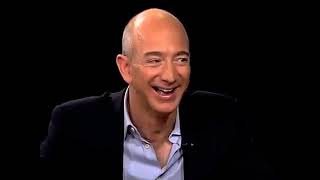
Interview excerpt with Jeff Bezos describing Amazon’s mission—"Earth's most customer-centric company"—and explaining how a missionary, long-term, customer-obsessed approach shapes Amazon’s decisions (product differentiation, tolerating criticism, and enduring short-term losses). Bezos contrasts Amazon’s strengths (selection, low prices, fast reliable delivery) with brick-and-mortar retailers like Walmart, argues that scale/purchasing-power issues have been leveled, and states Amazon tolerates multi-year negative financial impacts when investing in new businesses to earn customer trust.
Chapters
Your goal is to be the largest online and you are retailer in the world. Beyond that, what's the goal?
Well, our mission is Earth's most customer centric company.
But I don't know what that means.
Well, I'll give you an example. Right after World War II, Morita San, the guy who founded Sony, set as the mission for Sony that they were going to make Japan known for quality. You have to remember this was a time when Japan was known for cheap copycat products. And Morita san said, he didn't say we're going to make Sony known for quality. He said we're going to make Japan known for quality. He chose a mission for Sony that was bigger than Sony. And when we talk about Earth's most customer centric company, we have a similar idea in mind. We want other companies to look at Amazon and see us as a standard bearer for obsessive focus on the customer as opposed to obsessive focus on the competitor. So that's one of the reasons we work on differentiated products. It's one of the reasons we take a long term viewpoint on things. You can't really do the right thing for customers if you're short term oriented. And if you're going to invent new things, you've also got to be able, and this goes along with long term orientation. You got to be willing to endure a lot of criticism. You know, if you're going to put Kendall is a good example, if you're going to put your back into reinventing a 500-year-old industry, some folks are going to get ornery.
It was also feared at one time those people who had had your stock that once Walmart, for example, got serious about being online, they were going to blow you away. Why didn't that happen?
Well, I think it's because we did a good job for our customers. So, you know, we have you go back in time and we've been called Amazon Toast.
Right?
I remember Amazon Con, Amazon Bomb. You know, this is all like the first three years of our existence. And that's part of what I'm talking about, the willingness to be misunderstood. If you're going to do things, we lay out what we're doing and we tell people how we think about things. Like I'm saying to people, the iPad is not a Kindle killer. I'm very clear about that. But it doesn't keep people from writing that. And I'm very clear about why it's a totally differentiated device. It's $139, works in bright sunlight, you can read with one hand, it's so light and the battery lasts a month for $139. Why wouldn't you want a device like that?
Let me go back to the Walmart issue though. What was it that made you able to sustain a challenge from the world's greatest retailer?
Obsessive customer focus on.
How do you focus on the customer better than they focus on the customer?
Well, we, I mean they're pretty good.
At focusing on the customer too, but.
We'Re very differentiated in how we do it. And so our approach, when you, if you if think about our retail business, which I think is what you're asking about here, the really three things that we know are the heart and soul of your business. Well, and especially relative to the Walmart question, I think that's the key. It's selection. Low prices and fast, convenient, reliable delivery. So that the shipment side. And so we.
Okay, wait, wait. So Walmart doesn't have low prices, fast and convenient delivery?
I would claim that Amazon has much broader selection in many cases. I don't want to be overly bold in my claim, but the online model gives us significant cost structure advantages that lets us have even lower prices than physical stores selling online. Well, sometimes they do have umbrella problems, sometimes where they, they don't want to compete against themselves online versus offline.
But a Walmart with all of the volume that it buys, its purchasing power therefore gives it the ability to offer lower prices. Doesn't that give them an advantage? They ought to be able to translate because their purchasing power is bigger than your purchasing power, is it not?
I wouldn't. I think in a lot of the product categories that ship sailed a long time ago.
Meaning what?
Meaning that we have the purchasing power.
To compete with anybody.
We have the volume relationships with suppliers. That playing field has been leveled. If you'd asked me that question, you know, 10 or 15 years ago, I'd have agreed with you that there was.
A challenge you had overcome.
But even then we don't. Our profitability is not our customer's problem. We don't take the point of view that we're going to price products, you know, at a particular margin for ourselves. We say we're going to price products competitively and if that means on that product that we lose money, that's okay because we need to take care of the customer and earn trust and we'll figure out over time and if we can, if we find we can't ever make money with that product, we'll stop selling it. But we don't Want to. We're not going to make customers pay for any of our inefficiencies if you see what I'm saying.
You lose money on the Kindle.
Every new business that we have ever invested in, it has taken years. Most businesses have either no impact on our financials for the first five to seven years or a negative impact on our financials for the first five to seven years. And we do a lot of new things. The company is very healthy financially, we're doing very well and it's an outcome of customer obsession. So you know, when we were Amazon Toast that was because Barnes and Noble had, you know, we only had 100 when we were declared Amazon Toast, I think we had 150 employees. Barnes and Noble had 30,000 employees. And somebody wrote an article that said, you know, Amazon has had a great two year run but now the big boys have shown up and they're going to steamroll them. And you know, we had a all hands meeting. I called all 150 employees together. I said look, because everybody's worried. Every employee has read the Amazon Toast article. Every mother of every employee has read the Amazon Toast article and has called.
And said, father and mother who live.
Here in New York, are you okay? And so we had an all hands meeting and I said look, you should wake up worried, terrified every morning. But don't be worried about our competitors because they're never going to send us any money anyway. Let's be worried about our customers and stay heads down, focus, focused. And so I, you know these are big, most of these are big markets. Another way to answer your question about competitors in Walmart is to say, look, they can succeed fabulously and it won't stop us from succeeding. These retail markets are huge, so we can. It often doesn't make sense for us to think of it as a pitched battle. You know, sometimes people think about business as kind of like a sporting event. There's a winner and a loser.
It's not a zero sum game.
It usually isn't. I'm sure there are cases where, but most often industries succeed. So I can tell you I think E commerce is succeeding. And the way we think about it, nobody else has to fail for us to do well. I think ebooks is like that. I think there are going to be many winners. I think ebooks is going to be a huge industry.
Well, there are many competitors. Now you've got Barnes and Noble is one of them, Sony is another now Apple is another.
But I have a list of 50 competitors that we could walk through. I mean, you know, all over the world doing different things. And our focus is going to be, you know what, we'll try to pay attention to those competitors, but we're not going to obsess over them. We're going to obsess over readers, because those are the people who are buying that device. And we're going to make it. And it's not just a business for us, it's a mission for us. And missionaries build better products.