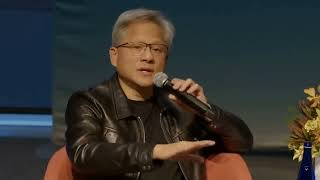
This content was created by Lorenzo. This content was uploaded by Lorenzo. This is a YouTube video titled "Jensen Huang on AI applications: 'The next 10 years are going to be unbelievable.'" It features a talk by Jensen Huang discussing the advancements in AI, particularly in learning representations of information and its applications in various fields such as design and protein engineering.
Chapters
AI's. So first of all, this is the giant breakthrough. Somehow we've taught computers how to learn to represent information in numerical ways. Has anybody heard of this thing called Word2Vec? It's one of the best things ever. You take words and you learn from the words, studying every single word, its relationship to every other word. You try to figure out what's the best number to associate with that word. So mother and father are close together numerically. Oranges and apples are close together numerically. They're far from mom and dad. Dogs and cats are far from mom and dad, but closer probably to mom and dad than they are from oranges and apples. Tables and chair, hard to say exactly where they lie, but those two numbers are close to each other, far away from mom and dad. King and queen, close to mom and dad. Does it make sense? Imagine doing this for every single number and every time you test it you go, son of a gun, that's pretty good. You know, and when you subtract something from something else, it makes sense. Okay, that's basically learning the representation of information. Imagine doing this for English. Imagine doing this for every single language. Imagine doing this for anything with structure, meaning, anything with predictability. You could take videos and turn vectors 3D into vectors, proteins into vectors, because there's obviously structure and protein, chemicals into vectors, genes eventually into vectors. We can learn the vectors of everything. Well, if you can learn everything into numbers and you know its meaning, then obviously you can take cat, the word C a T, translate it to the image cat, the nice image of cat. If you can go from words to images, that's called midjourney stable diffusion. If you can go from images to words, that's called captioning. What do you call it? If you go from amino acids to proteins, that's called a Nobel Prize. And the reason for that is because that's Alphafold. Incredible breakthrough. And so this is the amazing time in computer science where we could literally take information of one kind and generate it into information of another kind. So in the near future, you do something like this, you say, give me some options of a whole bunch of cars. I work for Mercedes. I really care about the brand. The, this is the style of the brand. Let me give you a couple of sketches and maybe a couple of photographs of the type of car I like to build. It's a four wheel drive suv, let's say, you know, so on and so forth, okay? And all of a sudden it comes up with 2010, 200 completely, fully 3D designed CAD. Now the reason why you want that instead of just finishing the car is because you might want to select one of them and you say iterate on this one another ten times and you might finally select one and, and then modify it yourself. And so the future of design is going to be very different. The future of everything will be very different. Now what's the long term impact of this? One of my favorite areas is if you could use language to describe a protein and you could use language to figure out a way to synthesize protein, then the future of protein engineering is near us. And protein engineering as you know, creating enzymes to eat plastic, creating enzymes to capture carbon, creating enzymes of all kinds to grow vegetables better, all kinds of different enzymes could be created during your generation. And so the next 10 years is going to be unbelievable. We were the computer, the chip engineering generation, you'll be the protein engineering generation. Something that we couldn't imagine doing just a few years ago.