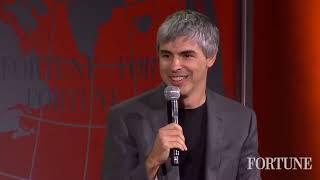
This is a transcript of a public conversation in which Larry Page responds to criticism (attributed to Steve Jobs) that Google/Alphabet is spread too thin. Page acknowledges the critique but explains Google’s drive to tackle large, world-changing problems (energy, telecommunications, transportation, healthcare/longevity) and frames the company as built for engineers and entrepreneurs. He describes how ideas can emerge from operational pain points (e.g., long lead times for transformers) and evolve into businesses when the right team and technology converge. Decision criteria discussed include judgment, team quality, potential scale/importance (affecting many people daily), business benefit, and motivational value for employees. Page also mentions concrete efforts—self-driving cars and high-altitude balloons for Internet—and situates Alphabet’s structure and ambition relative to Berkshire Hathaway (sharing some investment/management lessons but differing in mission).
Chapters
You're doing everything. I mean, you're going to remake. You want to remake the energy business, you want to remake the telecommunications business, you want to remake the transportation business. You want to. So can you talk about how. I mean, you heard this from Steve Jobs. I understand he said you're doing too many things.
Yeah, I mean, he was right. I mean, he did fine as well.
But you haven't slowed down. I mean, you're. You. That's why we called you the most ambitious CEO in the universe. And the truth is, we didn't have data on the whole universe, but we, We. You know, it's a. It's a lot you're biting off.
Yeah, no, I. I worry about that, in fact. And I think for me, you know, I mentioned how I wanted to make company kind of for engineers, like, thinking about it that way. I think also as an entrepreneur who had started Google, trying to make a company for entrepreneurs also is something I think we're striving for. And I think in the same way, maybe when I was working for the consultant company in dc, it wasn't really my inner calling. I think for most entrepreneurs, working for companies is also not so great.
Why?
I think it's a combination of companies generally trying to do the things they do well, plus the things that are adjacent and not thinking creatively about, you know, what they might have learned from doing one of the things they've already done, how that might translate into a new business.
They're not ambitious enough.
I mean, I think it's maybe not that as much as seeing learning from your business. Like, I really like going and talking to the people who run our data centers, you know, but I asked them, like, how does that transformer work? How does the, you know, how does the power come in? What do we pay for that? You know, ask lots and lots and lots of questions. And I'm thinking about it kind of both as a entrepreneur and as a business person. And I'm thinking, what are those opportunities? So I think in any big business, any of the people here, there's so many little things, you know, that seem like a little annoyance. Like, I remember we're having a problem getting Transformers. You know, take them a year for a Transformer to show up. You know, that's a problem, but it's also an opportunity. Why does it take a year? You know, why does it get shipped on a train car and then a special truck, and then it, you know, takes a long time to arrive? Is that really the right solution? It makes you wonder.
So how do you decide which of these problems slash opportunities to take on? I mean, we were having dinner with Craig Venter. He's focused on extending people's lives. You're doing the same thing.
Yeah, I love talking to Craig about it.
So you're. And you're going to be in the car business?
Well, I'm making self driving cars.
You're putting balloons up over a big part of the world to provide Internet business. How do you make decisions? How do you decide which of these areas you're going to go into?
Yeah, I think, I mean, I think that's one of the most difficult things. I think some of it comes from experience, some of it comes from just judgment, the right people to judge. Some of it comes from having the right teams in place. A lot of times, many of these ideas, you know, you have this observation like, oh, you know, it sucks. It took an hour a year to get the transformer and then 10 years later that might turn into a business because the right team showed up and the right piece of technology, somebody might have invented something new. The right person who understands that might show up as an entrepreneur. You might say, that kind of all makes sense. And then I think the other thing we're trying to do is say, is that thing really, really important? You know, is it going to affect everyone in the world? Is it going to affect a lot of people every day? I mean, look at smartphones. I mean, there's billions of smartphones.
And so what's amazing to see, but what's the threshold? So you're looking for things that may, you're looking for individual bets that will change the world. You know, what, what if something looks like it's going to cause a 50% improvement? Is that good enough for you? Or do you have to have 100% or 200%?
I mean, I think it's, you know, from a business standpoint, you're looking at the business benefit you might get. But I think also in terms of motivating ourselves and our employees, potential employees, entrepreneurs, we want to be doing things that are exciting, you know, that are going to really make a difference. And I guess the other, you know, what kind of caused Alphabet for me was, you know, I think also companies have pretty bad reputations in general. It's not like, you know, most people in the world get up and they're like, you know, oh, I wish I could go work for a company. You know, I mean, they do it because they have to. And companies are, I don't know, 90% of the GDP or something. So it's basically everyone all the time.
So if they're that much of the gmp, why do you think they have such a bad reputation?
I don't know. It seems silly.
Well, you obviously have thought about this a lot.
Yeah. And I think that's something we should work to change.
How do you avoid it?
I think we got to be more ambitious. We got to do things that matter more to people. We've got to do less things that are kind of zero sum games and more things that really cause a lot of benefit.
So too many businesses are either making marginal changes or fighting for market share as opposed to.
Or they're just doing things that aren't great. You know, in whatever way do you look at.
Is there any company out there that you look at and say, yeah, that's kind of what we want to be?
No. No.
Any problem. There you go. Any. Any CEOs out there that you look at?
There's parts of things, obviously, we really respect and like, but I think. I think in terms of doing, you know, at scale, doing the investment at scale that we're trying to do, you know, I wish I could just look at someone else say, if only we did what they're doing.
Some people said when you announced Alphabet, they said, oh, that's Berkshire Hathaway. This is his Warren Buffett strategy. Do you buy that?
I mean, you know, we're trying to talk a lot to Warren and to Charlie and to learn from them. And there's definitely aspects of that we've tried to borrow, you know, not reinvent the wheel. I think there's things that they do really, really well. You know, in any. Anything you don't have to reinvent, you should. You should borrow those techniques. And I think that.
But when he invests in Coca Cola or he invests in Union Pacific, he's not saying, we're going to change the world.
Well, I mean, I think he is, in his own way. I think they're doing a lot of interesting things on energy and infrastructure, which I think is really great. You know, I think there's a. Probably a lack of leadership in a lot of those industries, and I think they're working to raise the level of that, which I think is really, really important. So, look, I don't spend that much time studying it, but I think we have a bent where we want to maybe use some of that independence that they've done a great job of, but also do with the technology bent and science and engineering bent.