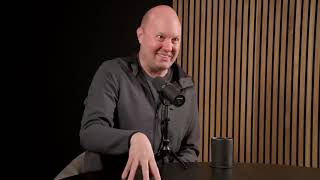
Marc Andreessen explains entrepreneurship as decision-making under deep uncertainty in a complex adaptive system. He introduces the "idea maze": founders mentally map possible product/business futures in advance, then execute while continuously learning, course-correcting, and treating plans as testable hypotheses. He emphasizes planning upfront, daily course correction in the "fog of war," and reframing mistakes as pivots.
Chapters
Entrepreneurship, creativity, innovation is what economists call decision making under uncertainty. And so both parts are important. Decision making, like you're going to make a ton of decisions because you have to decide what to do, what not to do, and then uncertainty, which is like, the world's a complicated place, right? And in mathematical terms, the world is a complex adaptive system with feedback loops. Military commanders call this the fog of war, right? You're just dealing with a situation where the number of variables are just off the charts. It's all these other people who are inherently unpredictable making all these decisions in different directions. And then the whole system is combinatorial, which is these people are colliding with each other, influencing the decisions. The really good innovators, they've got a drive to basically be able to cope with that and deal with that. And they basically do that in two steps. So one is they try to pre plan as much as they possibly can. And we call that the process of navigating. We call the idea maze. Right? And so the idea maze basically is I've got this general idea and it might be the Internet's going to work or search or whatever, and then it's okay. In their head they have thought through of, okay, if I do it this way, that way, this third way, here's what'll happen, then I have to do that, then I have to do this, then I have to bring in somebody to do that. Here's the technical challenge I'm going to hit. And they've got in their heads as best anybody could, they've got as complete a sort of a map of possible futures as they could possibly have. And so then they start on day one. And then of course what happens is now they're, now they're in it. They're in, now they're in the fog of war, right? They're in true uncertainty. And now that idea is maybe not helpful practically, but now they're going to be basically constructing on the fly day by day as they learn and discover new things and as the world changes around them. And of course it's a feedback loop because if their thing starts to work, it's going to change the world. And then the fact the world is changing is going to cause their plan to change as well. And yeah, the great ones course correct every single day they take stock of what they've learned, they modify the plan. The great ones tend to think in terms of hypotheses. It's a little bit like a scientific sort of mentality, which is they tend to think, okay, I'M going to go into the world, I'm going to announce that I'm doing this for sure. I'm going to say this is my plan and I'm going to tell all my employees that. I'm going to tell all my investors that, and I'm going to put a stake in there and it's my plan, and then I'm going to try it. And even though I sound like I have complete certainty, I know that I need to test to find out whether it's going to work. And if it's not, then I have to go back to all those same people. And I have to say, actually, we're not going left, we're going right. And they have to run that loop thousands of times, and they had to get through the other side. And this led to the creation of this great term pivot, which has been very helpful in our industry because the word, when I was younger, the word we used was fuck up. And pivot sounds so much better. It sounds so much more professional. But, yeah, you make mistakes. It's just too complicated to understand. You course correct, you adjust, you evolve. Often these things, at least in business, the businesses that end up working really well tend to be different than the original plan. But that's part of the process of a really smart founder basically working their way through reality. Right? Right. As they're executing their plan.