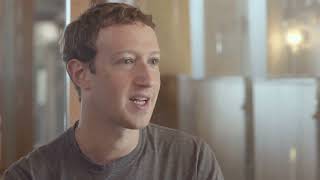
Transcript excerpt from a YouTube interview where Mark Zuckerberg describes his early approach to building Facebook and gives advice to 19-year-old aspiring entrepreneurs: choose something you care about, work on it first without immediately committing to forming a company, and validate it before formalizing. He notes Facebook became a formal Delaware company around six months in when Peter Thiel invested, and that the founders initially planned to return to school.
So you were 19 when you started Facebook? One question we hear a lot at Y combinator is, I'm 19 today. I really want to do whatever I can to make the world better. What should I do? So how do you advise people who are 19 today and want to impact the world like you have?
You know, I always think that the most important thing that entrepreneurs should do is pick something they care about, work on it, but don't actually commit to turning it into a company until it's working. And I think that if you look at the data of, like, the very best companies that have gotten built, I actually think a tremendous percent of them have been built that way, and not from people who decided upfront that they wanted to start a company because you just get locked into some local minimum a lot of the time, a local Maximus.
I totally agree. And just to make this point, how far into Facebook did it actually become a company?
I don't know. I think probably. I think it became a formal Delaware company when Peter Thiel invested in about six months in. When we were first talking to Peter about raising money, Dustin and I were very clear with him that we were planning on going back to school. Right. I mean, our. You know, I started Facebook when I was a sophomore. We took the summer off, or no classes over the summer. We were working on it, and then, you know, our stated game plan was to go back to school in the fall and continue working on it then, but not, like, sit in an office and work on it full time. And Peter was just kind of like, all right, sure you are. I guess he knew better than we do.
You think he just believed that you weren't actually gonna go back to school?
He must have. I mean, you'd have to ask.
But I will. We're interviewing him in this series. I will ask that question.
So I think he would probably say that he knew that we were not going to go back to school or believed that he could talk us out of it, but he didn't have to. It was pretty clear that the amount of work was just growing so quickly. But we actually didn't drop out immediately. We told Harvard that we were taking one semester off, and then we told Harvard that we're taking another semester off and then a year off. And then after that, we kind of decided we weren't going back.