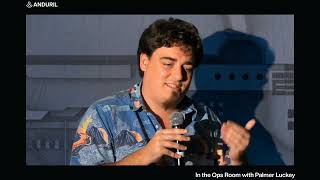
Palmer Luckey describes founding his defense startup Anduril by imagining, through hard science fiction, what a next-generation defense prime (a "Lockheed Martin of the 2050s") would need to develop today. From that fiction-driven lens he concluded the future lies in mass-produced autonomous systems across air, land, sea, and space, plus an AI sensor-fusion software platform. Anduril's first core product, Lattice, connects in-house and third-party sensors and underpins a suite of hardware (autonomous surveillance towers, counter-UAS systems, undersea vehicles, space sensing, aerial vehicles).
Chapters
So you're starting a defense startup from nothing. So how does that happen? What is the basic thrust of what you want to do and how does that then become products? So when we started the company, it was very different than how I had started Oculus. Oculus. I had a product that I wanted to make and the company was kind of built around that. With Anduril, we built the company around an idea. What would a next generation Lockheed Martin look like? If you were to build the next major defense prime today, what would it build? It's probably not manned fighter jets. And actually to frame it further, I thought of it from a science fiction perspective. If one were to write a hard science fiction novel where it is examining a defense contractor that dominates the industry 50 years from today, in that fictional narrative, what are the technologies that it would have had to start working on today to get there? I read a lot of science fiction, a lot of hard science fiction, and you start to realize that a lot of sci fi ideas, it's not because they're just fun, it's because they make sense. There's a lot of sense to making autonomous systems, large numbers of mass manufactured robotic systems across air, land, sea and space, around applying artificial intelligence to fusing data from all of these different systems into a comprehensive view that can be shared between the people and the machines in real time, filtering out everything that doesn't matter. That was actually how we came to the conclusion of what we're going to build. We started the company not knowing exactly what the products would be. And then we sat down and said, okay, what do we need to start building? And our first core product we built was Lattice, which is our AI sensor fusion platform that connects together all of our different hardware products and actually also a lot of third party hardware products. And then we built hardware products on top of this. So, you know, autonomous surveillance towers for counter intrusion on the land counter UAS towers that are able to detect jam and kinetically destroy enemy aircraft of a varying range of sizes, building undersea vehicles, building, building space sensing platforms, building a whole bunch of aerial vehicles that are able to feed data into Lattice. And every product that we built is built on top of that same software platform. That's kind of how it started. It was very much, what are the things we need to build today if we're going to be the Lockheed Martin of the 2000 and 50s?