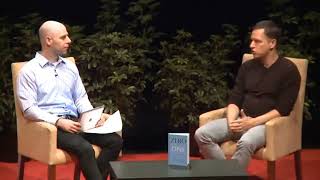
Peter Thiel contrasts social entrepreneurship with mission-oriented companies, arguing social entrepreneurship is ambiguous because ‘social’ can mean either objectively good for society or simply approved by society. He favors mission-oriented ventures: problems that would remain unsolved without that specific actor. He uses SpaceX as an example and emphasizes pursuing non-replicable, hard-to-replace projects.
Chapters
Always a little bit skeptical of social entrepreneurship, although I'm very much in favor of mission oriented companies. Let me distinguish the two. Social entrepreneurship is always ambiguous because it's unclear what the word social means. Social can mean on the one hand that it's good for society, or it can mean that it's good as seen by society. And in the second meaning you often end up with something that many, many different people are doing. So a lot of education related startups, and we think education can be improved and all these different ways to fix it, have this social entrepreneurship component where they're seen as good. You immediately get this feeling, oh, that's a good company, that's a good thing to do, but then it's something too many different people are doing. Whereas a mission oriented company is one where if you didn't work on this problem, nobody would. And I think that's always a good test. When Elon started SpaceX, part of the pitch was, we're going to work on the rockets going to Mars. And this was very inspiring to a certain group of rocket scientists who got involved early on in the company. Somehow SpaceX wouldn't quite fit into our standard definition of social entrepreneurship, even though Elon would say, well, it's really important for us to become an interplanetary species and this is actually good for society, but it's probably not seen as good by society. And so we always want to do things where if your company wasn't working on it, the problem wouldn't get solved. If you weren't working on it, it wouldn't get solved. And I think always, always go for that sort of counterfactual meaning. And you don't want to ever be in a place where you're just one of a hundred cogs in the machine and if it's not you, there are another hundred people to replace you the next day. You want to be in a place where you're doing something that can't easily be replicated, can't easily be replaced, either on individual level or the level of a company or any other project you're involved in.