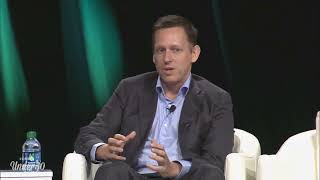
This is an excerpt from a YouTube interview (Feb 3, 2024) in which Peter Thiel argues entrepreneurs and societies should adopt definite, long-term views of the future. Thiel contrasts short-term operational focus (next month/quarter) with the need to think five to ten years ahead about value, competitors, technology, and societal change; he criticizes treating the future as purely random or attributing outcomes to "luck." He uses metaphors (chess, resume/random walk) to illustrate planning versus passivity.
Chapters
I think it's always worth asking where you're going to go with this business. And so I think we're always focused on very short time horizons because you have to figure out a way to get through the next month, the next quarter. How do you get some customers, how do you track? But it's always worth thinking ahead five to ten years. Why will this be a really valuable business in five to 10 years? And how's the competitive landscape going to develop? How's technology going to develop? How's the world going to develop? These are hard questions to answer, but I think the great entrepreneurs that I know always have some perspective on it. And it might be wrong, but it's just, this is what's going to happen and then it's sort of well reasoned. And so you have a plan. When I was playing chess in junior high school, one of the early lessons I learned was a bad plan is still always better than no plan at all. And so have a plan, you can always change it. But don't just pretend that you have no clue about what's going to happen and that everything about the future is random. If you sort of say that everything's random and out of your control, that's the way you set yourself up for failure.
You talk about that as, like, even as a societal problem. In America today, we are a nation of optimists, but without a definite idea of where we're going, unlike say maybe 50 years ago or.
Well, it's the way the whole education system works. You build a resume with a wide variety of activities and then you go to college, you get some general degree, and then it's supposed to lead to various jobs that lead to other jobs. And it's sort of this random walk. We sort of figure out what to do, what to do in your future. And so I do think, I do think we overplay the role of luck when we exaggerate the role of luck in our future. I've said I think luck is like an atheistic word for God, where when we attribute too much to luck, we could be thinking a little bit more.
So you think, is it the old hard work? You make your own luck? That old.