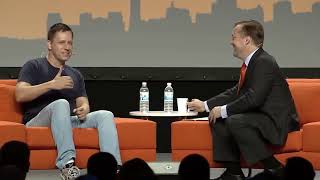
Peter Thiel delivers a short monologue (recorded Dec 9, 2023) arguing that industry trends and buzzwords are overrated; he warns investors to be skeptical of companies that describe themselves using proliferating buzzwords (SaaS, big data, cloud). He prefers companies that defy existing categories—those that lack buzzwords—and illustrates this with examples: Google (PageRank as more than 'another search engine') and Facebook (real identity vs prior social networks).
Chapters
Look at the various sectors you're investing in. Which one do you think has the most potential, you know, in the coming years? Health care, robotics, AI? You know, I'm always, I'm always skeptical of sectors and trends. People always ask me, what are some trends that I see happening in the future? And I never like the question because again, it's like I'm not a prophet. I don't think the future is fixed in that sort of way. But I also think at this point, I think all trends are overrated. And so healthcare, it, education, software, somewhat overrated. SAS software, pretty badly overrated. If you hear the words big data, cloud computing, you need to run away as fast as you possibly can. You need to just think fraud and run away. And the reason you want to be really careful about these buzzwords. If I said I'm building a mobile platform for SaaS Enterprises to do big data in the cloud and if you have sort of like a proliferation of buzzwords, can you introduce me to that company? I know, I know you, you'll invest without asking any questions. If you're investing, yes, I'll have them call you collect. But, but the, but the, but these, all these buzzwords, they're a tell like in poker that the company's bluffing and that it's undifferentiated because we've heard the buzzwords before. And so if you're the nth company in a category that's well established, that's problematic. You don't want to be the fourth online pet food company or, or the, you know, or the 10th Thin Film Solar Panel Company or the 1000th restaurant in San Francisco. So it's harder to describe because there's no buzzword that's good. Yes. So I would say, yeah. So I think the things that are, you know, conversely, the things that are underrated are the ones where there are no buzzwords, where it's sort of, it doesn't actually fit into any pre existing categories. And then you have to always be open to listening to those. And of course the challenge is that very often I think even the people who are running these companies will describe them in terms of existing categories because that's so much easier to do. So Google would have been described as a search engine in 1998. People said, why do we need another search engine? We already have 20 in that category. And what was the first machine powered search? And the PageRank algorithm was actually the key differentiating thing. And if you simply labeled it as a search engine, that would have obscured all the key differences. Or if you described Facebook as a social network circa 2004, even circa 2015, that's a misleading categorization. There have been many social networks before Facebook. Reid Hoffman, my friend who started LinkedIn, started a company called Socialnet back in 1997. They already had social networking in the name of the company, and it was sort of these avatars in cyberspace, and you'd be a cat and I'd be a dog, and we'd have these weird interactions on the Internet. And it turned out so no different than last week when it turned out, yeah, people aren't interested in networking in the abstract. They're interested in real identity. And real identity was the key innovation that Facebook had. It was the first one to crack real identity. So I think often figuring out the correct way to think about things in categories for which we don't even have the proper languages is really critical to do.