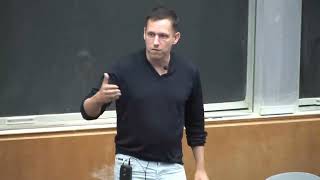
Peter Thiel describes announcing a narrow education program in September 2010 intended for about 20 people and explains how it unexpectedly sparked controversy. He reflects on widespread anxiety about higher education—costs, student debt, whether degrees deliver value—and critiques the current one-size-fits-all university model. Thiel compares today's university system to the Catholic Church circa 1500 (as the sole path to salvation/knowledge), argues for more fragmented, diverse educational tracks, and rejects the idea that he wants everyone to become entrepreneurs.
Questions this video answers
September 2010.
20 people.
April 7, 2024.
Chapters
When I announced this program In September of 2010, it was envisioned as a really narrow program. It was just 20 people. I didn't expect it to generate this enormous amount of controversy, but it somehow hit this incredibly raw nerve because people, there's sort of a lot of anxiety around education in our society. And so I ended up spending a lot of time thinking about the broader education question. I think the anxiety is that education is seen as the sort of the absolute be all and end all for everything. And then because it's costing people so much money, a lot of students are graduating with so much debt, there's an awful lot of anxiety. Are people getting what they're paying for? And so somehow it tapped into this much broader education debate. And so there are a lot of questions about how does one think about education? How does one change it? What will education in the future? I think the biggest misconception about it is that I want to sort of just blow up the universities and have everyone become an entrepreneur. And sort of quite the opposite. I believe the future will not have a one size fits all approach. If there's anything that's sort of unnatural about our current system, it is that it's a one size fits all. You know, you go to Yale or you go to jail. And I think the future will involve an education system where there's sort of vastly different kinds of tracks for different people. The analogy that I've used is that I think the university system today is perhaps sort of like the Catholic Church circa 1500. It's seen as the only path to knowledge. It's the way you get saved. If you get a diploma, you're saved. If you don't get a college diploma, you will go to hell, or sort of our modern equivalent of that. And there are sort of all sorts of challenges, but I'm not proposing to create some alternate unitary church. What I think will happen instead is it'll be sort of much more fragmented. And the somewhat disturbing message that I have is that like the 16th century reformers, is that you have to figure out how to save yourself, which is the absolute last thing people want to hear. So another question. Yes, go ahead.