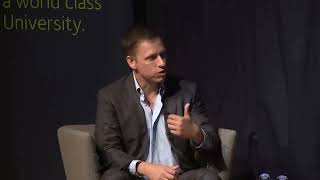
Peter Thiel argues that the popular ‘wisdom of crowds’ idea (as framed by Malcolm Gladwell) fails when social influence and imitation dominate decision-making. He contrasts independent judgments (e.g., guessing marbles) with herd dynamics that distort collective answers, links human imitation to cultural transmission and error, and claims Silicon Valley success often favors socially atypical individuals who resist being talked out of unconventional ideas. He also critiques business-school conformity and the broad persuasive power of advertising.
Chapters
Perhaps the antithesis of my book is the cliched version of Malcolm Gladwell, the Wisdom of Crowds. If you had to give credit to Malcolm Gladwell, the way the argument actually works in the Wisdom of Crowds is that if you have a crowd of people and they independently make a judgment and they all independently think something through, you can average it out and you'll get to a pretty good idea, sort of. You had a bag of marbles and you asked every single person how many marbles there were and everyone thought about it independently of one another. The average answer would be pretty good. But the problem is that in most cases, the decisions don't end up getting made individually. People are influenced by one another as they make them. And when you have a crowd dynamic in which people are drawing conclusions because they're looking to one another, that's where the crowd is untruth. In the time of Shakespeare, the word primate meant both ape and to imitate. And I think it was Aristotle who said that man differs from from the other animals and is greater aptitude for imitation. It's a very deep part of human nature. Kids learn language by copying their parents. It's how culture is transmitted in our society, but it's also how very many things go wrong. And the slightly extreme formulation I have of this is that there's this strange phenomenon in Silicon Valley where so many of the successful entrepreneurs seem to be suffering from a mild form of Asperger's or something like this. I think we always need to flip this around and ask the question, why is it that the people who are not suffering from Asperger's are at a disadvantage in our society where they're in fact talked out of their interesting original ideas before they're even fully formed? And you pick up on all these subtle cues from people, oh, that's a little bit too strange. That's too weird. I better just go ahead and open that restaurant or do something super conventional, which lots of other people are doing and probably is at the end of the day, weirdly not going to be that effective. My apologies to the audience here. I often think of the business school demographic as the anti Asperger's demographic. And so it would be the sort of people who are hyper socialized. They perhaps can be criticized for being somewhat low on the conviction level. And if you put all these people in a hothouse environment for a few years and they look to one another and try to figure out what to do with their lives, it's not clear at all that sort of process gets you to the the right answer. They've done these studies at Harvard Business School, where they found that the largest cohort of people all conclude, after two years, we're going to try to catch the last wave. And in 89, they all wanted to work for Michael Milliken one or two years before he went to jail for junk bonds. And they never really were interested in tech except 99, 2000, when they timed the dot com bubble ending perfectly. And so I think this is something to be aware of. And again, I think it's unfair to just criticize business school students because we're all subject to this. And it's disturbing how powerful something like advertising is. We always think of advertising. Who are all these stupid people who watch these TV ads and who these ads work? And the disturbing answer is that it's all of us, to a much larger degree than it should be.