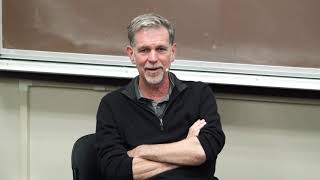
Reed Hastings explains how the CEO role changes as a company grows: in the earliest years the founder-CEO does everything (coding, customer work, marketing, investor relations) and must compensate for early disadvantages with talent and hard work. As organizations reach roughly 50–100 people the CEO must shift management style; by hundreds of employees the CEO focuses on higher-level strategy (market selection, global expansion, originals), culture, vision, and resource-allocation choices (e.g., percent of revenue for marketing) rather than day-to-day execution. Hastings illustrates with a personal anecdote: at age 33 he was leading a ~50-person company while still coding at night, which delayed letting go of dual roles and affected culture (people noticed his hygiene and availability).
Chapters
Do you define the role of CEO? That definitely varies by stage of company. In the first couple years, you do everything. You know, you're doing dishes at night, you're, you know, coding. Maybe you're writing marketing materials. For sure, you're dealing with customers and investors. And, you know, you have so many disadvantages as an irrelevant little nothing as a company that you have to make up for it with talent and hard work and brute force. And so if you're lucky, that's only a couple years, as opposed to 10 years, where you're just on call constantly in a very intense way. And then the trick is, as you get to 50, 100 people, you've got to evolve your management style. As you get to 500 people, kind of each 10x, maybe even just 5x, you've got to adapt to be more strategic, because it used to be you knew every person and now you don't. So now you got to manage a little bit differently, and still you want to be a great leader for those people. So when you get to real scale, most of what I do is vision about what markets we should be in. Like, we should go global. We should do originals. But I'm not picking countries and I'm not picking shows. You know, vision of we should spend 5 or 10% of revenue on marketing as opposed to 50% or 2%. So some big macro decisions like that, but not what's the campaign. So there's vision there. There's vision in terms of culture, what are the rules of the road, of how the firm operates, what's our character, so that it's a healthy place. So vision, focus, inspiration. But you really, you can't do much of the work because it's just too big. And so if you try to, you'll A, burn yourself out and B, you know, burn out, get everyone else upset. So it. In my first company, it's probably a more relevant example for all of you. So I was 33. The company's growing about 50 people, and I was still trying to code at night. We had 50. Yeah, 50 people. I was still writing product at night and then trying to be CEO a day and sleeping at work. And I wasn't careful enough about taking showers. And, you know, finally someone said to me, like, you know, shower, you know, it's just gross. You know, we don't want our leader to be gross. We get that you're working hard, you know, and by the way, when there's bugs in your coat, it's really hard. It's a different definition of culture. Yeah, it's really hard to get you to fix that things because you're off doing other things. And so I was trying to hold on too long to the dual roles.