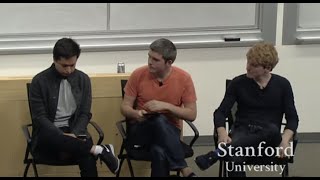
Panel discussion where founders (Patrick, John, and a third speaker) reflect on hiring their first ~10 employees. They emphasize selecting people who fit culturally: hardworking, high-integrity, low-ego, creative/quirky, and intrinsically motivated to build rather than join for pay or prestige. They describe recruiting from personal networks, favoring early-career or undervalued candidates, and valuing people who complete projects and obsess over tiny details.
Chapters
So one thing that a lot of speakers in this class have touched on is how hiring those first 10 employees, if you don't get that right, the company basically will never recover. But no one's talked about how to do that. So what have the three of you looked for when you've hired these initial employees to get the culture of the company right? How have you found them, and what have you looked for? Sure. So I guess this answer is different for every company, and I'll say for us, it was very inductive. So I literally looked for people that I wanted to work with and that I thought were talented. I think I've read all these books about culture, because when I don't know how to do something, I first go read things, and everyone has all these frameworks. And I think one big misconception that someone said once is that people think culture is like architecture when it's a lot more like gardening. You plant some seeds, and then you pull out weeds that aren't working, and they sort of expand. So when we first hired people, we hired people that were like ourselves. And I often looked at, like, three or four different things that I really valued in people. I looked for people that worked hard and seemed high integrity and low ego. I looked for people that were creative, and that usually meant they were really curious and they had all these different interests. Some of our first employees are probably some of the quirkiest people I've ever met. They were engineers, but they also had all these crazy hobbies. Like, one guy had made his own board game with this elaborate set of rules. Another guy was really into magic tricks, and he had coded not only this magic trick on the iPhone, but he had shot the production video in the preview. And I think that that quirkiness has actually been a little bit of a calling card. And we find that really creative, quirky. People that are excited about many disciplines and are extraordinary at one tend to build really great products, and they tend to be great at collaborating. And the last thing is, we really looked for people that wanted to. They just wanted to build something great, and they weren't arrogant about it, but they just felt like it'd be really cool to take a risk and build something bigger than themselves. And that, at the beginning, is very, very easy to select for if you were in our situation. We had this horrible office, like, nobody got paid. And so there was no external reason other than being excited about building something. In fact, there was every reason not to. And that's something looking back, I really, really value because we always knew people were joining for the purest reasons and in fact were willing to forego other great job opportunities. Market salary, a clean office, you know, good equipment, just for the chance to work. So to this day, I think a lot of those traits have been seeded and are embedded in the folks that we look at now.
Yeah, the first 10 hires are really hard because you're making these first 10 hires at a point where no one's heard of this company, no one really wants to work for it. You're just these two weird people working on this weird idea.
Their friends are telling them not to join. For our second employee, I think maybe he accepted the offer or he was just about to and his best friends took him out the night before. It was like a full on assault for why you should not try join this company. Why this is like ruining your life, basically. And so anyway, the guy subsequently continued to join and actually one of those friends also now works at Stripe. But this is what you're up against.
Yeah, and I mean, it's also hard because no batch of 10 people will have as great an influence on the company as those first 10 people. I think everyone's impression of recruiting is you open LinkedIn, it's sort of like ordering off the dollar menu. You're just like, I want that one and that one and that one, and now you have some hires. Whereas, at least for us, it was very much over a very long time period. Talking people we knew or friends of friends into joining. We didn't have huge networks. Patrick and I were both in college at the time, so there were no people that we'd. We'd really worked with to draw on. I. And so a lot of those early stripes were people we had heard of, friends of friends. And the other interesting thing they all had in common is that they were all sort of early in their career or undervalued in some way. Because when you think about it, if someone is a known spectacular quantity, then they're probably working in a job and very happy with that. And so we had to try and find people who were. In the case of our designer that we hired, he was 18 and in high school and in Sweden at the time. In the case of our cto, he was in college at the time. A lot of these people, they were early on in their careers. And the only way we could. You can relax when constrained. You can relax the fact that they're talented or relax that it's apparent that they're talented and not consciously, but we relax the latter.
Yeah. I think finding the people who are, I guess you have to kind of think like a value investor, right? You're looking for the human capital that's significant, undervalued by the market. You probably shouldn't look to hire your brilliant friends at Facebook and Google or whatever because they're already discovered. If they're willing to join, that's great, but they're probably harder to convince. John and I spent a little while yesterday afternoon trying to figure out in retrospect, what kind of traits our first 10 or so people had in common that we thought were significant. And in general, speaking about culture, I sort of want to caveat everything we say with Paul Bucha, I think said that advice is very limited experience wildly over extrapolated. And I think there's a lot of truth to that. But for our particular first 10 people, the things we sort of figured out that seemed to be important were they're also very genuine and straight. I think that actually matters quite a lot in that sort of. There are people that, that others want to work with. They're people that others trust. They sort of have an intellectual honesty in how they approach problems and so forth. They were people who really liked getting things finished. There's a lot of people who are really excited about tons of things. Only a subset of those are actually excited about completing things. There's a lot of talk about, for example, hiring people off their GitHub resumes or whatever. I actually think that doesn't quite ring kind of correct to me in the sense that that places a large premium on sort of lots of different things. I think it's actually a priori, sort of much more interesting to work with someone who has spent two years really investing in going deep in a particular area. And then the third trait that they all seem to have in common is they just sort of cared a great deal. Like it was offensive to them when something was just a little bit off. And again, in hindsight, there are all these crazy things we used to do that, I mean, do in fact seem crazy. Like we probably shouldn't have done them. But everyone was almost like, well, borderline insane in how much they cared about tiny details. Like we used to. Every single API request that ever generated an error went to all of our inboxes and phoned all of us because it seemed terrible to ever have an error that didn't go and get a resolution from the user standpoint. Or we used to copy everyone else on every outgoing email and we'd point out slight grammar or spelling mistakes to each other because it'd be terrible to ever send an email with a spelling mistake. So, anyway, those were the three traits we came up with anyway. Genuine, caring a great deal and. Sorry, what was my second one?
The other one?
Yes, Sorry, yes. Completing things like list of three items.
Yeah, I mean, only to say I just don't think there's any wrong place to find people. So when I look back at our first few folks that we hired, they came from all over the place. Like, I put up ads on Craigslist. I went to random tech talks. We met people at bar. We used to throw weekly barbecues at the office. It was like, bring your own. Like, bring your own food and drinks. And then we would just talk to folks. I think every time I ever went and got coffee in Palo Alto, like one of you guys was recruiting at Koopa because their office was like, strategically situated next to the best coffee shop. But I think that the really good people generally, they're generally doing something else. And so you have to go seek them out rather than expecting that they're going to seek you out triple. So when no one's ever heard of or is using the product that you're working on.