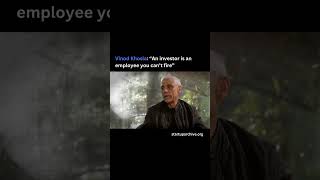
Short interview excerpt (YouTube) where Vinod Khosla advises founders on selecting investors for disruptive, long-lived companies. He emphasizes that capital is less important than the investor’s advice, tolerance for setbacks, and alignment with the company’s vision; recommends speaking with other founders who experienced setbacks to judge investors; and frames an investor as 'an employee you can't fire.' Khosla also encourages ambitious founders and stresses the need for clear step‑1/2/3 plans that reveal and address risks.
You've talked a lot about how to pick your employees, your team members. I think it's almost as important to pick your investor as well. So how do you advise founders if they're trying to build a significant company that's going to do something very disruptive, be around for decades, how should they think about their investors?
So I think every piece of equity you do, the money you get is the smaller part of what you get. Advice and the right approach is the much more important part. A simple thing. There's investors who are happy with three times their money, in fact want to sell as soon as they can and make 3x4x. And people who care about your vision, or people who understand the technological approach you're taking and will be much more tolerant as things go wrong. So those are the factors I suggest people optimize for.
And how do you tell. How do you know if an investor truly cares about your vision?
Talk to other founders, especially founders who've gone through a large promise, large vision, and had hiccups along the way. When things go wrong along an ambitious path is when you can actually judge an investor. I think an investor is an employee who you can't fire and that's how you should think about it. Otherwise, all the same principles apply. I get very frustrated with investors because they mostly detract from value. Most investors are negative value add to a company that's trying to be ambitious. If they're just trying to get to liquidity as soon as possible, then there's plenty of investors who do that.
Well, have you had founders who come pitch you and you say that's too ambitious?
I've never had that happen. I have had the following conversation. That's ambitious. That's awesome. Build a team for it. Now, what is step one, two and three? And let's be thoughtful about how you discover the risks on the path to the vision. Because frankly, achieving a large vision is first about discovering what's hard, what the problems are, what else influences success along that path. Once you've found the problem, which you can only discover by doing things, then you can.
The only recipe I've ever seen work for making really impactful companies is both a giant vision and a good step 1, 2 and 3. You have to have both and neither without the other will work.