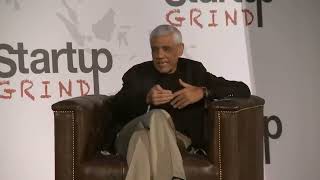
Vinod Khosla advises entrepreneurs to be "obstinate about your vision" but flexible about tactics, treating progress as a sequence of experiments that validate assumptions and build resources. He calls this approach "flexi planning": set a long-term vision but plan and test assumptions over short horizons (3–6 months), establish a "basecamp" (stable, learning stage, ideally cash-flow neutral) that helps you scope the path to the larger goal, and avoid overfunding or committing to a single high-risk plan.
Chapters
I like to say be obstinate about your vision, but be really flexible about your tactics. What that means is it's important to have a vision of where you're trying to go. How you get there is a series of experiments. Now, you can call them failures when they don't work, but they're learning experiments where you try things, see what works, try the next thing. What entrepreneurs do, and it's a factual reasoning. They have a big vision, but they don't try and get there in one leap. What they try to do is see where they are, what resources they have. And it may be nothing except their college money. You take a step in the right direction so you can garner more resources. Try the next experiment, the next step. It may fail or succeed. You may get more resources. You may not try something new. You try and garner resources for the next step every step. Not do the whole thing in one step. That's very high risk. And this is why I actually believe people who raise too much money get too much confidence in their own plan, which is normally bs. I say the right way to do a business plan is flexi planning, which is have a vision, but plan the next three to six months. Test every assumption you have. So realizing a business plan is about testing every assumption, even if you're sure it's true. Test it if you can, in the marketplace in running an experiment. Another analogy I use, which I think is very, very important for people who are just starting out, you want to shoot for Mount Everest, but nobody ever got to Mount Everest without getting to base camp first. You build a basecamp of a stable place where you've learned a lot, where you can tread water for a while, rest up, build a business. Maybe you get to cash flow, break even at basecamp, but you want to set up basecamp where it helps you scope out the path to Mount Everest. That's the whole point. Again, I riff on VCs. My problem is in the process of trying to get a cash flow neutral company or something. Basecamp. They don't worry about that particular basecamp being on the path to Mount Everest, helping you reduce your risk for the big climb. They'll set it up anywhere and then it doesn't help you get to the big vision. So these are nuanced trade offs you make all the time.