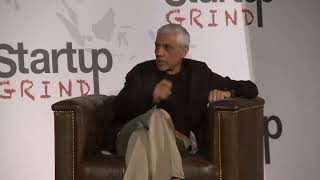
Vinod Khosla argues that willingness to fail is essential for achieving extraordinary success. He distinguishes 'smart failure'—small, bounded experiments where loss is limited (about 10–20% of burn) but the upside can be 10x–100x—from 'dumb failure' that risks killing a company. Khosla criticizes risk-averse strategies (including some VC/board pressures) that seek low-risk, inconsequential success and emphasizes that taking risks plus luck enabled his successes.
Questions this video answers
About 10–20% of your burn (not ~80%).
Chapters
There's smart failure and dumb failure. Okay, so let me be clear. Smart failure is when you take risks where if you lose something and when you win much more, so you win 10x or 100x what's also important, and this part gets forgotten about smart failure is you never want to fail in a way that kills your company. Sometimes you have to do it. But mostly failures should be learning experiments where failing at it is say 10, 20% of your burn, not 80% of your burn. And failing at it still gives you a chance to try something new. Failure is a way to learn. Not that failure is a good thing, it's not. But not being willing to fail means generally that you'll not take any risks, you won't do anything new and innovative. And if you don't do something new and innovative, you're doing what everybody else is. To do something exceptional, you have to do something out of the ordinary. And that usually means risk. If you're doing the ordinary stuff, the low risk stuff, you're doing what everybody else knows how to do and will do. The way I put it, I'd rather have a high probability of failure and a large consequence of success than reduce risk to the point where my probability of success is high and the consequences of success are inconsequential. And I think that happens in a lot of startup companies, especially with boards. And you've seen me riff on VCs in general. They try and get early revenue or reduce risk to the point where if you succeed, it's inconsequential success. You're not doing something big or consequential. So as much as you want to try and not fail without being willing to fail, you're not going to succeed in a big way because you're not going to take big risks. And the definition of risk is taking failure. My personal view is my willingness to fail is entirely responsible for my success. It enabled my success. My willingness to take risks that others wouldn't is what made me successful. That plus a lot of luck. So we shouldn't forget many of you are really good, tried really hard, and just get a few lucky breaks and you're successful and a bad breaks and you're unsuccessful. That's why I say you can try again.