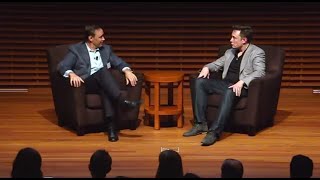
Larry Page said he'd leave his money to Elon Musk if he got hit by a bus, impressed by Musk's mission to get humanity off oil and colonize other planets. The speakers argue that purpose-driven companies like Tesla inspire employees and customers, and outperform their peers.
Chapters
I want to share a little story that leads to a question along a different angle. I don't think you've heard this before, but I find it fascinating. I was at a lunch at a Google event and out of the blue, with no expectation this would be a topic, Larry Page turned to me, knowing a little bit about our connections. He goes, you know, if I were to get hit by a bus today, I should leave all of it to Elon Musk.
Really?
Yeah.
He said that?
Yeah, he loves that.
He's a good friend of mine. I met Larry before he got venture funding.
Yeah, well, he's a remarkable guy, obviously also an underachiever and you know, has a company that wants to do good in the world. Right. And I think he looks at you with a bit of envy because what he then proceeded to say was, you know, I could give my money to a non profit and a lot less would get done than a corporation that's pursuing things that are directly aligned with things I care about, like getting off of oil and colonizing other planets. He believes in those missions and thinks that a corporation with endowed with the right to do that as his business purpose is the best vehicle out there and wishes he could do more of that in his own life. He compared poignantly, I think, to some other software companies in the Pacific Northwest who might have executives who do evil for the first part of the career, then do good for the second half. And then the sad story of others who never get to the second half of their life, like Steve Jobs. I mean, not in a joking way, I mean seriously. And it was a very deep moment. So it raises the question of a purpose driven business. So you've heard already that Tesla is not just trying to make money. That is not the parody. In fact, if you read the most recent shareholder letter that says profits are not.
In fact, I started off the shareholder letter saying the profits are not our primary goal. And then I got a little bit of some of the board members who questioned that statement. It's not that I think they're unimportant or anything, it's just not the primary goal. I actually told people that on IPO as well. And so it's not like new information. Amazing. The stock went up after that.
I think there's a profound reason. I mean, you see the benefits of being focused on something that's a higher calling as your primary motivation. Your employees love it, customers love it, and you feel better about your job. The interesting thing, the irony perhaps, is that at least within our portfolio, the companies that have that kind of a founding principle actually make more profit and grow their revenue more quickly than the ones that don't. It's this low sample set, but the handful that have taken this bold of a step to say, no, no, we will not make that our number one priority actually do a great job. I'm curious if that thought occurred to you that oh, yeah, the profits will come or yeah, we have to generate.
Enough cash flow to fund future developments, which requires having a good gross margin. And so I guess one could just say, okay, well, we're going to stop developing new products and then you would be really profitable. So at any given point you could sort of say we could be profitable at this point in a significant way. But we've got these great things that we want to develop for the future and they're a good investment and that's what we're doing.