Hacking your fears of the unknown | Mamoon Hamid | TEDxPurdueU
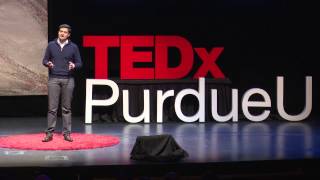
Mamoon Hamid moved from dreaming of space exploration to venture capital focused on social impact. He invests in companies like Neurotrack for Alzheimer's detection and Gluco for glucose monitoring, arguing that embracing risk and curiosity leads to unexpected rewards. He urges people to reclaim the fearless curiosity they had at seven.
Chapters
[FOREIGN LANGUAGE] Have you ever wondered what it's like to feel weightless? To be completely alive and free? That's how astronauts must feel like in outer space. Can you imagine that initial moment when you realize that gravity is no longer weighing you down? That realization that there are no boundaries as far as your eyes can see? That you are the only one experiencing this vast space, the luminescent stars, the blues and greens of the Earth, the shadowed craters of the Moon, and the scary and unknown black of the galaxy. Think about that for a moment. And then you realize you have to go number 2 in your spacesuit. What buzzkill! So let me bring you back down to Earth. How many of you wanted to be astronauts growing up? For me, it was the biggest dream I could wrap my head around. What wasn't cool about blasting off into outer space? Everything was. That's me. Let me take you to January 28th, 1986. I was 7 years old, a 3rd grader at the American School in Frankfurt, Germany. I just spent the day talking about, but mostly dreaming about, the launch of the Challenger mission. Right here. This was the mission. My very own science teacher almost got to go up in the spacecraft. It was like the Super Bowl with my science teacher as the quarterback, the starting quarterback. Yeah, that's how cool it was for me. So just as I got home, I grabbed my grilled cheese sandwich, turned the TV on, to watch this special event. But as some of you may recall, this event tragically only lasted for 73 seconds. The shuttle blew up in midair, immediately killing all 7 of my heroes. How could this have happened? How could these astronauts have died? They were supposed to explore the unknowns of the Earth. They were supposed to make discoveries. This was completely shocking to my 7-year-old self, and really to the entire world. I spent the next week sad and confused. But then I realized that these 7 were on a mission, and they didn't let their fear come in the way of what they set out to accomplish. If everyone on Earth became so scared and paralyzed by these tragic events, How would a new generation of astronauts be inspired to go into outer space? In that moment, I said, "I'm going to be brave and not let my fears supersede my curiosity of the unknown." I studied and researched what it took to become an astronaut. I found out that there was this university in America called Purdue, that— right here. Yeah, that graduated more astronauts than anywhere else in the world. My path to space had to have Purdue on it, of course. If it was good enough for Neil Armstrong, the first man on the moon, it was certainly good enough for Mamoon Hamid. My journey to Purdue was amazing. I arrived on a shuttle. That's me. The shuttle called Lafayette Limo. Yep. Yep, that was me. My space suit, loose khaki pants, white polo shirt. Payload, very heavy. Two Samsonite suitcases, you know, full of clothes, a calculator, compass, and of course my tattered map of outer space. I was 16 years old, 5'8", pudgy, and on a mission. Purdue was like an unknown galaxy to me. I was naive and a bit nervous. The view outside of my spaceship was that— I mean, my apartment— was that of a monstrosity, Ross-Ade Football Stadium. Rowdy and loud during games and silent and serene like outer space at all other times. I'd arrived. I was ready to explore. And explore I did. On my journey, I discovered the transistor. In EE 255, I learned about this fundamental building block that was the atomic unit for every single modern electronics device. Fascinating. How could a thing so tiny do so much? When combined with others like it. I learned how to build my first computer, brick by brick, transistor by transistor. I was in awe, and this quickly became my new calling. Although my initial aspiration was to be an astronaut, I now embraced the transistor and where it could take me. From something so vast to something so minute, Looking back, I was fascinated by space because it was the opportunity to explore the unknown and go into the future. When I encountered the transistor, I felt the exact same way again. It was like a spaceship into the future whose potential was yet to be discovered. So, for the second time in my life, I fell in love with possibilities. I felt like a child again. Children tend to embrace what excites them and what makes them feel alive. Sometimes I watch my 2-year-old daughter playing in our garden. The way that she connects with the dirt, letting it run through her fingers, getting her fingernails dirty, running through the grass, chasing birds, picking flowers, skipping on rocks, and sometimes even eating insects. She's unafraid of letting the day pass her by or even getting hurt. All she seeks is excitement. She's living in the moment. She's engaging all of her 5 senses until she's completely exhausted. This raw, childish wonder, innocence, and energy is enviable. Children aren't bogged down by the practicalities of life. They feel with their hearts, and they act with raw emotion. I think we all start out like this. But as we grow older, we start thinking about practicalities, about logistics, about how our choices fill into the constructs of our lives. With all the structure and predictability, we lose our fervor for feeling alive. So at the end of the day, you have to ask yourself, "What makes you feel alive?" What fills your lungs with air, your heart with blood, your brain with dopamine, and your soul with vigor? So, like a child, I embraced every unknown door on my path. Some of you may think that I stumbled upon my career by chance, but I have to stress to you today that every decision in life, no matter how, how big or small, unveils a different set of opportunities. Your path is determined by every left or right in every fork in the road, and taking risks is part of that journey. That's part of the fun. So, who would have thought that a pudgy little German-Pakistani boy who dreamt of being an astronaut would come to America, fall in love with a transistor, and then eventually become a venture capitalist in Silicon Valley? I don't know. Yeah. My path involved taking risks. My path involved giving up a lucrative job in a rapidly rising career at a Silicon Valley tech company. It was daunting leaving it all behind, uprooting my life, and going back to grad school in Boston, just so I could open a few new doors. Behind one of those doors was a very low-level, junior-level job at a venture capital firm. I had no idea where it would take me, but I knew it would unveil new forks in the road. I had no idea I'd be any good at this job, but I was going to be my 7-year-old self again. When it comes to life decisions and career decisions, we tend to become very predictable, and we look at the unknowns and we dwell on them. So rather than looking at what stimulates and really what excites us, If Mark Zuckerberg never dropped out of Harvard to start a small social network, then this world would be less connected today. But he left the security and comfort of a Harvard degree to follow his conviction and explore the unknown. So, some people may think, that investing millions in unproven ideas based on a PowerPoint pitch is irresponsible and risky. But what if taking risks was like taking a walk in the park? A walk in the park can actually seem risky if you think you'll get stung by the bee or get a splinter in your finger by sitting on the wooden bench or trip on the loose gravel and break your ankle. But as humans, we find ways to deflect the bee and watch for that splinter, and also just properly plant our foot. We find ways to minimize risk in our day-to-day lives, to the point we're no longer afraid to take action. So here I am today, taking risks to solve some of society's greatest problems. This wasn't my goal. This wasn't even my dream. But it became a possibility through the different forks I traveled down. What a blessing to end up in a career where I can give back, but also achieve and, and feel intellectual contentment. Within venture capital, my goal is not only to make some of the best investments, of course, but really it's to change the status quo in areas like healthcare and education. Because a healthy, more educated world leads to a better, more peaceful world, of course. In fact, I don't even call myself a venture capitalist. I call myself a social capitalist. Someone who deploys capital and technology to fuel social change. My goal is for everyone to have the latest technology regardless of socioeconomic status and geography. So let me talk about a few real-life examples of companies that I've invested in. Neurotrack detects early onset Alzheimer's disease with a computer, computer vision test. Anyone with a computer can take this test. Gluco helps diabetics manage their disease with a small hardware device that connects their glucose meter to their smartphone, where the data is charted and logged so that they can track it themselves, but also so that they can share it with their doctor and their loved ones. Anyone with a glucose meter and a smartphone can use this. InstaEDU connects students all over the world with a tutor on demand. Calc exam anyone on Monday? InstaEDU. Need ongoing help with organic chemistry? InstaEDU can help 24/7 for 50 cents a minute. There are many more examples of companies that I work with that are helping us live healthier, happier, and better lives. I feel alive doing this, completely weightless and free. There are no boundaries as far as my eyes can see. I love bringing technology in its most practical form to people, distilling complex concepts into simple applications. It makes the most of the doors that I've opened, the forks I've traveled down, and the challenges I've embraced. What makes you feel alive? Maybe the answer lies in what your 7-year-old self would do. The doors you will open, the new things you will learn, and the risks you will take, because you are fearless. This is how I challenge myself every day, and this is my challenge to you. Thank you. Mamoon Hamid.
More from Mamoon
#37: AI, Venture Capital, Faith & The Future of Work with Mamoon Hamid (Kleiner Perkins)
The Next Generation of Software | Mamoon Hamid, Partner at Kleiner Perkins | Ep. 16
Mamoon Hamid: AI - Where Value Accrues, Startups vs Incumbents & Scaling Laws | E1217