Ultimate Guide to Enterprise Planning (2026)
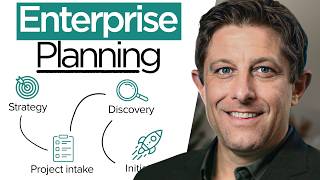
Marc Chabot, CEO of FourSequels, explains why enterprise planning has failed for decades and how agentic AI can fix it. The core problems: lack of ownership, treating planning as a one-time event, sequential handoffs that lose context, and hidden costs that emerge during execution. Only autonomous, goal-driven AI can run continuous planning, keep stakeholders engaged, and output execution-ready work.
Chapters
Every enterprise in the world plans projects, strategy sessions, intake meetings, discovery workshops, kickoff after kickoff, hundreds of projects, to thousands of initiatives every year. And yet ask 5 leaders in any organization who actually owns the planning process and you'll get 5 different answers. Executives own strategy, business side owns the problem, IT owns the execution, the PMO tries to connect the dots, and between all those handoffs, projects simply fall apart. That's why enterprise planning has been the weakest link in every organization, and most people don't even realize it. I'm Marc Chabot, CEO of FourSequels, and I've spent my career in enterprise technology. Today, I want to give you the complete guide to enterprise planning. What it actually is, why it's been broken for decades, and what's finally changing. Let's get into it. What enterprise planning actually is. Most people think enterprise planning is a single process. It's not. Planning in an enterprise is actually a fragmented set of partially overlapping processes. Every stakeholder has a different definition of what it means, different terminology, different scope, different success criteria. And every single one of these is a different handoff, a different type of documentation, different set of assumptions. So let me break it down what planning actually covers across the full lifecycle, because once you see it laid out, you'll understand why it's so hard. Starts with business strategy and portfolio planning. This is where you answer the question, what should we work on and why? You're looking at a portfolio of potential projects across your enterprise, prioritizing them, aligning budgets, and figuring out which ideas are actually worth pursuing across several hundred potential projects. Then you move to project intake, which is about framing each individual opportunity. Is it worth our time and resources? What's the cost, the risk, the feasibility? What's the potential impact? What are the gaps? Then project discovery, and the key question here is, do we actually understand the problem well enough to proceed? This is where you're defining the real problem, mapping stakeholders, collaborating across teams, identifying requirements, confirming alignment, and figuring out constraints before you commit. And finally, project Initiation and pre-kickoff is where you're making sure the project charter, the detailed requirements, the resource plans, the vendor contracts, the approvals, all of it's generally ready before execution starts. Now here's what makes this so complex. Look at how many people are involved. In strategy alone, you've got executive leadership, business unit leaders, strategy teams, finance, enterprise architecture, project management organization leadership. By By the time you get through discovery initiation, you've added business stakeholders, product owners, solution architects, technical SMEs, security, compliance, legal, change management, operations, vendor management, procurement. Dozens of stakeholders interact with any single idea across the lifecycle. And the reality is stakeholders enter and exit continuously. Information is distributed and usually only partially communicated and context gets lost between every phase. No single human being can hold it all together. It's just inherently too complex. Why enterprise planning fails. So knowing all that, why does it actually break? I think there are a few core reasons that are worth understanding because these are the same patterns I've seen play out over and over throughout my career. The first is no one owns planning end to end. Planning spans strategy, finance, PMO, product, IT, legal, procurement, delivery, operations. Each function owns their slice, uses their own language, and optimizes for their own local outcomes, not necessarily what's best for the whole organization or other groups in the organization. And you simply can't fix a problem that nobody owns. The second is that planning gets treated as a phase instead of a system. Organizations think of planning as what happens before the real work starts. You do your planning, you hand it off, you move on. But every idea is different. Every stakeholder you need to Every business case is different. So feedback from any one stakeholder can change literally everything in the plan. When you treat something this dynamic as a one-time phase, it becomes static and brittle the moment anything changes. And that's a big problem. The third is the handoff problem. The whole process runs on sequential handoffs. One team does their piece, passes it to the next, and walks away. Every handoff loses context. Why was the decision made? What were the trade-offs? What assumptions were we operating under? By the time you get to the last team, get to execution, half the people in the room don't have the memory to understand why a certain direction was chosen. And that's where things start to unravel. How many stakeholders completely miss a critical change? How did that change impact upstream and downstream dependencies? Does anyone know? Were all the dots connected or was this all bypassed? And then the problem resurfaces in execution or on rollout. Here's a real example of what it looks like. Your project team in discovery spends 3 weeks figuring out that a certain vendor can't meet a compliance standard. That finding lives in a meeting note or Slack threads or in someone's brain. It's not an issue for a limited pilot, so the team sprints past this requirement. 6 months later, it's time to scale the deployment and legal flags the issue and blocks the project. Now you're 6 months into execution, the project's stuck, you're back at square one trying to regain confidence and support and also find a scalable solution. And the fourth reason, and this is the big one, is that the cost of planning failure is always hidden. Planning failures almost never show up as planning failures. They show up as execution problems, delays, rework, budget overruns, scope creep, burned-out teams. Those are the symptoms. But the root cause is almost always upstream. Poor problem definition, missing stakeholders, unclear requirements, late discovery of constraints, and unresolved gaps. And rarely do these symptoms get pushed back to actually change the planning process because by that point everything's too fragmented, too many balls in the air. So the same patterns just repeat themselves project after project. Now before I get into what's actually changing, if you're watching this and thinking, this is exactly what's happening in my organization, I built a platform called Forest Equals specifically to fix this. It's enterprise grade, it's free to try. So go to the link in the description and take it for a spin. Now back to the video. What's changing today? So here's what's different now. For decades, technology could handle tasks, but it couldn't reason. It couldn't hold context across multiple stakeholders, and it couldn't ask intelligent follow-up questions all by itself. Planning requires judgment under uncertain conditions, and software just wasn't smart enough to handle that. That's changed, and I think the most important thing to understand right now is the difference between two types of AI, because most organizations are stuck on the wrong one. The first type is generative AI, and this is what most people are using today. GenAI helps with individual tasks. It drafts requirements, it creates summaries, it writes documentations. You go to it, you prompt it, it gives you a response. It's reactive. It's like giving every project manager a faster pen. You can write things quicker, but the process itself doesn't change. You still have to prompt the, the GenAI system to take action. Planning might be faster, with GenAI, but it's still fragmented, still human dependent, and the handoff problems are still there. The second type is agentic AI, and this is where things get fundamentally different. Instead of helping with tasks, it helps run the process. It operates on its own toward a goal. GenAI doesn't do that. GenAI is— helps within the task. Agentic AI, it asks questions to stakeholders, it identifies who's missing, it maintains memory across the entire project. What was decided, what's still open, what's changed, what needs to be looked at again based on a recent change in context or a new stakeholder's input. It's not sitting there waiting for someone to prompt it. It's actively working to move the plan forward. The way I describe it is GenAI is a tool. Agentic AI is a team of the world's best partnering with your team to accomplish a goal. And this creates an order of magnitude difference. It's not a small improvement. With GenAI, you can draft a plan faster, but a human still has to figure out who's missing, resolve the gap, translate everything into execution systems, and keep the context alive across handoffs. With a Gentec system, the AI defines the problem, maps the stakeholders, prompts the right humans, asks the right follow-up questions, generates the plan, and produces and maintains assets that are actually ready for execution. Planning and execution stop being two disconnected worlds. The way I think about it is a maturity model. Most companies are sitting at what I call GenAI-assisted. They've got AI helping with artifacts and documentation, but Humans are still doing all the coordination, all the translation, all the heavy lifting. The gap between that and using AI actually autonomously to run the planning process is massive. And that's exactly why so many AI initiatives fail. They can get a demo working, but they can't make it work operationally at scale. The organizations that cross this gap are the ones seeing real results. Faster decisions, fewer surprises in execution, and projects that actually land successfully. What modern enterprise planning looks like in practice. So let, let me paint a picture of what this actually looks like when it's working, because I think the concepts make sense in theory, but the real question is what changes day to day? The first big shift is that planning becomes continuous instead of one and done. Instead of doing a big planning push, handing off static documents and hoping for the best, the plan is a living thing that updates as context changes. If new information comes in from one stakeholder, the The plan adapts. If there's a constraint that shifts, the system flags it and adjusts. Portfolio views update in real time rather than waiting for a quarterly review. This is how our tool ForceEagles works. It maintains a shared state of the plan across every stakeholder in every phase of maturity so nothing gets lost between handoffs. All augmented by our AI agents pushing the people to communicate better, to uncover those gaps, and to achieve the goal of the particular plan or project. The second shift is that the right people get involved at the right time automatically. One of the biggest reasons plans fail is because someone critical gets left out until it's too late. In a modern planning system, the AI identifies who should be engaged at each phase— downstream, operational owners, security, compliance, legal— based on the actual context of the project, sends them the right questions at the right time, and it captures their input directly into the plan. This is something you'd see inside Force Equals. The platform asks questions to specific stakeholders and then uses those answers to inform the next question it asks to the next stakeholder. Each round gets smarter because it's building on what has already been learned. The third shift is that you get real requirements. Traditional planning produces vague requirements that get reinterpreted 3 times before anyone starts building. In a modern system, requirements are generated from actual context, the problem definition, the stakeholder input, the constraints, and they evolve as the project evolves. Functional requirements, technical requirements, operational requirements, they're all connected to the decisions that produce them. So there's always a traceable rationale, an owner, a sign-off. The fourth shift is that the handoff to execution actually works. This is where most planning falls apart. You've done all this work and then someone has to manually reenter everything into Jira or Asana or whatever execution system the team uses. You have to hand it off to development. You have to hand it off to procurement. In a modern setup, plans flow directly into these systems, Agile backlogs waterfall milestones, ownership assignments, all of it transfers without reentry and without losing the context of why each task exists. ForceEqual does this all well. It generates execution-ready assets and exports them directly into your work management tools. So delivery, development, all can start with shared understanding rather than rewritten artifacts. And the fifth shift, and this is the one that matters the most long term, is that the role of the PMO evolves. PMOs stop spending their time coordinating, updating spreadsheets, chasing stakeholders, and running status meetings. Instead, they focus on things that actually require human judgment: oversight, governance, decision quality, ethics, making sure the right outcomes are being pursued. The system handles the coordination. The humans handle the leadership of the system, of the Agentic ecosystem. That's the shift in mindset. You're not managing plans anymore. You're leading a planning system. If you want to start moving in this direction, here's what I'd recommend. Pick one project, run it through a modern planning process. Don't try to transform your entire organization overnight. Start rethinking how you measure your project management organization, which means you move away from task completed and hours logged and towards decision quality, alignment speed, execution confidence, and treat the planning as a system, not as a ritual. The enterprises that get this right over the next decade are the ones that will consistently deliver without the chaos, and these same organizations will outpace their competitors into this next evolution of business. So to recap, what's changing now is for the first time we have AI that can actually run the planning process, not just speed up individual tasks, but coordinate stakeholders, maintain context, and produce plans that are actually ready for execution. If you want to see what this looks like, go try Force Equals for free. The link is in the description below. And if you want to see a more in-depth video on how to use AI for enterprise planning, then watch this next video.







