The Complete 5-Step Workflow for Writing 100 World-Class Ads Per Week (Full Masterclass)
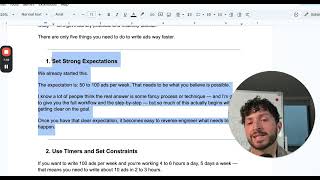
Mario Castelli teaches a five-step workflow to write 100 ads per week: set high expectations, use timers to force speed, embrace failure, allocate time across analysis, ideation, and writing, then execute with AI. The math: 100 ads weekly at modest rates unlocks six figures.
Chapters
In this video, I'm gonna talk about how you can write much better ads much, much faster and why this is so important if you are a creative strategist or if you're, you know, have your own brand and you're doing your creative strategy yourself. This is so, so, so important. This is a topic that many people struggle with. I know that inside of our community we have, you know, 400+ creative strategists and marketers and D2C brand owners. And this is a topic that continues to come up time and time again, so much so that we've done big breakdowns on speeding up this process and making sure people have a solid workflow that allows them again to write world-class ads much faster. Anyone with AI could write bullshit ads as fast as you want, hundreds and thousands of ads, but getting really big, like really important winning ads and doing it in a, in a timely manner and doing it in a fast way is a little bit trickier. And this is what I'm going to do inside this video, show you everything I have, all of the secret sauce. Okay. First thing is I wanna touch on why this matters more than you think. Obviously, if you're clicking on this video, you already care about writing ads. Uh, faster, but I want to reinforce and reemphasize that because once you understand the value of speed when it comes to writing ads, especially as a creative strategist, I think you're going to be that much more motivated to actually put into practice everything that I'm going to share with you on here. So when it comes to creative strategy, there's so much demand in the market right now that most people don't have that much trouble getting clients or even raising their prices. As long as you have some semblance of a brain and some semblance of a work ethic, Honestly, people are not struggling that much getting clients, at least the people who are in my community. They're not struggling that much with it. The real bottleneck is writing ads fast enough. Most of my, my members, they reach a point where they can't take on more clients, they can't do more work, so they need to focus on, you know, getting bonus deals and retainer structures or replacing their clients, which is all well and good. That's what I think you should be doing. However, the bottlenecks that they're running into is just managing clients. So they're actually churning clients, and this is a great place to be in the market because You'd much rather be in a place where there's more demand for the role than an overabundance of supply. But what really happens when you dig underneath the surface is that people are overediting, procrastinating, or just taking way too long even when they're using AI. Okay, so I'm going to show you the exact same process you can use to write ads a lot faster. In fact, I just clarified that in just a minute before this call. I got a message from someone in our community says I got a super sick ad script without writing it. Monday call was fucking awesome. Took me a while to get the hang of the workflow. It took me a couple of hours to set everything up. And get all the ideas and hooks. But after that, amazing. Thank you. Incredible. Now I can do 10%, 80%, 10%. Now you might not understand what it means to write a sick ad script without writing it, or 10%, 80%, 10%, but you will at the end of this video when we go through it. Okay? But this is just a little bit of validation that the call that I literally did earlier on writing this faster is exactly what I'm gonna be telling you inside of here. And this is inside of our private membership group. Okay? The other important thing is that understanding a little bit of creative strategist math. Okay. And just give me 1 minute because this is going to really reinforce, uh, you watching and putting this call into practice before we jump into the actual tactics. So the creative strategist role right now is about 80, about 90% writing ads. That's mostly what people are doing. Okay. I think that'll eventually change in the future, but for right now it's writing ads. And the most common arrangement is typically to write 5 to 10 ads per week for a client. Sometimes it's more, sometimes it's less, but typically the job is just about writing ads in the 5 to 10 ads per week range. This means you can simplify things really quickly. Your success as a creative strategist, in other words, how much money you earn, is a direct correlation to two things: how much you charge per ad and how many ads you can write per week. That's it. A lot of people charge $50 on the low end to about $250 on the top end. And some of my best students are at that top range. And of course, there are bonus structures, rev share, and things like that on top. And if you actually start to look and do the math, most people don't ever really run the numbers like this. You can see what you can expect to make weekly or monthly if you're doing charging this per month or doing this many ads per week. Again, I want to be very clear, this is not a promise of what anyone here watching this video could possibly do, right? The only reason I'm sharing this is just to show you basic ass math. If you multiply this times this, this is just a times table, okay? Not a promise of what you can do. However, if you could theoretically and possibly, and again, in some cases unlikely, but this is up to you. If you could do $50, $75, $100, $150, $200, $250, I have students who are charging this per ad. I have students who are more in this range and the average is typically around this range for the students that I have. And then you can see if you're writing 10 ads per week, 20 ads, 30 ads, 50 ads, 100 ads, you can see about what you would make weekly or monthly if you had those arrangements set up. And like I said, most of the creative strategist arrangements, um, follow in doing an X number of ads per week. So you can see, right, if you did 10 ads per week, $250, that's $10,000 per month. Or let's say that you do $50 per ad and you're able to do 50 ads per week, that's also $10,000 a month. So you can see the different ways that you stack these. And it makes it really, really clear for you because as long as you continue to raise this price and find clients willing to pay you, and as long as you continue to open up this bottleneck, the more money that you can make. So getting to a place where you can charge $250 is challenging, but it's definitely not impossible. I have students who do it. Getting to a point where you can write 30 or 50 or 100 ads per week is also challenging, but it's 100% possible. That's what I'm going to show you in this video because there's only 3 bottlenecks that are going to stop you. It's how much do you charge per ad, which is what we already just talked about. It's how many clients can you land, which we have videos on this channel that will help you to do it. And there's so much demand, it's actually not that hard. And the last bottleneck is how many ads can you actually write per week, right? So this is the bottleneck that this video is addressing. To open this up in here to get you to a point where you can write at least 50 to 100 ads per week. Okay? That is the baseline. I want all of my Genesis members to be able to hit 50 ads per week, world-class ads, right? And the ideal is I want them to hit 100 ads per week. This sounds crazy to most people. Most people probably can't even handle 30 ads per week, but we have high standards inside of our program. And so I believe that everyone is capable of doing 50 to 100 world-class ads per week. Especially using the workflow that I'm showing you on here. And in fact, I'm just going to show you basic math to show you how you can do this. Because if you can write 10 ads in a 2 to 3 hour sprint, which to me is conservative, 2 to 3 hours to write 10 ads. And if you just work 4 to 6 hours per day, that means you should be able to write about 20 ads per day. If you work 5 days a week, that's 100 ads. That's not even working weekends and it's not even a full workday. It's 4 to 6 hours per week. And to be honest, I think it is very possible to get 10 ads down to about 60 to 90 minutes, world-class ads. Again, this is a stretch and I like it because I like to challenge my people to be the best. But writing 100 ads per week, not that challenging, right? Not that challenging. And you can see just up here, if you can do 100 ads per week, even if you're charging $50 per ad, you're already at a nice little monthly, monthly income. And the cool thing is this is the variable that you control to some degree, right? A lot of times you have to negotiate with somebody to raise your rates. And to be fair, you do need to negotiate with somebody who's going to be willing to pay you and, and actually be able to find enough clients to write 100 ads per week. But in general, what I'm finding is most people are blocking themselves because they don't know how to get to this point. So they're actually their own limiter, which is great because you don't have to ask permission for anyone else. You just need to watch this video and put it into practice. Okay? Hopefully what I'm saying is making sense and you understand why I'm actually sharing all this before we jump into the tactics, because I really want to cement how important important this is because once you have this part done, then you're going to be way more motivated to actually put everything I'm saying into action. Okay? So let's get very practical and insanely tactical, right? I'm separating those two things because the first things I'm going to tell you are the actual most important practical things that are probably blocking you from writing ads. And we're going to round it out with very specific SOP step-by-step tactical stuff. Okay? So the first practical thing you need to do is to set strong expectations, which by the way, we've already covered this. A strong expectation is just you're setting the floor of what you believe is possible. So if I'm telling you 50 to 100 ads per week is the norm and 50 is the very bottom and baseline of what you should be able to do, you already now have a clear goal in mind of what you need to do. The only way you're going to write ads faster is by holding yourself to a higher standard. And we've already done that. Okay. The next thing that you need to do is you need to use timers and set constraints. So like I said, if you want to write 100 ads per week and you're working 4 to 6 hours a day, 5 days a week, you need to write about 10 ads in 2 to 3 hours. And honestly, you should try to push it down to 1 to 2 hours. So I'm gonna set the goal at 2 hours to write 10 different ads. You should basically set a timer and make it your goal to write 10 ads in 2 hours. Okay, now this gives you a little bit of buffer and a little bit of room, but it also shows you, you know, there's the principle that basically however much time that you give for a task is how much time it's going to take. If you give yourself 2 hours to write these ads and you're actually hardcore and disciplined with yourself and you say, hey, I whatever ads I write in these 2 hours are the ads I have to ship, then you will continue to get better and learn to be faster. That's basically it. So set the timer and set the constraints because the extra work you're doing, the overthinking, procrastination, avoiding the most important steps, doing work, uh, like doing busy work that moves, uh, nothing forward, that all comes because you don't have real constraints that clarifies the bullshit. So if all you did was understand the pace you should be working at and then act accordingly, that could be this entire video. And you would get amazing value from it because so much of this is actually just mental. So set a timer and use constraints. Again, we have our clear, strong expectation of what's possible. We've broken down the math so we know exactly what the goal is— 2 hours to write 10 different ads, which is both conservative, doable, and gives us enough buffer. The next thing is you need to get comfortable with failure. Again, I know this doesn't seem like it's tactical, but it's insanely practical because one of the reasons why people spend so much time perfecting their ads— I know because I used to be like this. Is because most of the time they're doing it for psychological safety. So what this means is they think that if the ad has to be perfect, then I need to overanalyze and rework it and rework it and rework it. And oftentimes they're not actually making it better. In some cases they're actually making it worse, and in many cases they're not really moving the needle at all. The reason they're doing this is not necessarily to make the ad better, but to give themselves a form of psychological safety because people are so terrified of a client being mad that that the ad is not that good or the ad not actually working and being a failure that they just try to overcompensate for it. But the reality is if you're writing ads, which is creative strategists, like maybe 10 to 20% of what you write will actually perform. I'd say 20% is a pretty good range. This will vary from account to account, but this basically means that failure is the rule and not the exception. You are going to absolutely fail. And the way that you actually get better comes from reps. This is what I found. It doesn't come from like trying to perfect the same ad over and over again. It comes from doing 100 different ads and spending a little bit of time trying to perfect each one. That's it. So if you actually want to get better and develop your intuition, it's gonna come from reps. So spending more time perfecting one ad is actually slowing down your rate of progress. So I'd much rather somebody, again, you could just speed through 100 ads and actually never learn anything. But there is a sweet spot between let me just get tons and tons of reps, let me not overthink it, let me let the market tell me what to do, let me get feedback faster, let me fail faster, and let me be comfortable with failure and comfortable with people being mad or even not thinking the ads are good so I continue to move faster. I promise you that this is one of the most important things on here. Get comfortable with failure because this is going to eliminate so much of the needless busy work that most people are doing. So hopefully by now you have an idea of what is possible, what your expectations should be and how to actually start to get there by eliminating your fear or trying to at least get comfortable with failure and then using timers and constraints. Okay, the next one is to get clear on your workflow. If you don't have a clearly defined workflow, you're gonna bounce around from task to task. You're not really going to execute each one of those things appropriately. You're gonna lose a lot of time and a lot of mental energy and bandwidth doing task switching, and you're just gonna kind of like spin your wheels a lot. So you wanna have a really, really clear workflow and a linear process that goes step by step. Everyone's process is different. If you have a process that works for you, awesome, right? So you should already be writing ads faster and writing 100 ads per week. If it's working for you, sayonara. If it's not, let me propose to you the workflow that I think is the simplest, which basically goes analysis, ideation, and writing. If you're a creative strategist, the first thing you're gonna do is look inside the ad account or wherever it is that you have your metrics. You're gonna analyze the past winning ads or the past ads that have some traction or losing ads. You're gonna develop your ideas based on that. So spend a lot of time doing ideation and then you're gonna move into the actual writing phase, okay? Now what I found, and I referenced this earlier, is that most people have these numbers completely backwards, right? Most people spend maybe 30% of their time in analysis or 40 to 60% of their time writing. If in the age of AI, if you're spending 40 to 60% of your time writing, you're missing. Missing the point. In fact, I think this is kind of almost the sweet spot here, right? Maybe I would say 20% analysis, 70% ideation, and 10% writing. This to me is basically the sweet spot. So I spend 20% of my time analyzing the past performers, 70% of my time on the ideation, which includes the hooks, and I have videos on my channels around writing vicious hooks. So focusing on the ideation and only 10% of my time writing. In fact, many of the ads I write, I just write 'em and I hardly even read them. I just kind of edit them and I'm like, all right, it looks good enough. I really edit my hook and I really edit the opening of my ad, but I spend so much of my time getting the ideation done right that that means I can come pop out the writing really fast. Okay, so people are spending 40 to 50% of their time on here, which is just completely stupid when you have AI that can write better than most people, right? The writing is mostly solved, especially if tools and workflows and processes like we have inside of Genesis, Of course, it makes it way easier and these ads actually sound amazing, right? Better, better than what I could write, better than what almost any other human could write. So this is the workflow that you wanna go for. If you're doing a 3-hour sprint, that's roughly 30 to 40 minutes on analysis, about 100 minutes on ideation, and about 30 to 40 minutes on writing. Again, just adjust these percentages based on the time that you're doing it. The most important part is that most of your time should be spent on ideation because the quality of your ideas and especially how you express that idea in the hook in the opening line is the most important part of your ads. The writing itself, AI handles that really well right now. Sometimes you don't even need to edit it or just make minor tweaks, okay? So you need to get clear on your workflow that you're going from analysis to ideation to writing, and this is the buckets of time of what you should be spending on each, okay? So now we're gonna go tactical into the actual workflow. Hopefully this makes sense because honestly, this is the most important stuff. This is the stuff that actually holds people back. They think they need tactics, but it's really this stuff that's holding people back. So I'm giving you that. But let's go clear into the actual tactical workflow. Okay, so we summarize all these. So first one, you wanna do analysis, it's about 20% of your time. So what you're gonna do is you're gonna go directly into Facebook, not the ad library. Typically you're gonna have access to Facebook and you're gonna go and you're gonna look at whatever reporting tool that you're doing. What I like to do is I look to look at all of the top spenders, right, within the ad account. Typically the top spenders are gonna be in there for a long time. So, I like to look at the top spenders and I like to go and look at new emerging ads. So, depending on how your ad account is set up, typically you're gonna have top spenders and there's not always gonna be new top spenders, but you wanna look at, you know, the top 20, top 30 that are still spending and still turned on and analyze those. And then you also wanna look at new ads that are recently launched that show signs of life. Every, you know, account's gonna be different, so you need to define what the KPIs are to determine whether it has signs of life. But you want to be looking at that too, because that's going to give you early signals of stuff that's working. And the purpose of this right here is twofold. So one is what I like to do, and there's other ways to automate this, but I like to literally physically copy either the transcript from the video or the ad itself and just put it into a Google Doc. And I typically always have a Google Doc with all of the top winning ads that historically have worked, as well as sort of ads with traction that are well written that seem to have some ideas in them. And then I'm reading these ads and I'm doing a couple things. So like I said, the first thing is I'm actually collecting the ad and the data, because we're going to use that to do the writing in a little bit later. So that's the physical process. The other one is I'm saturating my brain with material about these ads, because it's my belief that like the, the other way that you get faster is by making better decisions or faster decisions. And the way you get better is by making better decisions. So better decisions and faster decisions ultimately mean you have more high-performing ads. And the way that you make these decisions is developing your intuition and judgment and taste, which comes from saturating your brain daily inside of the ads that are working. Because you're gonna start to understand patterns, understand what's working, you'll see things differently. And I like to do this almost on a pretty consistent basis. 'Cause every time you do it, you're just training your brain and your intuition and your unconscious to identify and know what kind of ideas are gonna resonate and which ones won't. So I really, really encourage you to do this process. So you're saturating your brain with it. You're fine-tuning your instincts. And you're also consciously looking for patterns that will spark ideas. So you're just doing this analysis, maybe taking some light notes. And again, you're spending 10% to 20% of your time doing this, saturating your brain. Now you're going to move into ideation, which is, again, is about 60% to 70% of your time. This is where the real work happens. So here's how I structure my ideation. The first thing that I do is I define my awareness levels. So let's say for instance that I have 10 ads to write in a single week. Well, what I want to do is I want to define my awareness levels. There are 5 levels of awareness: unaware, problem-aware, solution-aware, product-aware, most aware. I've covered these in other videos and there's a lot of other videos that cover these, so I'm not going to go into them here. But for purposes of me writing ads, I typically just break these down into 2 buckets: unaware and problem-aware style ads, and then solution-aware, product-aware style ads. The reason why is because one, most aware ads typically are just discounts and stuff like that, and I don't really like to bother with those, cuz they're not high-leverage ads, right? Anyone can really do 'em. They're not that hard to do. The other reason is because unaware and problem-aware ads typically have a similar structure, which is important for the process I'm gonna show you. And solution-aware, product-aware ads have a specific kind of structure as well. So I like to kind of separate those two. And all I do is ask myself, how many unaware problem-aware ads do I wanna do? And how many solution-aware product-aware ads do I wanna do? Right? I make that decision. So if I'm writing 10 ads, maybe I'll do 6 that are unaware problem-aware because these typically have, there's more variety and more creativity here. And typically these can scale better. And I'll do maybe 4 that are solution-aware product-aware, or maybe I'll just do 10 that are unaware problem-aware, right? You get to make that judgment for yourself based on what you see missing in the ad account and what you think will work. But that's the first thing that I personally do is define my awareness level. So now I know I need 6 unaware problem-aware ideas and 4 solution-aware product-aware ideas. The next one is then I'm gonna start pulling ideas and I'm pulling ideas from multiple sources. So inside of our program, we use the acronym STORMING for brainstorming to come up with ideas, which means all the sources of ideas that I use are swipes, templates, organic content, research and comments, M for matrix, I for internal vectors, N for new styles, and G for gambits. And I'll explain what each one of those means in just one second so you understand it. But I wanna highlight something really important about the process that I'm showing you. You may have already picked up on this, uh, uh, unconsciously, and this is the reason why this, uh, this process and workflow is so powerful because there's actually two flywheels that are in place when you do this. The first flywheel, which I think is the most important, is that if you follow the structure and workflow I'm showing you, not only are you gonna write, uh, better ads faster, but you're actually gonna become better over time. Because you're— by going through this process, you're going to be exposing yourself to a ton of different ideas. You're going to be exposing yourself to the winning ideas that are working in your specific ad account, which I've already covered. And you're going to be paying attention to what's working in other sort of competitor niches and other sort of just like in general other DTC brands or direct response brands as well. So every time that you go through this process, not only are you writing ads faster, but you're actually getting better as a creative strategist and understanding your specific market. Which is just gonna make you go faster and increase your intuition and judgment. This is the reason why I like to do this because no matter how good your AI tools are, as long as they're still tools, then it's basically you need an operator. So it's how good of an operator and how good the tool is. We have the best tools, I believe, inside of Genesis. Like I know for a fact we have the best tools when it comes to create a strategy. And we also teach you how to refine and really fix your own instincts because then you become a great operator who uses these tools And that's where the magic happens, okay? The next flywheel is that you're actually building a stronger ad account by doing this. This one's gonna be a little harder to explain, but I'm gonna do my best. So the way I typically see accounts start to grow and scale is that it all starts with a new idea, which oftentimes is a long-form ad or a text-based ad with a static image. It could be a video, whatever it is, but it's just a brand new idea. And then what happens is once you get an idea that has subtraction, typically you start to optimize it. This means that you start to optimize the copy and the creative. So you test different styles of creative. You turn statics into videos, you try different spokespeople, you test the hook, you do different variations, you try different formats, and maybe you start to optimize and work on the copy. And then eventually, once you have copy and creative and a pairing that really works, then you start to build congruent funnels around it. So you have advertorials or quiz funnels or whatever else that are congruent with that specific copy and creative combination. And this is how you scale an entire concept. And once you have a bunch of these concepts that are scaling, so copy plus creative plus congruent funnel, that's the entire concept. Now, once you have a bunch of those scaling, you have these pillars inside of your ad account that support it for a lot of, lot of scale. Okay? So everything in here starts with new ideas that have a high probability of success. A winning ad account starts with new ideas that have a high probability of success. And the best way to ensure that you're getting fresh, high-quality ideas is by using a variety of different sources. This is why I teach my students to pull from these 8 different sources, because if they only— if you're only using one source or just using AI in general, typically you're gonna keep returning to the same ideas over and over and over again, which means you're never really gonna get a new fresh idea that could bloom and blossom into a winning pillar inside of your ad account. So I wanna diversify my sources to diversify my thinking and the types of ideas that I'm testing inside the ad account. Hopefully what I'm saying makes sense. I know it's a little bit more advanced or theoretical, but, uh, it's very, very powerful. Again, when you're forced to pull from different sources using this process, you end up with higher variety of ideas, which kickstarts both flywheels. It's a little nerdy, but it matters. All right. So with that little break, let's go down into each source. So S is for swipes, which means you look at competitors and big direct response brands and you swipe their ads. It's pretty simple. That's it. I think of this as Mad Libs. Go and look at winning ads that are direct competitors and winning ads in adjacent niches that are, have strong direct response principles, and then you just swipe that same idea for your ad. You should always be doing this. It's a very, very powerful process. The next one is templates, which means you have a proven list of high-converting ad templates like paradoxical question openers, quiz openers, things like this. We have a ton of these inside of Genesis. In fact, we have a bot based on 75 of the highest performing ad templates, and it'll basically adapt it for every single market. And you can just pull any ideas from these and boom, it's done. The other one I really like is organic, which means you have a separate Instagram or TikTok account where you basically cooked your algorithm so it shows you content that would be attractive and interesting to your target market. You go and you find the best hooks that are on there that are viral outliers, and then you repurpose those viral outliers into ads. The next one is research slash comments, right? So research can be forums or anything else like that. The one that I like to do is to actually go into the ads our own as well as competitors. And I like to read the comments because typically people will paste things in there that are high signal and you'll see a lot of engagement. You'll see like 20 people reacted to this comment, which shows that people in your target market are interested in this idea and you can repurpose that idea into a new ad. And I've seen those be very successful. M is for matrix, which I'm actually not gonna cover in this video. You can just ignore it for now. I is for internal vectors. This is probably one of my, the most important ones. It is one of my favorites, but it's, actually the most important one. This is just a fancy way of saying you're looking for the patterns inside of your winning ads and losing ones too. You're using AI in your own brain just by dumping in, hey, here are the winning ads, what are the patterns? Give me new ideas. And you're going back and forth with AI. If you just rely on AI to do the pattern detection for you, it's typically only gonna find the same ideas over and over again. But if you have AI do it and then you also give your feedback based on your trained intuition and your sort of like more, discursive, out-of-the-box thinking, typically that combination there is gonna give AI a seed of new ideas and AI will come up with a lot of new other things. So that combination is powerful. The other one you wanna look for is new styles. There are typically always new styles that are emerging, especially because of AI has made production of creative and video so much easier. People are being, you know, experimental. So animation stick figures or Pixar-style animations or these sort of like gothic-looking claymation videos that I've seen recently. Right? So anytime there's a new style that's emerging, you can say, oh, let's test a style like that because it's getting people's attention, right? Little vegetables cleaning the inside of the organs, right? Or the cheating apples and bananas that I see all over Instagram right now. So you just copy those styles and then you adapt, you create a piece of copy that is adaptable to that style, if this makes sense in here. The other one is gambits. This is basically just wildcard ads where you kind of sit down and you try to figure out like what idea could this be? I think your hit rate is gonna be a little lower with just wildcard ideas that you pull out of thin air. However, if you go through this process because we have this first flywheel that's making you better, by the time you get ready to just come up with your own ideas, your own ideas are probably gonna be a lot better. Okay, and I encourage you to do this 'cause it's gonna continue to make you sharp. So now, next thing you do is you put your ideation together. So like I said, you decide on your awareness levels, then you go through the storming process. And you're basically trying to come up with a bunch of different ideas that could fit the types of ideas that you need. Remember, we said we needed 6 unaware, problem-aware, and 4 solution-aware, product-aware. So if you're writing 10 ads, you should honestly have 20 to 30 really strong ideas just by spending maybe 30 minutes to an hour going through this process. Okay? And that means you almost have a month's worth of ideation in a single sitting. And you could do this every single time you sit down to write for an ad or a client. Or just come up with 30, 40 ads and just do that for the whole month, right, which makes this process way easier and actually you can write ads way, way faster. Alright, so I like to mix and match some of these different ones on here. The ones that are most important to me are internal vectors, right, which are looking for winning patterns. Research and comments is really important. Organic is really important. And then I would say swipes are really important. If you just were to do any of these, you could just do S-O-R-I, sorry, And those to me are going to be the best ones. Maybe there's another— trying to see if there's another acronym that I could put on here. Regardless, if you just do these 4 at a minimum, I like to do all of them, but if you do these 4 at a minimum, you know you're diversifying your sources, which means you're diversifying your ideas, which means you have a higher likelihood of really getting your ad account to be better. Okay, so then what you do is you just put your ideation together. What I like to do is just create maybe a one-paragraph brief that describes the idea. If I have a really good hook in mind, I'll put a hook in there. If I'm swiping from organic content, I like to take the exact verbatim hook that they have. But basically, I'm just taking my ideas and all of my thoughts about those ideas and putting it in one single place. And from here, we actually go into the writing, which is really, really easy. Inside of our program, we have a writing process that uses our Genesis bots, tools that we developed over the last 3 years, trained on all of our winning concepts. And we pair these tools with agents like Cloud Code and OpenClaw that can use these bots along with different workflows to spit out ads really fast, pretty much in one shot. So it's gotten to a point now where once I have my ideas and honestly it can do the ideation too, I just say, hey, write these ads and it writes these ads like perfectly in a single click of a button. But you can modify this and do it manually and it's still very, very fast. So the first thing is you start with your raw idea, which we already covered. The next thing you do is you get your hook dialed in. This is probably the most important insight that I have. Which is get your hook dialed in first. Then you get your body copy because once you get your hook dialed in, the body copy naturally sort of flows from it. I find AI does a good job, but AI struggles coming up with the hook and then trying to do the hook and the body copy all at once. Then you do your headlines and then you make your creative. So like I said, the hook is everything. AI struggles with hooks. Hooks are kind of intuitive and they're hard to teach. I have a video on this channel that will help you to do it. But once you get the hook right, AI does a pretty solid job with the rest. So the hook is about 70 to 80% of your writing effort. So what you need to set this up is you need a list of all your winning hooks. You need a list of all your winning ads, and you need a list of all your winning headlines. So a list of winning hooks is literally just the first 1 to 2 lines. Okay, so to generate your hook, I start with Claude, typically Sonnet or Opus, whatever the newest model is. I take my winning list of hooks plus my raw idea. I throw them into Claude and say, give me hooks like these based on the idea. Give me 10 to 20 different options. We have specialized prompts and bots that dial up the quality of the outputs. But even if you just do this regular AI, you get pretty good results. Maybe the first round isn't perfect, but you might see something in hook number 3 and hook number 7, for instance, that you like. So you say, give me more like number 3 and number 7. Then you say, okay, modify it like this. And maybe you do some manual editing, but eventually you'll come up with a really good hook. The next thing you do is you go back into Claude, you put in the winning hook you figured out, plus your raw idea again and your examples of winning ads. Remember I said you have to have a list of winning ads and you say, write me an ad that starts with this hook based on these winning examples. Again, our bots and agents make this even better, but you'll still get strong results just doing this. Then you do generate your headlines. Go back into Claude with your list of winning headlines, your hook, and now your body copy. You say, here are my winning headlines, here's my ad, give me different headline options. Choose the ones you like and you're done. That's the process. The majority of your writing time is spent on the hook. The body copy, if you do this process, you don't really need to edit it that much. AI does a pretty good job. It's not going to make grammatical mistakes or anything like that. Okay. Our bots and agents do this pretty much with the click of a button. but this process is good. Uh, we'll talk about creative separately, probably in another video. Uh, but this is the majority of the actual writing the ad that is really, really powerful. So just to summarize, the first thing you need to do is set your expectations that you should be able to do 50 to 100 ads per week. That's the standard and the floor. 2, you wanna use timers and constraints. So 2 to 3 hours to write 10 ads and try to push that even lower. 3, get comfortable with failure because it's inevitably gonna happen. 4, get clear in your workflow. So analysis, ideation, and writing. I would basically kind of adjust this even to 20, 70, 10. And 5, you wanna follow the actual process. So, uh, analysis, which is reviewing the top-performing ads, ideation, which is defining your awareness levels and pulling ideas using the storming framework. And 3, writing, having your winning hooks, ads, and headlines ready, generating your hooks first, and then you are done. So that's my entire process to go a lot faster. I hope this video was helpful. Let me know in the comments below if it was helpful, any questions that you have and other types of videos that you would like to see, and I'll see you in the next video. Peace.
More from Mario


easiest way to make $30k/mo as a creative strategist (I’ve helped 100’s of people)

how to write hooks so dangerous you break people's brains (4-step "deep fry" process)



The Complete Creative Strategist Pricing Guide for 2026 (Every Deal Structure I've Seen)


this copy instinct framework makes you a monster at ads (nobody teaches this) pt. 1


why "insight vectors" are the most valuable marketing concept of 2026 (I didn't want to share this)