The Simplest Client-Getting Strategy You're Probably Ignoring (For Creative Strategists)
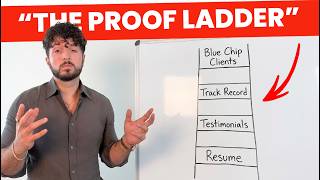
Luke Iha breaks client acquisition into one formula: conversion rate times outreach volume. Proof dominates your conversion rate at 80-90%, so he maps a seven-rung ladder from resume to blue-chip clients, with time-boxed actions for each. Most freelancers skip asking for testimonials because they're afraid to ask.
Chapters
In this video, I want to talk about the number one thing that you should be doing if you want to get clients as a creative strategist or as a copywriter or as a marketer, pretty much as a freelancer in general. This is the number one most important thing I know from working with hundreds, uh, you know, hundreds if not thousands of different creative strategists and copywriters over the years. This is the number one thing I've hired many copywriters and creative strategists. This is still the number one thing I talk to business owners all the time. This is the number one thing to focus on. Uh, you can see I call it the ladder of proof. Uh, we'll explain it a little bit more what's in here. But again, the purpose of this video is very, very simple. Most of the things that are actually going to bring you success in life, in business, as a creative strategist are actually the most simple direct things. In fact, they're basically common sense. And if you were to advise somebody else outside of yourself on what to focus on and just give them one thing to do, you would probably have the answer for them. The problem is when you're in the middle of things, we want to avoid hard things or uncomfortable things, or at least things that seem hard and uncomfortable. We want to avoid it. So we make up tricks in our minds that there's some other sort of tactic or strategy or loophole. And, you know, sometimes there are, sometimes there are little loopholes and little slides and little tunnels you can take to move forward in life. But in general, the path typically requires hard work, and hard is uncomfortable in the sense that it's difficult to actually do it, but also hard psychologically because it's a little unfamiliar. And so what I found is the most direct, simple path is usually the best. Why am I saying all this? I'm saying all this because I know that when it comes to getting clients, obviously you've seen the title of this video and seen this headline here. Proof, which is what we'll talk about in this video, is the number one most important thing that's going to allow you to get more clients. And if you just heard that and you're like, all right, I already know this, I'm going to tune off on the video, that's okay. But I promise the way that I'm going to approach this is going to be very different. And my objective in this video is to simplify and just really convince you of this one specific thing so you can ignore 99% of all of the noise that is out there and focus on the one thing that's actually gonna move the needle. Because when you get that clarity and you know, okay, I only need to focus on this one thing, you will be shocked and amazed how fast— days, weeks, maybe a couple weeks— if you really commit. And only a few percentage of you are gonna commit, like 5% at most. I could hope maybe 1% watching this video will really understand what I'm saying and commit. But those who do, I promise you're going to get insane results if you just focus on doing one thing for the next 2 to 3 weeks and actually move the needle and make progress. Okay, so what am I talking about here? I'm talking about proof, specifically this ladder of proof, and I'm going to cover all of these concepts on here. And this is really the number one thing. It's the blocker keeping you from getting clients, and it's the number one thing that will help you get clients. Okay, so I'm going to break it down first. If you don't know who I am, my name is Luke Iha. I run a program called Genesis. We have over 400 marketers. Including creative strategists and D2C brands that hire tons of creative strategists. I also run private mentorship cohorts where I help people scale to $15,000 and $20,000 a month as creative strategists. Some of our best students are hitting $30,000 and $40,000 a month. We've been pretty successful. You can pause this video and see some of the results. People spending using our AI tools, $3 million on ads. This person going from $12K to $106K. This person getting an offer for a 6-figure offer. This person going from $2,000 a month to $14,000 a month. Here's somebody who hit $37,000 per month. Here's people who are winning with our AI tools. Here's somebody from Uganda who made $11,000 a month from one single client, and so on and so forth. Editorials, etc. At the same time, I also work as a creative strategist for an 8-figure brand. These are my editorials and some of the ads that I wrote. I'm in a bunch of different masterminds where I talk to people all the time, and I personally have sold over $200 million with my own copy. This is a text from Stan Stefan Georgi, one of my old business partners, talking about how one of my VSLs alone hit $100 million, and there's other ones on there as well. My only point into saying all this is one, so you know who I am, but also to say that I have my finger on the pulse of what works pretty much at all times. I don't know if there's anyone who interacts with creative strategists in terms of the brands that are hiring them, the individuals who are doing the work, and also having the track record myself and doing the work than I do. And so the things that I'm talking about in here are not theoretical. These are based on, like, what has come up over and over and over again on my mentorship calls, in our community, all the time, in my own experience. This is the most important thing in the world. Like I said, success is simple, but it's hard. And many times, it's so subconscious that it's painfully obvious once someone else points it out. Right? The hard part is that we want to avoid the hard stuff. It's not that you don't know. You would 100% know if someone clarified it for you. It's that this thing is hard, so you subconsciously suppress it. I see it time and time again. So if you really take this message to heart and actually commit to doing the hard thing, you have infinitely more success. Okay? So what am I talking about here? Well, the first thing you need to understand is there is a formula for getting clients, and it is ridiculously simple. Okay? It comes down to this. How many clients you get is equal to your conversion percentage times your OU, which basically translates to what is your conversion rate times your outreach units. How many times do you go and you do outreach, whether on Upwork, on LinkedIn, on cold email, on sending lumpy mail or DMs? How many outreach units do you do? The next factor is what is your conversion rate, right? How good are you at converting those together? Every single person that I work with struggles with one of these two things. That's it. 99% of people have no volume. They have really inconsistent expectations on what it takes to actually get clients. They think I'll just send out 5 proposals or something like that. You're never gonna win like that. You need to consistently be doing anywhere from 5 to 10 pieces of outreach per day. And I would basically divide those across Upwork, LinkedIn, and cold email, with Upwork and LinkedIn being the best places right now to get clients. It's really quite simple. So if I were in this, in your, in your shoes, if you wanna get clients as a creative strategist, make your LinkedIn profile really good, make your Upwork profile really good, and do 10 pieces of outreach on those job platforms every single day. There are more advanced tactics. You can do things like cold email and sending mail, but honestly, I found that just doing it on there is plenty. It's more than enough, right? As long as you're baking in things like referrals, et cetera. And everything else I'm gonna talk about on here. So assuming that you're actually doing 5 to 10 consistently per week, which is hard, like most people will hear that and be like, oh, I could do that, I could do that. But very few people can actually do that consistently. Every time I talk to a freelancer or a creative strategist, I'm like, how much outreach do you do? And they're like, oh, I do like 2, you know, I did 10 every single day. And I'm like, all right, pull up your Upwork so I can see, and, or pull up your LinkedIn or show me the proof. And it's always like 2 or 3 every other day. So they're completely lying to themselves. So volume is always the first variable to solve. Assuming that you have this variable solved and you want to increase the efficiency of your outreach or you're still kind of stuck, the next part you want to focus on is your conversion rate. And your conversion rate is made up of 3 different things. It's how you position yourself times what kind of offers are you making times your proof. And by far, 80 to 90% of this depends on your proof. And we're gonna be talking about the proof, specifically the 7 types of proof how you can stack those together and really effective simple techniques to get all those pieces of proof as fast as possible. Okay. So positioning is basically the story you tell yourself, what clients think of you, et cetera. Then you have your offer, which is how you structure your offer. Again, as marketers, we're familiar with things like webinars, free content like this, low-ticket products, tripwire products, moving into high-ticket upsells, things like that. We understand there's a psychology for how people like to buy and go down the buyer's journey. And yet when we sell our own services, we don't treat it that way. We just say, oh, I'm here to do whatever you want. I'm here to just do retainers. Versus making deals of, hey, doing free work for somebody, doing work that's kind of cheap, what I call an entry offer, but allows you to kind of get a relationship with a client, et cetera. I'm not going into those too much because they are effective and really important. But again, the most important is, is proof. And my only goal, like I said, my only objective for this video is to impress on you how important proof is. And that is probably the only thing that's holding you back, assuming that you're doing volume. Okay, so let's go into that. Hopefully this makes sense. There's a formula to get clients. It's your conversion percentage times your outreach units. You always need to be doing your volume no matter what, but conversion percentage is basically made up of your proof, your offer, and your positioning. And by far, proof is the most important. Okay, so let's talk about proof. There is something that I call the ladder of proof. The ladder of proof. All right, and all it is is basically saying that there are good— there's like Okay forms of proof, good forms of proof, great forms of proof, and the best forms of proof. And your job, if you want to get more clients, is to rapidly ascend and get every single type of proof. Like it's a video game, check it off the box as fast as possible and then watch the floodgates open. Those clients who are getting $30,000, $40,000, uh, per month as a creative strategist, they literally have more offers than they can deal with every single day. Some of these individuals will message me literally today. Someone messaged me and they were like, Oh, I just got an offer. It's $12K a month. I don't know if I should. I don't know if I can do it. What do you think? Should I do it? Should I not do it? Right. Probably a day's worth of work as well. It's, it's really freaking insane, right? So once you master this proof, people start coming to you and you get insane amounts of inbound. So this is the only thing you should be optimizing for. Only thing. And like I said, if you're smart and you really care and you really actually are committed to your own success, you could do this in about 2 to 3 weeks. I'm almost guaranteed. That may seem impossible and it may seem like kind of a stretch goal, but if you put that in your mind, chances are you'll be able to hit it. So let me break it down a little bit more. So the harder your proof is to fake, the more valuable it is. Most people struggle to get clients even though they do outreach, and it's because why would anyone believe you? You don't have anything to back up what you're saying. This is the fucking common sense part, right? It's like you're asking people to hire you, but like you don't believe people without proof. So you're asking people to believe you without proof, right? It's just dumb. You need to give people a reason to believe. For most freelancers, the number one bottleneck is proof. Not tactics, not weird hacks, just proof. Stop trying to get around it. Stop skirting around it with tricks. Get proof. Your proof is coupled to your skill. There are ways to fake it short-term, but getting really good and getting hard-to-fake proof is the cheat code to getting infinite clients whenever you want. It's really that simple. So the counter, you know, the counter or the thing that's kind of unspoken here is that you should actually be getting good. So volume brings skill, and then skill brings your proof, and then proof brings your leverage. Okay, however, some people are actually really good. They develop their skill, but they suck at getting proof, right? Other people just get more and more proof and their skill doesn't really catch up. And to be honest, those people still make good money. They usually make more money, right? And skill is not even the most important factor for getting clients. It's proof. However, the best way to get proof is to also be good. So hopefully I'm making sense there. And then like I said, there is a proof ladder, right? And there's 7 different types of proof. These right here on the bottom are the easiest to fake, and these up here are the hardest to fake, which is why they're the most valuable. The first one is a resume. Anyone can make a resume, right? Bare minimum table stakes. You should close this video and make a resume right away. How do I make a resume? Go type in Google, what does a resume look like? Resume creative strategist. I mean, there's tons of resources in our program, but just do that. Ask AI, find me some resources. Go search, find me what it looks like. Make your resume. Take the stuff that you have that is as smart as possible. If you were, for example, an engineer, right? Or I was an SAT tutor when I started. Anything that makes you sound smart, anything that makes you sound interesting, anything that's gonna make me think, okay, I, this guy is the X guy, right? This guy is the SAT tutor guy. This guy is the engineer from, you know, Texas guy, whatever it is, build your resume based on that. The next thing you wanna do is you wanna build samples. Anyone can build samples. It's free. Go find some brands that are doing direct response, find them, go look on Facebook ad library and then make your own AI ads. Okay, or just your regular ads. Spend some time building your portfolio and your samples. You don't need a bunch. You need maybe, I would say like 3 to 5 different brands, like 3 to 5 ads per each. Maybe you have a VSL in there, maybe you do an advertorial, whatever. If you have access to the bots that we have inside of Genesis, literally cake. Like it's literally press buttons and soon you don't even have to press buttons. You're gonna talk to an AI agent and it will do it all for you. However, making these samples, done. Like this two things right here should be done in about 1 to 2 hours. 1 to 2 hours. It could be done whenever you're watching this by the end of day today. Move. Next thing is certifications. This is an added credibility layer. Certifications are not the end-all be-all. Some people just collect certifications like certification junkies. However, if you have 3 to 5 different certifications on your Upwork profile, on your LinkedIn profile, it's going to move the needle a little bit because what it demonstrates is, hey, at least this person is committed to their own education. They're diligent enough to go through this process. They recognize that credibility is important, so they're going out of their way to get these certifications. You can literally go and chat to BT or Claude and say, tell me certifications in marketing for creative strategists, for copywriters. Find the ones, find the cheap ones and make it happen. By the way, down in the link below, there's a Copyblocks program that we have. I think it is the best crash course 101 training on copy, and it's one of the best mental models even if you are an advanced copywriter. I really stand by it. It's so simple. And it, I just hear all the time over and over and over again, how much it has helped people improve their skillset. Buy it. By the way, when you buy it, there's a certification on there and it's not a bullshit certification. You actually have to go through a test and get a passing score. And I created the test. I made it intentionally difficult to make sure you understand those concepts, but that's a certification you can get for free. We're also running a free webinar or free training. If you ever see one of our ads, I'll find a way to link it in the future, but there's a certification for just showing up on that, on that one. That one there. And soon we'll do an official creative strategist certification that you can follow. But you don't even need our certifications. I don't care what certifications you get. I'm just saying down below, I think it's $27. Maybe it's an order bump, to be honest, I don't remember. But hey, it's a, you know, a dinner's worth or a meal's worth to get your certification. Boom, you're done. Then go find some other certifications, stack them together. Again, you should be able to do all of this maybe in 1 to 2 days. 1 to 2 days. All right. Now this is the basic stuff, this is the foot in the door, just have it, just have it. 'Cause look, you're already almost halfway there just by having it, okay? Next thing you're gonna do is you're gonna focus on testimonials. This is where we're starting to get some real work going. Now when it comes to testimonials, what you want to do is, again, this is why this is so clear, once you know in your mind, okay, my only goal is to get clients as a creative strategist, My only blocker is to get proof. Therefore, I need to go up the proof ladder. So first thing, I'm only going to focus on my resume. Nothing else until I have it done. Now I'm going to focus on samples. Nothing else until I have it done. Certifications. Nothing else until I have it done. Now you're going to be at testimonials. This is where people start running into their own mental bullshit. Even talented people tell me all the time, and probably some of you watching this, well, I had— they start making dumb excuses. Oh, I had a client. It was like 6 months ago or 5 months ago, and I didn't ask them, and I'm afraid, and they're busy, and— they're this and then that, and it's just you being a pussy, frankly, right? And excuse me if my language is harsh. I'm just using that to make a point, right? You can plug in whatever word you're saying. You're operating out of fear. That's all it is. If it's 6 months ago, just say, hey, I know it's been a while, but I'm coming back and circling back to do my testimonials. And if they don't answer, guess what? Bump again. And if they don't answer, guess what? Bump again. They don't answer, guess what? Bump again. People are like, oh my God, I'm so scared. Like, they're so busy and they're gonna be mad. They're gonna do this. It's like, if you come out like an asshole and you're like, Hey, you didn't answer me. Hey, you didn't answer me. But if you're just a chill person sending a funny meme, sending a GIF, being like, hey, I know you're super busy. I just wanted to bump this. Hey, you know, I'll only message you a couple more times, right? I'm not going to bombard you. Just want to make sure you've seen this. If they get mad at that, that is 100% on them. If you're a sane per— if you're an insane person watching this, ignore this next part. If you are a sane person watching this and somebody is reaching out to ask you a request and doing it in a gentle way, chances are you're not really gonna get mad, right? You might get a little annoyed like, ah, this person keeps kind of bothering me, but you would honestly not feel like you're in a position to get mad at that person. So if that's your own standard for yourself, why would you not hold other people to that standard or let other people off the hook because you think they're busier than you? It's bullshit. Just go and reach out to them, follow up with them, and when they commit, 'cause a lot of times what they'll do is they'll say, yes, I'm ready to do it, and then you'll just let it go to the wasteland. Follow up 3, 4, 5 times. If someone gives their word to something, be, be source for them to follow through and be people of their word. So follow up with them. The other thing to do for testimonials that's really powerful is just make it easy for them. Write the testimonial that you want, figure out the ideal testimonial you want talking about the before state, the after state, the tangible results, success, and what it was like working with you. Write it for them, make it, you know, not too insanely glowing, but exactly what it is that you want. And message them and say, hey, I wrote this testimonial for you. You can edit it, you can do anything you want with it, or if you just like it, you can just give me the okay and I'll run with it. Either way, I just want to kind of do that work for you, right? Very, very, very, very powerful. And if you don't have any clients that you've worked with, go and hustle and find people. Join communities, join groups, be aware, find people for free, find people on Reddit, go on Upwork. I used to go on Upwork and tell people, hey, I'll pay you $50 to work work for you, right? Which seems crazy. I'm not saying you have to do that. You can say, I'll do it for free, I'll do it for whatever. But it's like, I just knew that getting testimonials, I just needed it. So the testimonial was more valuable than their payment, because most of these people, what are they going to pay me? $50 or $15 or $20 or $100 or $200? Like, the people who are actually going to pay me are not going to pay a brand new beginner. So the shitty clients, the earlier clients, right, they can pay me something way more valuable, which is a testimonial. Of my character and how I show up. So whatever you need to do, I don't care. Get creative. I type in AI and say, if everything was possible, right, to the point that I'm gonna go and like knock on somebody's door and, you know, slip a sales letter underneath their door and then sit outside until they gimme a testimonial. Like, get weird and wacky with it, obviously within legal and moral and ethical bounds. But I'm saying think from this wild place of how can I get these testimonials and you'll find it. The next thing that you want to move on to is getting a track record. So testimonials is the first psychological blocker. And the next one, the track record, is another blocker. This one is partly psychological and partly logistical. So what does track record mean? This just means, hey, my ads have spent XYZ dollars. In fact, this is pretty much one of the most important ones. When people are hiring on Upwork or LinkedIn, they're just going to say, hey, show me ads that have spent XYZ numbers of dollars. Now you can get by this, of course, with some of the things that I teach, the advanced strategies. You can definitely get by this, but getting your track record is really, really, really important. Okay, now what are the ways to do this? Again, it's very similar to what I said with testimonials. Once you know that, okay, I got my testimonials, maybe like 3 to 5 or 5 to 10. Now my only goal is track record. You have in your mind, I need to find somebody who's spending money on advertising to run my ads. I need to find somebody who's blah, blah, blah. That's all you're going to think about and focus on. If that's all you're focused on and thinking about, your brain will come up with really cool creative strategies. Sometimes this is working for free, sometimes this is working for cheap. So for example, working with agencies is a great way to get spend on these accounts because typically agencies don't want to hire the best talent. They actually want to hire like people who they can create a margin on, right? So they're not paying the best. So they may not be the best paid roles and it's going to be a lot of work, but you're going to get amazing volume and you're going to get your ads to actually get spend behind them. So some of my students have had this success. They work with agencies, they work with really big brands, they get spend behind their ads, then they use those to pivot and start to do their own work. Really, really powerful in here. Or again, work for free or partner for somebody. And again, free sometimes is costly. If you go to somebody who's actually spending money on ads and you say, hey, run my ads, I wrote them for free and they're shitty ads, you're costing them something, right? They're literally spending money to run those ads. However, if you really spend the time to make your ads good, right, you buy courses and trainings, you get mentorship from types of people, right? You study YouTube videos like this, you really do your best to make solid ads, and then you present them to them, and then you figure out like, you know, ways to kind of talk them through into— I guess it comes down to attitude. So it's like, just because you did something for free doesn't mean that I want it. I did this for free, like run my ads. It's like, no, you're actually still asking me something. You may not feel like you're asking me of something because you did work for me for free, but you're still asking for something from me. So if I were to present some to somebody, I'd be like, hey, I know you're busy, your ads are really awesome, I love this ad, I love that ad, I wrote these types of ads for you, they fill this specific gap. I really— I got them copy-cheefed, I made sure that they were really, really good, I have high conviction that they're gonna work. Of course, I know you may not be able to spend them, but you know, if you're at all interested in them, here it is. It's so easy, I made it so easy for you to just upload them and let them go. Here's the static ad images, here's the headlines, here's the body copy, or I made the video for you, like What do you think? You know, can you, can you run it? That's one way that you can do it. So there's multiple ways to go about this. I can't tell you every single way. You need to be a resourceful person, but getting your track record is really, really key. The next one is case studies. Case studies is what happens when you stack your track records together, right? You have a bunch of winning ads and you're basically telling a story about how you impacted a brand. That's basically it. Then by far, once you kind of have track record, case studies, and testimonials, your only goal should be landing what I call a blue chip client. A blue chip client is basically any client that the industry recognizes. So for example, for D2C e-com brands, they're gonna know big companies like right now, like Rosabella, they might know companies like VShred or Mindvalley. If you're kind of in the coaching, whatever space, um, you might know ones like Spartan Hair or, uh, certain snoring brands, right? If you go to a funneloftheweek.com, I think it's like $17 or $19 a month. And they break down funnels every single week. Just look at all the brands that are on there. The reason why is because most D2C brands are probably following Funnel of the Week or have heard of it. And so they probably heard of the brands that are on there. If you could work for any of the brands that are listed on there, even if it's for a month or whatever, this is one of the most powerful things that you can do. My business partner used to run all the copy for Vistret, which is a $300 million company, right? Uh, or I think that's the most that I know that they made. They might maybe making more. I'm not sure. But he used to write all their copy, he was like their head copywriter there. So whenever he tells someone, oh yeah, I used to work for VShred, they like completely like, whoa, oh my gosh, like they're ready to work with him. Another one of my students, he wrote some ones for Spartan, not this Spartan, this is like Spartan races, but hey, I fucked it up. But he worked for Spartan Hair and he has some of their winning ads. All he has to do is tell a brand, oh yeah, I wrote these ads for this one, they wanna hire him right away. This is by far the most psychologically appealing one because it actually doesn't make the most sense, meaning you could work for a blue chip client for 1 or 2 months, have a couple wins for them or whatever, but simply the, you know, maybe, yeah, maybe a couple wins. And you could also have a track record that is way better, meaning the track record, you have more spend, but it's for lesser known brands. Most companies trying to hire you will be more impressed by the names of who you work for, which is just a psychological weakness of humans. But it's very, very powerful. And so again, you can skip some of these steps, but I recommend just going through the ladder one by one. Makes it very, very simple and it just gives you focus and clarity. Once you have these blue-chip clients and you're stacked all the way to the top, like I said, clients start coming to you more than you'll ever have to deal with. This is all you should be focused on. It is so simple. Like I said, 1, 2, 3 could be done in 1 to 2 days. If you have testimonials or not, I imagine this is anywhere from like a 1 to 7 day process. Okay. If you're starting from complete scratch, it's 7 days. If you have past clients, you can start today and follow up with them within 7 days. Track record, it might take some work. It might take some, a lot of volume and just trying to get someone to give you a shot. This might take anywhere from like 1 to 4 weeks, right? Then from here, both case studies and blue-chip clients again could take you anywhere from 1 to 4 weeks and it could take you longer. But if you stack all that together, that's basically 30 to 90 days to change your life. 30 to 90 days to be making $5,000, $10,000, $20,000, $30,000, $40,000 per month. Not claiming anyone can do that. Those are the outliers. Those are people who worked really, really hard. But I am saying that this is the process that they followed. So again, if you follow the same process, will you get the same results? No. But will your likelihood increase that you might get there? I think so. But you can be the judge of that. Cool. We actually covered a bunch of these already, so I can move through these quite fast. So the takeaway is to remember this formula: clients equal your conversion rate times your outreach units. Volume is almost always the answer, but if you want more efficiency, you need to work on your conversion rate. Your conversion rate is made up of POP, positioning, offer, and proof. And by far, 80% of that is proof, right, or more. There's a ladder to focus on, 7 rungs. Start on the bottom, work your way up to the hard, simple things, get clear on the path, and then move forward. If you want access to this document as like a cheat sheet, you can sign up on my email list below. I'll send you this plus pretty much every other document that I've done from any other video. Down below is also, uh, Copyblocks training where you can get the certification. You can access that. If you join my email list, you'll get, you know, kind of daily teachings and stuff on creative strategy or every other day you'll get things like that. And there's other resources down below. I kind of forgot what some of those things are, but you can check all of that out and happy hunting. I'm looking forward to hearing your success stories in the comments. Put in the comments anything else that you want to see from me. I got a lot of banger videos for you guys, but I want to make this stuff that you guys actually want to know about. Appreciate you. Ciao.
More from Mario


easiest way to make $30k/mo as a creative strategist (I’ve helped 100’s of people)

how to write hooks so dangerous you break people's brains (4-step "deep fry" process)



The Complete Creative Strategist Pricing Guide for 2026 (Every Deal Structure I've Seen)


this copy instinct framework makes you a monster at ads (nobody teaches this) pt. 1


why "insight vectors" are the most valuable marketing concept of 2026 (I didn't want to share this)