In this instructional video, Luke Iha explains how to increase the number of winning ads by horizontally scaling—targeting more distinct personas—rather than merely vertical scaling (adding ad formats). He defines key concepts: a segment (a market slice) and a persona (a named identity for that slice). He introduces a "3D" ODF (Outcomes, Demographics, Facets) model for systematically discovering and describing personas. The model maps primary outcomes (pain points and promises), primary demographics (age, gender, race, etc.), and primary facets (behaviors, beliefs, identities). Luke shows how to populate this model using competitor ad transcripts, comment scraping, Amazon reviews, and AI tools like Claude Code and the Exodus platform. He demonstrates stacking dimensions (e.g., "Black men struggling with weak erections") to create granular personas, and how Exodus’s AI bots can instantly generate creative ideas for each persona. He cautions against over‑targeting and emphasizes using common sense, balancing broad and hyper‑specific ads. The video also mentions his background, the Genesis community, and the Creative Cartel, but the core teaching is the practical 3D ODF framework for horizontal ad scaling.
Chapters
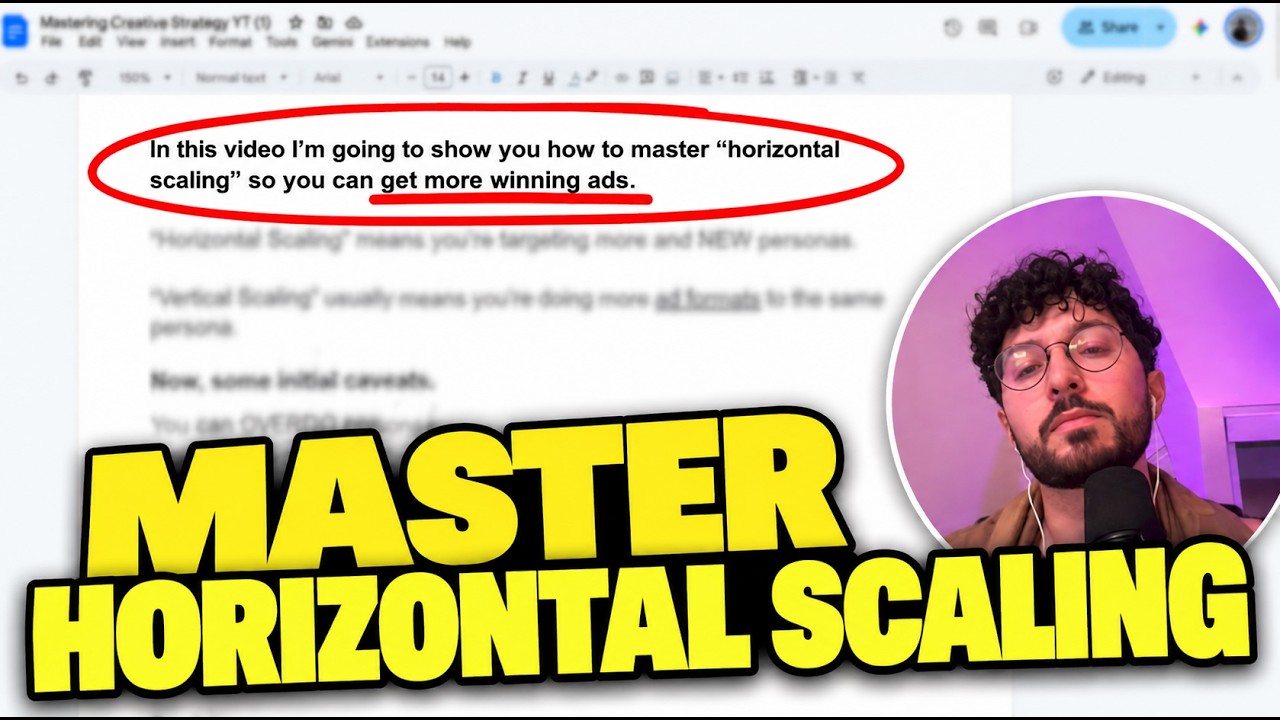
In this video, I'm going to show you some simple ways to master horizontal scaling so you can get more winning ads. And if you don't know what horizontal scaling means, this simply means that you are targeting more personas. So new segments of the market, or you're kind of narrowing down within a segment to get more hyper-specific, which means you're going to get better delivery for your ads and higher conversions. Okay. I'm gonna show you some really simple ways to do it and the model that we teach in our program. If you don't know who I am, my name is Luke Iha. And along with my business partner Mario Castelli, we're both copywriters. We generated well over $100 million each with our copy, and now we have a community with over 460 creative strategists, marketers, and brand owners called Genesis. We help people make winning ads, funnels, and a lot of other things. We also run the Creative Cartel, which is the invite-only membership with creative strategists for eight-nine-figure brands. Some of the brands that you see on here, and here's a bunch of different wins. This needs to be updated because we have a A ton more that I need to add inside of here. Okay, I kept saying that we're not good at updating things, so I decided there's no time like the present and I went and updated some of this. So here we have Raymond, super low spend on here, but basically was able to help him get some winning ads. Ad is the top spender in the account. Top video spent $100,000 in 7 days, should be crossing $10K a month. Spent $130K in the first 9 days, $100K in the first 48 hours, first $100K a week. Timeline spent $45K. How we landed a $20K client, $50K spend in 4 days. And many more. Okay. So we'll continue to update this document and you guys can check this out. It'll be linked somewhere below so you can see if you want to be involved in it. Okay. We cannot promise you will get those results, but you know, other people have had success. That's basically what I'll say. So anyways, we're going to talk about horizontal scaling. Horizontal. Who spelled that? Wow. Horizontal scaling means you're targeting more and more new personas. Vertical scaling means you're doing more ad formats to the same persona. Okay. Now some initial caveats. You can overdo personas and a lot of the top ads do not clearly target one pain point. A lot of them are very broad at especially like top of funnel, unaware story-based ones. Okay. But it's also true that some of the best performing ads, especially in bigger accounts and especially for more like middle-ish of funnel. Um, they come from targeting very specific personas. So in the kind of problem-aware, uh, variety. So you have to walk and chew gum at the same time. Yes, sometimes personas are overemphasized and a distraction. And yes, sometimes broad ads work the best. And yes, sometimes very specific targeting of personas with creative also creates breakthrough winners, especially on big accounts. So don't be dumb and use common sense. This means like just don't, Be a nerd about it. Use the mental framework and model that I'm gonna give you to see if there's good opportunities for like, oh, okay, this is a big segment, we haven't targeted them, let's try that out versus trying to be like too autistic and be like, I gotta target every single segment and subsegment and subsegment, whatever, and do this crazy testing strategy. In general, I found that that does not work. Okay? So use common sense. First, you gotta understand what a persona is. So most people don't really know this or they don't have a good framework. So inside of our world, Genesis, which is, I showed you a bunch of the wins from that, and Exodus, which is a, AI Copilot tool that helps you with creative strategy. It helps people get a lot of these wins. Inside of that, we have these definitions. So a segment is a slice of a market. This could be men over 35, Black women, vegetarians, people who wanna increase libido. A persona is just a name or an identity that you give to the slice of the market to make it easier to talk about and more personable to write to, right? So if you're targeting someone with diabetes, Diabetes Dave, right? Low Libido Lou, Smoker Sam. You don't have to use alliteration. It just is fun, I guess. Okay, that's it. Now, in order to figure out your segments, we use a 3D model, which might sound confusing, but it's stupid simple. All it means is that if you want to find your segments, you have to map the primary outcomes. So these are pain and promises, map the primary demographics, things like gender, race, and age, and map the primary facets, which are things like behaviors, beliefs, identity, things like that. Okay. So for testosterone product, you might have These as the main outcomes: testosterone, weight loss, sexual vitality, energy. These could be things they want, things they want to get away from. Okay, demographics could be who is the buyer, right? What's the gender? What's the age range, right? What's the race? What's the identity? And then a facet, which is really where a lot of opportunity is, is things like what state are they on finasteride? Are they smokers? Are they just divorced, right? Are they faith-based people, right? Gym goers, things like that. You can also get pretty granular. So for outcomes, you can break these down into people who have low T or people who just wanna optimize their T. For weight loss, you could target moves, love handles, puffy face, so different parts of the body. Sexual vitality could be erections specifically or libido. Energy could be about brain fog and focus or about an afternoon crash, okay? Again, use your discretion. A good way to find these is to go look at existing ads from competitors, one. So one, the best way is to take the model, like just literally take the transcript from this video or whatever else you want, throw it into Claude Code or use Exodus because we have this already all built in with all these skill files, whatever. But you just take this video, take the model, talk to AI. AI's pretty smart. It'll fill in the gaps for you. Okay? That's like level layer 1 and then use your judgment to adjust it. Next thing that you can do is you can go and you can scrape competitor ads and actually look at the transcripts and be like, okay, who are they targeting? And you can add that data into the mix. Okay? Next thing you can do is you could actually scrape the comments from yourself or from other, other ads. Comments are a great source of information. There's not really that great way to, to scrape comments except inside of Exodus. And you can take that as data. And another really good, good one is to go to Amazon reviews. So just take Amazon reviews for competitor products, use a tool called like Apify, A-P-I-F-Y, and you can just scrape a bunch of different stuff. Boom. And you can pop it in there and that'll help you to kind of make sure that you're in touch with the data to figure out what outcomes and sub-outcomes people actually have. But in general, using your common sense, trial and error and just using AI will help you get a lot of the way. Okay. Again, when it comes to facets, the most important ones are the state ones, things that are true about them, like habits and beliefs, cigarette smokers, weed smokers, vegetarians on GLP-1. Those are all good examples. Okay. Now what you can do, the reason this is a 3D model is that you can actually stack these together. So what do I mean by that? Well, this is called the ODF model, not OF model, but ODF model, which means you could target black men struggling with weak erections, which would be a demographic. Times a sub-outcome, or women buying gifts for her husband, which is just purely demographic, or men who wanna lose weight, which is an outcome, or older men, which is a demographic who want to lose moobs, sub-outcome, and are chronic smokers, right? Do you wanna get this granular? For some accounts, yeah. For some accounts, I've seen things like this actually work well if you are strategic with it. Okay? Now inside of our app Exodus, which looks like this, you can actually easily create these sub-outcomes. You can do this with Claude Code and then you can select it on here and you can instantly make your persona, which is awesome because now whenever I wanna come into my studio inside of here, which has access to all of our bots, it has access to basically our AI brain teaching all this different stuff. You could come in here and what was that one? I think it was Cortisol Cara. You could come in here, you could use the famous Mario bot or Marcio Narrative Ads bot. You know, give me ideas for this persona. Boom. And now we can start to target ideas for her. Okay. So a lot of things that you could do, and this gives you an idea of how that 3D model, that 3D actually model actually works. Okay. Oops. So you can see how you can stack these things together. Okay. Again, use discretion on which combinations are worth your time. Which is based on signal from all the things that I mentioned. And that's basically how you scale horizontally. Okay. Typically I see facets being underutilized as well as specific demographics like race. Okay. So, you know, black men who are cigarette smokers or black men struggling with whatever, Asian men, you name it. Okay. There's a lot of different things that you can do in there. And typically that's all you need to do. It's quite simple. And I hope you got value from that. Let me know in the comments below what else you want to learn, what you want to see, and I will see you all in the next video. Thank you.