5 Weaknesses of ChatGPT You MUST Know About...
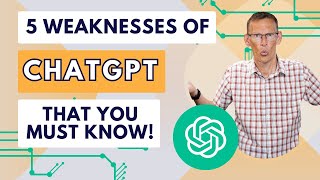
Short video by Mark Wickersham (chartered accountant) outlining five weaknesses of ChatGPT targeted at accountants/bookkeepers. Covered so far: (1) not always accurate/reliable due to human bias in training data and fine-tuning, (2) privacy/confidentiality risks including a March 2023 bug and Italy's April 2023 ban and the later opt-out training setting, (3) limited mathematical/complex-calculation ability (not reliable for tax calculations), and (4) tendency to 'hallucinate'—confidently produce convincing but incorrect answers (illustrated with an itinerary example).
Chapters
Hey. In this video, I'm going to share with you five things, five weaknesses you need to be aware of with ChatGPT. It's an extraordinary tool. It's something that you should be using. It's going to save you hours of time. But first you must be aware of its shortcomings. So let's go look at those five reasons, those five things to be aware of.
Welcome. My name is Mark Wickersham. I'm a chartered accountant. I run the Value Pricing Academy, and I help accountants and bookkeepers all around the world run more successful, more profitable, more enjoyable accounting firms. And in this ChatGPT series, we, we're going to be looking today at what are the five things that we must be aware of when using ChatGPT. We've done other videos on ChatGPT if you've not caught them yet, videos like how to get started with it, the big benefits, why you really must be using it, what it's great at, and also videos on how to use it. But we also need to be aware of its shortcomings. So let's look at those. I'm going to shut share five of the biggest ones, the five that particularly accountants and bookkeepers must be aware of. So number one, the first thing that you must be aware of is it's not always accurate and reliable. It's not always correct. Think of ChatGPT as being your virtual personal assistant. Think of it as being.
Your new employee. And just like with another human, another employee, they sometimes get things wrong. If you think about it, when you hire a brand new, hire somebody in your team and you give them things to do, they don't always get it right every single time. Well, ChatGPT is a little bit like that as well. And the reason for that is largely because of something called human bias. And there are two aspects of human bias in the way that the model was created. So just by way of background, ChatGPT was created by a company called OpenAI, which was founded back in 2015. They've been developing, developing CHAT GPT ever since it went public in November 2022. Since November 2022, there are hundreds of millions of people that now using it to further train the model. And when it was created to build the model, there were really two sides to it. So firstly, it had to be trained in information. The question is, where did that information come from? Where is the information that's inside ChatGPT? Well, it was scraped from the Internet. It came from stuff that's been created, written by humans. And as we Know, when we do searches on more traditional search engines like Google, for example, we know that not everything we read is correct. When we read things like Wikipedia, we hope it's pretty good, but sometimes there are errors because a human wrote it, a human put it in there. And us humans, we are not always correct. So firstly, the source information that ChatGPT was trained on is subject to human bias. It may not be correct. Some of the information, and the second aspect of it is once they'd put in the information, they then had to train.
The algorithms, the software, in how to interact with humans, how to deal with the request and give the answer. And so it had to learn how to interpret what was being asked, to go to its bank of data, and then to figure out how to give an answer. And as the model was being trained.
A human would be saying whether the answer was correct or not. And again, we have human bias because sometimes chatgpt might come up with an answer or which the human says, yep, that's a good answer, that's correct, it might not be correct, they might not know, it may be wrong, and vice versa, of course. So we have those two aspects of human bias that we have to be aware of. And therefore we have to take everything that comes out of ChatGPT with a pinch of salt, just like when we do a Google search and perhaps read someone's blog post. Just because somebody's written a blog post doesn't mean they necessarily know everything. So we need to fact check stuff. We need to make sure that we use it. We use it to assist us, like an employee, we use it to assist us, but we need to double check everything. We have to use our own professional judgment, our knowledge, our skills, our experience to decide if the answer is correct or not.
Second issue to be aware of, and this is particularly important if you're a professional, if you're an accountant or a bookkeeper, then you have to be aware of confidentiality and privacy. So one of the things that when you first set up your account with ChatGPT, it does quite rightly recommend that you do not put any personal information, any confidential information, any information about your client. Because the model is learning. When it was released in November 2022, as people were using it and they were putting information in that was also being submitted to OpenAI to help develop the model. And there was back in March 2023, there was an instance, there was a bug in the software, there was a breach, where what was happening is some people, some users, chats were appearing in other users Chats. So if there was private information then other people would have had access to that. Now they fixed it quick within a week. But the general advice is, and ChatGPT OpenAI tell you this is do not put confidential information into your chats. Now this was also a big concern in April of 2023 because Italy, Italy decided to ban ChatGPT, something that I was familiar with because I went to Venice as the start of a vacation. A week or so later I couldn't access my ChatGPT account. So in April 2023, Italy banned it. And the reason for that was because they were concerned about privacy issues and they gave OpenAI an ultimatum. Some things they had to fix before they would lift the ban. And at the end, towards the end of April 2023, one of the things that OpenAI built into ChatGPT, if you go into your settings now, you can go into your. And there's a privacy option which means that you can choose if you want not to participate with training the models and therefore keep your chats private. And I think that's a good thing. Personally, I haven't done that because I think it's a good thing for us all collectively to help train the model. So I just make sure that I'm careful what information I feed. I don't put personal information, private information, but there is that extra level of privacy if you you want. So please be aware of that. If you are putting in things like data, numbers, whatever, don't put stuff that can be your client names, client's details and so on. Okay, that brings me on to number three, the third one. And if you are an accountant or a bookkeeper, this one will be particularly important to you and it may be something that you see as a good thing as well. It's not good at math. It's not good at maths. Its primary strength is language. It's a natural language, it's a large language model, it understands natural language. And so whilst it has an understanding of numbers and it has an understanding of rudimentary maths, basic mathematics, when it gets more complex stuff, it does get things wrong. So the great news might well be is a lot of people in the accounting profession are cheering and celebrating because ah, good. It will not replace us. It will not replace us. Well, I don't know about that. That's a discuss for another day. You see, Chat GPT is a large language model, but there are other AI tools. And what we've seen, what we've seen really since the launch of ChatGPT in November 2022, we've seen an explosion in terms of the. The number of AI tools coming out. Now, AI is not new. It's been around for about 70 years now. It's not new, but it is gathering speed at an incredible pace. And, and really chatgpt, when that was launched, was a catalyst because now there is a huge AI race going on amongst all the main players. Microsoft invested in OpenAI, so Microsoft have put ChatGPT into Bing and Google then had to react to that. They launched Bard before they wanted to, before they were ready. Amazon are looking to be big players in the AI area with what they're introducing. Apple, Elon Musk is creating trust, sorry, Truth GPT, which is going to be. He wants it to be a big competitor to ChatGPT, which is interesting because he was one of the original founders of OpenAI back in 2015. Anyway, let's not get too sidetracked by some of the history, but other than to say this is moving so, so fast. So at the moment, ChatGPT is not good at maths, it will get better. And also there are other AI tools that may well be better at doing mathematical stuff.
The key thing we have to be aware of is that because it's not good at maths, we should not be using it, for example, to do complex tact calculations. And there's another reason for that, which we'll come on to in number five. But at the moment, as I record this in 2023, ChatGPT shouldn't be used for, for example, completing tax returns and working out tax liabilities, because it's not good at math, it may well get the answers wrong. So at the moment, accountants are still very much needed, bookkeepers are very much needed. So just be aware of that. It's a large language model. Its strengths are in natural language, it understands language, and that's where we should keep, where we should focus our uses of it. Okay, number four. Four is a really interesting one. Number four is it suffers from what's called hallucination. Hallucination is the word that's been used. And what it means by this is that it gets things wrong confidently. In other words, in other words, it's been trained to. It predicts what is the next most likely word as it's coming up with its responses. And if ChatGPT doesn't know the answer to something, it has this tendency to make something up. And when it makes something up, it's very, very convincing. So just to give an example, a little while ago, a month or so ago, one of the things that I used it for, from a personal point of view, which was really cool and quite powerful, was I was going away for a weekend, a long weekend break to a part of Portugal I don't know, and I fed it some information about when I was setting off, when I want to get back, how many days away I was going to be, what I want, what sort of things I want to do. And it came up with a step by step itinerary. It was awesome. It was a really good itinerary of what I should do over the three day long weekend.
But then as I got closer to the trip, I went into Google to check a few things. I wanted to plot a few things on Google Maps and so on. And one of the things that it gave me, it recommended a hotel. And I said to it, I said, why do you recommend that particular hotel? And it then gave the reasons and it sounded amazing. The hotel sounded like a brilliant hotel. And so I then got to the stage of booking the hotel. I went on to Google and yes, the hotel did exist, but nowhere near where I was going on my holiday. It was a completely different part of Portugal. And so it gave the wrong hotel with an address that was the wrong address. I went and then used Google Maps to go to the the address and it was somebody's house. The address was where I was going on holiday, but the hotel was nowhere near there. So there was that particular instance of hallucination. It also recommended a particular walk and the walk sounded amazing. It had a name, this walk did. It gave the distance again. When I checked it out, yes, that walk existed. It was an amazing walk, a well known walk, a popular walk in Portugal. But it wasn't where I was going, it was the far end of Portugal. It sounded convincing, but it was wrong. So we have to be aware of hallucination. It's getting better. It will get better. But when it doesn't know the answer, rather than saying it doesn't know the answer, sometimes it will make something up. So that goes back to my point number one. Number one was, remember human bias. It's not always accurate. Well, it's also not always accurate because it makes stuff up. And so we have to make sure that we take all the responses with a double pinch of salt, that we fact check everything. But if you're an accountant, if you're a bookkeeper, if you're a professional, then you would know that anyway. We should always use our professional expertise, our knowledge, our experience to double check everything. Just like we do with search engines. So that brings us on to number five and number five is another big one. It's not up to date. So when it was launched in November 2022, it was trained on data. It was supplied with data from the Internet up to September 20, September 2021. And so it doesn't know anything after then. Now it will start to, as it gets more trained and, and there will be future versions of ChatGPT after, after four where it will have more up to date data. But the data isn't up to date. And so we need to be aware of that because one of the things so we can't use ChatGPT for things like what is the weather today? What were the football results last night? We're used to doing that in Google. We can go to Google and other search engines and we can ask it what's the current exchange rate between dollars, pounds? And so search engines are still great for the latest things, the weather, the exchange rates, the football results. But ChatGPT isn't. And so we again must be careful. If you're an accountant or a bookkeeper and for example, you want to use it for something around the area of taxes, well, taxes change every single year and it may not have the tax data and the tax tables for the last couple of years. So again we have to be very, very cautious. We have to be very careful if we're using ChatGPT for technical stuff like taxes because it's not good at math, the hallucination issue, and it's not up to date, it can still be used. There's some powerful stuff we can do with taxes. I'm going to cover it on another video, but please be aware of those weaknesses. If you found this valuable, if that's helped you, if that's been useful, then please click the like button. Please also subscribe to the channel if you're not already and if you hit that bell notification you will get notified when we create brand new videos. Also let me know in the comments below. In the comments below what was the of all the five things I've shared, what was the one that's been the most eye opening for you? Let me know in the comments. I'd be interested to know. Finally, I have some free stuff for you. We created a little while ago an ebook which is 32 pages. It looks like this and it tells you more about ChatGPT. Some great tips, some use cases, some examples. So if you haven't got that yet, we'll put the link below so that you can grab that. Also we have a Facebook group that you can join. Again, I'll put the link below. We have lots more videos. I'll put some links below to some recommended videos. I also do a live stream regularly so if you want to come along to join one of my live streams, we stream them to YouTube, we stream to our Facebook group. So check those out. And if you want to go deeper on your learning then we have a training course on ChatGPT for accountants and bookkeepers. And at the moment we are making available as a bonus a free bonus to members of our academies. So if you're not yet a member of one of our academies, the best place to start is the Profitable Growth Academy. I'll put the link below and you can go and check out the page to find out more about that. You'll find out how we help people build a more successful, profitable accounting firm. But also remember there is a complete training program on how to get the very best out of chat. I will see you on another video. So check out our other videos on ChatGPT particularly. I've got one called 5 Ways to Transform your accounting firm with practical. We're going to go into the ChatGPT and we're going to go practical. Thanks for watching. Bye for now.
More from Mark








Effective Pricing Training: Mastering Software Settings for Optimised Pricing

Can Pricing Be Done in Writing? How to Handle Value Conversations Without Calls

