Healthcare Affordability - Know Your Rights w/ Marshall Allen
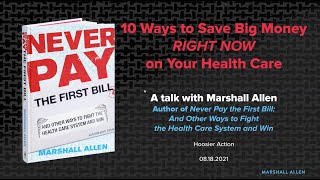
A Hoosier Action YouTube event ("Healthcare Affordability - Know Your Rights w/ Marshall Allen", Dec 5, 2025) featuring Marshall Allen and Hoosier Action members. Participants share personal medical debt experiences (e.g., Elaine's child's brain surgery billed ~$64k; April's large maternity and other bills) and Allen presents practical, evidence-based tactics to reduce or fight medical bills: check posted hospital prices and cash prices; ask if treatment can wait; use a "battlefield consent" to cap ER charges (e.g., two times Medicare); obtain itemized bills and billing codes; compare prices (fairhealthconsumer.org, hospital price disclosures); apply for nonprofit hospital financial assistance (example: Riley Children's Hospital); use resources like Quizify, GoodRx, Nanodropper, drugstoreunlimited.com, and debt-relief non-profit $4org; negotiate or sue in small claims (Indiana limit cited as $8,000); and strategies for handling debt collectors (dispute in writing, negotiate discounts). Allen also encourages employer-led solutions and collective action.
Chapters
So hello everyone here and hello everyone who is watching us on Facebook Live.
To Hoosier Actions. Know your Rights on medical debt and healthcare affordability. Hosted by the Moms of Hoosier Action. And this is a part one of what we hope to be an ever continuing series around medical debt and any issue, really, that we feel that people need to be empowered around. My name is Eva. I am a statewide Moms organizer with who's yous Action. And for days for today's Know youw Right, we're going to be joined by Marshall Allen, the author of the book Never Pay the First Bill. So thank you so much for joining us here and for us here in the room. And if you're watching on Facebook Live, if you can go ahead and introduce yourself, put your name, your location, and what brought you here in the chat, that would be great. We should kind of get to know each other a little bit.
And while you're doing that, I'm going to say a little bit about Hoosier Action. We are a statewide grassroots, nonpartisan organization and we believe that all Hoosiers, no matter the color of their skin, their income, geography, or origins, deserve to have a bright and thriving future. When we come together across our differences, we are actually stronger and we can have the state that we deserve.
We've spoken to families and people across the state, and the common thing we're always hearing is the fear and the struggle around healthcare affordability and struggling with medical debt. There is no person that we have talked to that does not have a story or an experience with medical debt or even just the fear of going to the doctor because of what that bill can look like. That family shouldn't have to worry. People shouldn't have to worry about choosing between their health and a possible medical bill. Today, what's going to happen is we're going to hear some lived experiences around medical debt and then Marshall is going to present to us and we are going to have a Q and A towards the end. For those of you who did submit your questions ahead of time, but if you didn't have a chance to submit your question, or maybe you're hearing questions that don't fit what your experience is, please put them in the chat. We have a chat monitor who is going to flag those questions and put them into the room. So we do want to hear your questions. If we don't get to your questions, we're going to try the best we can to get to everyone's questions questions. But if we don't, we would definitely like to follow up with you and hopefully we can get as many as we can answered.
So with that, I'm actually going to pass it to Elaine, who is going to open us up with her story.
Hi.
Thanks, Eva. I'm Elaine Bonadez. I live in Elliottsville, Indiana and I've been a part of Hoosier Action for going on two years now. And I'm co chair of the Moms of Hoosier Action. And I am so glad this event is happening. I think it kind of evolved out of conversations this summer that I started. This summer our daughter, through a normal routine eye doctor visit, was diagnosed with hydrocephalus. And we went from a visit on a Tuesday at an eye doctor to brain surgery a week later.
Along that way, I know we had a CT scan ordered. And with the CT scan, when I went to check her in at the hospital, they kept telling, it's going to be $750. Your insurance hasn't approved it. Are you sure you want to do it? And it was almost offensive, the fact that because insurance hadn't approved it that I would make a different decision about our daughter's health. I mean, we were getting the CT scan to rule out a brain tumor and I was like, absolutely, yes, we're going to do it. But the fact that I even had had them think I would contemplate it was just, it was, it was hurtful in a sense. And as we went on, that was just the day after the, you know, the first kind of, there's something going on. And then we spent a day in the ER at Riley waiting for an MRI with a very hungry three year old who couldn't eat because the MRI, this MRI was going to be sedated. And that day, $6,000 when I looked at the bill and we had to do it, we had to do it for her health. And again.
We got a phone call Friday that was, hey, you're going to go into surgery next week. And we talked to them Monday and they said we might admit you Tuesday because insurance again hasn't approved your surgery yet. And it'll be easier to get insurance to approve it if your child's admitted. And so we were looking at adding cost in order to get it approved, plus putting a three year old through an extra night at the hospital for no reason. And luckily, insurance did approve it. But just along the way, having all these decisions that really weren't ours to make about our child's health, they all deferred to insurance. And it was scary. We had no Idea what kind of cost. Brain surgery sounds like the most expensive surgery.
So she had the surgery, she's doing great. But this is going to be a lifelong condition. And I just, I want to learn from this to see what do we do, how do we manage this potential lifelong debt and how does she manage it when she's grown and off of our insurance? Does she have to be.
A big money making, does she have to go into stockbrokering or something just to make sure she can pay for her own health condition? You know, can she not entertain the idea of being a ballerina or an artist? It's, it's so many scary decisions. I asked the hospital for an itemized bill regarding the day of surgery because I'm like, how many more bills am I going to get? And honest to goodness, that itemized Bill broke the $64,000 down dollar amount by dollar amount and every line said hospital services. So even on the itemized bill, I still don't know what, what we're paying for and what other bills are still to come. I don't know if the anesthesiologist was on there. I don't know. So I, I have so many questions and they've come up along the way here and I'm so excited to sit and listen today. And I guarantee as this plays on Facebook Live, I'm going to be half of the replays watching again and again. I got the book recently. I haven't had time to finish it, but I'm thrilled that you were able to come today, Mr. Allen. And this is just one story. Everyone we talk to has stories when it comes up, just with friends, with family, with anyone. There's. Everyone has a story about medical debt and it's scary because we're completely out of control in that situation and our feeling.
Who's your action?
And I think everybody's feeling is no one should have to be afraid to get medical care. All across the state, people are afraid. I don't want my daughter to be afraid to go take care of her shunt for hydrocephalus because she's going to have to. It's life or death. She has to do it. I don't want her to fear the debt coming her way. So thank you again for coming today. I'm, I'm looking forward to what knowledge you have to impart. And at that I would like to pass it on to our director, Kate Hespace.
Thank you, Elaine. And thank you for taking the time to tell your story.
I don't need to tell Any of you that the fact is that if you have a body, you're going to need health care in this life. And yet we're stuck in this for profit system that doesn't put our health and well being first. And as Lane mentioned, in the thousands of conversations we've had with people across the state, no issue comes up more than the cost of health care, accessing health care and the incredible debt that families are experiencing. And I know first that it is scary enough to have a family member in health crisis and even scarier when families are contemplating whether or not they're going to be able to have any future after they take care of the health of that person. It's my pleasure to welcome Marshall Allen to give us strategies to fight back. He is the author of Never Pay the First Bill and Other Ways to Fight the Health Care System and win. Marshall spent 15 years investigating the health care system as a journalist, including a decade as a reporter for ProPublica. He's a two time Pulitzer Prize finalist and a recipient of the Harvard Kennedy School Goldsmith Prize for Investigative Reporting. He teaches investigative reporting at the Craig Newmark Graduate School of Journalism at the City University of New York. And before journalism, Marshall spent five years in full time ministry, including three in Nairobi, Kenya and now runs the Allen Health Academy to help boost the healthcare literacy of working Americans. And for more information you can go to marshallallen.com and I just want to wholeheartedly welcome you to Indiana and we are so grateful for your strategies to help families across our state. And with that I will hand it directly over to you.
Thank you Kate. And thank you everyone for having me here. It's really an honor to be here with you. I talk to via email and on the phone and in person.
Patients and citizens like you almost every day. You know, people are just getting ruined by the high cost of health care in this country. The dirty secret about the whole thing is that the cost of care does not actually need to be this high. What's happened in the United States is that a lot of big corporations, often for profit, but also the nonprofits unfortunately, and wealthy individuals have really created different schemes to exploit our sickness for profit. What we're seeing is more like predatory financial tactics on the part of many healthcare providers. If you aren't aware of the way the system works, which is really financially often working against you, then it's really easy to just there are pitfalls all around us and it's really hard to avoid.
The cost of care does not need to be as high as it is. There's a lot of waste in the system. There's a lot of unnecessary and unjustified overcharges. And so we can actually fight back and win. So let me share my screen here and I'm going to.
Show you a presentation I put together that I just call.
10 Ways to Save Big Money Right now on your healthcare. So we can talk about medical debt too. Maybe in the Q and A if you have more specific questions about medical debt. If you're interested, I could come back and do a session just on medical debt. But right now I want to show you hopefully how to avoid going into debt just by practicing some real hands on tips that you can put into practice for you and your family right now. If you have any questions, please interrupt me, put them in the chat. I know on Facebook Live people can post comments there. I can't see those, but we do have someone who's moderating the chat and who can let me know when there are questions. So a little bit about me. I spent two decades as a journalist, 15 years of that, doing investigative journalism about health care. A decade of that time was spent at ProPublica. And as Kate said, I also teach investigative reporting. And then before I was in journalism, I actually spent five years in full time ministry. And so I always have had a real heart for people and for helping people. Now I'm actually no longer in journalism. My day job now is working for the federal government. I work for the Department of Health and Human Services, Office of the Inspector General. Anytime I say that, I have to make sure and qualify that. I'm not speaking right now on behalf of the federal government. I'm just talking as an author and educator talking about my book. But that is my day job now. I do investigation of health care spending in the federal government programs, particularly Medicare and Medicaid and all the big cdc, NIH and all those other programs. My mission with my book is to equip and inspire working Americans and employers to fight back against the injustices in our system. I really want to hopefully inspire you today. When you fight back, you can save hundreds or even thousands of dollars per encounter and employers can save even more if employers could get on board with this, which is what I'm trying to encourage them to do. So my book is broken down into eight chapters for individuals and three chapters for employers. And it shows how to identify errors and overcharges in your medical bills, how to avoid unnecessary treatment, how to negotiate with medical debt collectors. I have a whole chapter on what to do if you have medical debt and how to sue in small claims court. I think small claims court is a really powerful tool for us to use when we're being exploited with our, with our bills and when we know we're being charged unfairly. Suing in small claims court is our right as Americans, and I show people how to do that. The book has led me to create Allen Health Academy and this is just continuing my health literacy push. And we're creating right now a video curriculum that takes the principles of the book and puts it into about 15 short on demand videos that'll be very engaging. And we're actually about to launch an indiegogo crowdfunding campaign to fund some of the production of the videos. So stay tuned for that. That's coming hopefully in the next week or two.
And as Kate mentioned and I put in the chat, you can go to my website, marshallallen.com you can pre order the video curriculum in the book if you're interested. And you can sign up for my newsletter and get the intro to the book for free. And the introduction to is or excuse me, my newsletter too is where I'll be sharing more victory stories. I'm sharing more and more tactics that people have used to save a lot of money on their healthcare. So let's get into the 10 ways to save. Okay, so I want to start with some principles. Okay. Because there's not always one way to solve a problem when you're navigating the perils of our healthcare system. First of all, price variation is extreme. So don't ever assume that the price you're being told in one place is the price. It has to be somewhere else. Now, if you're talking about Elaine's brain surgery, you're not necessarily going to be able to go shop around for that one. It may or may not be possible. Also if you're in an emergency room, but be aware that the price variation is just incredible and so you can try and hopefully find better prices on your drugs, tests, any type of treatment that you need. Number two, you may be able to negotiate. So don't assume that the price they give you is the price they will take. Number three, there may be lesser priced options available. I kind of mentioned that one. And number four, you can fight back and win. It doesn't mean you're always going to win every time you fight back, but often if you're persistent and polite and use the right tactics, you can leverage the pressure points that are existing to get them to give you a better deal or Give you a fair deal. And so that's what I really try and show people in the book.
So tip number one, check your prices. So hospitals are actually now required to post their prices on their websites. This is a federal government rule. And if your hospital is not following this rule, talk to their CEO, talk to their board member, challenge them to post their prices. Because a lot of hospitals still are not complying. They're required to show the cash prices, they're required to show the Medicare Medicaid prices, and every negotiated discounted price they have with any insurance plan. When you know that there's this kind of price variation and that you can see how your price compares to everyone else's price, this gives us the leverage we need to say that we want the best price. We don't have to accept the higher price just because they say that's what our insurance company negotiated. So tip number one, always check the prices. Number two, always ask for the cash price. So the cash price, surprisingly, is often lower than what it might be through your insurance company. And that's because it's easier for hospitals and doctors to get paid by cash right now than running things through an insurance plan. So this is a picture of a young woman named Gabby who had United Healthcare as her insurance plan. She ended up going to the emergency room just because she needed three little stitches in her little finger.
She was billed over $5,800 for that because UnitedHealthcare's price for the emergency room visit was $5,800. Well, she was able to look on the hospital website and see that the cash price was actually $256 for that same exact service. Somehow, the cash price was 22 times lower than what her insurance plan had negotiated as its special discounted rate. The cash price might be better on drugs. So you might be in a plan that has a $10 copay for generic drugs. That's a pretty common amount. Well, you might not realize it, but a lot of generic Drugs are only $2 or $3 if you pay cash. So generic drugs are actually really inexpensive. But if you think it's $10, well, you think you have to pay 10. Not necessarily. So always ask for the cash price you might be able to save. Number three, avoid unnecessary treatment. Maybe the only thing worse than paying too much for health care you need is paying any amount for health care that you did not need. I like to think about key questions you can ask your doctor or your nurse practitioner whenever they're saying, hey, we need to put you on a drug or, hey, your child needs to have this imaging test or lab test or procedure. Ask what happens if we wait. By asking that question, it doesn't mean that you're not going to do the treatment or take the drug or whatever they're recommending. But it forces that doctor or nurse practitioner or whoever it is to reframe the conversation in terms of the risk of not taking action, instead of the risk of taking action. Most doctors and hospitals in our country and in your state are still paid on a fee for service basis. That means they get paid more money for doing things. So their incentive is to do more than their incentive is to do less. And we're all susceptible to a temptation to do what's best for our financial interest rather than what's actually best for someone else. Like, I like to joke that if my publisher were to pay me a dollar per word for my book, you would be over treated too. My book would have been more than a million words, I can promise you, because I'm susceptible to that temptation too. Doctors, hospitals, even if they're not being nefarious, their leaning is to give you care whether you need it or not. They estimate that up to 25% of the services that are provided in our health care system are unnecessary. Unnecessary care is extremely common. You can also consult the US Preventive Services Task Force, Google them, check them out. They're especially good for recommendations about things like mammograms or prostate exams or different types of screening tests that a lot of doctors will say you need every year. Well, the U.S. preventive Services Task Force is made up of independent volunteers. They're not taking any industry money and they're not getting paid more based on the recommendations that they make. You can go to their website and read their guidelines and they'll tell you, what does the evidence show about doing these different types of preventive screenings.
Tip number four, this is the battlefield consent. When you go to urgent care or the emergency room and they give you this.
Financial agreement that you sign that says, I agree to pay for whatever the cost of these services is. Well, I don't know if you've ever thought about this, but you're signing a contract when you sign your name there. And so anytime you sign a contract, you should make sure that the contract is agreeable to you and the terms that you want to have on that contract. Now here's what you don't necessarily realize. The price variation is so extreme that Medicare typically gets the best prices. And if you're a working age American on a Different type of health plan, you might end up paying anywhere from two to five times the Medicare price, maybe even 10 times the Medicare price. So you can write this into the form before you sign it. And it says, I consent to appropriate treatment and including applicable insurance payments, be responsible for reasonable charges up to two times the Medicare rate. So what this is saying is I agree to pay for the services assuming they're reasonable and appropriate, and I agree to put a ceiling on the charges of two times the Medicare rate. That's still a very generous payment they're going to be making from you twice the Medicare rate. But what it protects you from is this price gouging that can occur in the emergency room because they charge you 10 times the Medicare rate. And so it puts a limit on what you've legally agreed to pay. If you do write this in, I recommend taking a picture of it so you have a record of it. And sometimes if they give you an electronic form or an iPad or something like that to sign, you can either ask them to print the form for you so that you can write this in, or you can have them type it into the form electronically. And so you have a version of it electronically.
Tip number five. Yeah, go ahead.
Quick question.
Yep.
Virginia asked in the chat about tip four. Like, does that actually work? Because it sounds really important. Like, do you have.
Any, like, stories on, like, how when this has worked in the past?
It does work. In fact.
I got this tip. I mentioned Quizify here. Quizify is a health literacy company that originated this battlefield consent. And they have a lot of examples of it working. And so you can go on the Quizify website and look up the story of a guy named James on the Cuizify site. James had to get an MRI and he was billed like $10,000 or something like that. And what it does is it creates a paper trail where it is a legal agreement. And so you have now agreed, you've said legally what you'll pay. And by treating you, they have also accepted. That's their form of accepting that legal agreement. So when they hit you with a bigger bill, it gives you leverage to contest that bill and if necessary, to sue them in small claims court for violating the terms of the agreement that you had when you underwent treatment. So, yes, I'm aware of a lot of cases where this has worked. And I think it's something that is our right as consumers. Why would we be expected to enter into an agreement where they get a blank check and they get to charge us whatever they want? That's not reasonable. And that's not fair. And so we can do this to protect ourselves on the front end.
Thank you.
Tip number five, check your bills and see if they're inaccurate or unfair. So like Elaine did, you want to get an itemized bill. Now, Elaine's itemized bill is a joke. They just said medical services or whatever. They didn't say what it was. That is completely outrageous. They should be ashamed of themselves. And frankly, when things like that happen, we need to start putting on. So if you want some Hoosier action tips, everyone should get the name of the board members for Elaine's Hospital. The board members are responsible for the quality of care and the cost of care that's provided by that hospital. Every state law holds the board members accountable. The board members are usually prominent members of a community. Board members should know that Elaine's itemized medical bill did not itemize the charges at all. That's insane. Like usually an itemized bill, they don't usually offer it to you. And so you like this lump sum. Pay $68,000 in Elaine's case or pay 10,000 or whatever the cost is. That would be like going to the grocery store and having them say, pay $200 for your groceries, but they don't tell you how much you paid for your eggs and your milk and your bread and your cheese. We wouldn't accept that at the grocery store. That's not how it works at a restaurant or at an auto mechanic shop. The itemized bill should describe each of the charges and it should also include the billing codes. So the billing codes are the lexicon that they use to translate the medical records, which they're legally required to keep from any visit, into a claim that they submit to an insurance company or a bill that they send to you. So these are the billing codes. Well, when you get those billing codes, you can look up the charges. And so you want to see first if your insurance plan processed it correctly. So you want to look at your insurance company documents. My book lays all this out, by the way. How to read an Explanation of benefits. That's one of the chapters in the book. You want to get your medical records. The medical records have to justify the complexity of the care that you received. So you remember the young woman, Gabby, I helped? They actually billed her for a mid level complexity emergency room visit. Well, she only went in for three stitches on her finger. It was not a complicated case. So that's called upcoding, where they charge you more than they should for what might be a very simple type of procedure, then you want to look up the fair price, go to the website fairhealthconsumer.org that's a website where you can type in your zip code and you can look up prices for different procedures that you need or that you receive. And that's a way to check and see if the prices you received were fair or not. And you can also look now, like I said, on hospital websites. So check those hospital websites and check the prices there. And then if you have been overcharged or inaccurately charged, that's where you can contest the bills. And that's where you want to challenge any inaccuracies in the bills or any.
Unfair bills, like overpriced bills. And by the way, with the board members. So if you want a little just a Hoosier action challenge, we could call it, okay, get the name of Elaine's hospital, identify who those board members are and call them, send them letters, put pressure on them, say, why is it that your hospital can't even give a poor Elaine an itemized bill? She's a reasonable person asking for something reasonable that you have. So please provide and do the right thing by Elaine. Okay, that's crazy. I'm so sorry to hear that, Elaine.
Okay, so this is all, as you can see, I've been building a little paper trail here, right, with the medical records, the itemized bill, pricing your bill, checking it for accuracy, writing out your battlefield consent. So in a case like Elaine's, that's not a case where she's going to be able to sue in small claims court because that bill is too high. But I just want to look up. Let's look at small claims court limits for Indiana.
So the limits in Indiana looks like they are $8,000. So an $8,000 limit in Indiana small claims court will cover a lot of your medical bills. Okay? So if your bills are overpriced or inaccurate, consider suing them in small claims court. So people think, like, what? Sue them? How can I do that? Well, this is our right as Americans. So if anybody loves our country, they should appreciate the fact that small claims court exists to protect individual consumers against the predatory practices of big companies and powerful individuals. It is super easy to file a case in small claims court, especially if you have gathered the evidence that I've showed you how to gather. It probably costs about 30 or $40 to file a case. You don't even need to do a lot of research. When you write out your your complaint to file your case, all you do is say the name of the person sending you the bill or the company sending you the bill and the amount of the bill that's unfair and then a case, and then they're going to get a summons in the mail that's going to show that they have a court date. And what that means is now they're going to have to explain their unjustifiable overcharges in front of a judge with you. They're not going to want to do that. And here's why else they're not going to want to do it. They're going to have to pay an attorney hundreds of dollars an hour to come fight you in small claims court when your claim might not even be worth more than a few hundred or a few thousand dollars. So it's not worth their expense or their time to continue treating you unfairly. And so most of the time what happens is these cases get settled out of court and it's incredible how much it increases the power in favor of the consumer. This is a picture here of some friends of mine from church, Josh and Jennifer and their two kids. And they had been over billed by their dentist for a root canal and it was about $300. They fought this for years with the dentist, with the billing company, they would not correct that bill. And so I told Josh, man, if you sued him in small claims court, I bet that would help. Well, he filed a case in small claims court and within weeks the attorney for the dentist called and said, look, we don't want to make this a thing in court. What do you want? And Josh said, I want you to repay me the $300 that you overcharged me. And the dentist wrote him a check, so it never went to court. So I will say small claims court is stressful. It takes some courage. But here's the thing. When your back is against the wall, we really have nothing to lose. Because even if you lose in small claims court, the worst thing that's going to happen is you're going to have to pay the bill that they're already trying to get you to pay anyway. So I recommend it. I encourage you to try it. And if anybody wants help with this again, you can reach me through my website. Go to marshallallengot.com reach out to me. I'm happy to help you and give you advice if this is something that interests you at all.
Okay, tip number seven. Now this is one that I'm hoping, I'm hoping, hoping this might help Elaine. Okay. So Elaine, did anyone talk to you about the hospital financial assistance policy?
We asked several times, and this was through Riley Children's Hospital. And so we've kind of dealt with them in the past with our kids, and everybody kind of passed it off to somebody else. And we finally got a social worker to come to our room, and her bottom line was, well, they don't send medical debt to collections anyway.
So that wasn't fairly helpful. We were given one program that's like a statewide thing that we're applying for.
Was this. Was this a nonprofit hospital?
I don't believe so. It's part of the IU health conglomerate. Someone else here might know specifically, IU.
Would be a nonprofit. Okay, so. Okay, so here's another. Who's your action campaign? Call those board members at Elaine's Children's Hospital. And while you're asking them why they can't give someone an itemized medical bill, look up the IRS regulations for hospitals that are nonprofits, they are required to tell every patient about their financial assistance policy. This is an IRS regulation that nonprofits are required to follow because they have a massive tax benefit. As nonprofits, they are not paying taxes. This is helping them bring in so much more money than they would bring in if they had to pay taxes. And so they're supposed to provide charity care. They're actually required by the IRS to provide charity care. And so in a case like Elaine's, now, I don't know. You don't need to tell us how big your income is for your family, but anything up to three times the federal poverty limit should almost be forgiven entirely. 100%. So if your family makes less than what's three times? Does anyone know. Eva or Kate, do you know offhand, federal poverty limit is there in Indiana for a family.
I don't know, offhand.
I can.
Okay, well, it's. It's actually. I'm sorry, I'm just going to. Because I'm curious. I just want to look.
Three times. Let's see here. Federal poverty limit.
Looks like it would be 36,000 for an individual.
Yeah. So for an individual, three times federal poverty is 36,000. For a family of four, it would be about $75,000. Okay, so that's not a small amount. So if you're under three times the federal poverty limit, you might be able to have your bill waived 100%. And if you're not. If you even make more than that. I've seen hospital financial assistance policies for people who are making six figures that still offer a sizable discount off of the negotiated price. Okay, so, Elaine, if you want to check out. You're happy to contact me and I can help you find it. But you can Google the name of the hospital and financial assistance policy. Let's just do it here since we're here with Elaine. Elaine, what was the name of the hospital?
Riley Children's Hospital.
R I L E Y.
Correct.
Financial assistance Program. Riley Children's Health. I don't know why they couldn't just showed you their website. Right? Like, why don't they tell people this?
To request an appointment with a certified financial navigator, contact us, apply for financial assistance, submit an application. So you can go here, submit the application.
And it's actually quite easy to do this. It doesn't take that long. You put in your name, you put in how many people are in your family. They often they're going to ask you for the number of people in your household, your income level, your assets. So they're going to check and see do you qualify for financial assistance. They're going to look here at your expenses. So perhaps you're, you know, you have a big mortgage or you have some other debt. So all these things get factored in. And every nonprofit hospital has this. They don't tell people the way they should. They are required by law to tell you this. Okay? So you can also do this retroactively. So I encourage any of you, if you're on a payment plan with your hospital, go look up their hospital financial assistance policy and apply for financial assistance and see if you can get it. I have even heard of cases where people, after they've paid their bills, have gotten paid back by the hospital because they qualified for financial assistance. If it sounds too good to be true, I know it does, but it's true. I want to point you to this nonprofit called $4org. $4 is a charitable nonprofit that exists to help people crush their medical debt and medical bills through hospital financial assistance policies. So $4 now they're swamped with cases. And I know the guy who runs it. He's a great guy, Jared Walker. But you can go to $4. They will actually help you do this. So, Elaine, hopefully that might be an option for you.
Yeah, this is all fantastic info. This is super helpful. And it's hopeful.
Yes, it's hopeful. And by the way, for anybody who has a win, okay, Anybody who has a victory, I'm trying to gather more victory stories and put those out on my website. I just, just started a YouTube channel. So I'm launching these victory stories because as we have these wins and as we have these victories, I Want to share these tactics with as many people as possible so that other people can begin engaging the system in this way. Okay, tip number eight.
Elaine also said this already in her case. It might have been hard to do this, but if you can avoid hospital imaging centers. So you would never know this, but it costs thousands of dollars to get an MRI or a CT scan in a hospital. If you go to an imaging center that's an independent imaging center, it might just cost hundreds of dollars. This is a guy named Kevin Vincent. This is actually the first victory story that I did with Kevin. He needed two MRIs before he had a spinal operation. He went to his hospital. He was referred to as hospital imaging center. They told him he had a $10,000 deductible. So that's the amount you have to pay before insurance kicks in. They told him it would be $11,000 if he went through his insurance and $9,000 if he paid cash. He was redirected through a company called greenimaging.net which does direct contracting with independent imaging centers. He ended up going to another independent imaging center about a half a mile away from that hospital. And he paid $950. So he saved more than $8,000 with the same quality MRI. He had them read. He got copies of the images. He saved more than $8,000 by driving half a mile and going to a different location. That's also true, by the way, for labs. If you need labs done and you get routed to a hospital lab center. If you can go to an independent lab center, call and get those prices, because the hospitals are always going to be the place to get care.
Tip number nine. Okay, let's talk Marshall.
Drugs.
Marshall, quick question.
In the chat about tip 8, Zach asks, is there a reason for this massive price discrepancy between, like, these independent imaging centers and what's at the hospital?
The reason for it is, and this is why I think I can objectively say they are exploiting our sickness for profit. That is what they're doing. They're taking advantage of not giving us the prices up front so they can require us to pay more. That's what it is. There's no justifiable reason why you should have to pay so much more in a hospital for an MRI than you would in an imaging in an independent imaging center. They might say, oh, well, it costs us way more to do things in a hospital. Well, okay, that's your problem. But I want to go to the place because they're going to send you to collections. They're Going to put you in medical debt. They're going to say, go on a payment plan. Well, it's. To me, it's not right to make people pay more than they should. I'm sure their excuse would be it's expensive to run a hospital, blah, blah, blah. Okay, but they don't need to be taking that much more of our money without telling us up front that we could get it for lower somewhere else.
Thank you.
Okay. Prescription drugs. Goodrx, I think is a great place to check. The variation in drug prices can be just as extreme. Like if you, if you look up, try. If you ever want an experiment, if you are on a particular drug, try calling five pharmacies in your area and asking them what the price is. It's going to be wildly different. So Goodrx is a website where they have discounted prices. Often that can be a better price. Check out the Good Shepherd Pharmacy program. This is a membership program from a pharmacy in Tennessee. In Memphis, they have a plan for. It's like $5 per drug per month for generic drugs. And I think it's. If you need insulin, I think it's $25 a month. And so this is also a good place to look for specialty drugs. Believe it or not, for really expensive specialty drugs, it's cheaper to import them from places like Canada, the United Kingdom, New Zealand, Australia. Go to the Canadian med store and the website is drugstore unlimited.com. and it's really ridiculous. It's the same exact drug made by the same company, same brand name. You can get it for hundreds or thousands of dollars less by importing it from some other country than buying it here in the United States. And that just shows how dysfunctional our pricing system is in the United States. There's all these middlemen that have marked up the cost of our drugs. You can avoid that.
Last tip. This is.
A funny one, but it could actually save you a lot of money if you use eyedrops. I did a whole story on the wasted medicine involved in the eyedrop industry. This is crazy, but the human anatomy is very limiting in terms of how much liquid our eyes can contain. Our eyes can only contain about nine microliters of fluid. That's why when you cry, your tear ducts fill your eye with tears and they run down your face. Well, the same thing when you put eyedrops in your eye. You've probably noticed that some of it always runs down your face. It's not because you missed your eye, it's because the drops are too big. Our eye can only hold 9ml of fluid. Eyedrops are typically between 25 and 50ml in size. So if you use something like Visine or a cheap eye medication, that's no big deal. I mean, it's expensive. You're going to waste a lot of that medication because it's like taking. If I took this glass of water and I just kept pouring it, if this was your eye and I just kept overflowing it, it's not like the extra medication is doing you any good. You're just wasting it. And then you have to go buy more eye medication. But this particular patient who I did a story about, he's using a glaucoma medication that cost hundreds of dollars a month. He was on a very limited income, so he would actually run out of his glaucoma drops, and that was causing him to go blind. So you might have something for dry eyes or some other eye medication. After I did this story about this problem, I was super inspired by these young engineers and medical students who started a company and they created this product called the Nanodropper, which is actually a little thing that you screw onto the top of your eye drop and it creates a micro drop, a 9 or 10 milliliter size drop so you don't waste your eye medication. So that might save you money. It will save you money if you use eye drops. That's just another fun and interesting little tip.
Thank you. It's my pleasure to share these tips and I'm going to reshare my screen back with Eva and we can talk questions.
Yes. Thank you so much. And I just want to see there's no more questions in the chat because we can get started with the questions that were submitted.
Great.
Okay, awesome. So April and I are going to read off. We're going to take turns and read off the questions that were submitted. So I'm going to kick us off with a question from Georgeanna. Do you have any success stories of people getting supplemental insurance.
From Medicare or Medicaid or Medicare, I'm sorry, Medicare or Medicare Advantage plans to cover oral surgery. It says on the CMS website that they are supposed to cover oral surgery when medically necessary. But I was advised by the oral surgeon's office that my friend's care pulling all of his teeth due to Parkinson's disease.
Muscle spasms can result in broken teeth. And because of Parkinson's, both the muscles freezing and tremors and increasing dementia make it almost impossible for him to care for his teeth. They said that it would not be covered. I want to fight back on this, but I'd like some guidance.
I have a whole chapter in my book about how to fight insurance company denials and I don't have any about.
Medicare in particular, but there's a young woman, young family in South Dakota that I just helped walk through this process where her doctor in her hospital told her that this procedure she needed, insurance company, they actually miscommunicated the insurance company, said it didn't need to be approved if it was an outpatient procedure. So she underwent the procedure. Then she got hit with $78,000 in medical bills and it took her a year and a half and it took her some careful negotiating and she had to bring her husband's employer into the battle with the insurance company. But just about a month ago, she got the word that the insurance company had covered most of it and then the hospital had waived the rest. And so she went. She and her husband were about to file for bankruptcy and they ended up getting it all forgiven. So the key when you're fighting these battles with insurance companies, including Medicare, is your tendency is to want to make an emotional appeal because you're either not getting the care you need or you're getting billed for care you can't afford. Make sure it's a contractual relationship. So your insurance company or Medicare, they don't really look at you like a human being who might die if you don't get the treatment you need. They look at you more like another entity that they have a contract with. So you need to understand what are the terms of the contract that Medicare has with the patient. And then how can you argue this and appeal this based on them violating the terms of their contract with you? So it's reframing the way you think about it so that you're thinking about it not from an emotional perspective, but from an evidence based, more contractual point of view. And I do have a whole chapter about this, so I encourage you to check that out. And I think it might be even tougher with Medicare. I don't know quite how you would do that with Medicare compared to a typical employer sponsored health plan, but I hope that helps a little bit. Persistence is also really important. Don't give up, don't go away and don't, don't say. If they say, oh, you just fill out this form and send in the appeal. Don't just follow their route of how to appeal it. Make your own appeal. Bring in other parties who are involved, bring in your state senators, bring in anyone who you can Think of who might be able to help leverage this in your favor.
Thank you.
Is there a max on how many times a creditor can call you? I get at least two or three calls a day from the same number.
I don't think there's a max as long as it's during daytime hours. And there are restrictions. Look up the Consumer Financial Protection Bureau has a lot of information about medical debt and what debt collectors are and are not allowed to do. I have a chapter in the book about how to handle medical debt. And one thing you always want to do as soon as you get that first call is don't avoid the call. So you may have been engaged in this for a long time, but make sure that you always engage right away and that you contest the debt in writing. In writing, tell them, I do not owe this money and you need to prove to me that you owe this money. I have a letter in my book that you can use as a template and so you can just adapt that letter for your purposes, but make sure that you contest it so that they know I'm not agreeing that I owe this money and you need to prove to me that I owe it. And that's because these medical debts get bought and sold on a whole kind of underbelly of the finance world. So let's say you don't pay your hospital bill first. If the hospital still owns the debt, they'll have their own debt collector come after you. So maybe they'll call the debt collector, but the debt collector is working for the hospital at that point. You can still negotiate with the hospital, but if it's been past six months or nine months or a year, at that point they might sell your debt to a debt buying agency. So now the debt is owned by someone else and they have a different type of medical debt collector coming after you in a really dark way. You want to follow the same steps, contest the debt, make them prove that they're the ones who own the debt. That's going to create a huge burden for them administratively. That might cause them to leave you alone, but it's not necessarily going to make the debt go away because now you have to deal with, deal with that debt collection agency and that debt buyer. So at that point, then my recommendation is negotiate. Okay, so first of all, if you follow the other steps in my book, you can price your own debt and you can see was it fairly priced, was it accurately priced, or not. All of this information can help you with your negotiations with the debt collector. The other thing you want to do is, what's the amount that you can get as a discount? Well, the amount you can get as a discount is a lot higher than you think. So in a dark way, if your medical debt is in collections, this means they have given up on you. They think they're not going to get anything from you. So when they say, oh, you owe us $1,000, the bill is $1,000. You owe us 1,000. Well, that might be what the hospital bill was, but when it gets sold to a debt buying agency, they buy it for pennies on the dollar. So it might, like. I talked to some experts in this field. They said that it might be at the most, 5 cents on the dollar. They paid for your debt. So if you owe 1,000, that means the debt collector bought it. The debt buyer bought it for about 50 bucks. So they don't need to bring in $1,000 now to make a good profit. In fact, the expert I talked to said you about 15%. If you negotiate it down to 15% of what you owe, they still make a profit. So they'll be happy and you get a massive discount. So hopefully you can get out from under this debt. Right? This is assuming that you actually owe the money. And so at that point, then it's like a negotiation game. Okay, so I have tips in my book about how to take each step of the negotiation, but one thing I would just say is be friendly to them. I know it's hard. I know it's not your natural inclination when someone's chasing you, especially if it's an unfair debt and they're calling you all the time, but just tell them. Hi, you're April, right? Hey, I'm April. I would really love to pay you this money, but the truth is, my family is really underwater right now. We are struggling. We had hours reduced because of the pandemic. Our kids have expenses. I have other bills. I'm not gonna be able to pay you anything. I'm really sorry.
Send them away, they call you again. Hey, how's it going? Oh, you know, life is tough. I still don't have any money. How are you doing? Have you ever had to face medical debt yourself? There's a good chance that your medical debt collector also has had medical debt. I mean, one in five Americans has medical debt in collections right now. So this is an extremely common problem. So see if you can build a relationship. Okay. Now, I'm kind of an outgoing, friendly person, so for me, this is, like, sort of fun. I know this isn't fun, okay? But and everybody's personality is going to be a little different. But see, if you can begin to establish enough of a relationship where you can learn from them, what would they consider a win for them that you could also consider to be a win for you? And by the way, if you pay it all at once, that's going to get you an even bigger discount. So look for the discounts you can get if it's not suitable to you don't make any deal. And by the way, don't ever make a deal with a debt collector that you cannot fulfill. Because if you get a discounted rate and then you violate the terms of that agreement, let's say you guys agree, okay, you owe 1,000. We're going to let you pay it off for 200. So you pay the 200. Or wait, let's say it's a payment plan, okay, $50 a month for four months, but you're unable to fulfill it, well, now they're going to come after you for the full thousand again. So make sure you never enter into an agreement that you can't keep. Keep a good relationship with them. Make them prove that they're the ones who can chase you for that debt, and then hopefully you can get out from under it. And if it's still owned by the hospital, then you're negotiating with the hospital.
But I do have a whole, a whole chapter on that, so I hope that that can help. And if anybody wants to go deeper on that, that, that alone could be a whole session. Right. We could just talk about medical debt.
Thank you.
So next question comes from Michelle. I live in a town whose primary health care provider is effectively a monopoly. What real options do I have for increased billing transparency or price negotiations when the provider and insurance company decide behind closed doors?
Well, so that's a, that's a great question and a great astute observation about what's happening. So you have the insurance companies and the hospitals and doctors agreeing on prices, and then they expect us to pay the prices. And especially if you're in a high deductible health plan, that's going to be tougher for you to pay because now you have to pay every dollar. Your insurance plan doesn't even pay anything. So again, I think, you know, using that battlefield consent where you put a ceiling on the charges and it's linked to Medicare, so the Medicare rates are almost always going to be the lowest every time you undergo care, you could write that on your consent form. And if they violate your agreement by charging you more, well, then you can argue and contest that with them and maybe even sue them in small claims court. So that's what I would recommend. And here's the deal. If we all did this, if we all filed claims in small claims court when they cheated us, they would be overwhelmed with lawsuits that they would be forced to respond to. It would be so expensive for them to hire attorneys to respond to all these issues. They would be helpless. And so we have numbers on our side. We just need more people to be informed about what they can do to fight back. So those are my recommendations there. And if you can get care elsewhere, get care elsewhere. But I know it's tough in some towns. It's a one hospital town and they do use that monopoly to exploit us.
Yeah.
This question is from Tammy. Had several medical bills from the same provider in collections. Made an offer in April 2020. Also sent the offer to the provider, called to follow up and they didn't know what I was talking about. Late July, they called wanting payment. I no longer had it. Extra heard from them again, August 2021 again asking for payment. The provider does not bill automatically turns bills into collections. Your comments and thoughts on that?
Yeah. So in that case, it sounds like the debt has already been sold. If the debt's already been sold to a debt buyer, then the provider would have no attachment to it. So that's why they would have nothing to do with it. If you have a doctor who's sending you to collections prematurely, then I would file a lawsuit against that doctor in small claims court to stop billing you unfairly and stop sending things to collections, especially if it's inaccurate or overpriced. So that would be my recommendation there. You can also file complaints about doctors and hospitals with state regulators. So you could consider that.
And then go to a different doctor. Like if you can, don't deal with anybody who's going to treat you that way. That's not fair and maybe you're not able to do that. But if you are able to, I would avoid that person.
Timothy wrote in is it smart to consolidate your medical bills or is it best to try and deal with them one at a time?
I think dealing with them one at a time is going to be better because then you can price them one at a time.
Again, you want everything to be itemized so that you can keep track of which one is a fair bill and which one is not a fair bill. Which one do I contest, which one do I need to pay?
So I would keep them separate.
Richard wants to know how would non payment affect one's credit score for and things like mortgage loans from lenders.
I mean, I'm not a lender, so I can't really speak to that with authority.
Not all medical bills get sent to collections, so it does that. Not all things get that medical bills lead to damaging your credit, but they can. And I'm not quite sure when they do and when they don't. So that's kind of the hard part there. I'm sorry, I just don't have a better, more informed answer there.
Awesome.
I'm so sorry. Can you hear me? My camera had.
Shut up.
Okay, great. I'm going to just still ask the question Saldana wanted to know. How can we generate real change when lobbyists have their hands in our elected officials pockets? I think this is around what hospitals.
Can and can't do, so I think calling the board members and putting pressure on them is a great idea. I think they've gotten off the hook here. Nobody's ever held the board members accountable, but under state law, the board members are accountable. They're usually prominent people in the community, you know, like the mayor or the town council or the bank vice president or something. They should be publicly shamed for allowing these problems to persist. And so especially, let's say you have a hospital that's not giving you an itemized bill or that's not.
You know, following the federal government's rules to provide prices. I would apply pressure to them and say the buck stops with you, board member. So do your job and improve this situation for the community. Or why wasn't Elaine told about her financial assistance policies? There's an application right on the hospital's website. Do you think that would have been relevant to Elaine? The answer is yes. I think we need to be less tolerant and less susceptible to trusting the facade that they've created that somehow they just. All they care about is our healing and our health, right? Yes. The doctors and the nurses and the clinicians, they're the ones who care about our healing and our health care. But on the financial side, the industry has created a lot of schemes that are, frankly, deceptive, and they're not even following the federal government's rules. The IRS requires hospitals to make their financial assistance policies known to every patient. So the fact that Elaine wasn't even told what it was is a violation of what the IRS says should be done. So that's where I would put pressure on the board members. I would not expect policymakers to bring about positive change. That doesn't mean don't push Policymakers, it sounds like you guys have a good force there in Indiana, but Republicans and Democrats have had decades to figure this out in a way that would be to the advantage of the public. There is so much lobbying by the hospitals and the insurance companies and everyone else that lawmakers and policymakers are often very conflicted. And so they don't make disruptive change. They might fix something here and there. You know, if you need an appeal taken care of or an individual case taken care of. But they're not making meaningful change that will drive down the cost of care for the public. So I personally, my book is not a political book. You'll notice I say I'm not waiting on someone else to come to our rescue. We each individually need to be equipped and we need our employers to get involved. So I happen to know that in Indiana, there's a pretty active employer forum in Indiana that is pretty active in terms of fighting these battles. I think those would be great allies for you guys because they are putting pressure on. Let me see what their name is and I'll tell you.
But they did a really.
Really good study with the RAND Corporation called Hospital Prices in Indiana. Findings from an employer led transparency initiative. And whatever the group is that's behind this, I think you all could reach out to them and get them engaged. I'm gonna put this in the chat.
I see Zach asking, do you have any victory stories around that kind of collecting collective action, pressuring hospital board members? No, I don't. Because to my knowledge, it hasn't been done. So.
I've never seen the board members be held accountable because it's too uncomfortable, you know, so we've. We've all been playing really nice. You've been expecting them to play nice with us, and they haven't been playing nice with us. They're driving us into debt. And so all I'm asking for is fair treatment, where we just say you're not actually able to. Just because poor Elaine's child needed a brain surgery, that, that Bill had an MRI on it for $6,000 or whatever it was she said that's not fair. So you need to be fair.
And by the way, please keep me posted if you do, because I want to tell that story. So I will be happy to follow up with you. And the board members are publicly identified with the hospital. So you could go to Elaine's hospital and send them a letter. Send them letters on behalf of Hoosier action.
Absolutely.
And by the way, she might qualify for financial assistance. So maybe make your campaign to say, hey, Elaine probably qualifies for financial assistance. Would you please fulfill your IRS obligation as a tax free hospital, as a nonprofit? We're asking you to please provide the charity.
To provide and forgive Elaine's bill 100%.
Yeah, I think we've gotten a lot of really great clarity and ideas from this. I wanted to ask Kate's question that she sent in earlier. She was curious about what policy or structural changes we could potentially work on at the state level that would improve things for patients, if you have any.
So I think transparency is really great. I think like there could be a state law that says every patient gets an itemized bill with the billing codes.
Why not make that a state law? Like, why would we be expected to not get a receipt for our services just like we get at the grocery store? So if you do have some policymakers that want to bring forth and I mean, believe me, the hospitals are going to squeal, oh, it's too expensive to do that. No, it's not. It's not too expensive for your local taco place or your local restaurant, you know, to give you an itemized bill. So how is it impossible for a hospital to do that? It's just not been something people have required them to do and so they haven't done it. I would also say that anybody who doesn't follow the hospital price transparency rule is like not qualified to bill for services. Like, why would we say it's okay for them to avoid posting their prices? Post your prices. Come on. A lot of hospitals are doing it, so it's not impossible to do.
Another question that came in the chat was from Aubrey. She had mentioned that like we've talked about, go to a doctor who doesn't treat you that way. And she hasn't met a doctor who doesn't treat patients in this way. And she wants to know, do you have any tips on how to find a reasonably priced doctor?
I don't have any great tips on that other than a lot of doctors now. And hospitals are willing to give you cash prices upfront. There's also variation in pricing. So I think in that RAND study that I sent, they actually put out a map of the highest and lowest priced hospitals in the state and around the country. If it's not that report, it's another RAND report does that. And so you can actually see who the lower priced and higher priced facilities are and go to the lower priced facilities. There's. There's no need. So here I'm going to send, I'm going to Put another link with the map to the prices. But I think we need to reward the people who are fair with our business and shun the ones who are not fair. Just say we're not going to go to you.
So I have a question here. Is there any from Beverly. Is there any hope if bills are already in collections?
Yes. So you can retroactively do hospital financial assistance policies. It's going to be a lot tougher though if it's already gone too. If the debt has been sold, that's going to be much more difficult. That's where it's tough because at that point the hospital can't really forgive it anymore because they sold it.
So the hope there is to get the best negotiated discounted price you can get. And I know that's not a great hope, but if it's 15 cents on the dollar, at least you can get a good discount.
Yeah.
Then next question from Angela. Is there any recourse if a doctor ordered a test, then you find that it find out that it needed pre certification which he did not give, therefore insurance did not cover it. And now the patient has a bill just under $3,000 for a test.
Yeah, that's the exact scenario I just talked about with this young woman who had the $78,000 bill. That's just appealing an insurance company denial. And I have a whole chapter in the book on how to do that. Again, you want to make sure it's an evidence based appeal, not an emotion based appeal. Treat it like them violating the contract they have with you to provide you the care that you need. So you want to show that this was needed, that your doctor ordered it because it was necessary. And so therefore they need to fulfill their contractual obligation and pay for the care that you need under the terms of your agreement.
And then another question. What can you recommend for small employers? I know you mentioned about them starting to get involved with this. What can they do?
So small employers also have a ton of power that they're not actually utilizing. All employers do. And my main piece of advice would be to find an advisor who's not funded by the health insurance industry. So I have a whole chapter in my book about this. Most health insurance brokers and benefits brokers are funded by the health insurance companies. They get massive bonuses, big commissions, and so they are conflicted. So they're supposed to be representing the employers, but they're actually representing the industry. A lot of times there are advisors, benefits advisors, who don't play this way. In fact, in Indiana, Ben Connor in Indianapolis has an agency, C O N N O R. And I know that Ben is one of these advisors who doesn't do things the same old, same old way. And what they'll do is they'll take fees from employers where they get paid by the employer, and then they design a health plan. They help the employer design a health plan that's better and much, much lower priced. So believe it or not, employers who do this are saving 30, 40, even 50% on their health care costs while eliminating deductibles, eliminating co payments, providing better health care, better benefits for their employees. So I have. That's what I go into in the employer section of the book.
Awesome.
And then one final question. How can I deal with medical coding issues that insurance won't cover for a reason that did not apply? And said when I argued that there was a coding issue error, the coding error, the office disagreed. Specifically, I was tested for Lyme disease. The test was not covered because the insurance company said that they did not COVID testing of animals. Here, the tick for the disease.
When I said it was my blood tested, not the ticks, they said it was not coded correctly, but the office insisted that it was the right code. After hours of my time, I gave up and paid the $400.
So in that case.
Sometimes there's these disputes where the insurance company and the doctor or the insurance company in the hospital disagree about whatever happened, but they still send you the bill. Right? And so I don't care whose confusion it is, whoever is sending you that bill, if it's an inaccurate or unjustified bill, you sue the person who sent you the bill. So it's especially effective if you've already paid the 400 because now if you file that case in small claims court, you can show actual damages. You paid $400 more than you should because they couldn't figure out how to code this and run this through your insurance plan. So either I would tell the doctor or the hospital, I would say either you gave me an unnecessary test, which I didn't need, or you couldn't figure out how to code it with my insurance plan, I don't care what the problem is, but you just made me pay $400 more than I should have and so I would get the medical records, price it out, and then you could file that claim in small claims court and make your case there. But believe me, if you file a case for 400 bucks against a doctor or a hospital, they're going to have to pay their attorney $400 an hour just to defend Your case, that's not worth it for them. So that will give them the motivation they need to come to the table and treat you fairly.
Awesome. Thank you so much for answering our questions.
And I am going to actually pass it to April, who's going to begin to close us out, and she's going to share some of her story.
So my name is April, and I'm a leader with moms of Hoosier action. And I got started with them last year after a bunch of health issues happened with me. But basically, I was, like, really healthy, no issues. Had the cheapest insurance up until, like, 2017. I got pregnant at the end of 2017, and I got put on the pregnancy Medicaid, and then I found out that I was having a miscarriage, and I decided to do the DNC option where you go in for the surgery. I asked that, I called the insurance company, and I made sure that they would cover it, and they told me yes. Well, a few weeks after my DNC, I ended up getting a bill for $4,000 for my portion of the $16,000. It was actually closer to 5,000. So that was really hard to deal with right after a loss. So that was pretty hard. And then.
I got pregnant shortly after that, and I had my daughter in December of 2018, and her birth, I had an emergency C section, and it was $88,000, roughly. And out of that, at that point, I didn't have pregnancy Medicaid. So I was just on my insurance through work, and I owed $10,000 out of the 88,000. A few months after that, I got a bill in my daughter's name for her portion for $3,000 on top of what I was already billed, which included part of her portion.
So between those two bills, I was, you know, racking up a lot of debt. Then my. My dog even had to have surgery, which was like $5,000. I was just. It was so much. I was using credit cards to pay the debt. I ended up just filing bankruptcy.
The.
When I filed bankruptcy, the attorney actually told me, he said, if you're gonna have any more surgeries or get pregnant again, wait to file bankruptcy. And I laughed at him. And I was like, yeah, no. Two weeks later, I found out I was pregnant. And then a few months later, I got diagnosed with cancer after having, like, I had gallbladder surgery, an ER visit.
It.
It was a lot. So after being. Getting my debt taken care of in bankruptcy, now I'm starting to build up again, and I ended up having pregnancy Medicaid Started again after my gallbladder surgery, which they wouldn't go. I've always heard that they go back and cover for three months, but they did not go back and cover my gallbladder surgery or ER visit because, in fact, they didn't cover my first MRI because it was not pregnancy related. So they. They didn't cover it. So I owe like $5,000 for that. Then it ended up switching to regular Medicaid. I had surgery, I had the baby, I had surgery to remove my tumor. That was all paid for. But I started getting other bills again. So out of like 117,000, I'm already back up to.
8 to $8,000 in debt again. I try not to answer my phone when they call, which I know you just said not to do that, so I'm going to stop. I don't like to check my mail because I know it's going to be a bill from a debt collector. And I know I can't afford it. I'm not working now. My husband does not work or. I'm sorry, my husband does work at home with the two kids. So I just can't.
I can't afford to pay it. And it's terrifying to know that they're out there and it could affect my credit at some point after filing bankruptcy has already affected my credit and. And I just feel like people shouldn't have to constantly feel this way. Like, I. I am already dealing with a lot without being worried about what happens if I lose my insurance and have to have my quarterly CT scans that they do at the hospital. My medicine, that's $11,000 a month just for one pill, and not even counting the other medicine I take. I just. People should not have to feel the way I feel is how I think of it.
Thank you for sharing that story and thank you so much, Marshall, for being here with us. Is there any. As we begin to close out, is there any last and final thoughts that you want to share with us here and those who are watching us?
Well, first of all, April, I'm so sorry to hear about all that. That is incredibly painful and so stressful and hard to navigate. Right. And I think.
It sort of underscores the cruelty of our health care system. And the sad thing is we spend more per person in the United States than we spend about twice as much per person on health care than any other developed country. And our health care system is much worse. And we have people being saddled with all this medical debt, declaring bankruptcy because of medical bills. This is really a Common thing. So sometimes people say to me, like, oh, patients aren't going to fight back. And, oh, you can't expect people to do this. And, oh, it's too hard to do. And I'm like, well, look, what are we going to do if we don't fight back? We're just going to continue to get steamrolled more and more and more. We have one in five Americans with medical debt in collections now. What's it going to be next five years from 4? 1 in 3? I mean, are we all just going to have medical debt that's just part of our lives as Americans, and so nobody else has the incentive to stand up for us, and so we have to stand up for ourselves. And this is where your group is so great that you actually have a pretty sizable force there in the state of Indiana. And no one's ever really tried to push back on behalf of patients. Nobody's done this because whose interest has it been in? It's not in the interest of the big hospitals or the elected officials or the doctors groups or the employers to fight on behalf of the public. And so the public needs to start advancing this ourselves. And there will be winners and losers, Right? Right now, we're the losers because we're in debt and we're being forced to pay more than we should. Well, the losers might be the companies that are taking way more money than they should.
They're not entitled to just take more of our money. So I just hopefully, April, I mean, your story certainly motivates me to keep pushing and keep helping people learn and be informed. But I hope it motivates Hoosier action, too, you know, to identify some places where you can exert some force. And I guess the other thing I would say is don't ever underestimate the moral force of being in the right. Like, even one person, when you're being ripped off and you say, hey, you're taking advantage of me, not okay. There is tremendous power just in arguing for what's right and what's ethical and what's just right. So this is a position that we're taking here in terms of saying we want things to be fair and fairly priced. That's not really a radical thing to say. But somehow the idea that we would actually voice our opinion, that's been something that hasn't been done before. So I'm hoping my book demystifies all this and gives you some ideas and helps you understand how the system works, because I think there are a ton of leverage points where you could really bring about positive change. So. So I'm really encouraged by this conversation and I've enjoyed it. Thank you. I appreciate you having me here.
Thank you. Thank you so much. And thank you to everyone who's attended and submitted questions and everyone who's watching. We are dropping a link in the chat. We have a feedback form that we would really love for you guys to fill out. We want to keep doing these on medical debt and really anything that we should be talking about when it comes to a know your rights training or event. So filling that out helps us figure out what do we need and what should we do a know your rights on. And we need you to be able to put that feedback in so we can go forward. So on the feedback form you'll see where you can put your feedback. There's also opportunities like Marshall saying we do have to stand up and fight. We do actually have to step into this. We can have a state where people are not afraid to get the care they need because of crippling medical debt. We can have a state where we're thriving, but we have to make the decision to step into it and fight back. So on the forum there's a chance to join us. Join us. You can also see our events@hoosieraction.org the moms of Hoosieraction are always hungry for more moms to join us in this fight as well. And we're going to, we want to keep it going. So there's opportunities to join us. If you want to talk to somebody from Hoosier Action, you want to talk to an organizer, there's also that option. And also what type of Know youw Rights training would you like to see in the future? Another option we have is on our website. We are a member led organization and some of our members pay dues and it's what funds our work, it what makes it possible for us to do this. So if you want to become a dues paying member, you can choose what you pay. But it's another way that we can build power and we can continue to do more fights like this and step in and build our state. So again, thank you so so much for being here Marshall and thank you everyone for joining us and I hope you all have a great rest of the.
More from Marshall






Marshall Allen, "Never Pay the First Bill' Part 1 | The Ovation Show w/ Dan Labroad




