Marshall Allen - Never Pay the First Bill
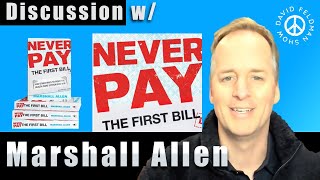
Marshall Allen, former ProPublica reporter, explains how to fight medical billing. Request itemized bills, spot upcoding, use small-claims court. Insured patients often pay multiples of what Medicare allows, and Allen says you can win by knowing the system.
Questions this video answers
marshallallen.com; marshallallen.substack.com (Substack newsletter)
Tennessee: $25,000; Texas: $20,000
Assistant Regional Inspector General, Dallas (Office of Evaluation and Inspections); started the role in July.
Chapters
Marshall Allen is a Pulitzer Prize finalist and reporter for ProPublica, where he covers the healthcare industry. His latest book is Never Pay the First Bill and Other Ways to Fight the Health Care System and Win. Welcome to the show. It's good to see you again, Marshall.
Thank you. Good to be here with you, David. Thank you.
I'm going to give this the Feldman guarantee. Go buy Never Pay the First Bill and other ways to fight the healthcare system and win. If this book doesn't light a fire underneath you, I will reimburse you. That's the Feldman guarantee, Marshall, that is a great guarantee.
I love it. The promise I like to make people is that if you put the tactics that are in my book into place, you could save hundreds or thousands of dollars on every healthcare encounter. I mean, there's so much money to be sa because, frankly, our system is exploiting people to such an extreme degree that if you just can learn to navigate through the predatory practices, you can protect yourself and your family. So that's what I'm trying to do with the book. Yeah.
Thank you for this book. You were on the Ralph Nader Radio Hour and go download Ralph's conversation with Marshall Allen. It's fantastic because.
Never Pay the First Bill is a guerrilla guide to healthcare. It teaches you not just how to get health care, but how to get even. Let's start from a place of rage and anger. You will sit down if somebody contacts you. You will help them go on.
Yes, absolutely. In fact, from Ralph's show, we put the call out for people who need help. And I take great pleasure in helping people fight these battles and win. It's a combination of strategy and persistence and tactics. But the patients can usually come out on top if they navigate it the right way. I've had a lot of fun helping those listeners.
I got charged.
I'm embarrassed to say that thanks to the writer's guilt, I have a pretty good healthcare plan. And in America, that's like, hey, look at me. I'm driving a BMW. I'm ashamed to say that I have a pretty good healthcare plan. And I went in for a COVID test and they billed my insurance company, I think, $300 for a COVID test?
Yeah.
And I look at it and I call a friend who's a doctor and I say, should I make a stink? And of course, my friend who's a doctor says, no, no, no. That's just the game they play. They bill the insurance company and they know they're not going to get reimbursed. It's just a. What should I have done?
Well, you probably weren't paying anything out of pocket there, right?
No, but it's ended my sensibilities.
Yeah. So your incentive isn't to create a big fuss because you haven't actually paid anything out of pocket. But the way we all get duped then in the long run is this, of course, raises healthcare costs over the long term. So all that Writers Guild insurance plan is gonna go up and up and up because they are overcharging for these Covid tests. A COVID test routinely would be around $100 reimbursed, which is still too much. I mean, it's a very simple test. It's very basic technology. It should be even cheaper than $100. So definitely they were taking advantage of your health plan. And that's something. When I started covering health care in Las Vegas, there was a former hospital CEO. They call it the biopsy of the wallet. When they see a patient come in with that rich health benefit plan, oh, they want as many of those patients as they can find, and so they obviously cash in on that. And yes, they are overcharging you. And it's tough to fight that because your incentive is to let it go.
There are laws on the books that outlaw price gouging. What is the definition of price gouging? What does that mean, price gouging?
Well, I don't think there's a real clear definition of it. I think the fact is they can kind of get away with charging whatever they want. There is a term in the law called the open price term. This is part of the Uniform Commercial Code. And what that says is if they don't give you a price up front, then it is assumed that the price you're going to receive is a fair and reasonable price that's set in good faith. Now, I would say a $300 price for a $100 COVID test is not a fair price that's set in good faith. But it is rare for this to be challenged. And I think in the book, what I try and show people is there is a moral and ethical argument, and often there's a legal argument to contest this type of price gouging. And now that most patients are in these high deductible plans, where they have to pay the first thousand dollars, $3,000, $5,000, even $10,000, they're much more incentivized to challenge these price gouging bills. So my definition personally is I don't think that it's fair to expect one patient to pay a lot more than any other patient for the exact same service with the exact same doctor at the.
That's been the standard practice. So Medicare pays way less. If you're a working American, you're going to be paying 2 times Medicare to 5 times Medicare, even 10 times Medicare. And I don't think that's fair. I call that discrimination against working Americans.
I want to ask you about small claims court in a second. Earlier in the show, I was talking about statutes on the books in California and New York that prohibit anybody from price gouging during an emergency. If there's an earthquake, fire, flood, you cannot charge, you cannot gouge people for water. And I did see it enforced during the hurricane season. I did see certain police officers cracking down on it. Are we in a Covid emergency right now?
Is this an emergency?
Didn't Biden. Aren't there emergency authorizations being issued by the executive branch? If this is officially an emergency, why can't. I mean, we know why, but if it is within the powers of our president to prosecute the health insurance companies and the hospitals for price gouging, I.
Think we are certainly in a state of emergency with COVID and it would be entirely appropriate to examine and find anybody who's exploiting that emergency for their own profit. I think the problem is in health care. It's typically an emergency when someone needs health care. I was just talking to a patient today who's being told that she's not allowed to pay cash for a test she needs because she is insured. But the problem is the insured price that her UnitedHealthcare plan has negotiated is twice as much as the cash pay price. And that's often something you find. In fact, I have a whole chapter in the book on how often it's cheaper to pay cash than it is to use your insurance plan. However, in this case, the testing center is wrongly telling her that she has to use her insurance because she's insured. That is not true. But the problem is she needs this test. Yes, we're in a state of emergency right now with COVID but anytime our health is basically being used in almost like a hostage situation, like, oh, do you want to get better? Oh, do you want this test? Then you have to agree to pay twice as much as someone would pay if they didn't have an insurance plan. Or when you look at the price variation in health care, you could have the same treatment at the same facility, but if you're covered by Aetna, it might be three times more than if you're covered by UnitedHealthcare and five times more than if you're covered by Medicare. Again, this type of price gouging and exploitation is happening every day. It's happening everywhere. And it's not just during the state of emergency due to Covid.
Okay, we are. Thank you for doing this and I hope you come back. We got some time left here. Never Pay the First Bill written by Marshall Allen. Go buy Never Pay the First Bill in Other Ways to Fight the Healthcare System and Win by Marshall Allen. Buy this book. Support Marshall. He will if you contact him. And maybe we can dragoon you into coming to office hours and doing an hour to teach us how to go over our medical bills.
I'd love to. I'd love to. So I put my website in the chat. That's marshallallen.com if people do have problems with their medical bills, I respond to all the messages I get on my website. So feel free to reach out to me. I'm also on Twitter. I'm easy to find there. And then I also put a link to my substack, that's marshallallen.substack.com that's my newsletter. And I put out a newsletter every week and I share tips and I share what I call victory stories, which are examples of just David beating Goliath, the little guy fighting the big guy, the big corporation and winning. It's happening all the time and I love to share those stories.
Right. So I was talking about Berkeley earlier. Mario Savio, who started the Free Speech Movement, said the following. And I want, as I read this, I want you to think of the truckers who are violating the law. I support the truckers. I don't support breaking the law unless it's peaceful. This is what Mario Savio said in his famous speech. There's a time when the operation of the machine becomes so odious, makes you so sick at heart that you can't take part. You can't even passively take part. And you've got to put your bodies upon the gears and upon the wheels, upon the levers, upon all the apparatus and you've got to make it stop. And you've got to indicate to the people who run it, to the people who own it, that unless you're free, the machine will be prevented from working at all. That's Mario Savio's Bodies on the Gear speech.
How do we put our bodies on the gear? Let's continue here. Talk to me about small claims court. What can we do legally? To punish the healthcare system.
Without rested and without endangering anybody's life.
Yeah, of course, first of all, sometimes you're gonna, you need the care you need, right? This isn't like we're shopping for a big screen television or a new car or going on vacation. I mean, when people undergo health care, it's because they are sick, they need treatment, it might even be an emergency. And so this is not optional care. And that's why it's especially unethical and immoral, I believe, to use that as leverage against a patient to find ways to charge them way more than you should for a particular service. So right away, I think we have a very strong moral and ethical argument that we should not be price gouged at our time of greatest need. Right. And I think small claims court, I think is probably the most underused weapon that we have in our arsenal. The small claims court system exists across the United States. It allows a weaker individual to sue a more powerful corporation or individual who is taking advantage of them, who is preying on them. This is perfect for health care. The limits are also quite high in a lot of states. They're different in every state. But like this woman who I was helping today, she was in Ohio. And I told her, I said, look, if they insist that they will not let you do the self pay route for your care that you need. She's having her test tomorrow, she has to get this care on the back end. You can sue them in small claims court for the difference between the insurance company price which they're telling you to pay and the self pay price which is half as much. In this case, it's about $1,500. She's being overcharged. Now think about what happens. As a consumer, you do not need an attorney to represent you in small claims court. And if you follow the steps in my book, I show you how to get an itemized medical bill, how to price that bill so you can see if you're being taken advantage of, how to check to make sure that bill is accurate. If you get an itemized bill, you can see, am I being charged only for things that actually happened for treatment I received. You would be blown away by the number of bills that include things for care that we didn't even receive. Or they're often what's called upcoding. Upcoding is where they use a medical code that is exaggerating the severity of the case and exaggerating the severity and the complexity of the care that was provided. And then they price you more for that, they charge you more. So if you look at these billing codes, you can Google them. It's actually really easy. And I show you in my book the websites to go to, how to check these things, how to price them, and then if they won't correct them or if they will not give you a fair price, you've gathered all the evidence you need to sue them in small claims court. And believe me, think about how it flips the power balance. I love this because it puts the power in the hands of the consumer. Now the big hospital System or the Dr. Group or whoever it is, they have to hire their own attorney, typically at a cost of hundreds of dollars an hour, to defend themselves against a case that might only be worth $1,500 or a couple thousand dollars for them. In some states, the small claims court limit is huge. In Tennessee, it's $25,000. In Texas, where I live now, it's $20,000. So the limits are actually high enough to cover a lot of the care that people receive, especially on an episodic basis. And I have a letter in my book, it's a 30 day warning letter. That's a template that consumers can use. And basically it says, hey, look, I did everything I could to negotiate a fair price for this service I received, but unfortunately you are not negotiating in good faith with me. So you've left me no other choice but to sue you in small claims court and you send that 30 day warning letter. And this also bolsters your case with the judge, because if you ever do appear before a judge, the judge wants to make sure that you're not wasting his or her time. They want to make sure that you're not just abusing the time of the court. But there you can go to the judge and say, judge, I sent them a 30 day warning letter, I offered them a fair price, they refused to negotiate with me. But unfortunately, judge, my opponent here is wasting all of our time by trying to price gouge me at my time of greatest need. Usually these cases don't go to court. You get a, you get a call from the hospital attorney. Now they're in the mood to negotiate and they wipe the bills away or they reduce it to a price that's fair. And, and what I like to say is small claims court, it gives them the incentive they need to come to the table and give you a fair price. They're not allowed to push you around anymore because now they're accountable to the court.
Most bankruptcies are because of medical emergencies.
Yes.
Medical debt is, I think, a leading cause of bankruptcy. I'm not sure it's the leading cause, but it's definitely one of the leading causes. And one of the really terrible statistics is that if you get a cancer diagnosis in the United States, it doubles your chances of filing for bankruptcy. So medical debt. There's one out of every three Americans has medical debt. One out of every five Americans has medical debt in collections. And so I have a whole chapter. I saw one of the people in the chat asking about negotiating with debt collectors. I have a whole chapter in the book about how to negotiate with debt collectors. I have another chapter on how to win appeals. When your insurance company is denying you the treatment that you need, which is unfortunately a very common problem, and there are strategies that actually work. It's just nobody ever explains this stuff. You know, I like to say this is all the stuff that you're never going to be taught in your employee benefits enrollment meeting. You know, the broker is never going to come and tell you, hey, here's how you take the system on and here's how you win. And that's what I'm trying to show people how to do.
We are talking to Marshall Allen, author of the book Never Pay the First Bill and Other Ways to Fight the Healthcare System and Win. It gets my guarantee. Buy this book. If it doesn't light a fire underneath you, if it doesn't pay for itself, I'll reimburse you. Marshall will help you personally go over.
Your bills with you. From a mental health standpoint, a lot of people suffer from depression, which is exactly what the system wants. They want us to feel paralyzed, that it's futile to fight the system. One of the things I've done is I've buddied up with people. I have a friend who has a chronic medical condition and I became his advocate.
Great.
Is that a better. So explain to me on a personal level why you find it so satisfying to help others. Personally, I have a friend who needs to negotiate the healthcare system in California, so I invest. Lately it's been okay, but I'd say to myself, okay, this is going to take two hours a week and I'm going to treat this as a job and I'm going to take care of his healthcare. And I found it very satisfying. Is it better to buddy up with somebody, to get somebody to help you take on the health insurance companies than try to do it by yourself?
I think it's great to buddy up with somebody whenever you can. It's important that people are educated and equipped. So they have the right tactics too, because it's paralyzing a lot of times, like you said. And we've been conditioned to be passive. We've been conditioned to be trusting. You trust your doctor or you trust your nurse that they're going to care for you. And generally speaking, they do, or they do their best to. But we make a big mistake when we transfer that same trust to the billing department or to the hospital CEOs or to the drug companies or the insurance companies. For a lot of them, they're treating this like a business opportunity. They've got a great opportunity to leverage our benefit plan for their benefit, not ours. And so I think having a community of people is great. In fact, I've now launched a company, Allen Health Academy, and I'm creating a series of health literacy videos that are based on the book. It's called the Never Pay Pathway. And this is going to be a video curriculum that I think will be a lot more easier to engage with than the book. I mean, a lot of people don't read books, right? And I really want to have this reach the masses. And also it'll be translated into Spanish or at least have Spanish subtitles. There's a huge Spanish speaking population that needs this information. And a part of that component I'm also going to include is kind of a coaching and advocacy component where people can join an online community that all moderate. And I'll have regular office hours there. I would love to do office hours with you. I think it's a great idea. And sometimes people just need some coaching and some encouragement. If you look at my Twitter feed just today, there's my chat with this woman from Ohio who was being told that she can't pay cash when she has insurance. And so this is the very case I'm talking about. People can tweet at me. I'll respond to you on Twitter too. My DMs are open on Twitter so people can reach out to me on Twitter. But ultimately I'm trying to bring this to scale now with my health literacy videos and with this community that I'll moderate. I want this to be part of every employer sponsored health plan. I think health care financial literacy needs to be taught in our schools. Unfortunately, I wish it wasn't this way. I wish we had a health care system that wasn't exploiting our sickness for profit. But unfortunately we're in a position where we have to learn some self defense. That's really what I'm on a mission to do now.
The mission as I see it is don't be paralyzed, be angry. Take your anger and instead of channeling that anger into racism, misogyny, hatred for the least fortunate point, your hatred and anger towards the CEOs of these healthcare.
These criminal enterprises, they really are criminal enterprises. What is available out there.
Government wise to assist other than say, the small claims court if you bog down your congress, I always think write to your congressman, say this is my problem, help me. They have constituent services. If enough people start calling Josh gottheimer's office with real life medical issues.
And I hate to talk this way, but say my kid is dying, help me. Yeah, you need to flood Josh gottheimer's office with letters and phone calls. I'm dying. Help me. My son is dying. Help me.
So, David, I think in a lot of cases there are also. First of all, I agree with you that contacting elected officials is a great idea. I would encourage people to think locally. Every healthcare market is different. And the people who are really accountable, let's just say at the hospital level, those are the board members of the hospital. Nobody ever scrutinizes the board members of the hospital. It's often like the president of the bank and chamber of commerce and some local muckety mucks are on the board of the hospitals. All these hospital boards are legally accountable in each state for the quality of care and the care that's provided at that hospital. They don't get any accountability. They're the ones who the CEOs report to. I really believe that if we put a lot more pressure at the local level on the hospital boards, I think that would bring about a lot of change and I think it would be a huge help. Let me give you one example that where I think we really could have people could make a difference is in the amount of charity care provided by nonprofit hospitals. There was a study that just came out this week from a team at Johns Hopkins that showed that nonprofit hospitals are not fulfilling their responsibility. By the way, this is because they have nonprofit status. They are not paying taxes. This is a massive privilege that they have. But the IRS requires them to provide charitable care. This study found that hospitals are providing a minuscule amount of charity care and that there's a negligible difference in the amount of charity care provided by the nonprofit and the for profit hospitals. So in other words, the for profit hospitals are doing it just as well in many cases as the nonprofits. And so we need to encourage these nonprofit hospitals to live up to their charitable privilege and provide charity care. And so one example I have in my book and my videos is hospital financial assistance policies. Hospital financial assistance policies are supposed to cover anybody up to at least 200% of the federal poverty line, but many of them go up to even 500%. I mean, there are hospital financial assistance policies where if someone is making six figures, they can get a discount on their bills. And so nonprofits need to be held accountable for the type of charity care that they're providing, because in many cases, they're not providing much at all.
We've been talking with Marshall Allen. He is the author of Never Pay the First Bill and Other Ways to Fight the Healthcare System. And when go buy this book right now, and if this doesn't light a fire underneath you, I will reimburse you. Marshall is a Pulitzer Prize finalist. And are you still a reporter for ProPublica?
I am not, actually. So one other thing I was going to point out, David, I now work my day job. I work for the Office of the Inspector General for the Department of Health and Human Services. I do. So I'm not here speaking on behalf of the oig. Right. But I would encourage people. Now, OIG also only covers Medicare, Medicaid plans, the cdc, nih, anything that falls under the HHS umbrella.
Wow.
Notify the oig. The OIG has a tip line. If you're in Medicare or Medicaid and you see something, say something, those are things that the OIG can investigate, especially if it's fraud related or something like that. But I just have to be clear. Anytime I do these kind of interviews, I'm not here speaking on behalf of the oig.
Right.
They always want me to make sure that's clear. But, but the OIG is, is doing a lot of great work in these areas. And so especially if it's Medicare or Medicaid related, then that would be an OIG thing.
You're an inspector general.
I'm not the inspector general. I work out of the Dallas region. My title is actually Assistant Regional Inspector General in Dallas. So the Dallas region. And I'm in what's called the Office of Evaluation and Inspections. And so we basically do evaluations and inspections of federal government spending on healthcare. And so I started that job just in July.
Okay.
Fantastic. I'm going to be bothering you to come back, please. To my audience, people buy books who listen to this show. Please pick up Never Pay the First Bill and other ways to fight the Healthcare system and win. We're running 10 minutes behind. Dr. Philip Hirschenfeld is about to join us. I'm sorry to keep you waiting. My last question is.
Now I'm feeling guilty for keeping somebody waiting. This is what I asked you on the Ralph Nader show.
We are told the free market, the efficiencies of the market will keep prices down. What I don't understand is I go to a doctor, he charges $300 to my insurance company.
For a COVID test. Shouldn't the market dictate, hey, stop overcharging us for Covid tests. You're lying. This is fraud. Why aren't these for profit insurance companies trying to protect their bottom line by calling out fraud?
Well, so if you think about the insurance companies as a middleman, which is essentially exactly what they are, the middleman makes a percentage of the total spend or the total revenue. So the middleman really benefits when the costs go higher and higher and higher. And so for an order, in order for for profit insurance companies to continue to give a larger and larger return to their shareholders, they need those health care prices to keep going up, up, up. So their slice, their percentage of the piece continues to grow larger and larger and larger. And so we sometimes think of health insurance companies as these custodians of our dollars or these protectors of our money. They're actually not in many cases. Also, about 60% of Americans are working. Americans are on fully insured plans. That means the employer is actually funding the health care and these big insurance companies are brought in to administer the plans. They're called a third party administrator. They're just paying the claims, giving access to their networks and things like that. In that case, the insurance company has zero incentive to care about the cost because the employer sponsored plan is bearing all of that cost. It's actually being paid out of the employer's compensation they give to their employees. So the insurance companies do not have the incentive that you would think to keep our healthcare costs low.
We're going to have you back and I'm going to try to get you to come to office hours. It's an honor to talk to you again. Please buy, never pay the first bill and other ways to fight the health care system and win. It's written by Marshall Allen and.
You'Re going to be sick of me by the doctor.
I'm glad. And please, please also subscribe to my substack. Like I'm building this community. The other thing I encourage people please consider a paid subscription on substack. You're not required to. It's a free newsletter. But I am donating all of the money I raise on substack to help patients in need. Sometimes these cases get very complicated and someone needs a paid patient advocate. I'm using these funds I raise on substack to hire patient advocates for patients who have especially complicated cases. It's really an honor to be here. Thank you so much for your interest and people can reach out to me also on my website, marshallallen.com Great.
Thank you, Marshall. Thank you.
More from Marshall






Marshall Allen, "Never Pay the First Bill' Part 1 | The Ovation Show w/ Dan Labroad




