Networking and Learn with Marshall Allen: "Never Pay the First Bill"
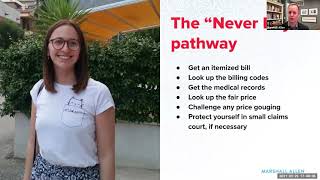
Health care reporter Marshall Allen explains how to fight inflated medical bills. Get itemized charges and codes, check prices against Medicare and FairHealthConsumer rates, challenge errors, and sue in small claims court if needed. One ER visit cost a patient thousands in bogus charges.
Chapters
This is Maggie Booth, Chicago Booth 1987. I'm currently serving as the VP of alumni engagement for Chicago Booth San Francisco Alumni Club. On behalf of the University of Chicago Booth School of Business San Francisco Alumni Club, I would like to welcome you all to this book discussion webinar with health care reporter Marshall Allen about his upcoming book Never Pay the First Bill and other Ways to Fight the Health Care System and Win. The book is a primer for individuals employers who want to protect themselves and the people they care about from the outrageous cost of health care. Before we get started with the main discussion, we would like to acknowledge the help of our event sponsor, Claremont Partners. Claremont Partners will provide the financial support for the Chicago Booth San Francisco Alumni Club to give away 50 ebooks to people attending the webinar tonight. Devin, would you like to say a few words about yourself and your company?
Yes. So glad to see all 29 of you interested in this important topic. We're really happy to be making the book available to the first 50.
Registrants when it comes out in June. A word about Claremont Partners we work with organizations that want to get the most out of their healthcare dollar. We're entirely outside of the broker, agent and insurance agency channels and I think after tonight, if you didn't already have a sense that that was important, you'll understand why.
That'S important. We do have experts on prescription drug pricing and medical billing and direct contracting. If anyone wants to chat, I'll put my contact information in there. Thank you all for attending.
Thank you Devin. If you're interested in getting a copy of the ebook when Marshall Allen's book is being published in June, please after this event email me as soon as possible. My email is maggie wuahoo.com to claim your copy because we have close to almost 100 people registered for this event. So the books will be given to the people who get in touch with me first and they will be given away on the first come first serve basis.
So here is the agenda for today's book discussion webinar from 5:30 to 6:30pm in the San Francisco time zone, Marshall Allen is going to do a slide presentation about his book and we will also take advantage of his presence here to do some group Q and a. And from 6:30 to 7pm we're going to have breakout sessions for networking.
And we really want to take advantage to help everybody to network during this webinar. So here are some networking tips you can rename yourself in Zoom. For example, in my case that would be Maggie Wu, Chicago Booth 1987 and I'm a principal of Echoice Advisor. You can also use the chat function to share some information about yourself, like where you starting from, why do you want to attend this webinar. And also you have a choice of uploading your LinkedIn profile to help other people to get to know you a little bit better. And there are a couple housekeeping items that we would like to take care of before the main presentation. So Marshall Allen's slide presentation will be recorded. So you will be muted throughout the speaker speaker presentation. And if you want to ask questions from the speaker or ask the audience in general, there are two ways to ask questions. One is that you can use the chat function, so submit the questions to the moderator, Maggie Wu. If you want to ask the question anonymously, and if you want to ask the question directly in front of the audience, please use the raised hand feature on the bottom of your screen. And then you will, we will unmute you or you will unmute yourself and then ask the question in front of the audience directly.
So without further ado, I'm going to hand the mic virtually to Marshall Allen.
Thank you, Maggie. It really is a pleasure to be here with you all. Maggie, do you want to share so I can share my screen?
Yes.
Okay, I should be sharing now. You all can see me, right?
We see your presentation slide.
Good. Great. Okay, so I'm shared.
I just want to thank you. Thank you to Devon and Claremont Partners for sponsoring this. I really appreciate it. Thank you so much, Maggie, for inviting me. It is a huge honor to be here. I want to kick things off by telling you a little bit about myself. I've been an investigative journalist for 20 years and 15 of that has been focused on health care. I've done reporting for a decade at ProPublica, which is an investigative news organization based in New York City. I'm also a professor. I teach investigative reporting and before I was in journalism, I spent five years in full time ministry. When I write about health care, I'm writing about it from the perspective of the patient. I'm thinking about the patient who has to navigate the healthcare system. Sometimes that patient is me. And I'm glad Devin said that they do prescription drug pricing because I want to tell you about a drug that my orthopedic specialist prescribed to me called Vimovo. And if you haven't heard of Vimovo, I think Vimovo illustrates a lot of the problems with our pricing of healthcare in this country. It's hidden and often based on very deceptive Schemes. And the reason Vimovo is so deceptive is because it's a specialty drug that my doctor prescribed to me. I didn't really know what it was, but it was a little suspicious because he said I had to get it through this mail order pharmacy called White Oak Pharmacy. And that was a little unusual. So I got kind of suspicious and I called my insurance company about it. And I found out Vimovo is nothing more than a combination of two over the counter medicines, Nexium and Aleve. So you could go buy these down at your drugstore, but instead they've combined them. Horizon Pharma has combined them into one drug that's now a specialty combination drug. And so.
Vimovo is a combination of two common over the counter medications that cost about $30.
What's the price for Vimovo? $3,252 is what my health plan was charged for this combination of two common medications.
Horizon Pharma actually created this drug and if you read their annual reports, their strategy was to exploit employer sponsored health plans. And so they've been very successful. My plan ended up rejecting it because some plans have caught booted Vimovo from their formulary.
But Vimovo has been very successful.
Net sales for Vimovo. I just pulled this from their annual reports for these seven years. $665 million of employer sponsored health plan money has gone for this combination drug. Another one Horizon has called Duexis is another combination of two inexpensive over the counter medications. I think that one's up to almost 900 million dol. So it's not hard to find examples of the drug industry and the medical system taking advantage of us. And I compare Vimovo to Goober. Do you guys know what Goober is? It's that combination of peanut butter and jelly. You can go to the store and you can buy your peanut butter and buy your jelly and make your sandwich, or you can buy Goober, which is a combination of the two. And so I like to say that.
Would be the Goober of drugs, but only if a jar of Goober were to cost $350. Because the price of goober is about 350. So you know, you can do the math there and figure out how I got to that number. So we don't pay $350 for our goober. We don't need to be paying $3200 for our Vimovo. So what's my mission? Okay, this book was an absolute delight for me to write because I was able to take all of these years of reporting all of these stories that I've told of patients and employers getting ripped off by the healthcare system. And I'm now saying, okay, it's a given that there's a problem. Now what are we going to do about it? And so in the book, my goal is to equip and inspire working Americans and employers to fight back against the system. So the book is like a how to manual. It's filled with tactics. Each chapter tackles a different problem, and it's also inspirational. I mean, I think a lot of times we need coaching, we need a little boost and encouragement to see how we can overcome these problems. And if you notice, the important two words on the subtitle are fight the healthcare system and win. I'm focusing on the wins because there are a lot of wins. My audacious proposal is that we've been paying more for health care and getting less for our money. If you look at the data and the numbers, we should be paying less for our health care and getting more for our money.
The book has a lot of how to topics, how to identify errors in your medical bill, how to protect yourself from price gouging, avoid unnecessary treatment, and more. And I also have another thing coming, a health literacy curriculum. So as I've been talking to brokers and consultants and advisors about the book, I've been really pleased to have some employers doing bulk orders and some advisors doing bulk orders of the book. I had some employer benefits advisors ask me to develop a curriculum. And so I'm putting that together now. It's going to be 10 short consumer education videos, maybe five minutes each. I'm putting together a smartphone app with these action steps. We're going to have an online forum for HR and benefits teams and a Facebook group for consumer support. And my goal is to push this movement forward because there's already a movement of consumers and employers who are sticking up for themselves and figuring out a smarter way to do their healthcare benefits. And so I'm trying to really spur that along, and I'm doing it at the grassroots level. You can go to my website, marshallallen.com and sign up for my newsletter if that interests you, and then you'll be notified about kind of the latest developments. So I'm inspired by doing these stories by talking to everyday Americans who are being taken advantage of and really exploited by the healthcare system through what I would call a lot of very deceptive schemes, frankly, to take their money, like Vimovo. And this is a young woman named Gabby, who I met recently. And Gabby is a super interesting, very smart young woman. She's a bridge engineer living here in New Jersey. She works for a major engineering firm. And this is her story, and I call this story how an avocado mishap led to the healthcare system's betrayal of a young American and by the way, her employer's health plan. Here's what happened to Gabby. She cut her finger while slicing an avocado. She went to the emergency room near her home for an in network emergency room visit. There was no doctor examination. Physician assistant just gave her three stitches on her finger. It was as simple as it sounds. Very standard routine. She would have gone to urgent care, but it was after hours, so the emergency room was the only place open. So how much should someone have to pay for something like that? I think the problem in US healthcare is that there is no set price. In fact, a hospital can pretty much charge whatever they want when you go into the emergency room and you can be at their mercy. So you could say, what's a fair price? Is it under $500 for three stitches? Between 500 and $1,000? More than $1,000? More than 5,000. I mean, who, who says what a fair price is? Well, unfortunately, the healthcare system has been able to make up whatever price they want and then really expect us to pay it. So I got an email from Gabby back in December. This is the actual email I received. I've redacted some of the details because I'm not, I haven't published this story yet, but I will be publishing it down the road here. But on October 6, she says, I went to my hospital. The charges for these three, the total charges were almost $15,000. And her insurance plan, the employer sponsored plan, funded 3,000 of that. And then she was left on the hook for a bill of about $2,700 because of her deductible. The deductible is that amount, as you all probably know, that you have to pay out of pocket before your health plan kicks in. So between her and the insurance plan, we're looking at almost $6,000 paid for an insured patient in network to get three stitches. So that's almost $2,000 per stitch.
When Gabby emailed me, you can see that's in December and I'm finishing up my book, right. I just actually turned in the final fact checked manuscript. But at that time I'm still kind of, you know, tinkering with a little bit and I kind of want to practice what I preach here. A little bit. And so I have what I'm just calling the Never Pay pathway in the book, where I guide patients on what to do if they find themselves in this situation. So I thought, okay, this is a great opportunity for me to see how this works. Right. So the pathway is this. And the book shows all this. I show patients how to get an itemized bill, and that means a bill that has the billing codes attached. Usually when a hospital gives you a bill, it's like one lump sum payment for your services. It's like if you went to the grocery store and bought a whole grocery cart full of your eggs and whatever else you buy and they gave you one price. You don't really know. What did they charge you for eggs? What did they charge you for a loaf of bread? What did they charge you for milk? So the itemized bill breaks down all the charges with billing codes. I also show patients how to get your medical records. It's a patient's right to have their records. I show how to look up a fair price. How do you know if the price that they're billing you is fair or not? And then challenge any price gouging, challenge any inaccuracies in the bill, and if it comes to it, sue them in small claims court if they are not playing fair with you. So unfortunately, the medical system has gotten so entitled to taking our money without us pushing back that a lot of times you can't get a straight answer when you try and get the revenue department of a hospital to adjust your bill. So let's see how this worked out for Gabby. So she has her itemized bill. Total charges, you can see there are almost 15,000. The UnitedHealthcare discount. Again, a discount is meaningless if the price is just jacked up so high that it's ludicrous to begin with. But the discount is 9,000 and the plan paid 3,300. She owes 2,670. And on the right here, you can see the itemized bill.
So when you look at that itemized bill, you can see that the bulk of the charge, more than $13,000 of the charge, comes from this ER Intermediate 3. That's an evaluation and management code for the emergency room visit. And that's where they just do the examination of the patient. So the bulk of this bill is really in this one code from what you can. And they wouldn't provide the billing codes and the hospital would not provide the billing codes, but patients can always go to the insurance company and the insurance company will provide the billing Codes. So Gabby got the billing codes and she could see that that level three ER visit was a 99283. That's a CPT code. It's just the current procedural terminology I think they call it. And I show patients in the book, you can look up, you just Google, use the Internet. Most patients are going to be capable of doing this. You can look it up and see the description for that code. If you look at it, you can see that that CPT code should be used for a case of moderate severity in an emergency room. It requires three key components. An expanded problem focused history, medical decision making of moderate complexity, counseling and coordinating care with other medical providers. None of these things were necessary for Gabby's three stitches on her finger.
This is what's called upcoding. Upcoding I think is probably the most common type of fraud that you see in the healthcare system where they just put their finger on the scale a little bit and turn the codes up a notch. You can have a level one to a level five emergency room visit. They called this a level three. This should have been a level one. This was a very simple case. But by charging it as level three, they can charge a lot more money. So the big question, how do you know if you're getting ripped off? How do you find a fair price?
Let's look@fairhealthconsumer.org so this is a website that gathers what insurance companies are paying for different services in different parts of the country. If you look up, I'm just looking at that one code because it's easier, but I would recommend you look up every code on your bill. But the 99283 we can see the in network, that code alone in network would be $288 in her region. And even if you added all the other possible ancillary costs, Fair Health consumer puts that payment at $1,100. Now remember, with her and her plan, they were paying almost $6,000. So no matter how you look at it, according to this website, which is using actual insurance companies paid prices in this community for this code, they're getting charged about six times. They're being required to pay about six times more than they should.
Now this is the biggest breakthrough for finding fair prices. The hospital price transparency final rule. This is something, you know, there are a lot of people have strong opinions about our former President Donald Trump. But one of the things I applaud him for is this executive order where he required hospitals to post on their websites their discounted cash prices for Patients who are going without insurance and their payer specific negotiated rates. So in other words, hospitals now are required to post on their websites all the negotiated rates for the most common services they provide. So no longer do we have this mystery of what insurance companies reimburse a hospital for a different type of service. And they're also supposed to include their minimum and maximum negotiated rates. Compliance has been spotty on this so far. But where you see hospitals complying, it's been very interesting. And so in January, when I realized this rule had come through, I told Gabby about it and we looked it up for her hospital. So it's fascinating what this revealed. And if you had to guess, which insurance plan do you think gets the best price? Okay, so we're going to have Blue Cross Blue Shield. This is just for this one code. Remember we have Medicare, we have United Healthcare and we have cash pay patients. We're going to look at the cash price.
And this is kind of fun. You all probably realize this, but Medicare usually pays the lowest prices. And sometimes more sophisticated progressive benefits plans will use Medicare as a benchmark price. And that's another thing I recommend in the book, even for everyday consumers. You can look up the Medicare price because it's public and then you can compare what you're paying to Medicare. And usually working Americans and employer sponsored plans are required to pay anywhere from 150% of Medicare all the way, sometimes up to six times Medicare or eight times Medicare. And I'm trying to reframe the way we think about these things. What I call this is discrimination against working Americans. Okay? There is no reason why a working American should be required to pay more for a service than a Medicare patient. It's like if my mom and I went into McDonald's and I ordered a Big Mac and they charged me $20 and they charged her $4. It's not fair. It's the same burger. We should get the same price.
So let me show you what this revealed. Okay? This is what the hospital remember. This is posted on the hospital's website. Okay? So Blue Cross Blue Shield for that same CPT code, the negotiated price Blue Cross would pay was $768. Medicare $230. So as you would expect, the Medicare price is a lot lower. UnitedHealthcare $5,805. So in other words, Gabby, who is covered by UnitedHealthcare. It's like playing Russian roulette with your insurance plan, right? When they're charging 5800 and you could have it for 768. But the real shocker is this. The cash price, $256. So, in other words, if Gabby walked in there without insurance, she would have paid 22 times less than her health plan paid with United's negotiated rates. So how screwed up does our health care system need to be when the employed Americans who are working with insurance plans that are supposed to negotiate great rates for us have not even gotten us anything better than the cash deal? I reached out to United. I mean, I'm a journalist. I go. When I'm going to write about anybody or talk about anybody, I'm going to go right to them and I'm going to ask them, hey, do I have this right? Because this is really confusing and looks kind of messed up. So I asked United, why is your price 22 times higher than the cash price? And they said, we made the decision to bring them into our network. The first year rates are higher than our competitors, but that we'll have rate reductions in future years. So I guess Gabby maybe should have waited. Maybe after cutting her finger, she should have waited a year to go in, maybe two years. Then the rate would have been a little better. But it might have scarred over by then. So obviously we need the care now. We can't wait for you to figure out your rates so that they are close to cash. And then the hospital told me the cash rates are for uninsured patients only. The insurance company, acting on behalf of their member, entered into the financial agreement. And it's amazing how blatant they are. Right? The hospital's telling us, look, we made a deal with the insurance company, we agreed to a price, and now the patient has to pay it. And the patient's employer sponsored health plan.
This isn't fair. So who cares about Gabby, Okay? Gabby has been left on her own. Gabby is so desperate, she's emailing a random journalist. She doesn't even know she went to her HR department. They wouldn't help her. She even showed all this to her HR department. They didn't care. The hospital billing department wouldn't even call her back. She appealed it to United Health Care. They just said it was adjudicated correctly because that's about all your insurance company is going to do. They just, well, the claim was filled out correctly and it was paid according to the negotiated rate, so it's correct. And the United Healthcare customer service wouldn't help her at all. And this completely has stressed her out. She's waking up in the middle of the night because she has this pressure to pay this bill and she wants to even go to therapy, but she's afraid how much it's going to cost her. Under the plan that she's under with United Healthcare.
There are about 155 million Gabby's in the United States of America. These are all the people covered by employer sponsored health plans. There are probably another 30 million uninsured Americans who are dealing with this same thing. Although I guess in this case they would have probably gotten a better price with these 155 million people, including myself, in an employer sponsored plan. We're spending so much money that the problem in this country is not that we're not spending enough money. We spend about twice as much per person than citizens of other countries. We still have tens of millions of uninsured. We have one in six Americans that has medical debt in collections. In fact, I have a whole chapter in my book about what patients can do if they're being hounded by a medical debt collector. Because it's such a common problem, it would have been negligent for me to leave it out. We have very little price transparency and price gouging is rampant. There are these reasons we need to fight back. Employers are funding the outrageous prices. Employers have to pay for these employer plans as part of their workers compensation. But workers like Gabby are paying 100% of this out of their compensation. So I think workers need to understand that this is all coming out of your compensation. And so when your compensation gets consumed by high health care costs, your employer doesn't have as much money to give you a wage increase like you would hope to get every year. And so I think employers and employees need to wise up and work together to tackle this problem because it's in both of their interests for them to turn this around. And we're the ones paying, but we don't get treated like customers. I mean, they're just blowing Gabby off. And that's a very common problem. Our money is being wasted. They estimate that about 25% to 33% of all healthcare spending is wasted. We might be wasting a trillion dollars in health care spending every year. If we could eliminate the waste, we wouldn't have a healthcare cost problem. We wouldn't have anyone uninsured. As one consultant that I know likes to say, healthcare isn't broken. It was made this way. This has been going on for decades, year after year after year. If we don't snap to our senses and do something about it, then we have become enablers, we have become suckers. We need to actually.
Take some initiative here and address the problem. So Gabby's not backing down. And I have really enjoyed coaching Gabby and guiding her along this pathway. February 19th, she sent a certified letter to the hospital and said, you're not operating in good faith with me, and so I'm going to sue you in small claims court. And she sent this to the CEO and the cfo and she urged them, don't discriminate against me and exploit me because of my insurance. And she said, my plan has already paid you $3,100. That's more than enough for you to accept.
So she said, I'm offering two pathways here to avoid you getting sued by me. One, accept my insurance plan payment as full payment or return the money you received from UnitedHealthcare for these services and bill me the cash prices that are listed on your website and do it at a level one visit, not a level three.
And she said, in the event that my offer is not accepted by March 30, that's next week, I'm going to sue you in small claims court.
She just heard back this last week from the vice president of Revenue cycle there. And again, it's sort of a form of ignoring her concerns and responding in the same way. Just saying this has been determined by your insurance company. Not usually. We're happy to work with you to create a payment plan, make this financial burden placed on you, buy your insurance provider more manageable. Notice the passing of the buck there. And I love how the healthcare system seems to think the answer to their high prices and their outrageous, unjustified prices is more medical debt. That's the thing. You just need a payment plan so you can owe us money for years down the road.
And this is what Gabby just told me yesterday when I was talking to her about this. I feel like Little Red Riding Hood in the hospital is in disguise as a sweet old grandma, but they're really a wolf trying to trick me. And then she said, Little Red Riding Hood is fighting back against the big bad wolf, even though she is little. And I love that. And Gabby's plan right now is to file her lawsuit in small claims court.
She's planning on filing in what's called the special civil branch of the civil court in New Jersey, which actually allows for suing for claims up to $15,000. Small claims courts around the United States have pretty high limits. I'm originally from Colorado. The limits there are 7,500. And a lot of these.
Courts, they're set up for this type of situation where a consumer is being taken advantage of by a powerful individ or corporation. And we just have not been using this resource to stand up for ourselves. So let's look at some of the money saving lessons from Gabby's case. Number one, always get an itemized bill and analyze it and look and see if it's correct. Number two, look up the billing codes, read the descriptions. Are they accurate or not? I've talked to lots of experts who do medical billing and it's very common to have errors in medical bills. Insurance companies auto adjudicate them. They process about 96% of them by computer. It only looks at whether the claim is filled out and all the boxes are filled. It doesn't actually check to see if those are accurate in describing the services that were provided. So I encourage patients, scrutinize your medical bill, do a price check, look@fairhealthconsumer.org, look up Medicare prices, check the hospital websites to see if they're posting prices as the government requires.
And contest any billing errors. And then consider suing in small claims court if that's something that works for you. The worst thing that can happen if you lose in small claims court is that you will have to pay the bill. And so in other words, the worst case scenario is really the position that you're in right now. And I've talked to lots of patient advocates who use this tactic and often as soon as they send the warning letter, the hospital comes to the table and negotiates. Or as soon as they file the case, the hospital comes to the table and negotiates. So often you don't even have to go to court to deal with it.
So how does Gabby's story end? We're going to find out. We don't know yet. And even if she loses, Gabby has been informed. She's been equipped and she's been empowered. What if she doesn't win? As I said, she's standing up to a bully. She's 26 years old. She's got a great education in how the healthcare system works.
And she is pushing to make a change. And that's something that we all need to do. In fact, what if 155 million Gabby's followed her lead? What if all of us who are being taken advantage of by these unjustified prices, by this price discrimination against working Americans, what if we all stood up and said that this shouldn't happen anymore, the bullies would back down? And I think that's where in my book I really feature the stories of people who have pushed back and won. Because if we follow their lead, if we use these same tactics, we can save as individuals. We can save hundreds or thousands of dollars on every interaction with every drug we purchase. I mean, look at how much Vimovo would've cost my health plan, right? But because whoever was running my plan knew that this was a ripoff drug, they excluded it from the formulary. But unfortunately, for hundreds of millions of other dollars, that hasn't been the case.
Employers and consumers need to realize we hold the power in this situation because we have the money that the healthcare system needs, like we need oxygen to survive. And if we were to start giving our money and our funds to the hospitals, the doctors, the third party administrators, or insurance companies that treated us fairly and didn't exploit us because of our sickness, we would reward those who treat us fairly and then we would penalize those who are being unfair with us.
I want to encourage you to sign up for my newsletter@marshallallen.com.
You can. When you do, you'll get a free copy of the introduction of my book once it becomes available. And stay tuned also for my neverpay employee health education curriculum. I think that's going to be something that's really going to help a lot of people by showing them what they can do. And I'm realistic enough to know that a lot of employees are never going to take the time to read a whole book. But I think the videos will be a really engaging and fun and interesting way for them to learn and then also be empowered and equipped so they can push back.
I love this quote by Abraham Lincoln. Let us have faith that right makes might. In a case like Gabby's or in the case like Vimovo, when we stand up to these injustices, we are right in these cases. It is not okay for us to be taken advantage of in this way. And there's moral force. ProPublica talks about how we want to use the moral force of investigative journalism to bring about change. There is moral force when Gabby stands up to this hospital and when she puts this revenue cycle manager in her place, or the VP of revenue cycle in his place when she names that hospital in this lawsuit, she has moral force behind the truth of what she's standing up for. And again, in the words of Abraham Lincoln, let's have faith that right makes might.
Thank you very much and let's talk. Okay, so I know there's a lot of questions that were submitted. I'm sure you all have your own avocado horse story, so I will stop sharing my screen. And I'll turn it over to Maggie to moderate. And thank you all for being here and letting me do this presentation for you.
Thank you, Marshall. This is a wonderful presentation and I think everyone can benefit from your advice on how to figure out what a medical procedure really, truly costs. And then they would pay the lowest possible cost sharing for the service that they use from their providers. Before I put on this event, I have asked people to share some questions.
I see some in the chat here.
Yes. So if there's anyone who want to ask.
Marshall questions directly, you can certainly unmute yourself and ask Marshall the question. If not, then we are going to pick some questions that we have received before this event.
I could hit some of these in the chat too, Maggie, because some of these are related to the conversation. But I see. Kwame, did you have a question?
Oh, yes, I do.
Real quick.
Who do you think's the worst in the system? So let's say you got doctors, make a certain amount of money, nurses, everybody needs to get paid. But who is overcharging the most in the system?
So I don't think so. Let me say this. It's really hard to say that because what you have is a system that's set up to take advantage of the patient and the employers and they're kind of colluding together. But I would say, let me just say this. The ones that I do not think are the worst are, say the doctors or the nurses. The clinicians who are caring for us are not the main problem. I mean, of course you have some bad actors out there, but generally speaking, the doctors and the nurses are the ones who are actually providing the care that we need. And then the business side of the industry is exploiting the services they provide. And there's really a halo effect around them that they're glomming onto. So that the same trust we put into our doctors and nurses, we end up just implicitly putting that same trust into our hospitals or into our pharmacy benefit managers. Not that anybody knows they have a pbm, but or the insurance company, you know, and if you look at the slogans of all these big companies, you know, they really do promise that they put the patients first, but especially if they're a for profit company, I mean, their fiduciary duty is to their shareholders. Their duty is to make more money. And that's true for nonprofits and for profits.
That's good. Thanks.
Thanks for the question. Hi, Brenda.
Hi, Marshall.
Hi, Maggie.
It's been some while. Brendan McKay based in Los Angeles Marshall, I applaud you.
For publishing this book and doing this research.
Just.
I'll get to my question in a minute. But best background. I'm a healthcare investor. I've worked in the big pharma industry, saw the dark side. I lived in Europe for 25 years and came back only seven years ago. I read in a public library the Affordable Care act for Dummies, and it was a lifesaver for me. I'm still figuring it out, actually. I do pay for my own insurance. The question I have to ask you is, do you have a point of view on why the initiative with Haven, which was a big initiative between Amazon, Berkshire Hathaway and JP Morgan to actually attack for all their employees this over bloated medical expense? Why was it abandoned only two and a half years after setting it up?
So I don't have any special insight into Haven. I haven't done any reporting on it. So I can't. I don't have any actual knowledge about that. But what I can say is that in order to change the healthcare system, it's going to have to be extremely disruptive. And so there are going to be winners and losers here. Because if you look at our almost say, $4 trillion health care tab, one fifth of our economy, and then you look at all the studies that show that up to maybe a third of this spending is wasted, well, the health care system is depending on that for their profits, for their jobs, for their revenue. They need that wasted spending. And so far there's been almost an entitlement just to demand that taxpayers and employers and working Americans fund the wasteful side of this industry. So there has not been anyone forcing them to change. And so I think that type of change only can come from the people who are most incentivized to bring the change. So I don't think that the healthcare industry should ever be looked at as the ones to reduce spending. Right? Like that's. I don't think that's a realistic thing to look at. I also don't think it's realistic to look at the politicians as our hope, because the politicians on both sides are so largely funded by the healthcare system. And so I think it is up to the patients and the employers. I think they are really the sleeping giant in this scenario who have never been empowered, who have never been pushed, and who have never. Everything's been hidden from us. And so now I feel like there is some momentum growing because people are like snapping to attention and they're looking at the cost and the cost is not justified. And the cost keeps going up year after year. So I think it's maybe because, I mean, again, I can't say this about Haven, but you would have to be so disruptive to bring about real change that people are going to lose money. I mean, big corporations are going to lose revenue if we push back and if we fight back and win. And you know what? I'm okay with that. Disruption has come to all different industries. Journalism. I mean, I'm a survivor, right, in journalism. But I have watched our industry get decimated by innovation, largely. And so it's tough. It's a tough reality, but that might be what's necessary.
Thank you.
I see some other questions in the chat I could get to.
Yeah, that's a good idea.
I see Catherine asked, should I claim to be uninsured to see what the cash price is and then compare with my insured price thereafter? Yes, the answer is yes. So I have a whole chapter in the book about always ask for the cash price. And I have so many absurdly silly, darkly ridiculous stories of insured patients just like Gabby finding out that the cash price is way better than the special rate their insurance company has negotiated. So, yeah, I would always ask for the cash price. And now that some of those prices are posted on at least hospital websites, we should be demanding that more people show the cash price. And I see Michael here says, I know people who pay cash only for their healthcare. And that's, you know, doctors and hospitals want to take cash. Actually imagine for them avoiding the hassle and expense of dealing with an insurance company. I think that we could, if the disruption really were to move, we would start taking these middlemen out of the equation and we would get from the employer and patient directly to the doctor. And you see that more and more with, like, employers setting up direct primary care relationships where they actually get better care at a lower price for their employees. And then that direct primary care can also protect employees from the overpriced hospital system that's just going to do unnecessary treatment on them or overcharge them for MRIs and CT scans. And I think, to me, one of the missing pieces here has been that these are good ideas. But sometimes employees can be very suspicious of them if their employer is the one saying, oh, the direct primary care doctor is going to protect you from paying too much. The employee is suspicious and thinks, oh, well, I'm not going to get as good a health care. We think sometimes more is better. What I'm trying to do with this book is educate employees so they can see them and their employers need to be on the same page so that they can do things in a way that saves everyone money and delivers better care. Tony says, why do major employers tolerate this nonsense? Great question. The big employers have the resources to dig into this data and insist that their insurers get their act together. So I also in the book, my three chapters written for employers, one of them is about a relationship between the consultant, advisor, broker and the employer. And the way the traditional health insurance broker is set up is the insurance broker is paid bonuses and commissions by the health insurance company or the vendor.
And the employer is the one actually funding that. So there's a conflict of interest that's been built into the traditional broker relationship. I have a whole chapter on that. And as a result of a story I did about that, Congress actually passed a law that is changing the disclosure requirements for health insurance consultants and brokers. And so starting next year, all of that payment, all the indirect and direct compensation is going to need to be reported by the broker, consultant, advisor to the employer for each type of business. I mean, a broker or consultant could get paid a commission for the pbm, for the wellness vendor, for the health insurance company, for the tpa, for the long term insurance, for the short term. All these different products have commissions attached. Some of the commissions are ridiculously high. I've documented commissions on disability plans that are in the range of 50 or 60% going to the broker. So employers need to look at who's giving them advice. And if your broker is being funded by the industry, then you need to A lot of employers are now going to direct pay relationships with their brokers and then they pay them directly and sometimes even put a bonus in place where the broker gets a bonus if the plan saves money. Well, what do you think that broker, which now they'd use the term maybe advisor or consultant, what do you think that advisor is going to do if they're incentivized to save money for the plan? And UnitedHealthcare is trotting out the same big box.
Health plan with the same traditional PBM model where everything's in the dark, you can't even look at your data. A broker who's incentivized will say, well, let me find you something else. Maybe there's a better option where there's more transparency, where we can get your data, where we can get your claims reviewed before they're paid, which is something that a lot of times the big insurers don't do. Kwame I Saw you. Do you have a question there?
No, I. Well, you read my mind. I really didn't. But I was thinking, is there a business here either pre care to kind of be a different kind of broker providing prices where you tell Gabby, hey, Gabby, I'm sorry about your injury. Can you drive one more mile down to that hospital or post care? What I do is I do auditing, not just for medical care, but there's a lot of reward in finding waste when you're an auditor. So I guess that's what I was thinking about.
There are vendors that provide these kinds of services, kind of healthcare navigator type services.
That's a little bit what I'm going to be doing with my curriculum, frankly. I mean, I'm going to be bundling my curriculum with my book and I'm going to be selling it to employers. So I'm going to try and be more of a navigator where I can be. But there are also vendors who have done the data analytics and can show where people can get prices. But there's no substitute for the patient being educated themselves. And even I have a chapter in the book on avoiding unnecessary care. If you avoid unnecessary care, you've just saved yourself a lot of expense and also a lot of potential harm that can come with health care.
I see. Christopher Whaley asked, should part of Gabby's complaints be directed to her employer, which decided to use United as their employer's health plan and thus subjected her to UHC's prices? Yes, absolutely. Employers have been complicit with these problems. Gabby's HR person who she called is unfortunately sort of typical, kind of blew her off and said, well, that's the plan we have and as if there's nothing they can do about it. And I think there's this myth that employers and employees have been living under that there's just nothing to do about this. And I just think we haven't got enough attention to the people who are doing things differently and finding ways to win. And it's a shame. I mean, I really wrestled with how hard to kind of hit the employers in this book and how hard to criticize them because the employers have just been passing these costs on to their workers and they've been raising deductibles without actually educating their patients about how to navigate the system. They've been raising premiums.
That's the standard for employers, unfortunately. And so I think they need to not be complicit with this passing on the cost to employees. So I think that's a really good Question, Christopher. Part of the complaint should definitely be to the employer.
Maggie, you see any other questions you want me to hit?
Yeah, sure.
Marshall, I've got one for you. Yeah, so when you were talking about the conflicts of interest for advisors, you had mentioned that in light of the article you did, that there was some positive legislation coming out requiring compensation to be disclosed.
In your article you also noted that some of the compensation is based on volume.
Yep.
And I'm wondering if you've got a big brokerage firm and there's these incentives for volume. Isn't that hot? Hard to tie to any particular employer client such that the broker could be like, oh yeah, everything that we got specifically for you we gave back or we didn't take anything specifically for what we recommended for you. And the frontline person from the broker can honestly say that. But as a corporation there's kind of this like lump sum volume bonus that they get.
And you talk in your article about that kind of emails coming from the C suite saying push this product, we want the volume based compensation. How, how do you foresee that getting untied?
So my understanding of the way it's going to work, and this is just from watching some webinars with attorneys who specialize in this. So I'm not, I'm not the expert to go to, but I think this is going to be a game changer, at least in the area of disclosure because the employer is going to be responsible for finding out and having the broker tell them all their forms of compensation. And it's, I think it's like anything over $400, it's a pretty low bar. So even those volume forms of compensation are going to need to be disclosed. There are so many different types of broker compensation out there. I mean there is volume based compensation, there's retention compensation. So United Healthcare or other big insurers or vendors will reward a broker with a bonus for keeping an employer with them. So imagine if you're the broker, how are you incentivized? Are you going to go find the best deal by leaving that vendor behind when they're paying you a retention bonus or a volume bonus?
There are even some other really shady type things where they would have even like.
No shop deals where you're not allowed to shop and find a better rate from someone else if you take the deal right now. And this has been traditionally hidden in the industry. I wrote a list, I came up with a list of all the different types of broker compensation, all the schemes that have been used by the industry to Influence the brokers in the industry's favor, not the employer's favor. And I sent that to the 11 biggest brokerages in the nation, like, you know, the Willis Towers, Watsons and the Aons, the big billion dollar companies. And I asked them to tell me, are you accepting all these different forms of compensation? Not one of them would even answer the questions. Many of them would not even respond to me. But even the ones who responded wouldn't answer the question I have. If you look at my story I wrote about that, I put a link to those questions in it. And if you're an employer, you should get that list of questions and go to your broker right now and say, hey, can you tell me how are you compensated anyway? What type of incentives does it create when you get money this way? And examine whether you should be in a relationship with a broker where it's a direct pay relationship where the employer pays the broker or the advisor and then the advisor works on behalf of the broker. I've had a lot of advisors tell me I work for whoever is writing my paycheck, which makes sense. I do too. ProPublica signs my paycheck and what ProPublica tells me to do, I do. And that's kind of how the world works, you know.
Okay, so Marshall, looks like we are getting close to 6:30. And I know that alumni are very eager to start the networking session. So we're going to put people into different breakout rooms. You're going to have a choice of room that you want to go to. So when I show you the list of different types of breakout rooms, please click the one that you would like to join. If for some reason, like say the breakout room for San Francisco Alumni Club members are really big, then I would. If you send me a text or something, I will create additional rooms so that people you know will have a chance to talk to each other during the breakout session. Marshall Allen will have a room all to himself. So if you would like to ask more questions, again, one on one, please go to Marshall Allen's room. And I'm going to stop the recording at, at 6:30 so that whatever you want to talk about you don't need to worry about. The content will get out of the audience of this webinar. So I look forward to having you have a great time at the breakout session and get a chance to network with your fellow alumni.
This is Shelby.
How do I. Hi Shelby.
Are you in my room?
Oh, okay. All right. Sorry, I didn't know how to get into a breakup. Okay.
I'm not sure how it works either.
Yeah.
Thank you so much for the presentation. It was great information.
Thank you.
I wish I had known this information before, like, previously. Like, one time I had a big surgery, and then the copay alone was like, two, three thousand dollars. I wish I had known all this information. Yeah.
I'm going to join my own room now. Okay. So I'm joining.
More from Marshall






Marshall Allen, "Never Pay the First Bill' Part 1 | The Ovation Show w/ Dan Labroad




