Networking & Learn with Marshall Allen: How to Save Money on Health-Care Costs
Investigative reporter Marshall Allen shares ten tactics to cut healthcare costs, from price-checking before treatment to challenging surprise bills in small-claims court. He walks through real cases like an ER visit that cost $3,000 for stitches and explains how to ask for cash prices, avoid unnecessary imaging, and find financial assistance programs.
Questions this video answers
June 22 (as stated in the webinar)
Chapters
Hi, I am Maggie Wu, VP of San Francisco Alumni Club. On behalf of the University of Chicago Wu School of Business San Francisco Alumni Club, I would like to welcome you all to this book discussion Webinar Number two with award winning public health care reporter Marshall Allen about his upcoming book Never Pay the First Bill and Other Ways to Fight the Health Care System and Win. This book is a primer for individuals and employers who want to protect themselves and the people they care about from the outrageous causes of health care. The book will be published on June 22. Marshall Allen have also created a health literacy program that go along with the book to help people to have a deep dive of the subject matter and also find resources to fight the abuse in the healthcare system. During webinar number one on March 25, Marshall Allen shared an overview of his book with the University of Chicago audience. In particular, Marshall Allen have shared the story of a young woman named Gabby who went to a hospital to fix a cut from her hands. After many conversations with the hospital administration, the insurance company, Gabby's employer, etc. Gabby found out that she had to pay over $2,000 after the insurance payment. Gabby would have been doing much better off financially had she been smart enough to pay the $280 to the hospital instead of using her insurance when she received the bill from the hospital. Not surprisingly, alumni friends attending the March 25 webinar had much to share about their own healthcare horror stories and the dilemmas similar to Gabby's situation during Webinar number two. Tonight, Marshall Allen is going to share some of his strategies to help consumers and employers fight abuse in the healthcare system. He is going to discuss 10 ways that you and your employers can do to save money on health care. Feel free to join the conversation and share your own stories and insights. Before we get started, I would like to go over the agenda for tonight. From 5:30 to 6:30pm, Marshall Allen is going to do a slide presentation and also take questions from the audience from 6 and this session of the discussion will be recorded and share with the alumni in the future when people go to YouTube to view tonight's presentation. During the last half hour of Tonight's webinar from 6:30 to 7pm we're going to have breakout sessions for networking and people will have the opportunity to go to a breakout room to ask more questions with Marshall Allen. Or if you like, you can also join your alumni friends from the San Francisco area or the Chicago area or the east coast to get to know each other better.
So before we get started There are opportunities to.
Rename yourself in Zoom. For example, I am Maggie wu, Chicago Wu, 1987, and I'm also a principal of Echoice Advisor. You can also use the chat function to share some information about yourself. Where are you dialing from? Why do you want to attend this webinar or upload your LinkedIn profile? To help other people to get to know each other better.
And a couple housekeeping items. So, during Marshall Allen's slide presentation, the first hour of the slide presentation and also the group Q and A will be recorded. You will be muted when Marshall Allen is doing his slide presentation. So if you want to ask questions, there are two ways to share your questions. One is that you can use the raise the hand function and unmute yourself if you want to ask the question directly in front of the audience. Or if you want to ask the question anonymously. You can also use the chat function to type in your question as the speaker is doing his slide presentation. And the speakers will select the questions from the group chat messages so that everybody will have a chance to share those ideas and questions with the speaker. So, without further ado, I am going to pass the mic virtually to Marshall Allen. And thank you, Marshall Allen, for doing this presentation to the University of Chicago Alumni Club. Thank you.
Thank you, Maggie. It is a pleasure to be here with you all tonight. Maggie, thank you so much for putting this together. I really appreciate your enthusiasm for, for my book and for the message of my book about equipping and empowering individual consumers and also employers to fight back and win against this health care system that's got us all under its thumb. I mean, financially, we are really being taken advantage of and our sickness, unfortunately, is being exploited for profit. And it's been a pleasure for me to write this book and now promote the book and talk a lot about the book. And it's dealing with what Americans call their number one financial concern, which unfortunately is high health care costs. And the problem here isn't that we're not spending enough money. I mean, we are spending about twice as much per person on health care than the citizens of any other developed nation. And yet we are still being oppressed by these high health care costs and it's holding down our wages, it's driving people into debt. And I'm really happy we can talk about it tonight. Before I share my screen, I want to emphasize that if anybody has any questions at any point during my presentation, turn off mute, speak up, put questions in the comments. It's going to be more interesting for you and for me and for all the participants, if you just interrupt me and ask questions as I go. I'm going to talk tonight about 10 ideas I have. It's actually going to be more than 10 ways that you can save money right now on your healthcare tactics. How to things you might want to talk more about one of these things. I might go past number three and I'm on number five and you're like, oh wait, I wanted to hear more about number three. Just speak up. And I want to make sure that we talk about what interests you. And when I get to number through the 10, we can also come back and circle back to any of them too. And if any of you have tips, we would love to hear them too. I mean, I think we're all here for the same thing and that's to try and get a better deal on our, on our healthcare. So.
With that being said.
I need to get to slide number one here and get started.
Okay.
Let me see if I can get the chat view here just so I can see any questions that come up.
I see grid view.
I'm not seeing the chat, but so Maggie, you might have to chime in and let me know if we have questions in the chat, okay?
Oh, okay.
I'm not, I'm not seeing how I'm able to see it here.
But I'll trust. There's the chat. Let's see here. Nice.
Okay, I'm seeing the chat. Let me stretch it out. Okay, cool. I got my on the chat now too. But still, I might miss something, so just flag me. Okay? Okay. 10 Ways to Save big money right now on your health care costs. Let me tell you a little bit about me. I have spent the last 15 years digging deep doing investigative journalism about our healthcare industry. I'm very focused on healthcare from the point of view of the patient. I've done a lot of work on the quality of care, about patient safety, and also about the high cost of care, especially for people who are in that employer sponsored healthcare world, the 160 to 180 million working Americans. That's where I've done the deepest dive. And that's what I'm going to talk most about tonight. I'm also an investigative reporting instructor at the CUNY Graduate School of Journalism. And before I was in journalism, I actually spent five years in full time ministry and I have a master's degree in theology. So somehow I went from ministry to investigative journalism. My mission with my book is to equip and inspire working Americans and employers to fight back and win against this unjust, an overpriced health care system. So the book is really like a field manual. It's like a how to guide. I've broken these things out into different chapters that address different common problems. And I'm trying to give you winning tactics by highlighting stories of people and employers who have, who have fought back and won. And I define winning, by the way, as getting better health care at a lower price. So we're not talking about denying people the care they need. We're about talking there is so much waste and inefficiency in our healthcare system that we all should be paying a lot less and getting a lot more for our money. And unfortunately it's been the opposite. We've been paying more and we've been getting a lot less.
I make a promise in the book and I think that this promise is true. If you put these tactics into place, you could save hundreds or thousands of dollars with every health care encounter. It doesn't mean you will, but there's a chance that you could and employers can save even more. And so obviously, if employees on a health plan are saving hundreds or thousands of dollars, that's going to save the health plan a lot of money too. And so I have three chapters in the book that are devoted to things employers can do. And I have eight chapters in the book focused on what employees can do. The book goes into things like how to identify errors in your medical bills. Experts who review medical bills say most of them contain errors. I'll talk about that a little bit tonight. The book goes way more in depth. How to protect yourself from price gouging. Price variation is extreme and working Americans are paying the highest price. I go into that in the book how to avoid unnecessary Treatment. The most expensive, ridiculous, wasteful spending is the spending on health care that we didn't need in the first place. And they estimate that a third of all healthcare might be wasted, might be totally unnecessary. It's just over treatment. And we're steered that way because the system, it's a fee for service system where the medical providers and hospitals get paid. The more they do, the more money they make. I make a joke in the book that if I would have been paid by the word to write my book, I'm tempted too. You might have had a million words in my book. Okay, you would have been over treated as a reader. Right. And I think one of the biggest wins for us is small claims court. I think small claims court is totally underused by consumers. And so I go into Some depth in the book about winning tactics to sue to protect yourself. It's actually a lot easier than you might think. Writing the book led me to create Allen Health Academy. So this is now a business I've created. I had some people ask me health insurance brokers if I would create a series of health literacy videos that are based on the book. And so what I've done is I've bundled the book with these videos that I'm in the process of producing right now. We hope to launch this in July. But the idea is that most employees are not necessarily going to read an entire book. I realize that. And so the book is kind of a reference manual and the videos are three to five minutes each. Pretty short and and digestible nuggets of information. Just like the stuff I'm going to share tonight. But maybe a little more detail than what I'll share tonight so that employees can be equipped and empowered and get an overview of how the system works. People don't realize all the pitfalls that they can fall into. Weighs really tricks, really deceptive schemes that the healthcare system has created to extract more of our money than it should from our wallets and from our paychecks into, into their bank accounts. And so this is, I call it the NeverPay pathway. That's the curriculum name. And if you want more information, my website is marshallallen.com I encourage you, please go there. You can go right now. I can't see you. You could be, you know, daydreaming all you want right now. But I encourage you, if you're browsing the Internet right now, Please go to marshallallen.com Sign up for my newsletter when you sign up for my newsletter, you'll get a free copy immediately of the introduction of my book and the table of contents. I hope that you'll like it. And if you're interested, you can also pre order the video curriculum there. We're offering a special on it right now. Okay, now the moment of truth. The 10 ways that you can save. Let me get a drink of water and let's launch into this.
I want to start with some principles because there's never just one way to go with a lot of these tactics. Okay? There's different things. If you understand how the system works, you can understand things that you can do. It does not mean that those things will always work, but these are different things that you can try and often they will work. So one principle is that price variation is extreme. You can get the exact same services for one price at One location and you might pay three times more or even five times more at another location. So keep that in mind. Price variation is extreme and price gouging is the norm. This is one area of life where deceptive business practices have been built into the system. And we don't often assume that because I think we trust our doctors, we trust our nurses, we trust the clinicians who are trying to heal us. What we don't expect is that the financial side of the system is functionally predatory. It is looking to prey on our ignorance and take our money. Number two, you might be able to negotiate. There are no real prices in healthcare. Everything is kind of this fictional number. It's discounted. And we can play that game too, as individual healthcare consumers. So keep in mind, negotiation is the name of the game in a lot of cases. That doesn't mean you'll always be able to negotiate, but you don't have to take the price just because they say that's the price. And number three, I've kind of mentioned this, but there might be a better path to get what you need. And so don't assume that just because maybe your doctor has referred you to one specialist or told you to go one place to get like a lab test done or an imaging test done, that that's the best place for you to go, you might be able to get that same thing somewhere else.
So let's start with tip number one, check the prices. This would have been much more difficult before the beginning of this year. But on January 1st of this year, the hospital price transparency final rule went into effect. And this rule requires hospitals to post on their websites their discounted prices, how much they discount insurance companies prices, their cash rates, their Medicare rates, all of their prices for common procedures are now required to be posted on their websites. Sadly, many hospitals are not complying with this rule. Big surprise. But many of them are. Checking your community, see if your hospital is posting its prices. If it's not posting its prices, it is in violation of federal rules. So demand those prices. And this is going to come in handy sometimes before you get a procedure or a test or an image or some other type of treatment done. But it will also come in handy after you get your bill. Because I think the most important thing I'll talk about one of the other tips is to check your bill and make sure that it's accurate. Also, fairhealthconsumer.org that's a website that gathers all of the payments that insurance companies have made for different services in different communities. And so you can go to that website and if you have the medical billing code or if you know the name of the thing that you need or that you received, like let's say it's a colonoscopy or a CT scan of the abdomen, you can look that up in that database and it will tell you what a fair price estimate is in your community. It's incredibly valuable because you can get an estimate of what the price should be for a service. Again, it's sad that we even have to say this, right, because the American healthcare system doesn't give us the prices upfront. Like, you know, when you go to a restaurant or when you buy a TV at Walmart or whatever, they give you the price. Unfortunately, we have to do some investigating in healthcare to find the prices.
Tip two, always ask for the cash price. So this Maggie mentioned my new friend Gabby, who lives here in New Jersey, and she went to her local hospital because she cut her finger while slicing an avocado. She got three stitches. And for the emergency room visit, the posted price on that hospital website, which she ended up having to pay with her insurance plan, or they billed her, I should say was $5,800. For this level three emergency room visit, she didn't even see a doctor. The whole Visit took about 20 minutes, almost $6,000. For this visit, I showed Gabby how to look up the prices on the hospital website. The cash price for that same visit, $256. So in other words, if Gabby would have gone in and said, you know, I want to pay cash, she would have paid a few hundred dollars. Instead, they made her health plan pay about $3,000, and then they were coming after her for another 2,800 or so dollars. I actually helped her successfully fight this bill. And so she ended up not having to pay that amount, but it was a.
Battle to deal with that. And so we can talk more, more about that later. Tip number three, avoid unnecessary treatment. So again, I mentioned that about half, excuse me, about a quarter to a third. Studies estimate of all health care that's provided is unnecessary, just completely wasteful. And that's because the system is really designed. The medical providers and hospitals get paid when they do things. So again, it's that over treatment problem. Right? I think there's one key question that we can ask.
To really help us protect ourselves from over treatment. And that question is when your doctor is offering something discretionary, something that you may or may not need, and you're trying to decide whether you should do it, let's say It's a drug. Let's say they're saying you should get a CT scan. Let's say it's some type of procedure. Ask the doctor. Instead of just asking what are the risk of the treatment or the side effects of the medication, ask what the risk is or what would happen if you don't do that treatment. I think by reframing it as what happens if we don't do this, instead of assuming that we will do it, it forces that clinician to reframe the discussion in a way that instead of assuming that you're going to move forward with it, let's talk about what happens if we don't. What's the worst thing that's going to happen to me, Doc, if I don't take this medication right now? Is there urgency for me to do this right now, or is it optional for me to do this right now? I think that's a really important question. Another tip for avoiding unnecessary care is to consult the U.S. preventive Services Task Force. This is a independent panel of volunteers. What they do is they assess all of the best and most reliable and most unbiased evidence, and they make recommendations about whether or not people should get common preventive things like mammograms or prostate exams. And a lot of times their recommendations do not align with some of the big specialty groups that, by the way, happen to be funded by the pharmaceutical industry or the device industry. The independent advice is often more conservative and recommends less treatment than what the industry is recommending. And that's because I believe there's a conflict of interest with a lot of the recommendations that are made by the industry.
I've gone through three of the tips here. I just want to see. Does anybody have any questions so far about any of the things that we've discussed? Maggie, is there anything that jumps out to you?
I don't see people asking any questions at this point, so maybe we'll hold off until the end to discuss this a little bit more.
Let's keep going, folks. If you have any questions, pop them in the chat, and I will keep going.
Okay, sounds great.
Tip number four. This is called the battlefield consent. This is a tip that I got from the financial literacy organization Quizify. And when you go to the emergency room early on in your visit, you're going to be given a form to sign that says, I approve or I agree to be held responsible for whatever charges are affiliated with this visit. Right. It's the financial consent form. The battlefield consent is a little different. Remember how I talked about the price variation. Well, Medicare prices, because they're set by the government for people, agencies 65 and above and people who are disabled, the government sets those Medicare prices. Hospitals take Medicare rates by saying writing in the I consent to appropriate treatment and to be responsible to pay for up to two times the Medicare rate. What you're saying is, I'll pay twice the Medicare rate. I won't pay more than that. And what it does is it puts a ceiling on the charges that they can hit you with. This does not mean that it's a guarantee that they won't charge you more than two times the Medicare rate. There are no guarantees. But what it does is it preemptively protects you through this legally binding document that you've signed because you've written in a clause that says how much you're willing to pay. The ceiling on what you're willing to pay. And like I said, small claims court is something I recommend down the road, if you end up having to sue to protect yourself against an unfair medical bill, this is something you can use as leverage to say, look, when I signed our legally binding agreement that said I would pay for services, I agreed to pay up to twice the Medicare rate. I did not agree to pay whatever you charged me. And so Al Lewis from Quizify calls this the battlefield consent. And it's because it's that, you know, you're in the fog of war when you go to the emergency room, right? You're doing something to preemptively defend yourself in case of attack. Because believe me, these bills that can come from emergency room visits can be astronomical. And so we have to be thinking preventively when we go to the ER.
Let's see here. Hi, Marshall, where should the statement be included? Great question. I would write it right on that financial services document. So write on the document they give you where they ask you to sign it. Write it right there. That language. Put it right there. And sign your name. And if they just give you an iPad or something electronic, tell them you need a printed version of the form so that you can write that in on the form. Trust me, they probably aren't even going to look at it. And here's another tip. They are required by law to treat you, so they can't use you writing in that clause as a reason to deny you emergency care. They're required by federal law to provide emergency treatment. So Anand asked, where should it be? Where should the statement be included? Write it right on the form.
Tip number five.
Check your bills. Okay? This is. This is you know, the title of my book is Never pay the first Bill. And this is a principle. It doesn't mean never pay the first bill, but it means never pay the first bill until you have analyzed it and made sure that it's accurate and made sure that it's priced fairly. This is the kind of pushback that we need to start doing as consumers. So, number one, you want to get an itemized bill. When you go to the grocery store and you load your cart up with groceries and you go through the checkout line, they don't give you a receipt that just has like one lump of sum total on it. They give you a receipt that shows the price of the eggs, bread, milk, cheese. That way you can see if it's accurate and see what the prices are for each item. So get an itemized bill from the hospital or from the doctor. It's your right to have one, and they're easy to obtain. Number two, make sure your itemized bill has billing codes on it. These are the codes that your hospital or your doctor uses to submit to your insurance company to get the payment. They have to have a bill. It's a lexicon, a language they use to translate those medical services into payment through your insurance plan. Your itemized bill might not have those, and if the hospital won't give them to you, your insurance company, it's easy to get that from the insurance company. This is one thing insurance customer service people are very good at, looking up claims and telling you what the code was. Once you have those codes for each service, you can see if the services actually happened. A lot of times you'll get a bill. It'll have stuff on there that didn't actually even happen. Doctor exams, lab tests, things that you know didn't happen. You can contest those items. You can see if you're. You can see if they've been priced fairly. Remember I Talked about the FairHealthConsumer.org website or your hospital websites? You can use those codes to see what other people are paying. Did they overcharge you? There's no reason you should pay more than someone else should for the same services. You can get your medical records. It's every patient's right to have their medical records. Get those records and see if the records accurately describe what you received. And then see if they are accurately translated into your medical bill. And then challenge any price gouging. Tell them that they need to correct the bill if it's inaccurate. They need to contest the prices if they're overcharged. So it sounds like a burden. Sometimes it is. I'm not going to lie. This can be work. But by identifying any errors or overcharges in your medical bills, you could save thousands of dollars. So I like to look at it like paying myself hundreds of dollars an hour by saving my money instead of just giving it to them. I'm seeing some questions come in. These are. Okay, let's look at some of these questions here, because I'm seeing a bunch pop up. Most financial consents have an assignment, the insurance that may conflict with the battlefield consent. I'm not quite sure what that question is asking.
So I think what you're saying is maybe your insurance rates might disagree with it.
I look at my relationship and I think the way we need to look at our relationship with our hospital as.
Like, it's not okay for an insurance company and a hospital to agree to make us pay more than we should for healthcare services. That's just not something that I accept as a given. And I think that's something that the system has told us we're supposed to do. But if your insurance company has agreed to a price that is completely unfair for you, I don't think there's any reason why we should accept that. I'm sorry, that's not fair.
So if your insurance plan has agreed to prices that are more than twice the Medicare rate, then I would push back on that. So that would be my answer there.
This question concerns Medicare coverage of durable medical equipment. Who determines how often supplies are reimbursed by Medicare? Is it the manufacturers? This is a question I don't know the answer to. I don't know how Medicare decides what's covered.
In terms of medical supplies.
Yeah, I see this person just saying that CPAP supplies can be a real racket. That's absolutely true. That's another case where the cash price can often be better than paying for. I've done some stories about CPAP machines and the high cost of CPAP supplies through your insurance, when really you can often get those same supplies for much cheaper by buying them retail.
Julie asks, what about misdiagnosis? That requires a second ER visit. I would never pay for the first misdiagnosis visit. That's a great question, Julie. Misdiagnosis is a massive problem. And I think maybe one of the greatest injustices of our healthcare system is that if they make a mistake, they still send you the bill and make you pay for it. So this is another case where I think I would look to small claims court as a possible solution. Depending on the cost, because sometimes these things are above small claims limits. But it's actually my next tip to talk about small claims court. So let me just hit that next tip number six. Okay, so let's say you've been misdiagnosed, and let's say it required treatment that you didn't end up needing. I would contest any bill related to that treatment that was related to the misdiagnosis. And small claims court is a great venue to do this. Now, a lot of people go small claims court. It sounds kind of small, right? I mean, these bills can be big. Well, the surprising thing is that in a lot of states, the small claims limits are actually quite high. Texas, the small claims limit are $20,000. In Tennessee, the limit is 25,000. I think Tennessee is actually the highest in the nation. Where I live in New Jersey, there's a branch of court called the special civil branch, where you don't need to be an attorney. You can represent yourself. And it's like small claims, but the limit is 15,000. I grew up in Colorado. The limit there is 7,500. So these are limits that are high enough to cover a lot of the cases that we have. If your case is higher than that, I would really recommend enlisting a patient advocate. Patient advocates are often paid by the hour. They're experts in processing these kinds of things, and they can be worth their weight in gold. And I have some information in the book about how to find a patient advocate, and there's some even websites I refer to about how to interview a patient advocate. So if you're stuck with a case that's a much higher dollar limit or it's exceptionally complex, I really do recommend bringing in a patient advocate, a pro who can help you. This picture of this family, this is Josh and Jennifer. They go to my church, and they were having a dispute with their dentist for about $300. Jennifer had gone in for a root canal, and they had given the credit card to the dentist for any charges that weren't covered by insurance. And unfortunately, the dentist overcharged their credit card by about $300 when he should have run the bill through the insurance plan. And so the billing was all screwed up. The dentist just made them pay an extra 300. They fought this thing for years. They argued with the guy, they called him. They dealt with the billing department. They got the runaround for years. And I was in the process of writing this book, and I said to him, I was like, man, you guys should sue this guy in small claims court. What Happens when you sue in small claims court is you take the battle out of the playing field where they make all the rules, and frankly, they have gamed and rigged the system in their favor. And you take it into an independent court, which is set up by our constitution, by our judicial system, to protect consumers against powerful individuals or corporations that are taking advantage of us. And in this case, Josh filed a lawsuit against the dentist. Again, it's about 300 bucks. But small claims court, it costs like 20 bucks or something to file a case. You don't even have to write a detailed description. He already knew what the issue was because he had been fighting this thing for years. Well, when you file that case, let's think about what happens on the other side. All of a sudden, the hospital or in this case, the dentist realizes, oh, what's the deal? I'm gonna have to go into court. I'm gonna have to hire an attorney, maybe to defend myself. It could cost hundreds of dollars an hour just to hire an attorney. It's not worth their time. It's not worth their money to try and defend something that's indefensible. And so it gives them the incentive they need to come to the table and treat us fairly. And sure enough, in this case, before they even had a court date, the attorney for the dentist called Josh and they refunded his money, as they should have done in the first place. And so what small claims court does is it gives the incentive to the party that's abusing us to come to the table and treat us fairly.
Let's look at another question here. Jim asks, given you have some time before you need treatment, do you think treating this like an RFP by sending the diagnosis to several reputable health care providers, asking them for quotes, I think that's a great idea. What are the risks of doing this? How do you find out who to negotiate with at these large institutions? So, Jim, that's a really great suggestion. And especially, let's say it's something. It's easier if it's something common. I mean, if it's something like you have a rare form of cancer and there's only one place you can get treatment, well, that's going to be a much harder thing to deal with. But let's just pretend it's a knee replacement. A very common, the most common, maybe the most common operation. Well, a knee replacement. The range of prices I've seen myself are between $20,000, even less than that, and $100,000. I've seen charges and payments demanded at over 100, over six figures for knee replacement. So you could get a wide variation or even childbirth. I mean, that's another one where the variation is massive. Just for a regular, uncomplicated vaginal childbirth, the price variation can be extreme. I would start with the hospital websites. So the crazy thing is, if you have, let's say you have UnitedHealthcare or Cigna. Well, now hospitals are required to show you what their negotiated price is with your insurance plan. And often the marquee medical facilities, the big brand names that dominate the different marketplaces, they have used their name and their market power to negotiate higher prices from insurance plans. But for something like a knee replacement or childbirth, something very common and typically uncomplicated, a community hospital that isn't the big brand name can be just as good. In fact, I've done a lot of data analysis to show the quality of care. It's often more dependent on the doctor than it is the hospital anyway. So a lot of these hospital prices, they're just making you pay more for the same thing. So I would treat it like an rfp, Jim. I would look at different hospitals and see what their prices are. And if they're not posting prices, remember, they're required now by federal rule to post prices. So how do you get that if they're not posting it on their website? Every hospital should have a patient advocate. Remember, that patient advocate is paid by the hospital, so they're not going to really stick up for you. But just to get a price, they should be able to help direct you to know where to get that price. Or call the billing department and see what they say. If they won't give you prices. Now, because of that federal rule, I would raise holy hell with those people. I would call the board members. I would make it very uncomfortable for them because they need to hear from the public.
The federal regulations require them to post prices. If they're not doing that, they're violating what the federal government requires.
That's my answer for Jim. I have another direct message here about an HSA plan. I want to get an MRI done on my knee for an old sports injury. A clinic 50 miles away does it much cheaper than where the knee specialist practices. Not a big surprise there. I'm going to talk about that. That's actually one of my tips. Will the specialist find it acceptable that the MRI was done elsewhere? They should find it acceptable a scan done one place. Again, these imaging facilities are licensed. The radiologists and doctors and techs doing these imaging procedures are licensed. They are accountable. They are inspected. An MRI done at an independent center that's less expensive than the hospital center where your specialist works, it ought to be just as good. And so I would check with your doctor and if your doctor pushes back, I would just because sometimes actually doctors own imaging centers. So you want to check about that. I would just make sure they can justify why it's not just as good to go one place than another. And that's actually.
That question is skipping ahead. You'll see. I think that's tip 8 here. Tip 7, see if you qualify for financial assistance.
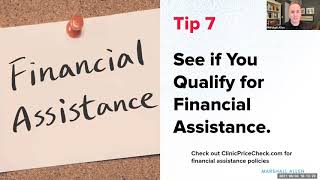
I didn't know a lot about financial assistance policies until I started researching this book. But if you go to this website, clinicpricecheck.com and you look up in your community, it will search and find different financial assistance policies near you. Every nonprofit hospital is required to have a financial assistance policy. Many times they are very generous. Even people who make six figures for their household can qualify in a lot of cases for financial assistance. And if you make less, a lot less, like say two or three or four times the federal poverty level, you can often get your entire bill waived. They are supposed to. They're also required by law to make their financial assistance policies readily available. Often it's right on the back of a bill. Look at the back of your bill and see if it has a phone number on it where to call if you need financial assistance. It might be on the back of the bill. It might be on a hospital website. But I talked to a woman just the other day who had a partial knee replacement. She's 53 years old and her insurance actually covered most of the charges except for an anesthesiologist bill of $385. Some people might not blink at 385. They would just pay it. No big deal. It's only a few hundred bucks, right? But did you know that about 40% of American families do not have more than $400 in their savings account? So for a lot of people, $385 is a big chunk of change. That might be their entire groceries for the month. And in this woman's case, she and her husband had lived a really kind of cool non traditional lifestyle where they had been living off their savings on a sailboat traveling up and down the west coast of the United States and Mexico. So their income level was actually incredibly low. I think the husband was Medicare and she had some Social Security, but they didn't make a lot of money. And so I told her about financial assistance policies and she's in the process right now of applying for it. And usually what they do is they ask you to verify your income. They might ask for check stubs. In her case, they asked for some tax documents. But on paper, she doesn't make a lot of money. In fact, they have a very low income. So I would not be surprised at all if she's able to get that bill waived. So check for financial assistance. We're now through seven. Any other questions? Does anyone want to brave the microphone and speak up or should I keep going? Maggie, what do you think?
Maggie, are you with me?
All right, I'm gonna keep going. I don't know if we lost Maggie. I don't know.
I think we have some brave attendees who want to ask some questions.
Oh, good, good. Okay, great. Let's hear it.
Turn on your camera and let's. Let's hear your question.
So I think Daniel has a question.
I think instead of small claims court, maybe another option is to charge back. Charge back with the credit card company.
Oh, like stop payment with your credit card. I think that's a great idea.
I think that's a great idea. The problem is they'll still send you a bill. So there, you know, let's say you block payment on your credit card. Then they'll just say, oh, okay, well, we'll just send you the bill. And then if you don't pay the bill, they could send you to collections. So you're going to have to deal with that bill somehow. So I don't know. That might help you in the short term, but not the long term.
Okay, so I'm curious. Like you say, never pay the first bill, so maybe it would take a while for the providers to figure out the charges. Right. And in the meantime, you're not paying the bill and it might pass the 90 day limit. What kind of damage would it affect the consumer financially?
So these things can get resolved within 90 days. You can come to a quick understanding. So let's say you get the bill, but you need an itemized bill. They should be able to get you an itemized bill the same day. Or within a couple days, you might need to make a phone call. You might need to make a reminder phone call. But getting you an itemized bill is something they have right at hand. And you can call the billing department and get that. So you can immediately get the billing, the itemized bill, you can quickly get the billing codes, and then you can quickly look up to see whether the bill is accurate and whether you've been overcharged so that can be done within a matter of days. And then you'll know, okay, do I need to fight this or do I need to pay it so that that won't take 90 days. It's actually quite, quite quick.
Yeah. I think before this event, a lot of people have submitted questions, and I'm kind of surprised to notice that quite a number of people have asked that, like, they went to the hospital and the hospital is supposed to be an in network provider for the insurance plan, but somehow they end up getting a bill for doctors who are really out of the network. So is that very common or what should people do when they experience that kind of situation?
It's extremely common. And it's been so common that a surprise billing legislation was put into. I think it was one of the stimulus bills that was passed toward the end of last year. And so that's going to protect consumers from these surprise bills. And so now our insurance plans are going to need to.
Deal with those that the consumers are not going to be hit with those in the same way anymore.
I just need to text my wife to take care of my dog here because he's scratching at the door.
Excuse me.
So I hope that that surprise billing legislation is going to correct that problem.
But we will find out how that will go. Unfortunately, that is a common problem. And that's also a case where those surprise bills are often for charges that are much higher than they should be. And I think that's also a case where we should contest those and sue those providers in small claims court. We need to make this as painful and inconvenient for them as they've been making it for us. And consumers have just never stood up for themselves and they haven't known how to stand up for themselves. If we were to begin pushing back in this way, we would be creating incentive for them to stop unfairly billing us.
Okay. And I think someone in the audience by the name of Julie want to share some tips that she know would work. She say, I know several people who have called a hospital and said they can't pay the amount. Hospital asked, what can you pay? And offer 20%. And the deal was done. Collections usually only pays 10%, so 20% is a better deal for the hospital.
That is an awesome point, Julie. You're absolutely right. And that's what I found, too. I have a chapter in the book on how to deal with medical debt collectors when they start calling. And the way that process works is just like Julie said. So after the hospital is seeing that the bill has not been paid, they might hire their own debt collector, and that debt collector will then get a portion of what they get. But if your bill goes to collections and a debt collector is calling you, that's a good opportunity to renegotiate the bill. And so you can get a big discount. And if your debt gets sold to a debt buyer, it will probably be sold for pennies on the dollar. So like Julie said, it may be that they only get 10% or even 5% for the money that they're owed. The debt buyer buys it, then the debt buyer has a debt collector coming after you. And at that point, you can then renegotiate that at a much lower price. So it is a good idea to, to do that.
Now. My cat is meowing outside my door. How about this? Working from home.
You probably can't hear him, but he's out.
Okay, so we have a good question here about medical errors. This is again, one of the greatest injustices of our healthcare system. Medical errors are one of the leading causes of death in the United States. And not only do you suffer harm, but then they send you bills for it. So this question is, how do you deal with a medical error that results in permanent damage, but it's difficult to prove the cause of the damage? I'm sorry, I don't have a good answer for that. I have probably done as much reporting on patient safety problems and medical errors as anybody in the country. And this is just a total injustice. So I don't have an easy answer for you. I'm really sorry. I wish I did.
Because it's so hard to prove some of these errors, and it's very hard. They want scientific data. Lawyers don't take these cases. It's a myth that there's a bunch of frivolous lawsuits filed by patients against medical providers. It's a myth because lawyers won't take these cases. They only take the cases that are absolute slam dunks. And so patients often are left completely wounded and harmed with almost no recourse. And it's a very common thing. And unfortunately, there's often not a lot you can do about it. I'm sorry if that's the case for you.
Let's look at the next tip here. Tip 8 Avoid hospital imaging centers. We talked about this a little bit earlier, but.
Studies have shown that hospital imaging centers are the most expensive place to get your CT scan or your MRI or X ray or other imaging tests done. If you can check an independent imaging center, it's probably going to be A lot cheaper. This guy. I did this victory story about Kevin Vincent from Amarillo, Texas. What he found was he needed 2 MRIs before he had a back surgery. He found that the place his doctor referred him to, the hospital imaging center, said it would cost him $11,000 and he had a $10,000 deductible. So he had to pay that first 10 grand before his insurance plan paid anything. He asked, okay, what about the cash price? Remember, always ask the cash price. They said, well, it'll be nine grand with the cash price. He's like, well, that's a little discount, but not a great one. Well, he used green imaging. And if you go to greenimaging.net, next time you need a non emergency imaging test, check green imaging. Because green imaging has direct pay contracts with imaging centers all over the country. And they're not in every community, unfortunately. They're growing, but they're not everywhere. But they happen to have a contracted imaging center in Amarillo. Kevin went from paying either 9,000 or the $11,000 charge for two MRIs to $850 for his two MRIs. The imaging center that was the independent one was about a mile away from the hospital imaging center. It wasn't even inconvenient. And he saved like $8,000 just like that. And so again, my cars are not even worth $8,000. So that is a massive, massive savings. And again, it doesn't always work, right? But it's things that you can check to see if they will work.
Okay, we have a question here. Do you believe that commercial insurance like UnitedHealthcare play any role in the rise in healthcare costs? Yes, I absolutely do believe that they do. In fact, one thing that's really interesting, and I mentioned this in my book, there's something called the medical loss ratio. And the Affordable Care act put a rule in place where the medical loss ratio, this is basically the ratio between what you spend on premiums and what gets spent on health care claims. And some insurance plans, like especially junk insurance plans or short term insurance, they might have a medical loss ratio of 50%, which means only 50 cents of every dollar you pay in premium goes toward medical costs. So in other words, that insurance company is making like a 50% margin. That's outrageous profit, right? So what the Affordable Care act tried to do, and it's a good thing, right? They wanted to limit the amount of profit insurance companies could make. So they set the medical loss ratio at 80 or 85%. That meant that the insurance company could only make a Profit and administrative cost of say, 20 or 15%, depending on the type of plan that you have. And insurance companies love to say this. They love to say, oh, our profit margins are so small, we only make like a 3% profit margin. And there is some truth to that because of the medical loss ratio. But think about it this way. If the medical loss ratio means that they can only make a 15% margin for their administration and their profit, their incentive is to have those costs go higher. But because their 15% gets bigger as the costs go up. And so the medical loss ratio actually incentivizes our health insurance companies to have those costs go up. I don't think that's the only reason the costs have gone up, because they were going up before the medical loss ratio went into place. Another huge problem is that the insurance companies are more loyal to the doctors and the hospitals in their networks than they are to the members who are paying the bill for all of this care. And so you have insurance companies really collaborating with doctors and hospitals to have these prices go up. And they don't really care. They're middlemen. All they're doing is taking the money they bring in from us and from employers and doling it out and taking a cut of it. It's not their money, so they're not actually losing as healthcare costs go up. So I definitely believe commercial insurance companies play a huge role in the rising cost of health care. I do not think that they're protecting our money. I do not think that they are advocating on behalf of their members to keep healthcare costs down. What they're doing is they're staying true to their mission. As for profit companies to bring in a good profit for themselves and their shareholders. That is their job, really, if you think about it. And so one of my main arguments in the book is that we need to stop thinking someone else is going to come to our rescue. The politicians have not come to our rescue. We've had both parties in power where they could have made changes that would make these problems not what they are. They haven't done it. They haven't. They've made some small incremental changes. They've made some big changes that have been good. But even like take the Affordable Care act, which has a lot of really good things in, does not address the health care cost problem. It doesn't. In fact, what it does is it actually adds a lot more paying customers to a system that is totally overpriced and filled with deception and filled with price gouging. So it hasn't helped us in the area of healthcare costs. In fact, costs have gone up a lot since then. So the politicians aren't going to save us. The healthcare industry isn't going to save us. They offer these incremental changes that they promise are important, but they're just working around the edges to try and show that they're doing something. But again, look at the evidence. The evidence shows year after year, for decades, our costs are unjustifiably high and our outcomes are worse than other countries. So I wrote this book because I have been observing this, I've been studying it, I've been writing story after story about it. And I do believe that employers and employees and just regular consumers, if we were educated about the way this game actually is played, and if we stopped wishing that someone else would take care of this problem for us, there's actually a lot that we can do. It's just that it's going to require us to snap to attention and start pushing back and start using some of these tactics that might sound confrontational, they might sound difficult, but really it's just standing up for ourselves, folks. Like, we wouldn't allow a restaurant to do this to us, we wouldn't allow a retail store to do this to us, but somehow in healthcare, it's just something that we've come to accept. Now, I'm on a real soapbox here. You've got me all, got me all excited. Okay, let's go to number nine, prescription drugs. Okay.
Goodrx. Studies that have been done that look at prices at pharmacies in different communities show that the Goodrx price is often one of the lowest prices you can find. And Goodrx, if you don't know what it is, it's a website where they have coupons for different drugs and you may have to go to a different pharmacy and pay cash using the Goodrx coupon, but the price will often be lower than you would find in other places, and it might even be lower than what you'd pay with your insurance plan. So check Goodrx and see if it works for you. Also check this pharmacy in Memphis called Good Shepherd Pharmacy. This is a very progressive pharmacy where they have a membership program. You can pay $5 a month to be a member and you get for your $5 a generic drug that you need. So it ends up being about $5 per month per drug that you need. But they have lots of common drugs available. And if you're uninsured or if you're on a high deductible plan. That Good shepherd mail order program might be a really good one for you. Also, if you want to know how crazy our healthcare pricing can be, check out the Canadian Med store. Okay? This is especially for specialty drugs. So Good shepherd can handle your generics, which are usually pretty inexpensive. Specialty drugs are really the high dollar problem. Drugstore unlimited.com. what they do is they actually import drugs from Canada, the United Kingdom, New Zealand, Australia. It's the exact same drugs that we get here in the United States. The same brand name, the same manufacturer, the same packaging, but it's imported. Our drug prices are so gamed and there are so many middlemen and markups here in this country that it's cheaper to import the drugs from other countries to our country than it is for us as Americans to get them here. And if that doesn't show the injustice of our, of our health care system, I don't know what does. But check it out. It might be a good solution for you. Last tip on my top 10. And actually, I could have made more. You know, obviously, I love to talk about this stuff. Some of these tips are broken. You know, there's lots of tips contained in each one. I did this really fascinating story a few years ago when I was writing about wasted healthcare spending about eye drops. I did not know. You know, when you put in an eye drop and there's always that bit of it that runs down your face or overflows your eye, it's not because, like, you missed or something. It's because our eye is only designed. The anatomy of our eye can only hold about nine microliters of fluid. But the typical eyedrop is anywhere from 30, 40, even 50 microliters in size. The eyedrops that are made by the eyedrop manufacturers around the country are three to five times bigger than they need to be. Studies have shown that a micro drop, a little 10 microliter drop or 9 microliter drop, is just as effective as a giant drop. The giant drops, which unfortunately are the regular drops we get. It's like overflowing your eye. It's just running down your face anyway. It's not like you're getting more medication. This is not such a big deal if you're using the occasional bottle of Visine that you get for five or ten bucks down at your drugstore. But if you're a glaucoma patient and your drugs cost $200 per bottle, it's a big deal if you're wasting your eye drops. And so one of the. This is one of the most inspirational things for me as a journalist as I wrote this story. And some young medical students and designers ended up creating this new product called the Nanodropper. And what this is, as you can see from the photo here, is it is an attachment that screws on to eye drop bottles and creates a microdrop, a tiny little drop that does not waste your eye medication. And so if you're a person who needs to use eye drops regularly or you know someone who does the Nano dropper, this attachment, I think it's about $15, it can be reused. This might be a great solution for you. It could end up extending the life of your bottles of very expensive eye drops. And so it's something that I recommend that you check out.
I hope this list has been helpful to you. I hope this conversation has been interesting. I am available in one of the breakout rooms. We can continue the conversation. I also urge you, please, please buy my book. I'm really hoping people will pre order my book. It makes a great gift. Perhaps you have some adult children who need some health literacy as they start out their careers. I don't know. I hope you enjoyed this conversation and I welcome any questions that you might have. Thank you.
Thank you. Marshall Allen.
More from Marshall






Marshall Allen, "Never Pay the First Bill' Part 1 | The Ovation Show w/ Dan Labroad




