Never Pay the First Bill (and Anecdotes about Healthcare Fraud and more)
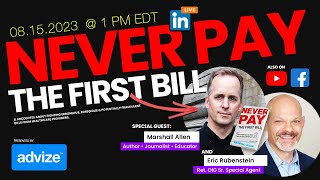
Marshall Allen, investigative healthcare journalist and author of Never Pay the First Bill, explains why billing errors and fraud are rampant in U.S. healthcare. An MRI costs $400 in one Dallas clinic and $4,000 in another; knee replacements range from $22,000 to $150,000. Allen teaches patients and employers how to audit bills and negotiate prices using his NeverPay methodology.
Questions this video answers
August 16, 2023.
He created more than 20 NPI numbers, billed about $25 million, and was paid about $4 million.
16 videos, about five minutes each.
allenhealthacademy.com
Chapters
Foreign.
Thanks again for joining us for another LinkedIn Live event. We're really excited about this event. If you've ever seen the book Never Pay the First Bill.
Or if you've ever looked at a ProPublica article, or if you're on LinkedIn, you know who Marshall Allen is. Marshall Allen is an author, he is an investigative journalist and he is my guest today on this episode of LinkedInLab and we're talking about a bunch of things involving fraud, waste, abuse and compliance as they relate to medical debt and some of the pitfalls that are out there with medical debt. I got to meet Marshall a number of years ago when I was still an OIG agent after reading his article in ProPublica with respect to the fact that third party payers and TPAs, as they're known, are oftentimes the largest victim of fraud. And it's one of the areas that's really not spoken about very much because it is not as commonly well known in the public as other things. So Marco, I'm super excited to have you. I know you and I have spoken more times than I can remember. I obviously follow you on LinkedIn. I've read your book, as many have in fact, over here at Advise. We just started a book club and we've given this book to any of our employees that were interested in reading it. And I am going to talk to you about having you on as a guest for the virtual book club that we do. But Marshall, I just want everybody to understand who you are, what you do, and sort of what drove your passion for kind of figuring out all of these problems. So tell everybody about who Marshall Allen is.
Well, Eric, I've been an investigative journalist focused on healthcare now for about 17 years, and I've always written about health care and investigated healthcare from the point of view of the patient. If a patient has the most at stake in any healthcare encounter, they're ultimately the ones paying for it. And they're putting their bodies on the line every time they undergo a healthcare experience. And so they have the most at stake and yet they have the least amount of influence, sadly, about what happens and when things go wrong, either on the patient safety level, with the quality of care, or on a financial level, they often get ignored. You know, they get shunned even and blown off when they have problems with the healthcare system. And so I have documented this now hundreds of times. I've talked to thousands of experts in hospitals, insurance experts, benefits advisors, fraud investigators, patients. So I've done an independent investigation of this system and that's eventually what led me to write the book Never Pay the First Bill and Other Ways to Fight the Healthcare System. And when. Because I saw all the leverage that patients and employers actually have, and I wanted to show what they can actually do about it. You know, it gets kind of discouraging as a journalist, just writing these stories year after year after year about all these problems with the healthcare system. And, you know, you need. You need to remain independent when you're a journalist, when you're a reporter. So with the book, what I've really enjoyed and with Allen Health Academy, which is a health literacy company that I've started, what I've really enjoyed is now I can actually help people navigate the system. I can help them understand the incentives, I can give them the tactics that they need to fight back. So the mission of Allen Health Academy is to help individuals and employers navigate the health care system so that they can get their money's worth, frankly, get better health care at a lower price. That's what we should be pushing for.
Yeah, and I want to talk a little bit about your. Your time at ProPublica. Yeah. Because, you know, you spent a lot of time at ProPublica as an investigative journalist. ProPublica, for people that don't know, is an amazing news, investigative journalism outlet. You know, they put together the, you know, the price comparison tools that are out there. You know, I use them here at Advise. We do training for a lot of SI use and we talk about that. You know, the dollar for docs and price comparisons. Yes. You know, one of the examples I always give is a case that I worked when I was an OIG agent involving a doctor named Libby Briachi, who, from a data analytics perspective, he rose to the top for the particular fraud that he was involved in. And if you went onto the ProPublica site and looked at Dr. Riachi's things, you would see that he was an outlier for a lot of things. And the data kind of, you know, spoke for itself. So, you know, the ProPublica stuff is really good. People need to really get on there and take a look. I wanna talk about this article first as kind of a segue in our conversation. And this was the article that I first read right when it came out. This is the article that got you and I connected up, and it was a great article. I retired as an OIG agent in January of 2019, and I reached out to you shortly after having retired, and this article really did set a tone for me because it does talk about the Fact that there was all of this stuff going on right under the nose of everybody and no one seemed to care. So what was the thing that became the two questions, really? One is, what was the impetus for you to write this article? And then what were the results of having written the article? Did anything come out of this?
Well, so what, what that article came about because I had seen so many cases where an individual patient had identified something fraudulent or, you know, to say fraud, it requires willful intent. So let's just say a billing practice that was obviously flawed that resulted in a massive overpayment for the provider. Whether it was actually fraudulent or not, we don't really know because we can't get inside the mind of that person doing the billing. But I had seen case after case where a patient had identified a completely erroneous bill and had gone to their insurance company, and their insurance company had basically shrugged. I'll give you an example. During the COVID pandemic, I talked to a doctor who was working for a particular clinic. This doctor got a COVID test at his own clinic. The clinic charged his insurance plan more than $10,000 for one COVID test. And the insurance plan paid it 100%. Didn't even give any discount on it. One COVID test over $10,000. It is that absurd and outrageous, some of these numbers? Well, this doctor was really troubled by this. And plus it was his own clinic, so he thought, this is like fraud happening by my own employer. He was actually so troubled, he ended up resigning from this job. He called the insurance company and he said, this is not accurate. This is not right. How can this be accurate? And he said the insurance company basically shrugged, like, you know, if we see a pattern of it, maybe we'll do something about it. He said they didn't take any action. They didn't do anything about it. And so I had done lots of stories like that where the insurance companies advertise themselves as these guardians of our healthcare dollars. That's how they market themselves to employer groups and to individuals. They also market how they're going to get the best prices for you because they have market share, because they have collected all of these members together, and so they're going to get good prices for you. And what I've seen hundreds of times is that this is not the case. This is just not true. So with that particular story, I started talking to some people in the fraud investigations world, and I was just trying to understand it. I was just trying to learn about it. And I learned about this Massive loophole in our payment system where healthcare, well, not healthcare providers, anybody is allowed to get an NPI number just by having a taxpayer identification number and then lying on their application to Medicare to get the NPI number. So in this particular story, this guy, David Williams, who was a personal trainer, so he did workouts, he was leading boot camps where people were doing push ups, sit ups and burpees, right? This was not a medical doctor doctor, but he lied on his application to CMS to get an NPI number. And Medicare doesn't check to see, they don't verify to see that someone is an actual medical licensed medical provider before they give them that npi. Then he used this NPI number to bill fraudulently.
The big insurance companies. Aetna, Cigna, UnitedHealthcare, this, this billing, it was not. Again, these are not criminal masterminds. As you know, these schemes are crude. They are stuff that an elementary schooler would come up with. I mean, all he did was write his name, David Williams, on the claims forms. Every bill he submitted, every claim he submitted was for a level five doctor visit, which again, how unlikely is that one doctor is going to have all of them as level five for people don't know, you know, they're level one to level five. Level five is the most complicated. So you get paid more. So everything he billed was for a level five and he wasn't an actual doctor and these claims were actually being paid. And the biggest, the biggest victim here, you know, it's not the insurance company. So people misunderstand the incentives here. The insurance company is, it's not their money, you know, especially with a self funded plan, it's the employer's money. And I would say actually it's the employee's compensation. The employer has allocated the employee compensation to be used to pay the benefits. So this is actually employee compensation 100% that has been funded by the employer. But so when you have United or Aetna or Cigna or one of these big companies acting as a third party administrator, a tpa, they're just managing someone else's money. So think about it. Does it really give them any reason to be aggressive with their fraud investigations when it's not actually their money? That's just going to be a cost for them to really police fraud. And what you see, I've talked to more than a dozen fraud investigators who work for the big insurance companies and what they will tell you is they can find the fraud all day long. It's not hard to identify it, but the insurance company's incentive is to keep the network happy to avoid that provider abrasion or provider friction by monitoring what the hospitals and what the doctors and what the dentists are doing. They want to have broad networks, so their loyalty is actually to the medical providers, not their own members. And it makes sense. Once you think about the incentives, you can kind of see how this plays out. Well, so in this particular case, so fascinating case because he actually got caught. You know, eventually he got noticed that he wasn't actually a doctor. One of the insurance companies sent him a letter and they said, hey, David Williams, we've noticed that you're not actually a doctor, so you need to repay us the hundreds of thousands of dollars that we have paid you. And if you don't repay us, we are going to dock your future payments to recoup the money we've already paid you. I mean, are you kidding me? So that's clearly, clearly they sent a template, just a form letter, right? They didn't even take the time to revise their form letter that they sent to them because obviously the letter itself contradicted itself. So did David Williams repay the money? What do you think, Eric?
I mean, you know, of course not. You know, the humor of this Marshall is. And you know, you laugh at it, but, you know, it's. It's not. It's funny, but it's funny in just a bizarre way. So we've caught. You're not a doctor, We've identified that you're not a doctor. But if you don't pay us this money back, any of your future payments that you're going to get by submitting them as if you're a doctor, we're going to offset. But you know, the thing that's interesting and without being centric to a particular insurance, you know, cms, though, for one second.
You know, they spend millions and millions of dollars a year on at least two systems that are intended to prevent providers from getting in who shouldn't be in. One is the NPAS system, which is what gets you your npi. And the other one is known as the aps, the Advanced Provider Screening System. The whole point of these two systems in conjunction with the third system known as Pecos, Right, Provider Enrollment Change of Ownership System. These systems are intended to prevent the issuance of an NPI number or Medicare provider number to people that shouldn't be in the system. What is boggled my mind for the 25 years that I spent at the OIG and in this field, I've been in this field now for almost 30 years. And it is mind boggling to me that something as simple as verifying if someone has. Well, so this is what's medical degree.
So this is what's interesting and different between Medicare and the employer sponsored plans. What CMS told me is they do check before someone bills Medicare to make sure that they are a licensed provider, but they don't check before giving that NPI so that that person can then go to the employer sponsored plans.
Right.
And so, and so United Healthcare doesn't check. Aetna doesn't check, Cigna doesn't check. So in this particular case, again, these big insurance companies, and again I don't want to make it sound like this is difficult to do. I mean these, these companies are bringing in hundreds of billions of dollars a year. If they wanted to check, they could. All of these people are licensed. There are databases for every state of licensed doctors who would be billing. So it's not hard to do a join on those data sets and actually check whether or not someone is licensed before you start paying their claim.
Sure.
So, so it's, it is, it is unique. Again, it shows the fragmentation of our health care system. It shows that the right hand doesn't know what the left hand is doing. There aren't consistent standards across the board for how things are done. So the David Williams story though gets even more absurd because after he got caught, he didn't repay the money. He created new NPI numbers and again he started billing under these new NPI numbers. And I don't, again, I want to emphasize this guy's not a criminal mastermind. He used his actual name, he used the same address. He changed the name of his LLC or whatever company slightly. But this was not something where he was hiding. He was not telling the truth obviously. And he ended up going to federal prison for this. So this, this all I found out about this because it resulted in a criminal case eventually. This went on for about four years. He created more than 20 NPI numbers. He billed for about $25 million. He was paid about $4 million. And an even more absurd piece of this story, which again as a, as a storyteller, it made it so interesting. But his ex wife actually found out about this from early on when he was committing these crimes. And she notified.
All the insurance companies. She called them and she told them she talked to the fraud investigators and her dad did. They reported him. Again, it just shows how slowly the wheels turn, how little incentive and how little urgency is placed on protecting healthcare dollars because the incentives are not in place to really have the big TPAs, the big insurance companies protect the dollars of the employers and the working Americans who are overpaying for their healthcare.
Right. Well, you know, we see all the time instances where providers get caught and you know, they, they get criminally prosecuted and as a result they get excluded from, from participation in the Medicare and Medicaid program. And most of the contracts in the commercial space have you know, some verbiage that says, you know, if you have something like that occur or criminal conviction that you'll be terminated. And we see all the time instances of providers who have been excluded from Medicare Medicaid for criminal prosecution of healthcare fraud are still in the program. They haven't been, you know, the commercial payers are, It's a slow churning system. And you know, I really do encourage people that are, that are tuning into this to really go online, read that article. Because if you, if you want to make yourself really angry, but you really want to have an eye opener as to the way that the system sometimes fails, this article really does bring it to light. Because you know, I've said this for years, that the circus never changes, it's just the clowns that are different. Right? So if you read a lot of the press releases that are out there on the fraud schemes, they really don't greatly change, they become just new versions of it. You know, we see it now with the telefraud cases. Right, the telephraud cases with dme. DME fraud has been around forever and a day. But we saw years ago with for example, diabetic testing supplies and the robo callings. I did a whole bunch of those cases in New Jersey where it was like a boiler room operation. You know, you see it now with genetic testing. You see it now, we saw it with the compound, the prescription compounding. It's this kind of recycling of schemes. It doesn't really change. Right. It's sort of the same. But so now you write this article, you've written a whole bunch of articles and now you decide you need to write a book because you're mad as hell and you can't take it anymore. So what prompts you to start putting together the thoughts on how you put a book like this together?
Well, I wanted to create a guidebook, basically like a handbook for people to fight back and win. And the key word here is winning. That might be the most important word in my title and subtitle because people think that they can't win. And another thing that I discovered as I was Doing my stories for ProPublica is that there are employer sponsored health plans where they have.
Redone the way they do their benefits. They're not doing sort of the easy button of a big United Healthcare or Aetna or Cigna or Blue Cross health plan where it's all bundled up for you and it's nice in a box, but it's a black box, you can't see into it. So you don't see all the games that the middlemen are playing that are extracting your money from your, from your health plan. And so when I started writing stories, you know, when I do these investigative stories, I try and also point to a solution and highlight a best practice so that it's not just a story that highlights something negative, but also shows something positive. And what I found is there are employer sponsored health plans who are teaming up with really savvy benefits advisors. They're teaming up with vendors like you all and others who are helping them unbundle their health plan and then optimize it and get engaged and break it down on a different level so that, let's say something like fraud on the front end. You could protect yourself from fraud by entering into direct contracting relationships with hospitals and doctors and doing more direct primary care so that you make sure that you're paying directly. In those cases, you're not even going through a middleman like a big insurance company that's offering some discount off some outrageous price to begin with. You have that direct contracting relationship. That's something that employer sponsored plans can do on the front end and on the back end, bringing in a company to look at the claims, do some data analytics, get a hold of the data, see what your plan is spending, identify these overcharges, identify cases where the plan is paying more than it should, and then recouping that money or avoiding these overpriced providers and steering your employees incentivizing to go to reasonably priced providers. And so when I saw that happening, so in these plans, Eric, and I'm sure you know this, these folks are probably some of your clients. They are saving 30, 40% on their health benefits spend while delivering better benefits for their employees. So they are eliminating deductibles, in many cases, providing direct primary care, reducing drug costs. Some companies have even returned a dividend back to the employees because they've saved so much money on their health plan. So they're not cutting the benefits. I mean, the traditional way they've saved money is by cutting the benefits, passing more cost onto the employee. These Plans are doing the opposite. They're improving the benefits, lowering the cost to the employee and providing better benefits. So there's a, there is a solution here. We just need the employers to get engaged, to wake up and take responsibility for this and break free of the system that's been exploiting them for so many decades.
Right. Well, we know there's so much money. I mean, you highlight your book, the fact that some studies show that the commercial payers are sometimes paying as much as 247% or 250% above the Medicare fee schedule. And you know, I don't want to, I don't want to, you know, Medicare isn't, you know, obviously isn't the wealthiest, you know, when it comes to paying and Medicaid is the payer of last resort. But to see that in the commercial space, you know, 250% and, you know, and the CMS numbers are typically the benchmarking that others go on. And you know, even in this, in the Medicare world, there's something called the limiting charge for non participating providers, which is 15% over the 100% of the fee schedule. So there are some benchmarks out there that people can go to. And you talk about your book about shopping for value and the one example that you Give is on MRIs. And I can tell you that that's the one area where I've seen some of my family members, they go to a place and they're told that their copay is going to be 500 or $600 on an MRI. You know, where if you shopped around, you know, you gave an example in your book, you talk about one particular place where two MRIs, $950 now, you know, versus $10,000. You know, it's a little bit like looking around and saying, like, is if I have a $10,000 deductible, which means I am 100% responsible for the costs until, so basically I have no insurance until I hit that $10,000 deductible is, you know, having to spend having a copay of five or six or seven hundred dollars better than just paying the, you know, per test, by the way. So it's not a copay for the, for the universe. It's that one, is that better than just paying the 950 and kind of calling it a wash. And you actually talk about the fact that paying out of pocket could actually be a cost savings for someone.
Yeah. So what we're seeing now, when you, because of price transparency, the hospital price transparency final rule was A piece of policy that has had a massive benefit for the working people and the employers who are paying for this, this health care. Because like you said, the average they're overpaying is about 250% of Medicare, but they're often paying more than that. I mean, so if that's the average, you know that there's a low end and a high end. On the high end, you could be paying 500% of Medicare, 1,000% of Medicare. I was just looking at prices for some, some imaging tests, MRIs and CT scans. And in the Dallas area, you would spend anywhere from $400 to $4000.
A 10x difference for that scan, depending on where you go. And so that's why it's so important that we educate employers and employees. And then they have got to take action, okay? They have got to get engaged. Employees and employers can't keep doing things the same way they've been doing them and expecting different results. Right? That's what they, some people call the definition of insanity. Keep doing the same thing and expect different results. It does not work that way. So I'm on a big push now with my book and with Allen Health Academy, and then I created some videos that are based on the book, a whole curriculum for employees. I'm on a push now to educate people. So they, the starting point is they have to understand what they can do, and they have to understand just how upside down this whole system is. I mean, you would never think that you would pay a 10x difference for a scan in one metro area just because, frankly, of your insurance coverage. I mean, people just don't know that that's the case. Once you know it, then you actually need to do something about it. So we have to have a lot of behavior change. We're at the beginning of this disruption. So I'm very encouraged because we're seeing the light bulb come on for employers and employees. But it's, but it's not widespread. I mean, you know this. I mean, you talk to a lot of employer groups. A lot of employers are just kind of shrugging like, yeah, I'm good. No, we have great benefits. That's. You'll hear them say that we have great benefits. They don't. They don't even. They've never even looked at it. They don't realize how conflicted their broker is who's probably been their primary advisor. They don't even realize, you know, most brokers are being paid by the insurance companies, by the PBMs, by the TPAs. They need to find an independent advisor who will tell them what they should be doing. But I am encouraged because this is happening now. This disruption is starting, it's going to accelerate. And I think one of the main accelerants is the Consolidated Appropriations act of 2021, which really emphasized the fiduciary duty of the employer. The employer has a fiduciary duty to manage their plan in a way that benefits the people on the plan. And again, that's because it's their money, it's the employee's compensation. So the CAA really does recognize that and it emphasizes this fiduciary duty. It also says employers have a right to their data. So in the past, you know, the big TPAs have held onto this data and they said it's their property. Well, that's the big fight you're seeing now. The employers and the plans are now where the employers are getting engaged, saying, no, it's our data, we're the ones paying for it. We need to see what we're paying for and analyze it. Now they're opening this up and I know this is what you all are doing. They open this up and they are having some really alarming findings. I mean, maybe you could talk about that. What's the stuff that you guys see?
So, you know, we do a lot of work on the payer side. We, you know, we're an outsourced SIU for about 15 different plans. Most of them are in government space, in the Medicaid space, we've got a fair footprint in the commercial space. You know, we're, we're doing some data mining projects now where we're just, we're finding all of this stuff and you know, we go back to the payer and work with them to help create stronger edits to ensure that these claims aren't going through. Because, you know, typically what a payer is doing in their analytics is they're taking what are known as the NCCI edits, the National Correct Coding Initiative edits, and the mue Medically Unlikely edits. They put those together and that becomes the foundation for determining whether a claim is going to be paid or not. Obviously, you know, with some of the things, you know, talking about like the level five, you know, we've had some issues here. You know, we helped somebody, a family friend who went to the emergency room for an allergic reaction, you know, pipes, and we find out, you know, the insurance company got billed for a level 5. They were in the emergency room for 45 minutes. It was at 2 o' clock in the morning, wake up, man, I got hives. Emergency room, shot of Benadryl, a prescription for prednisone, 45 minutes out the door, you know, 2 o' clock in the morning in a, in a community hospital. And it's a level five. So we helped write a letter to the hospital saying, hey, we disagree with this. We don't have any of the medical records. Please send us the medical records. But we disagree with this being a level five. And they sent the medical records. Half of the things that were in the medical records were erroneous. You know, for example, there was, there was a box check that the patient claimed to be a smoker and a regular drinker. This is a person who is a vegan, doesn't smoke, doesn't drink. And like, you know, all of these things, there were things in the family history that were wrong. It was just an entirely erroneous record. So we said, you know, we disagree with this. We think this is based upon this. We had an auditor on our side look at us, and we think this is a level three. And we basically appealed to the hospital. The hospital returns a letter saying, we disagree. We had our, we had our chief medical officer review. We think it's a level five. We said, okay. We then filed a complaint with the insurance company and it went nowhere. No response from the insurance company. Nowhere. So on our payer side, for our SIU team, we're working a little bit more gradually because we're seeing things in kind of an aggregated fashion and helping them to make some, you know, more informed decisions from the, from the SIU space. But, you know, it really, it really is, it's a challenge because oftentimes there is that push pull on not having provider abrasion because the networks are important, and large provider networks, you know, group systems will threaten to leave the network. And with that, it then angers the patients, right, who are the members? And they go to their employer and they say to their employer, hey, did you know that, you know, Dr. Jones from XYZ Medical Group is no longer in there? It really, it really is this, you know, push pull.
What's, what's, what do you advise employers to do, or what would you tell employers that they should do when they're, when they're in that situation?
You know, so I think that, you know, the issue of price transparency is going to really help. And the no Surprises Act, I think at least on the hospital side, has started to do that. But, you know, you're still seeing these situations where hospitals are publishing their data, but they make it in unreadable formats. They bury it on a website where it's a challenge to get to that data. But at the end of the day, the employers can get their own data from their plan sponsor. And you know, I would encourage employers to get that data and do some independent analytics. It's not that hard. I mean, we're talking about basic analytics. What's your spend for things you should know where you're having these tectonic shifts? We worked on a project here. I was retained as an expert for a case involving a PBM that was being sued by a self insured union. And the issue was that the self insured union had paid out millions upon millions of dollars for compounds. And they kept going back to the PBM and saying to the pbm, we're paying for this, we're paying for this, it has to stop. And the PBM kept putting forth to them suggestions. Here's how we could stop it. We could blacklist certain ingredients, we could put step up therapy, we could put prior authorization, we could put limitations, we could put higher co pays to dissuade patients from just saying okay. And the plan, the.
Insured union plan came back and said, no, no, no, we have binding arbitration. We can't do that, we can't do it. The result actually was that they could do it. They just didn't want to, you know, and they knew their data, but they just weren't doing what they needed to do. So yeah, it's look at your data, know your data and then see where your, see where your holes are that you need to be plugged in.
I love that story because it illustrates some of the other complexities here. Right. It's not enough just to see your data and see the problems. You have to have the courage to do something about it.
It's actionable intelligence, right? Actionable intelligence.
Actionable intelligence. And the employees have to understand that they need to change their behavior. So sometimes you have employees who think, well, I don't want to change what doctor I go to or what hospital I go to. Well, what if that, what if that hospital that's your favorite hospital or that doctor that's your favorite hospital? Let's just say it's a knee replacement. You could charge 22,000 for a knee replacement. That would be, I've seen direct contracting prices that are about 22,000 all in for a knee replacement.
Okay.
I have talked to benefits advisors. One of them told me he had $150,000 knee replacement. I've heard of $100,000 knee replacements. 80,000, 60,000, 40,000. Anyway, the point is, anything over 22,000, you're paying more than you should be paying for a knee replacement. This is a standardized operation that happens hundreds of thousands of dollars or hundreds of thousands of times in the United States every year. It's like an assembly line process. It's not, you know, every case is like a complicated, really case. It's standard. Right. So the prices could be standardized there. But if an employee says, but I want to go to this doctor, this is my surgeon. I want to go to my surgeon. And then that surgeon charges $80,000, the employee needs to understand this is your compensation that's being wasted, squandered. You and your co workers are losing out on pay increases because you're blowing your money to prop up a health care system that is exploiting our sickness for profit.
Right, right.
So, so the employees need to get educated and understand this is their money. They need to stand up for themselves, protect their money, and not buy into this idea that, oh, well, I have to go to my special doctor.
Right.
Even if that doctor is ripping you off, that's not wise.
Right. Well, you know, the, so the nuance to the, or the postscript to my story was that part of, a large part of the issue involving the fraud in this case was the fact that many of the employees were actually getting paid kickbacks by middlemen who were working as marketers in effect, to allow their insurance information to be usurped for the purposes of this. And it was correct. And it was a, you know, it was a large metropolitan transit authority. And so it's a very interesting tale, but it, you know, it kind of shows that there's this push pull, you know, look in the knee replacement world just to kind of loop back, you know, it is, it's a standard operation. And you know, if you're, you know, 45 year old Marshall Allen, who runs, you know, 20 miles a week and you need a knee replacement. The hospital doesn't want to put the $30,000 knee in your body. They want to put the $3,000 knee in your body because they're not getting paid, you know, a million dollars. So, you know, that, that push pull exists, but you know, as kind of a wrap up to this. And I want to, I want to talk about the, I want to talk about your, really, the Allen Health Academy, because this is, this is fascinating to me and I, and I get it. You know, look, you've got a living to make so the book is. It's an amazing read. I told you. We at ADVISE are doing a book club, and we've given this book to all of our employees that wanted to learn a little bit more about this, and we're having people read it here. But, you know, the Allen Health Academy is a great adjunct to this because it's really about. It's always about education. Right. It's. It's always about getting people to be a little bit smarter than they were the day before. I mean, in no other world, other than health care, do we not know what the cost of an item, service, or procedure is before we get it right. We talked about looking at your bill, and, you know, last month at our LinkedIn Live, we had Eli Rushbanks from the great charitable organization $4. They're getting rid of bills. They're crushing bills for people who would have been qualified under charity care or disproportionate share hospital payments. But at the end of the day, nobody knows whether or not that bill is accurate or not. And, you know, we talked a little about this before we started to do this, about the fact that there are, you know, some studies out there that show error rates of 80% in hospital bills and whether those numbers are right, wrong. Clearly we see it all the time. There are errors in bills. And so the argument then becomes, if people are paying for something towards their deductible, if they're paying for it out of pocket, whatever it is, it should be accurate and correct. And, you know, the biggest thing that I see, and you talk about this a little bit in your book, is when people get an explanation of benefits. How do you even understand it? It'll sometimes give you the cpt, the current procedure terminology code, and it says office visit, and you have no conceptual understanding of what that is. And so a lot of it, and this is where your book really does a great service, is you tell the story and then you provide at the end kind of your action items. How do you understand what these things are? And I think that really where the Allen Health Academy fits in is kind of creating this adjunct. They have to work together.
Yeah. So the book led me to create a series of health literacy videos. It's a whole curriculum. I call it the NeverPay pathway. And it just takes the tactics and the principles and the action steps from the book and translates them into video format. So it's. The curriculum has 16 videos. The videos are about five minutes each. It is a lot of content. I mean, it's a lot of content, but it's presented in a very engaging way and it so I teach people. Here's how you look at your eob. Here's what the things mean on your eob. Here's why you need to check your eob. Here's what you do when you get a medical bill. Here's how to get an itemized bill. Here's how to look up the billing codes to see are your prices fair, is your bill accurate. Here's how you get your medical records. Because like you said, if you can check the medical records and correct them, you can also use the that to leverage corrections on your bills. How do you, how do you deal with insurance company denial when they've denied the payment on a claim that is supposed to be paid? And hospital financial assistance policies? I have a video on that and I refer people to $4. $4 is doing amazing work and they will do it for individual employees for free. They're a charity that will wipe away your bills by using hospital financial assistance policies. But people need to know these things and then they need to take action. So it's a, it's a subscription model, it's available to individuals. And by the way, I have scholarships on my website. So anybody who has a problem paying the subscription can just take advantage of the scholarship offer. It's at allenhealthacademy.com so basically it's available to everybody@allenhealthacademy.com and then the big vision here is to roll this out to employer sponsored health plans and to those union groups and to everybody who's a working American getting their benefits through their employer so they can be prepared on the front end, right? So they can understand why their employer might be entering into a direct contract with a hospital for knee replacements for instance, or for birth giving live birth, which is again something that should be standardized, not, not overpaid for. So I'm trying to do this education and empowerment of the working people. And it's fascinating to do because Eric, I don't think anyone's ever tried this before. No one has ever put enough trust and faith in the employees to actually show them how the system works. And I think honestly a lot of the employers have no idea how the system works either. So they haven't known how to do it. So the curriculum and my book are demystifying health care. It's exposing the incentives and it's really most importantly showing people what they can do about it. And the promise I make in my book and in my videos is that by Putting these tactics into practice, you can save hundreds or thousands of dollars per healthcare encounter. Like the amount of money you could save if you avoid an overpriced MRI is astounding. The amount of money you can save if you go to $4 and qualify for charity care is incredible. So it's a, it's a huge return on investment for an individual and also for a health plan when they take the time to educate their, their people.
Yeah, I mean, it is, this is, this is. You know, I've always said that the two most complex areas, as a, as a lifelong fraud investigator, I've always felt that the two most complex areas in the white collar world were healthcare fraud and securities fraud, I think are two very complex areas. And you know, I've always said to the new agents, when I was working as an OIG agent, I would mentor tons of agents and I would say the learning curve is three to five years to really become literate in understanding healthcare fraud. And I don't mean it. And I mean it in the broadest sense. Understanding the interplay of CPT codes, HCPCs, ICV, 10, DRGs, all of these things out there. The learning curve is very big. And I think, you know, I made a career, career out of it. You've made a career out of it. Think about the average person. Yeah. Doesn't interact with this on a day in and day out basis. It is, I mean, it's a, it's a daunting thing. So you've been able to really kind of make it a lot simpler for people. The book is an easy read. We've had people, you know, we wanted to do in our book club chapter, weekly chapters. We've had people who read the book in, in a weekend because, yeah, it is, it is engaging, it's interesting, it's very straightforward. So I really do encourage people. I'm not being paid to push this, obviously, but if you, if you haven't read Marshall's book, it is a great book. It really does give people actionable intelligence on how to at least understand the system a little bit better. And then obviously you can go up onto the Allen Health Academy and you know, see what's, see what's out there. So closing thoughts from you, Marshall, as we run out of time, where do you see, where do you see the system going? Obviously with price transparency on the hospital side, it's better. By the way, the onc, right. There's some new regulations. OIG has now looked to step up enforcement for violating some of the. No surprises act and data blocking and the data blocking rules that are out there. We already know that there's been some lobbying from the provider community on price transparency on their end. But final thoughts, where do you see this all going?
Well, I mean, I see the disruption is already happening and the prices are so unjustified and the schemes are so deceptive and dishonest that as this is becoming more and more revealed and as employers take their fiduciary responsibility seriously, we are going to see change and transformation in our healthcare system for the good. But it requires people to get educated and to have the courage, especially at the employer level, to fight back and win because you can do it. And so I think that this is happening. We're seeing more direct contracting relationships, we're seeing more cash paying arrangements and we have 100 million Americans in debt because of medical care. So you're seeing more motivation at the, at the level of the people to do something different. You know, people are seeing that they've been taken advantage of, they're being exploited, they're angry about it and now they're looking to know what to do about it. So I'm, I'm actually optimistic. I mean, partly because things couldn't get a lot worse, you know, than they are now. But that's the kind of pain, that pain motivates, the disruption.
Yeah, I mean, look, Murphy was an optimist, so, you know, we put prepare for the worst but hope for the best. Yeah, I mean, I think you're right for the most part. It's been so bad for so long. The question is, have we hit rock bottom and are we on the way up or has someone just handed us a shovel and said, well, you're really not at the bottom, start digging.
That's always a possibility.
It's always a possibility. But Marshall, look, we could talk for hours about this. We could, yeah.
This is great.
Thank you. As you know, as broad waste, abuse, compliance, geeks that we are, these are just conversations that kind of continue to perpetuate itself. So as always, thanks for taking the time to talk, to talk to me, to talk to the LinkedIn community about this. This is obviously a hot topic. I do encourage people again, read the book, go on to Allen Health Academy. You can also get a hold of marshall through marshallallen.com and you can see what his website has.
There's a lot of here on LinkedIn too. I mean, I respond, I, I love to talk to people. I learn a lot. If people need help, let me know. Let's get engaged on this. Thank you so much for having me here.
It's amazing that you're as responsive as you are because I do follow you and I do. And you know me. I know you. So I, you know, I know you're going to engage, but you're, you're engaging. You do respond to everybody. You're better than most doctors. You don't make me sit in the waiting room for two hours for a visit. So, again, thanks everybody for tuning in. Marshall, always great to have you. Please sign up for our newsletter so you can get our weekly content, including our OIG roundtable discussions that come out every week in the newsletter. We've got some exciting stuff coming in the newsletter in the future, including a general counsel's corner, compliance corner. We'll be doing a lot more content. So if you're not getting our newsletter, sign up for that by reaching out to us@hellodviseadizehealth.com tons of content out there. Keep liking our stuff. We're going to continue to do our LinkedIn lives and we'll see you on the next one next month. Marshall, thanks again.
Thank you.
More from Marshall






Marshall Allen, "Never Pay the First Bill' Part 1 | The Ovation Show w/ Dan Labroad




