Revealing Value: Price Transparency in Healthcare
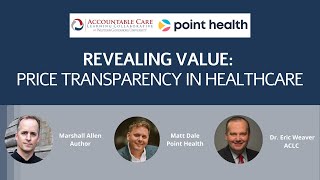
Recorded panel discussion (host Eric Weaver) with Marshall Allen (investigative health journalist, author of Never Pay the First Bill) and Matt Dale (CEO, Point Health). Guests describe the harms of opaque hospital pricing (medical debt, extreme price variation), share patient vignettes (e.g., $15,000 colonoscopy; $7,600 ER bill; rotator-cuff quotes $68,000 vs $8,000), and discuss the potential impact of a CMS price-transparency rule (effective Jan 1) requiring hospitals to post prices for ~300 shoppable services. They argue transparency plus consumer-friendly technology and employer engagement can create downward pressure on prices, enable shopping for higher-value providers (often ambulatory surgery centers), and empower patients to contest bills. The session closes with audience questions on policy durability, insurer roles, physician engagement, urgent care/lab pricing, and bright-spot examples (surgery centers, Free Market Medical Association).
Questions this video answers
A hospital price-transparency rule (effective January 1) requiring hospitals to provide pricing for about 300 designated shoppable services.
One in five Americans.
Marshall Allen — investigative health journalist, author (Never Pay the First Bill); Matt Dale — CEO of Point Health (sponsor).
Chapters
You price transparency in health care. My name is Eric Weaver, Executive Director of the Accountable Care Learning Collaborative. And I have two amazing guests to present to you today who are subject matter experts on hospital cost transparency. Before I introduce them, I wanted to introduce our sponsor. For today we have Point Health as sponsor for today's program. Point Health is an Austin, Texas based digital health company that is paving the way for major changes in the industry primarily through their smart healthcare platform that combines powerful navigation, shop and compare tools, personalized assistance and the largest, most flexible selection of cash pay providers in America on a single intuitive platform. You know, this is a company that's really committed to making healthcare, you know, easy to understand and easier to afford for consumers. So really excited to have them and their CEO today. Matt Dale is one of our, our esteemed panelists. He's the CEO of Point Health. He has, he spent a career committed to making healthcare easier to find, easier to understand, easier to afford for patients. Prior to being a CEO of Point Health, he was a leader in Charis Group which was recently acquired by Point Health. Through his work over the course of his career as an entrepreneur and leader in healthcare. Matt's someone that is just directly impacted millions of patients lives by providing possible care at affordable prices. He's an entrepreneur, very successful, someone that I consider just to be just so mission driven and such an advocate for patients especially in helping them have more transparent pricing. So welcome Matt to the conversation. And then we also have Marshall Allen. Wow. Marshall, you know you've spent, you know, 15 years as a, as a healthcare investigative journalist. You know, you have spent a decade prior to the work that you're doing now with ProPublica. You're a two time Pulitzer Prize finalist, recipient of the Harvard Kennedy's Goldsmith Prize for investigative reporting. You've been an investigative reporter for over a decade and you have this interesting background where you spent five years in full time ministry. You're now running the Allen Health Academy to boost health literacy of working Americans and you're the author of, of the bestselling book right now Never Pay the First Bill and other ways to fight the Healthcare System and win. So gentlemen, thank you for being a part of our conversation. I'm real excited about where we're gonna go today and really raising awareness around this important issue of price transparency in healthcare.
Thanks Eric. It's really an honor to be here. Yeah. To dinner.
That really appreciate you having us on.
Well again for our audience, we're taking questions. So I'm with the aclc. We're a learning Collaborative. We're here to convene industry through our member association, provide an ecosystem for collaboration, peer learning. We put out intelligence in the form of case studies and intelligence briefs. We have a competency based framework that is really a driving force for those organizations that are looking to upskill and reskill their workforce. We put on peer learning sessions like these. Definitely check us out and learn more about our organization. And then we recently released a brief that's on this topic. It just came out a few months ago, so definitely check that out. And if you want more information on this important topic. This brief was done in partnership with Point Health and I think it's a good way to start our conversation today. Again, post your questions, audience members into the chat. But you know, let's go ahead and, and go ahead and start the conversation. Gentlemen, I have a couple of questions for you. You know, as we start off today, you know, and I'm just thinking, first and foremost, you know, we have a broken system right now. We all know the stats. You know, we're approaching 20% of our GDP per capita spend is, you know, twice the amount as the number two country in the world. You know, we've increased our spend about a trillion dollars in the US in the last 10 years. We're now at 11,500 per person right now. Health care bankruptcy is the number one cause of personal bankruptcy in our country. And I really think that, you know, mandating price transparency is really an important policy lever and really slowing down some of the cost increases. And we're going to get into some of the more legislative aspects of, you know, help price transparency later today. But I think it's really important to stay grounded on the how this is adversely impacting families, consumers. You know, I thought, you know, Marshall, this might be a good question, you know, for you to start off with. But, you know, can you provide maybe some, you know, in your investigative reporting some stories like, you know, how has the lack of pricing transparency impacted patients and their families, resulting in medical debt that has really ruined lives? Can you maybe provide some framing as we start our discussion today?
Yeah, I mean, it's, you can't overstate how bad the lack of transparency in healthcare is for the American public. You really cannot exaggerate just what a tragedy it is and just what a crisis it is. We have one in five Americans who has medical debt in collections right now. And again, as you said, we all know the stats. The problem isn't that we're not spending enough. We are spending way more money than we Should. And if you look at the statistics and the studies that show how much money in health care is wasted on things like high prices, unnecessary treatment.
Administrative bloat, the inefficient way we process claims, all of these inefficiencies are adding up to squandering upwards maybe now of a trillion dollars a year, about 25% of what we spend is just being wasted. And so when you look at, that's the big picture, but then you get on the micro level and how that's affecting American families. Like I think about a woman I spoke to at a conference recently, she was charged $15,000 for a colonoscopy. Now a colonoscopy should cost, you know, I think Medicare would probably pay under $1,000 for a colonoscopy. You know, maybe $2,000 would be reasonable, $15,000. And the, you know, you don't see the price up front. So she didn't know that that's what it was going to cost her until she got the bill. By the time she got the bill, she didn't know what to do about it. And of course, the solution that you always hear is from the hospitals or the doctors or other medical providers is, well, we can just put you on a payment plan. So believe it or not, they put this poor woman on a 10 year payment plan to pay off her colonoscopy. And if that doesn't sort of metaphorically illustrate exactly what's happening to the American public, this is a completely unfair, unjust, unethical, immoral situation that the typical American finds themselves in because they desperately need care, they have to get care. But when the prices are not given up front and then the prices come on the back end and they're completely unreasonable or inaccurate, it's driving people into debt. And a 10 year payment plan for a $15,000 colonoscopy is just an injustice that we should not tolerate anymore. And the only reason we tolerate it is because we've all become accustomed to accepting it. It's this normalized deviance that sort of cloaked the whole system and it's caused people to not push back and not fight back. And so that's really the campaign I'm on, is to help people understand what the problem is, reframe it so they think about this in a little different way and then be equipped and be empowered to do something about it.
So Matt, I know you do a lot of work there at Point Health too, you know, working with patients and their families. In our case study, there was a Great example of, I believe, a patient just went to the emergency room just for something that was relatively benign and ended up staying in the emergency room for five hours and gets a couple of tests and has a $7,600 bill. And I'm sure you guys see this all the time, just the ruinous nature of the pricing and the lack of transparency in our system.
Yeah, absolutely. And so the problem that you're describing, it's really not isolated to any one condition, any one part of the country. It's something that happens all over the place. And it's fairly common for us to see a 5 or $10,000 bill from an emergency room visit where a patient saw a doctor for maybe 15 minutes or less. And, of course, the numbers are not insignificant. And the more major the surgery, sort of the bigger the problem is. One example that we dealt with recently, we had a patient that needed a rotator cuff surgery, and he called his insurance company and asked where he should go, and they said, hey, go to your local hospital. And the guy had a defined benefit plan where no matter where he went, his insurance was going to charge or they were going to pay $5,000 towards the cost of the procedure. Well, the local hospital wanted to charge him 68,000, so he would have been stuck with 63,000 out of pocket. And to Marshall's point, that's really a life sentence. You're going to be paying that off for the rest of your life. And of course, when transparency comes into play, there was a surgery center that was 15 minutes from where he lived that was willing to do the whole thing for $8,000. One of the big challenges that the system has is that you shouldn't have to be an expert like ourselves to know that there's a facility that will do something for 8,000 when the hospital is trying to charge you 68,000. And of course, you know, this problem is not. It's not a secret to anyone that works in the industry. You know, it got so bad here in Austin, I actually went and I met with the COO of Ascens, which owns Seton, which is the local hospital chain, where we're at. And as I was talking with her about the problem, she basically said to me, you know, Matt, if you want to save your patients money, you've got to stop having them come to the hospital. And, of course, she wasn't actually talking about keeping them healthy. She was readily admitting that the hospital is not the place that you want to have a procedure done, if you can have it done anywhere outside of A hospital setting, there'll be your surgery center that can do it for a lot less. Just unfortunately, most patients don't have access to that.
So this is a good, you know, point of departure, you know, in thinking about hospital price transparency. You know, I think everyone, you know in the meeting today is thinking about this new rule that went into effect on January 1st from CMS that's requiring hospitals to provide transparent pricing so consumers can have more value oriented decisions about the care. There's supposed to be, I guess, pricing on 300 specific shoppable services, things like CTs and MRIs and blood tests and other elective procedures. And hospitals bought this kicking and screaming, but it is in effect. And I just wanted to ask you both, I mean, this is rule going to have a positive impact on pricing since patients have better estimates on in hand and they can make better, more empowered choices. And also, are we going to see maybe competition on pricing between hospitals for downward market pressure on pricing? You know, Marshall, I'd love maybe to hear you and provide some initial response to this.
I think that this price transparency rule is a total game changer. And I know it's rough right now and I know a lot of the facilities are still not complying with it. So many hospitals are violating the federal rule right now, flagrantly. But when people at least have this information out there, I make this a backbone of the strategy that I provide. In my book, never pay the first bill. I show people how to get an itemized medical bill and then how to look up prices. You can look up prices now at your local hospital and you can see that different health plans because they're required to post the prices that are negotiated with each insurance plan and the cash prices. So now patients can see if they're motivated. Obviously they have to be motivated to do the research. It's not easy right now for them, but they can look up and they can see the prices for the services they receive. So let me give you an example. A young woman named Gabby was charged $5,800 her and her health plan for a level three emergency room visit. She only had a slice in her finger. She needed three stitches. It was not a level three emergency revisit. I mean, again, upcoding is a whole other problem we could spend a whole other session on. But she was able to look up and see that her United Healthcare Plan had a $5,800 discounted price with that hospital. Well, she could also see on that hospital website that the Blue Cross negotiated rate was $767 for the same level three emergency room visit. And she could see that the Medicare price was $230 and.
The cash price was $256. So somehow her United Healthcare plan, which was supposed to be giving her this great discounted rate, was charging her 22 times more than the cash price than she would have paid if she just would have gone in without any insurance at all. Using that information, she was able to fight back against that bill. And so that's. So this price transparency through hospitals posting their prices on their websites, this is coming down the road with insurance plans. FairHealthConsumer.org is another website. I point people to where you can get price estimates for your community. This right now, we're in the early stages where people are just now beginning to learn how to use this information. But if they're motivated, employers and employees and patients can take this information and they can use it to find a better deal on the front end and then fight an unfair deal on the back end after they've received their bill. And it's only going to get more powerful so that we can leverage it more and more to get a fair deal down the road.
Matt, are you sharing in this optimism on the new rule?
I am.
So. I think the price transparency rule, even though the hospitals aren't all in compliance, I think they're all going to get in compliance because what you see happen, it's really sort of an Economics 101 idea, which is that once you put transparency out there, the hospital that isn't in compliance isn't going to gain the business. You know, going back to the example of the rotator cuff surgery, if it's known what, you can get a rotator cuff surgery done for one facility and you can do it for 8020. And it's unknown at another facility or a hospital saying they charge 65,000. They've really got two choices. They can drop their price or they can get out of the business of doing rotator cuff surgeries, because no one's going to shop for something where they're paying 10 times the cost. I think what you really need to see happen next, though, and this is one of the things that Point Health is working on, is working on taking the information that is now becoming publicly available that hospitals are putting out there, but putting it into a format where consumers are able to access it and they're able to shop for healthcare the same way that they shop for every other major purchase in their life. People don't go on Amazon and download a CSV file that has crazy descriptions and codes and all of these things they then have to interpret, they look and they search for something that they know they need and they see clearly what it costs and they get sort of a review of what it is that they're buying. And as more companies take the data and create that consumer friendly shopping experience, I think that's when you really start to see change happen.
You are seeing those vendors come on board though, you know, they're starting. You're seeing people scrape the sites, you're seeing people package this information right now. It's rough and it's complicated, but you're going to see more and more of this become mainstream. And so it's not just the frontline kind of patients, the consumers, they're obviously the least sophisticated type of audience out there. So maybe a smaller percentage of them are going to use this information, although even a small percentage of them is millions of people. Right. But the employers have a great opportunity here, especially the larger employers are going to be a little more savvy and sophisticated. But you take the advisors and the brokers who are guiding the employers and the employers, they're having less and less of an excuse now to ignore this problem. And frankly, the employers have ignored this problem for too long. They've kind of just passed these costs on to their employees through higher premiums and higher deductibles. But now that this information is becoming more known, it's showing up in ProPublica, the New York Times, throughout the media, you're seeing more stories done about it. This unjustified price variation is becoming well known now the employers are going to be more obligated to do something about it. It is their fiduciary responsibility, after all, to do something about it. And so if they don't do something about it, that might create fiduciary problems for them. I mean, I'm hearing now lawsuits being discussed where employees would be suing their employers for violating their fiduciary duty to manage that health plan in a responsible way. So we're at the early stages here, but I do think that it's going to become more mainstream. I think the more companies are going to get on board with packaging this information in a way that's easy to understand. And I think it's going to become even much more powerful.
Yeah, 100% agreed. You know, for employers, healthcare is normally the second or third biggest line item on their P and L. And there's no way a CFO would let an employee stay at a hotel if he was at a conference picture paying $10,000 a night when there's another comparable hotel down the street for $300 a night. But we see that sort of delta happening in healthcare all the time. And as the C suite inside of organizations, as they start to recognize this and have access to this information, they're absolutely going to be one of the driving forces that pushes the adoption of higher value, lower cost providers.
So you both make some great points. On the employer side, I wanted to kind of shift our discussion and go back to that. The individual employee or healthcare consumer. You know, the lack of financial literacy is a major challenge. Even if you have transparency and healthcare is already complicated. I mean, we all know about the information asymmetry between a provider and a patient. You know, it's very complicated. And then you factor in the byzantine rules and reimbursement mechanisms that we have. I mean, I'm in health care and sometimes can barely, you know, understand, you know, how to, how to, how to, how to make sense out of an eob. But, you know, there was a great survey Waystar came out with a couple of years ago and there's, you know, the data was pretty interesting. You know, about a quarter of patients, you know, didn't understand a charge master list and how it differs from negotiated prices. You know, 38% of patients didn't even know that cost could vary depending on different facility settings.
You know, there's just a lot of different challenges. So my question for you, and maybe Matt, this, this will be a good one for you to chime in on initially. You know, I'm just interested in, you know, how, you know, with this complex fee for service billing that we have and the lack of financial literacy, you know, how is that going to contribute to providing a more optimal, consumer centered approach to providing transparent healthcare delivery?
I think there's, there's really three pieces of information a consumer needs in order to make an informed decision about healthcare. They need to understand cost, which is happening with the transparency legislation. They need to understand quality, you know, what is the outcome, how likely they are they to have a successful outcome of a medical procedure. And they need to understand what the user experience is going to be like. And you're starting to see technology companies come in and take this information and package it up in such a way that they're actually able to understand that. And so I think that's been really the missing piece is giving consumers a tool that allows them to make an informed decision that simplifies the complexity of the information that they're looking through and mirrors the shopping experience that they're used to with every other major purchase in their life. So you're absolutely seeing it happen.
What say you, Marshall?
Well, I'm glad you brought up consumer financial healthcare literacy because I am on a absolute campaign right now to educate and equip and empower consumers to understand how the health care system actually works. I mean that's really.
My book, Never Pay the first Bill is I identify the problem in each chapter. I identify people, whether it's individuals or employers, who are really solving that problem, fighting back and winning. And then I show the how to tactics that individuals and employers can put into place to overcome these problems. So like Matt said, there are a lot of companies coming alongside the employer sponsored plans and the consumers and offering services that are making this much easier for people to figure out. But people still need to understand just how truly deceptive our healthcare system is, just how opaque it is and just how much the system is geared to take advantage of your ignorance and take more money from you than it should. And so that's also what I lay out in the book. And now I'm translating the book into a series of a curriculum of health literacy videos. So I've recorded 17 short three to five minute videos. I'm in the process now of raising money through a crowdfunding campaign. I see.
The link was posted in the chat. Thank you for posting it there. And basically I'm raising the money now to fund the animation, the graphics and the editing a smartphone app, the things that will make this really engaging so that consumers, you know, I know many people are not going to read a book, but they can get this content now in about a one hour video, one hour series of 17 short videos. And then they can be Neverpay certified. I'm calling it the Neverpay pathway. I'm going to be rolling it out to employer sponsored health plans. So I really am on a big push because at the grassroots level, the employees need to understand that this has to be a partnership between them and their employers to take on this challenge with the partnership of advisors and brokers and other vendors who can help them understand the system, help them navigate the pitfalls and when they do that, they can win. Like the subtitle of my book, It's Never Pay the First Bill and Other Ways to Fight the Healthcare System and Win. The and winning part is really the most important two words in that title because we do not have to suffer this way. There are things that we can do. I think that the employers and the consumers have never been equipped and never really risen up to push back. And so when they do, they can push back and win. They can get much better healthcare at a much lower price. It is possible. People are already doing it. They just have to have the courage to learn something new and go for it.
One of the interesting things that Marshall brought up there that I want to just touch on briefly is he said much better health care at a much lower price. And I want to really emphasize just how true that is. You know, we've done a, done a lot of sort of looking at quality statistics and health care is the one industry where there's an inverse relationship between cost and quality. If you're buying a car, you're probably getting a better car if you spend $80,000 than if you spend 10,000. But in healthcare, it's actually flipped. And a big part of the reason for that is the facilities that have really driven down cost are often hyper specialized surgery centers. And you're dealing with a surgeon that might be doing a procedure several hundred times a year, rather than a surgeon who's mainly working in a hospital setting that's only doing that particular procedure 30 times a year. Because I think it's really important for consumers to understand that because it's one of the big pieces of pushback that I tend to get when talking about health healthcare costs is people say, well, do you really want to shop for healthcare based on who's going to do it for the lowest price? The strange thing is the answer is actually yes. You know, you're probably going to get a better, better outcome at the lowest cost provider.
So let's talk more about the employer side of it. You know, I, you know, in a prior life, you know, before, you know, leading the collaborative here, you know, I was, you know, in the, you know, in the trenches, you know, leading ACOs. I was having discussions with payers and employers and I remember, you know, being in an employer conversation at the time and you know, they wanted to do value based care, but they didn't want to do anything on benefit design, you know, redesign. They wanted to have an open PPO network, you know, but they just, you know, kind of tinker around the edges and you know, and you know, I, you know, Marshall, you said in your book, there was a sentence that really stuck out to me and you said, you know, employers are the sleeping giants here. You know, they're, they're waking up and you know, they're no longer going to tolerate you know, as you mentioned earlier, the one of the top items on their P and L is healthcare. And it's just outrageous the price increases that they're seeing, you know, self insured plans now are thinking more innovatively. I mean, this is a market, the employer side, it covers 157 million Americans. There's 530 billion in.
Just poor health costing employers and on top of the 880 billion that they're spending in premium dollars. So I just wanted to ask you, Marshall, this would be a good one for you to respond to initially. Are we going to start seeing employers beginning to exert the pressure on the industry to really provide more transparent pricing?
Well, I think, I hope so. I mean, I hope so. Employers have been too passive and too afraid and I think they've been wishing that someone else would come to their rescue. You know, we've been waiting for politicians to figure it out. And politicians on both sides of the aisle have not figured this out. I mean, if you look at who's funding our elected officials, it's no mystery that when the healthcare industry is funding people to put them in office and then their lobbyists are influencing the policies that get made, it's not a surprise that our elected officials are not coming up with the true disruption that we need, because we need real disruption. We should be able to cut out 25%, possibly of healthcare spending and not suffer at all, not have a compromise in the care that we receive. That's not gonna happen at the politics level. And I also don't think it's gonna happen in the healthcare system. You know, so all of the value based care, value based payment, accountable care organizations, all the solutions that you see put forth by hospitals or insurance companies, again, these are nibbling around the edges. These have not been shown to be saving the type of money that needs to be saved. So it has to come from the employer point of view. And again, the employers need to partner with their employees. I think frankly, a lot of employers are afraid of their employees. They're afraid of causing disruption. They're afraid of friction, right? They're afraid that the employees are going to complain. And I think that that's just because the employees are ignorant. The employees think that the employer or the health insurance company or the government or someone else is paying for this for them. And one of the fundamental points I make in my book is that employees need to understand that they are the ones paying for this health care. Even the costs that are covered by their employer are coming out of their compensation. So when you look at, obviously the employer is funding the compensation, but after that the compensation belongs to the employee and it's 100% employee compensation that's going to fund the health care benefits. So just like I wouldn't let somebody take money out of my paycheck and why would I let people take more than they should out of my healthcare benefits, which are coming out of my compensation? Because when our employee compensation gets sucked away by the health care system through overpriced care, unnecessary care, all these other expenses, there's less money that can be devoted to giving employees pay raises. And so if employees understood, oh, the reason I'm not getting a raise next year is because our healthcare costs are out of control, as has been happening now year after year for two decades. I think if employees understood that, they'd be more open to some creative benefit design, to being routed through an outside vendor that might guide them to the most high value care at the best price. Right. So I think that openness is going to happen now. Is it happening now? Not on a big level, not on a broad level. This is just barely starting. But where it is starting, we're seeing it be effective. I mean, employers are dropping their health care spend by 30, 40, 50%. I mean, I've documented it in my book. It is happening. It just needs to be more widely adopted.
So I have one more question for you both and we're getting so many great audience questions, so I'm going to spend some time, you know, going through those. But you know, Matt, this is a question I really wanted to pose to you. I think it was yesterday you had this post on LinkedIn about this, the iPhone moment in healthcare and drawing a lot of the lessons, you know, from just the iPhone and you know, just how dynamic and how embraced it's been in our society. You know, and I'm just thinking about, you know, the implications on healthcare specifically, you know, coming out of a pandemic like this where, you know, if you look at telehealth adoption and consumer expectations, you know, now there's, you know, I think more awareness and you know, more acceptance of technology and you know, it's going to, I think technology potentially right now at this moment, there's a universe of possibility. It's always been there, but now it's being catalyzed. And I just wanted to ask you to maybe speak to this movement towards digital mobile consumerism and bringing that to the mainstream.
What's the importance of really having technology enablement for the consumer to do comparison shopping and also with this new hospital price transparency rule. Do you think that's going to spawn innovation with app developers and building consumer friendly tools and really helping the consumer navigate the system, the complex system that we have now?
Absolutely. I think what happened with the iPhone is the iPhone really introduced a new way of doing things where consumers demanded simplicity. If you go back 15 years ago, before the iPhone was launched, none of us really cared too much if we had to sit on hold for 20 minutes to order a cab and then waited outside randomly hoping it would show up. But of course, with apps like Uber, no one is going to go back to the old way of doing things. We demand an experience where we can, with a few simple taps, have a taxi delivered. And we're seeing the same thing in healthcare. Healthcare lags behind other industries, but you're seeing it clearly with telemedicine and the adoption of telemedicine. No one is happy with the experience of going to a traditional doctor's office and waiting in a waiting room for 45 minutes to be seen by a doctor for five minutes. It's so much more convenient to open an app like Teladoc and with a few taps, be notified of an appointment time that you hop on and a doctor is waiting for you. And so I certainly think that consumers are demanding a better experience and I think companies are starting to deliver it across the spectrum. Whether you're talking about telemedicine, whether you're talking about shopping and comparison, comparison tools, the technology and healthcare is catching up to the rest of the industries out there.
What are you thinking, Marshall, when it comes to technology at this point and this move to consumerism?
Well, all I know is that this situation is ripe for disruption. So I come out of the newspaper industry and I like to compare this to the big media moguls back in the 80s, 70s, 80s and 90s. When I first started in journalism in 2001, this was just the beginning of the Internet era. And it was so interesting to hear the stories from back in the heyday of the media. In fact, one of my editors was a former editor at the LA Times. He told me he got scolded when he started as a young reporter in the 70s, because when he turned in his expense report, he got chastised for not flying first class. They told him, LA Times reporters always fly first class, of course. Right. So by the time I got into the media, they weren't rolling in that type of money. I mean, they were, they were raking in money in the media in those early days. Well, then the Internet came along. The Internet completely changed the media industry. The media moguls were so fat and happy when the Internet was introduced that they didn't want to change anything. In fact, reporters would mock other reporters because. Because their story would get posted online and not in print. Newspapers didn't want to have a website because they said, why would we have a website? We deliver everything to people's homes. You know, so, so the thinking was so status quo. That's the kind of thinking we see from the healthcare giants right now. Why would they do anything differently? Yeah, they are making so much money now. Meanwhile, you have a bunch of scrappy technology driven vendors who see a great opportunity in that $1 trillion of wasted health care spending every year. They see this price variation that's completely unjustified. They see the pain that's being caused to the Americans who cannot afford these ridiculous premiums and deductibles. There is great opportunity here. And so I think that, you know, the big health care giants are going to keep riding it out just like the big newspaper moguls did until frankly, it crashed on them. Right. And you see this in industries when they get disrupted. It's interesting that Matt pointed out that health care seems to lag behind other industries because it seems like it's the big industry that hasn't yet been disrupted. But I'm telling you, consumers are not happy. I mean, I hear from them all the time. People know they are getting a raw deal. They know they're being taken advantage of. They know they're being exploited. And I hear from them every day. And also they're interested in learning these tactics about how to fight back and win. They're interested in exploring other avenues. So people are more open now. And so I think this thing could flip faster than the healthcare industry thinks that it will flip.
Well, there's definitely a lot of accelerants in play. Macro economy. There's consumer demands. Employers now are waking up and then you have this movement towards risk based payment and you know, policies that are coming out of CMS to really force a lot of groups to take risks. So great opportunity for the industry, but also an opportunity for leaders to step in that maybe think differently to really guide the industry and, you know, really think more consumer or in a more consumer oriented way. Well, I'm going to go ahead and go to some audience questions. We have some really incredible ones. The first question is from Jesus Grah. He's the CEO of Fully Alive Health and he asked this question. It's really, it's a great one. You know, we have this white coat syndrome where, you know, patients feel like, you know, when they see the doctor, you know, they're captive to whatever decisions are made. Wherever the PCP sends them, they're. They don't ask questions. And then the PCPs themselves, often they feel like if they're in a large system and they're employed, they can only make the choice to refer internally. So his question was really about how do you get the message out there to the patient that they're also a consumer and that they can choose the right care, right time, right place, and really even have a voice to say in having the right price. You know, Matt, this might be maybe a question for you to start with, if you'd like. Just, you know, how do you really raise, you know, the. Empower the consumer in a way where they feel more like they have a voice to say here in the transaction.
Yeah, I mean, I go back to. I'm a big believer in you keep it simple and you provide consumers tools. You know, if a person goes to a doctor, they're diagnosed with something and they're not sure that they're getting.
Sort.
Of the right course of treatment, use an app like SecondMD. Right. There's tools out there that people have created that allow you to get expert second opinions. You don't necessarily have to just follow the advice of your doctor. I'm not saying you shouldn't follow the advice of your doctor, but there are tools out there now that allow people to explore other options for care.
Absolutely.
You know, Marshall, do you have any thoughts on this? Just.
Yeah, I mean, I have a chapter in my book about how to avoid unnecessary care. You know, sometimes people think it's difficult to fight back. Actually, some of the tactics that you can use to fight back and win involve avoiding unnecessary care. And I think it's important for people to understand the way their doctors or other healthcare providers might be paid. You know, if it's on a fee for service model, the doctors in the hospitals get paid for doing stuff. And so anybody can relate to that. You know, I mean, I joke that, you know, if you would have paid me a dollar a word to write my book, I would still be typing as we speak and I'd be over a million words. You'd be over treated too. Right. But we just have to realize doctors are human just like we are. They're operating under incentives. And if you're going to pay people for what they do, that's going to be their incentive. And that doesn't mean that you ignore what they say, but it means that you need to go in with your eyes wide open and realize that you don't have to do everything that they tell you to do. In fact, I also point people to organizations like the US Preventive Services Task Force, which is a group of volunteer experts funded by our taxpayer dollars that look at all of the best independent guidelines and research on preventive screenings like mammograms or prostate exams and colonoscopies, and then they make recommendations that are truly independent and truly evidence based about when evidence shows people should get these types of preventive screenings. Their guidelines are often not the same as the specialty groups that are funded that are making money providing these same types of treatments. Surprise, surprise, right? People recommend more of what they get paid to do. So I think consumers just need to be more aware, more equipped. And that's something that I focus on in my book and also in my videos.
Well, let's shift gears a little bit. I have a great question from Jan Grimm, chief revenue officer at Butterfly Network, and he's asking, let me find this question with a change in administration. So you have the Biden administration now, you know, stepped in, this new rule was, was being put into effect. Are we at risk of maybe having this price transparency rule modified or, or repealed altogether? You know, you know, his comment was, you know, I'm seeing a lot of payers and providers drag their feet on this as the deadline, you know, is already passed or it's being extended. I, I just thought maybe if you both had maybe some, some perspective on, you know, kind of where you see this going from a policy perspective. You know, Matt, it looks like you have a good response. Go ahead.
Well, it's certainly interesting. So if you would go back and ask me, you know, two months ago what I thought would happen around price transparency under Biden, I think I would have said there's a good chance it gets reversed. But about six weeks ago, I was actually really pleasantly surprised to see that the Biden administration came out in support of it. So it certainly appears that there's consensus on both sides of the aisle that price transparency inside of health care is a good thing. So I'm really hopeful that that continues.
Yeah, I think Biden, the administration actually said they were going, they were supporting the crackdown on people who are violating the federal rule and enforcing penalties against hospitals that were violating it. And I've also heard from other experts. Again, I'm not an expert in this domain, but I have heard from other experts that they expect that the price transparency for health plans, for insurance plans, is also expected to go into effect. I think that's going to be in July of this coming year, 2022. So that's going to be a big deal, too. Once you start seeing all these insurance companies negotiated rates, that people are going to start saying, what are we getting with these networks? What is this insurance company really providing for me if I don't actually get a better price through my traditional insurance plan? It's really pulling the curtain back and it's showing that the emperor has no clothes. Okay, your big insurance company that you are trusting to get you the best deal, did you realize that often the cash price is better than that insurance price? In fact, I have a whole chapter in my book about how it's often better to pay cash than it is to run things through your insurance plan. That doesn't mean it happens the majority of the time, but it's commonly the case. In fact, I was talking to a friend of mine last night over dinner. He owns a pharmacy. He told me he estimated that 30% of the time the cash price for a generic drug is better than the insured price. But their PBM contracts do not allow him as the pharmacy owner, to offer that cash price. If the consumer asks for the cash price, they can give it to them, but he's not allowed to offer it. So that's how, even on the front lines in our pharmacies, these cash prices are often better than the insurance company negotiated rates for generic drugs. Once that cat is out of the bag. I mean, now I'm throwing all these, you know, cliches out there, right? But once, once that's widely known, people are going to start looking at their big Buca insurance plan and saying, why exactly do we have to go through this big company? What is this big company actually doing to add value to get me a better deal? Because often you find that it's just not giving you a better deal.
Well, let's talk about that for a minute too. And we had this great question from Scott Lee. Before I get into that question, I think one of the things that we haven't really talked about is how, you know, insurers have been complicit in handing out these massive fee schedules to, you know, health systems. And, you know, the, the, the question that Scott Lee had, you know, was, you know, like the, the Chargemaster is really based on the contract allowable they get from insurance companies. So there's no rhyme or reason really, other than just optimizing their revenue on a fee for service basis. So his question is really around, you know, now that we're moving into more pricing transparency, are hospitals going to start moving away from that model and then really getting into more cost accounting where, you know, their pricing is really based on, you know, looking at their actual cost for the service and, you know, having some kind of like, margin based on that to where the pricing is actually more aligned with the provision of the services and the cost accounting that goes into that. I'd love to hear some perspective on that, if you have any, about how this is really going to change the game for just pricing of healthcare in general.
Yeah, I certainly think it is going to change the models that hospitals use. And I go back to just Economics 101. Right. If there's competition and people are competing on price, which they will, hospitals are going to have to be efficient. And so if it's able to be offered at a lower cost somewhere else, if hospitals want to stay in the business of providing that particular type of medical care, they're going to have to figure out a way to drop that cost on it. So you're going to see efficiencies in the system, which it certainly seems to me is going to require hospitals to change some of the underlying models they use to determine their pricing, and you'll hopefully see it come more in line with other, other industries.
Well, as we're talking about hospitals, we had another question from Wally Hankwitz, and he was wanting to know, like, you know, we've been talking a lot today about hospitals, and I haven't heard the panelists yet really talk about physicians. You know, what role, if any, do you see physicians playing in cost transparency, especially the independent physicians who have categorically have had some of the greater success in acos. Do you guys have any perspective on maybe the role of the independent doctor in this? I know ambulatory care probably isn't as big of a cost driver, but still, it's important to really focus on that aspect as well.
I think that the physicians have a lot of opportunity here, and I know that they're victims of the, you know, the billing games, the claims run around, the prior authorization nonsense. I mean, they're being harmed by this not in the same way as the patients, but probably just as much as the patients. I mean, when you look at the number of hours doctors have to spend, doctors and other clinicians have to spend doing administrative work to just keep up with their medical records and to do the claims, fighting to get paid, it is a Nightmare for doctors and hospitals to get paid by insurance companies. The way things are operating right now. You can see in some states, they publicly report the rejection rate for different insurance companies of claims. Some insurance companies are rejecting up to 30% of claims the first time that they are filed. Now, that means, you know, you still have to go through the process and refile it. But this just, the difficulty of getting paid is just ridiculous. And so when you think about the opportunity to cut out that middleman of the insurance payer and say, okay, let's go to a direct pay relationship, let's go to a bundled payment arrangement, we're seeing more and more of these things starting. And it's the pain that is caused by.
Just the mess of the system. Right. That you see how these middlemen are not adding value. They're marking everything up so that they can take a margin for themselves and they're not actually providing the care themselves. So at some point, the people on the front lines providing the care are going to start looking at the people who are actually the ones paying for the care, and they're going to say, maybe we could all get together here, you know, and like, let's cut out these other folks that are making life difficult for all of us. And I'm not saying there's no role for insurance companies. Of course. Of course there is a role for insurance companies, but we're not seeing them provide the value that they promise that they, that they provide to us. And so things need to change. And this does create an opportunity for those independent doctors and even the hospitals to start doing things differently.
Yeah.
New.
Just to add on to that, you know, you, you are absolutely seeing physicians that are, that are frustrated and are leaving the system. Right. It's the whole direct crisis primary care movement where physicians are saying to their patients, look, just pay me a subscription fee of $50 or $100 a month and you can see me as often as you want. Let's get rid of all of the administrative burden that comes with the insurance. And so you're seeing disruption certainly happening in the primary care market.
So I have, I know we're getting close on time. Maybe we could do a couple of more questions kind of rapid fire style a little bit. You know, I have, let me see here from Shahram. You know, in our audience today, he's just asking about, you know, pricing transparency, applying to maybe urgent care or diagnostic labs. I know here in Texas, you know, the urgent care is really interesting because you have the, the delta between freestanding ED and urgent Care and, you know, just the, the challenges with patients making the wrong choice at times. But any, any, any ideas on, I guess, or insights into the applicability of transparency in those models?
I do think that as it rolls out through health plans and through insurance and through hospitals, there's going to be just more of an expectation that prices would be available and it will be more mainstream to ask what the price is up front, to expect the price to be provided up front. I think that that also normalizes.
Just getting prices, you know, which is so ridiculous because in every other enterprise as consumers, where we're paying the bill, we get the prices up front. Right. So it's ludicrous that it's taken this long. But this price transparency rule was a big breakthrough because it normalizes the expectation that prices need to be provided. And so far it is happening. And where it's happening, it's incredibly powerful. So I do think that we're going to see more prices. I see more and more. Like when I was doing research for the book and I have the chapter on how it might benefit you to pay cash, it's more and more normal to get a cash price. Five years ago, 10 years ago, I think that would have been much more rare. But now a lot of places will give you a cash price because again, that frontline medical doctor or clinician or dentist or whoever it is, they know, oh, wow, if I can get paid right now up front, this is going to save me a lot of cost and a lot of hassle trying to run it through the insurance plan. So let's, let's give that cash price and make it attractive to the patient.
Absolutely. It reaches a tipping point where even if the legislation doesn't directly mandate urgent cares and labs to provide price transparency, they're going to do it voluntarily just because it's expected. And you're, you're already starting to see a lot of it with chains like any lab test now and things like that, where it's. All of their prices are up front and you know exactly what you're going to pay when you walk in the door.
So I have one last question for you. So a lot of our audience, you know, they're in industry, you know, they're in the value movement doing their thing and they're looking for examples. And I can tell you, you know, the aclc, we always try to illuminate those bright spots, those exemplars in the industry where we can, you know, do case studies and reference them in podcasts and have, have intelligence you know, around, you know, what's going on in industry. But I got to tell you, you know, I could not find a health system CEO to go on record to be on this pod, on this webinar. And thank you both. I mean, you know, you're out there, you're the voice, you're providing this perspective. But just in the provider community in.
General.
You know, are there any like bright spots that you would recommend, like any health systems surgery centers, you know, anyone that's kind of leading in this transparency movement on the provider side? And then maybe any book recommendations our listeners might appreciate as they're looking to get deeper on the topic. Other than yours, Marshalls, yours is the first and foremost. Go to.
I think on the facility side, there's a lot of surgery centers out there that are really engaging in price transparency, really sort of led by the Surgery center of Oklahoma. But if you look at the Free Market Medical association, they have a long list of surgery centers that are part of the price transparency movement. So definitely a good place to check out if you're trying to find providers that are, are engaged here.
I don't, I can't point to any specifics myself in terms of the providers, but I just encourage people, you know, this is a deal making world. You know, make a deal, make an offer, do, do your shopping, just don't, you don't have to do things the traditional way. The traditional way has been to be passive. And I think there's a lot more openness now to creative arrangements to pay directly for care and get prices up front. So I just encourage people, whether you're an employer or an individual.
Try it, go for it, see what happens. In terms of books, I have to recommend Dr. Marty Makary's the Price We Pay, which probably a lot of people have read. I actually edited that book. Marty and I are good friends. It is an excellent book. And of course, please read my book. And if you're interested in bulk buys, you can email me. The discounts are great on bulk buys, so I'm happy to put people in touch to make that happen too.
Marshall. Matt, it has been my pleasure to spend time with you today. Thank you for sharing your insights, your thought leadership around this important topic of cost transparency in health care. We are up on time today, but there's one last announcement, a couple of things I wanted to bring up in terms of next step. So we do have a survey on this session. The link is in the chat. It's going to be mailed out to you as well. Please take the minute or two to fulfill to complete that survey. It really helps us here at the ACLC making sure that we're meeting the educational aims for our members in supporting your transition to value based care. And then we have a couple of upcoming events I just wanted to let you know about. We have a peer learning session on the 14th with Brigham and Women's Hospital.
We have October 5th tech enablement around pop health with Jefferson. We have South Central foundation on October 18th, Nuca. That's one not to be missed. And then Women in Medicine featuring Geisinger on the 27th of October. So definitely stay tuned. Hope to see you again and I wish you all a great day. Thanks for everyone on this call for doing the work that you do in this important movement to value based care.
Thank you everyone.
Thanks everyone.
More from Marshall






Marshall Allen, "Never Pay the First Bill' Part 1 | The Ovation Show w/ Dan Labroad




