Brush and Squish
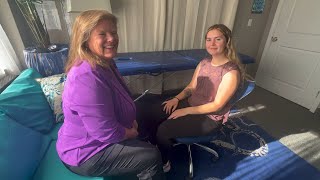
Mary Kostka teaches brush and squish, a calming technique that combines firm brushing on the arms, back, and legs with joint compressions. It activates proprioceptors to settle the nervous system and works for about 80% of children when done three times daily for three weeks.
Hi, I am Mary Koska and this is Miss Kylie. And we are going to demonstrate brush and squish. So we're going to start on the left arm and we're going to go in a circle. We're going to start with the brush. It's important to have a flat hand and not grabby, because if you're grabbing with your fingers, she's going to want to pull away or flinch. And we're going to go between the elbow and the wrist. And we're not going to get on the tender skin. We don't want to tickle. We want to do it nice and firmly. So the bristles are bending so it feels more like a deep massage. And if she wants it, she likes it on the palm. You can do the palm, too. So that's it. You just go once around like you're painting. And then you're going to go to the upper back and just do like a W up and down or zigzag, skip the spine over to the other side. And we're not doing the low back because that is really tender and can be tickly. So now we're going in a circle. We're going to go to the other arm and just like we're painting again, flat hand. And if they're comfortable, you can do the palm. So what we're doing here is we're stimulating the receptors in the muscles, much like a massage. So it's a very calming input. You're going to go to the leg. Oh, I should have you take your shoes off. Go ahead and take your shoes off, Kylie. And then if they like it, you can do the bottom. Do you want to feel it on your feet? Sure. Okay. And you can do it with a sock or barefoot. But again, be very, very firm. And I. On the palms of the feet. I mean, the palms of the hand and the bottoms of the feet. I always ask them first. And again you're going to do the same thing. Firm pressure, but not. Not on the backs of the knees or down by the ankle. So that is the whole brushing part. And now we're going to do the squishing part. So the squishing part. So on the brushing part, we were getting down into the muscle belly, stimulating the receptors, which are called the proprioceptors, and they go to the limbic system. They give the brain a lot of calming input. The other receptors are in the muscle joints and same receptors, proprioceptors, they help with position, sense with calming. But now we're going to do them by compressing the joints. So we'll start with the shoulders. And again, you don't want any of this to be uncomfortable. If they don't like it, you're not forcing it on them. Just don't do it again. You don't want to be grabby, so you have to unnaturally lift your fingers up and use the heel of your hand on the shoulders. How's that feel? So I'm just going to do 10 of these. I like to have the kids count with me. 5. I was at 10. 6, 7, 8, 9, 10. And it's important that they're up straight. Slouch down like if you're not straight, or the other way. Like you're bending forward. Like a lot of the kids are kind of bent here. Then I'm just bending the spine. I'm not doing anything. So you want them to sit up tall when you do it. Okay, so next we're going to basically do the same thing. We're going to left arm, right arm, and then the legs. So now cup your hand like this. Again, no fingers, no grabbing. And you're going to put the elbow right under the shoulder. And you're going to basically do this motion of pushing the elbow towards the shoulder. And you can do 10 of these. 4, 5, 6, 7, 8, 9, 10. And it's kind of a solid feeling. If you're not lined up right, it doesn't feel solid. So it just feels nice and firm. Then you're gonna go between the wrist and the elbow. So you're going to cup your hand this way behind the elbow. Personally, I like to hook the thumb and then wrap my fingers over the wrist. And you want to focus on keeping the wrist straight because you don't want to torque on the wrist. So I just do it like that. With little kids, it might be easier just to kind of grab them like that. And then you're just gonna bring your hands together like this to 10, 2, 3, 4, 5, 6, 7, 8, 9, 10. Same thing on the other side again. This is the main correction that I have to make when I. When I'm helping parents learn. It's very unnatural to not grab. See, have to consciously not dig your fingers in and keep your fingers flat. So 1, 2, 3, 4, 5, 6, 7, 8, 9, 10. And 1, 2, 3, 4th, 5, 6, 7,8, 9, 10. Now, the next part you can do sitting, you can grab behind the hip and the knee and do it this way. But usually what I do is much easier. I'm gonna have to get on the floor, Kylie, or my back. Especially with the little kids, it's just easier to do it this way. So it's easier for me to just bring the knees up like this and then just push straight down. So, 1, 2, 3, 4, 5, 6, 7, 8, 9, 10. And then you're gonna go heel to knee. One, two, three, four, five, six, seven, eight, nine, ten. How's it feeling? Good. Feeling relaxing? Yeah. One, two, three, Four, five, six, seven, Eight, nine, ten. And then go ahead and just set up. Crisscross. So the last. The last part is a little different. It's a. It's a centering downward pressure. So I always tell parents, it's not cpr. You're not going like this because you've been kind of working hard up to this point. This is a more gentle pressure. And so you're going to use the heel of your hand on the spot. Sternum. And you want to move any hair out of the way and on the middle of the back. And you just want to do. I call it the V. You want to do kind of like a downward pressure like this. And think of it as you're centering them. You feel that kind of down by your. By your belly button. So you're just gonna do three, and it's really slow. One, two, three. So you all. And that's it. So you always have your hands, so you can do these. You can do the squishes anywhere, anytime. So you could be in the line at the grocery store and your kids acting up and they're in the cart, and you could just do the shoulders or just do the V and just help them center and calm. But if you're digging into the brush, you want to always follow it with the squishes, because the squishes are the more calming part of it. And I will do another video that goes into a little more detail of when to do this, how to do this, why it works. In general, we recommend doing it three times a day for three weeks because you're going to give your child a whole bunch of calming sensory input. It helps them know where their body is in space. So if you have a kid that's just bouncing off the walls, trying to figure out where their body is in space and seeking all that input. This is a calm way of giving it to them. And also it helps prevent meltdowns because it helps with emotional regulation. So those are the main reasons that we do it. We do it right away in the eval to see if it kind of helps us get through the Eval and see if it's a good technique for them. And then we teach it on. Usually on the first. First visit. And it works for us. It works with about 80% of the kids. So that's why we're including it in. In the kit so that you can get a little head start. Thank you. Okay, so that is basically how you do brush and squish. And you're going to want to do this three times a day for three weeks. And then you can. Then you can do it. It's a tool that you can have. You can continue to do it like that or. Or just whenever you need it. Like I said, you always have your hands, so you always can do those squishes. And the brushing, you should always follow up with the squishes. When you do the brushing. You want to make sure that you're always keeping those. You don't want to go, like, up and then down because then you're going to hit this little tickly spot where it's light. So you want to keep the bristles bending and then just switch. Switch directions like that. That's ideal. The main thing you don't want to do is over stimulate the child by tickling them. And that is the caution here, because if you do it incorrectly, you could make them feel worse, not better. So you want to just make sure you're using a very firm pressure. You don't ever want to force it on them. If they're not liking it, they're not having it. Do not force it on them. This is meant to help them feel better. It does help about 80% of the kids feel better. Sometimes they just won't want to do this brush, and they'll just want to do squishes, and that's fine. Basically, you just want to find out what makes them feel good. We do this during our evals because a lot of times they come in and kids are very intuitive and their bodies tell them what they need. And so they'll come in and they'll be crashing, slamming down on their knees or crashing into the wall or bumping into. Into people. And they're just kind of like wild and crazy. And it's their body saying, I need input to my muscles and joints. And so this is a way you can. Whoosh. Give them a whole bunch of input, but they're just calm and still, but you're giving them what their body's craving in a really calm and organized way. And so doing it in a. In a. Always doing it in the same pattern is Much more calming because it's predictable. And so if you change it up a little, like you just decide to go clockwise instead of counterclockwise, just do it the same every single time. And you always have your hands. You can do the squishes anytime, anywhere. If you do the brushing, you want to follow it up with, with the squishing. It should always feel comfortable to the child. You don't want to ever force it on them. You don't want them to be more uncomfortable. And so it's something to never, never force on them. Sometimes kids can only handle a little bit of it, or sometimes they want more and that's okay. You know, maybe you only do start with just the arms, or maybe you just do five instead of 10 repetitions and you build it up. You just. The main thing is to operate within the comfort zone of the child. So. So this technique is a kind of a spin off of something that I had learned probably 20 years ago. And it's a more intensive protocol. They would do it like every 90 minutes. Boulevard depressure protocol was done like every 90 minutes for tactile defensiveness. I started modifying it and doing it specifically for helping kids just be more centered and calm. And what I really like too is that it gave parents a tool, a way that they could connect and help their child feel better. So we use it, we've modified it, we do it for a different intention and in a little bit different way. And I've done it, like I said, for over 20 years like this, with great success. Sometimes they'll want more and it's okay. If they're saying, I need 50 squishes, give them 50. I had the first time I actually really saw what a difference this could make. I was, I was working in the schools and there was a little boy who was throwing furniture and kicking and just in a full on meltdown. And they just kind of grabbed me like, as an ot, they were just like, hey, you know, can you help? And, and so I had just, just learn this technique. And I'm like, well, I didn't have a brush, so I'm like, well, I could at least like do some shoulder compresses, compressions. And. And I just did that. And he just looked at me and he's like, can you do that 100 times? And I was like, hey, he's not biting and throwing things. I'm like, sure. And I just kept him, kept doing it and helped him be calm. And. And then the next time I saw him, he's like, can you do that 50 times. I'm like, sure. Again, he's not being violent. It's not gonna hurt him. Fine. And then from then on out, it was just the 10. And we taught his teacher and his. The aides and the daycare person and his parents, and it really changed his life because it just helped his body, his little body, just feel centered and organized. He knew where he was in space. It was calming. Well, I ran into him. He's in his upper 20s, and I ran into him at my mom's apartment complex because I knew he had lived there, but I hadn't seen him. And I ran into him, and I was like, hey, how's it going? I hadn't seen him since he was a little kid, and he's like, hey, Mrs. Koska. Good to see you. And I was like, wow, I'm really impressed you remember my name. It's been so long. He goes, well, of course I remember your name. You're one of my favorite childhood memories, because you made me feel. Feel good. And when I was in preschool and I was just, like, mind blown. I mean, that's the power of being able to help a child not feel like they're in fight or flight, help them get calm and centered. So anyway, that is. That's basically it. And if you have questions, you can put it in the Facebook group, and I'll be happy to help you out. Okay, so next, I have a little film of me actually doing it on a child for the first time. And you can see he's a little wiggly and just kind of how. How I work with him and how I do it. One thing about the little kids is their arms are so short. Like, they might only be, like, that long. So you might be just hardly. Hardly moving it at all. You can do it. We can sit in your lap. There's just. You just kind of go with it. Like, it doesn't have to. It's not going to be perfect. Like, when I was doing it on kylie, she's like, 100, cooperative. So, you know, kids are wiggly. So. So I. I have a. This other video, so you can kind of see just kind of what it. It looks like. And like I said before, you can modify a little bit, do it less frequency till they get more used to it. You can. So you can do it less. The repetition, the actual, like, squishes. You can do 5 instead of 10. If you're craving more, it's okay. Do more. You know, you might start out just once a day, and then do Twice a day and then three times a day. It's like I said, it's just a tool to help you. What's important, though, is to get them used to it first. And the best time to use it is before they're having a meltdown. If they're in the middle of the meltdown, it might help, it might not. It depends. In that example that I gave you, he was, you know, he was in a meltdown, and the shoulder presses calmed them down and stopped it. But sometimes. Sometimes that's not going to work. And so in this. In this kit, in the videos, in the book, there's going to be a lot of different things that you can try. Sometimes you just have to change the environment. It's important to stay calm yourself. But this. This tool works best as a preventative measure to just give them that calm, calming input multiple times through the day. So next you'll see the video of me doing it on a little guy and just kind of see what that looks like. And I wish you the best. And like I said, if you have any questions, you'll be able to ask me in the Facebook group. Yes. And you like the squishes. Okay. Okay, so we're going to start with your arm, and we go between the joints. So we don't want to get on the tickle spots. So we're just going to just. Okay. I go a little harder, so it's ouchie. Stop playing. Ouchie. So we got to go in between. Right. Not too hard, not too soft. How's that one? Do you want it on your hand? Yeah. No. No. Okay, we'll go on your back. Okay. He's a good example. Like, we like to do it firmly, but you're gonna have to, like, not too much. Okay. Hold on. We're gonna do your leg, too. Now we're gonna do that like. So we like to do it firm where the bristles are bending. Otherwise it's too tickly. But he doesn't want me to go too hard, so you have to kind of find just the. Just right. So practice in a minute. All right, so like that. Do you want to feel it on your foot? No foot. No foot. Okay. All right, so now we're gonna do squishes. Are you ready? Okay. Sit up tall. Look at me. So I'm gonna push on your shoulders, and I'm gonna have my hands out straight. No. Dang. Can't. No. Okay, well, so you can tell me harder or softer. We'll do 10 of those. Oh, good. All right. You want to count with me? We'll do ten. Yes. How's that? Is that okay? Yep. I had to go a little harder for him to like it, so I'm. I'm trying to not grab because then you feel like you're being ground and you don't relax. So I'm being very gentle. Okay, you ready? 1 to 10. 1, 2, 3, 4, 5, 6, 7, 8, 9, 10. He's squeaking. Okay, so now we're gonna go on the floor and lay on your back. That one? Is it that one? What are you looking for? The swing? No swing. Okay, here, lay back. I'm gonna do your knees. Ready? Are you gonna squeak again? Yes, you are. You're like a squeaky toy. Yes. I'm trying to do 10, and then I'm gonna go heel to knee, 10 of those and the other one, heel to knee. And then I'm gonna end with a very gentle sit up, a very gentle V using the heel on my hand on the chest. We're gonna do. We're gonna count. We're gonna count to three. You ready? So you can see when you're doing it on a little one, it can be a little tricky. And he had a very narrow pressure point that felt good to him. So if I was too light, he didn't like it. He might say ow or tickle or something like that. And. And he didn't like it if it was too hard. I had to, like, find the exact right pressure to where he was comfortable. And. And he. His was a much narrow, narrower range than a lot of kids, so. But it's just really important to tell them to let you know if it feels good. Sometimes I'll just do, like, thumbs up and. Or thumbs down, but get a communication going of some kind with the kids so that you know that they're. That it's feeling that it's feeling all right. And the video cut off, but I did do three to finish, and then you're done. So that for, like, being, like, the first time doing it with him went actually pretty well. It's kind of typical that. That it's kind of touch and go like that because it's something new for them to experience. But overall, you can see he was. He was enjoying it more and more. Towards the end, you could tell that it felt pretty good to him overall. So like I said, just really get some feedback with them, make sure it's feeling good. There are our sensory kids on often have a very narrow. I call it the tightrope of that just right feeling of where it's not too much or too little. So you just have to really try to figure out where that is for them. Okay. Aloha.










