Happy Staff Webinar with Mary Kostka 4/19/23
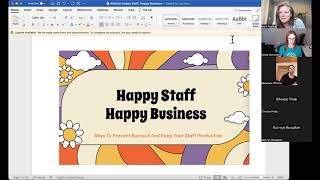
A 4/19/23 webinar led by occupational therapist and practice owner Mary Kostka (with assistant Haley Scholten) about building and maintaining a happy, productive pediatric therapy team. Mary presents a three-step method — (1) a happiness formula (Control, Progress, Connection, Vision), (2) a daily pulse check using role-specific daily sheets, and (3) empowerment through delegation and elevating staff — illustrated with concrete examples (daily checklists, delegation matrix, incentives, culture practices). The session includes Q&A about caseloads, pay/incentive structures, documentation, recruitment, and a promoted in-person workshop (OT Freedom Live in Clearwater, FL).
I'm recording. Good for me. Okay. How do I get minimize all this here? Okay, so, Haley, I won't be able to see the chat while I'm doing this, so just let me know if there's something I need to know, okay?
Okay.
All right. Can everybody see this? All right, can you see it, Haley?
Yep.
Okay. Welcome, everybody. We're gonna go ahead and get started. It was really, really cool to hear where everybody's from, man. All over the country and Australia, and I didn't see anybody from Canada, but there might be somebody from Canada in here, too. And I'm just really, really excited to start to share with you just some things that I've learned along the way. And so here's just a little introduction. I'm Mary Koska. If you don't know me already and put me. Can you see me still talking? Now I realize I made myself disappear. Can you see me, Haley?
I don't see your picture on the screen also.
Oh, I can see myself. Okay, well, I'll just kind of go between this and sharing and not sharing. Okay. So I am an OT for 35 years, and most all my career has been in Pete's, but I've done a little bit of everything, and I've been a practice owner for 14 years, and it's really become quite the family business. Everybody in my family helps with it. So I am wife and mom of two adult. I always still want to say boys, but they're 24 and 26. I guess they're not boys anymore. Wonderful sons and daughter and sister. Two amazing women. My. My passions. You'll see me out on the kayak a lot. I. I tend to do lives on kayak because I get super relaxed, and then I don't feel nervous in front of the camera whenever. So I'm, like, always paddling around and talking to you guys. I love hula and karate. This is my husband, Pete, my mom, Fran, Nikolai, and Lukash. And when I say it's a family business. Pete built my clinic. Both my boys have worked in it. My mom does billing, and now my sister has become my client advocate. And I didn't really plan it that way. It's just they've just helped me along the way. My main mission is to elevate other people. That's what gets me excited. I'm hearing some background noise. Can you do, like, a mutual Haley?
Yes. I'll go through. Okay.
So anyway, so my main mission is to elevate other people. That's. You know, I really have given it A lot of thought. I'm like, what fills my cup. It's anytime somebody's like I did it. So it's really all been about for me the sensory, sensory kids and their families. And then that has grown to training therapists and then in si, and then that has grown to helping practice owners because I want, it's a tough business to, to do, to be successful in financially. So I love sharing what I've learned. And then about probably seven years ago, my, the two in the front, my son Lukash and Pete, were diagnosed with form of muscular dystrophy that's actually very common but very not well known. And not just there's no cure, there's very little research on it. And it's called fsh. Facial Scapular Humoral Muscular Dystrophy. And so as I earn more money, I donate a percentage of the money I pay to myself to this charity. So that's my favorite charity and my son and my husband actually are guinea pigs in this research. So trying to help get a cure because it's, it's horrible. It's been very devastating to our family. But, but it gives me, you know, some fire and some drive. So for that it's good. So what to expect, we are going to go over my three step method that I use to make sure my staff are happy. And then I have a power tool, something that I use with all my staff every single day. And I can't wait to share that with you. And then towards the end, because this will go kind of fast, I have a lot to cover fast, but I'm going to share with you how you can learn more from me. I'm doing a, I'll let you know about a workshop that I'm doing in Florida in June. So if you're interested in hearing more about that type in the chat, learn more. And I will be happy to share that with you guys at the end and then we'll have some questions and then we'll have. All right, people want to learn more. I know this is going to be like fast and furious. I had like this much and I'm like, oh man, I gotta condense it down to this. So. But it's really, really exciting what I'm gonna do. So I'll share that with you at the end and then I will stay on for questions. I'll stay longer than a half an hour. I mean whatever questions you guys have, I'm happy to answer at the end. I have a fun surprise for you guys. We're Gonna. I guess it's not a surprise if I tell you. Should I tell them, Haley, or not?
I don't know.
There could be cat. There could be cash involved.
There could be some.
It could be something really, really good. There'll be some winners, let's put it that way. For the people that stick around.
Can I just say something really quick?
Yeah.
Mary has so much knowledge that she's going to share, and I'm really proud of her for condensing it, but she. I have. I've worked with Mary for about four years now, and she just, like, I'm impressed with how she condensed things, but she just has so much value to share, and I just. As an employee, I want to share that with you guys. She is a wealth of information, and I'm very, very proud of her. Oh, okay.
Thank you, Haley. And I really. I really have to give a shout out to Haley because Haley makes me look good. Seriously, she corrected a lot of typos in this presentation. Oh, I'm trying to get. I guess I need to close my chat. I've got it right in the middle of my thing here. How do I do that? I guess I can't watch the chat. It's going to distract me too much. Okay. So there. Yeah. Haley. Haley is my admin assist. And I'm seriously, like, Haley makes it so that I get so much done and it ends up looking good. She makes me look good. I love my Haley. So, yeah, let's stay to the end for a fun surprise. Okay. So when I decided to do this, it occurred to me, I'm like, what the heck does happy mean anyway? And. And so I actually looked it up and. And I thought this was really interesting because feeling or showing pleasure and contentment. So contentment, and then having a sense of confidence and satisfaction. So I thought, well, that's interesting. Contentment, confidence and satisfaction. So I think that's a good, you know, baseline. That's what we want our staff to feel. So these are some groovy facts. Just kind of so, you know, kind of where I'm coming from. My. My productivity and my staff is extremely high. It's 88%. At the same time, I have. And I know that's, like, astronomical, but it really is that high. And at the same time, my retention is really high. For the past three, four years, it's been. I've really only had one person move to another state because to be with family during the pandemic, we've nearly tripled our visit. So we're like, this close to tripling from right before the pandemic hit. As of last month, I'm off the treatment schedule. I only treat if I want to, so sometimes I want to because, like, we're really full and we've been really enforcing our makeup policy, like if you miss to make up and sometimes there's no place to make up. So I've, I've picked up a few here and there, but it's only if I want to. And my staff, they just, we're just like a play hard, work hard crew. They like to have fun. In fact, they are going tonight to go get like pedicures just on their own time together. They just have a lot of fun together. And here's, here's the crazy thing. We leave on time and they don't take any work home because we have super efficient systems. So I realized that this just seems kind of like pie in the sky, but it's real. But it wasn't always like this. So I'm going to share some of the pain with you. I did this recently. It's just kind of like something I did on paper. I, I wanted to put into perspective and don't worry, you don't need to read any of the stuff on here, but I wanted to put in perspective what I'm Almost at year 15 in my practice and I'm like, it has been a rocky, wild ride. I've nearly lost, I've nearly gone bankrupt, I've nearly lost my home. I've had the taxman knocking at my door. I've had them take money out of my account. I mean, I've had so much happen, not to mention the pandemic. But with everything, I grew and I learned. So I started out just me and treating out of my house and you know, not seeing that many and, and built it up and like, like most of you guys, if you've, you know, we didn't learn how to manage a, a staff. And so I did a lot of things not very well here. And I call this my bleeding heart broken business model because I, I didn't have it like in a profitable way. And I was growing and I wasn't managing my staff very well. And I had most everybody I to that runs a practice. At some point you have like a big turnover and then you kind of wake up and you're like, I got to do things better. So this was kind of like a big turnover and then I was doing things better and things were actually cruising along quite nicely. And this is about when I Started focusing on team happiness and just really focusing on pouring into my team just during this whole second part. And then Covid hit, and of course, that was devastating. Um, but I had been doing a lot of online stuff, so I was. I had another source of income to help my. My company kind of get through all that. But since then, it's just been a rocket ride, just adding staff and just doing more and more and more and more. And so during this whole period, and I had started right before the pandemic, and it helped us get through the pandemic and all here I have been doing all the things that I'm going to be talking about today. And then this section was quite painful. Let me know if you've been there. Maybe you are there now, but have you felt the pain? I want to know that I was not alone. Just write yes or pain or been there. I'm not alone. And you know what? We all feel alone most of the time. So we got to get together. Oh, good, Casper. Getting out of it. Yes. You know what? I don't know any practice owners that haven't been through it. And, you know, at this point, at 14 years, less than 1% of business of any kind make it so, you know, it's just business. It's. It'll leave you bleeding on side of the road unless you persevere and you figure things out along the way. So anyway, I just wanted you to know that it wasn't always like this, but there's definitely a lot of things I've intentionally done that have got me there that I want to share some of that with you today, so. Oh, I am right on schedule, Haley. So the three step, three step method. The first one is the happiness formula. So this comes from the science of happiness. I was at a. Actually, it was Brandon Siegel's conference, and he just, like, mentioned Science of Happiness and these four things. And it was so cool when I heard it because I'm like, that's how I can categorize everything I do with my staff. It's in these four categories. And I also wanted to see, like, am I hitting all four categories? Which I was. And I'm just calling it CCPV so I can remember it. So it's a sense of control. Don't worry about writing that down, because I'm going to have it on the next slide. There's my awesome team. Okay, so it's. You can write it down now. So people need. And this is just in general, like, for people to feel happy and. But you Know for your staff to feel happy, they have to have these four things. They have to have, feel like they have some kind of sense of control. They need to feel like they're making progress, having a sense of progress, a sense of feeling connected and a sense of being vision of being part of something bigger. And when I think of like when I left my first job, I pretty much didn't have any of those things. So they cut my continuing ed. I didn't feel like I had any. Like they weren't sure about the paychecks because they weren't financially doing very well. I wasn't learning anything new, so I didn't feel like I was progressing. I did have a sense of connection. That was the hard part about leaving because I, I did love the people I worked with and I just didn't have a sense of where this hospital was going, this little hospital. It just didn't seem like it was even maybe possibly not going to make it. They did make it, but at the time, as a new grad, it just after two years I, I left because of these three things when I think about it. So I'm just going to show you some pictures of what this looks like when you're doing these four things. This is just my staff having a good time, going hiking together. We have lots of parties. This is from our retreat. This is up at my house. They came up for a little, we were having a little winter doldrum so we decided to have a little winter sledding party. That was really fun. When I started, when I started this, I, I did this whole presentation and I like wrote down all these things and I thought, you know, this is what I think I should ask my staff. And so I just asked them some open ended questions. What makes them feel like in those four categories. I just said, you know, what makes, gives you a sense of control at Ohana? What Just open ended questions. And so a lot of what I'm sharing with you today is actually what they said because I thought what they said is more important than what I think. And so there's some different little quotes that came from this, but one of them was, you know, that sense of something bigger. One of the staff members said all the work we do is for the same mission, to help families strive. The harder we work, the more families we help. And I think that's such an important thing for staff to feel like if we're working hard, it's, it's a good thing, you know, we're helping more people. So I thought that was pretty sweet. So when you're looking at these four things, I literally realized I was doing about 20 in each category. I'm serious when I said I've worked really hard at this, but that's something I can share more in the workshop, like all that detail. But these are like some of the top ones that they mentioned that they liked. So I thought I'd share those. A lot of people think, oh, it costs a lot of money. I would say like 75 to 80% of the stuff I do does not cost me any money. It does cost me time and energy, but it doesn't cost me any money. Then there's some low cost things and then the high cost things are just the things that if I'm paying them when they would be producing, like if I'm losing revenue, like I take a day, let them all have a day for the retreat. That's a, that we would be normally treating so that, that, that's a high end item. But you can do those things, you know, voluntarily, like on the weekend. I know Kim, Kim's on here, I think one of my business besties. And we've talked a lot about all these things and she's implemented a lot of these things, but her pay structure is different. And so when they do their staff meetings and when they do, you know, events together, X throwing or whatever, they, they do it on their own time, but they still do it. So. So sense of control. These are all things my staff told me. They said, you know, it's, we have really clear tasks and roles and expectations and that they feel like I really trust them and that they don't feel micromanaged. And when you see something that I have them do every day, the first thing people tell me is they're like, don't your staff feel micromanaged? But this is actually what they told me. They're like, nope. We feel like we know it's. Everything's really clear. So. And having a sense of control, like having my own practice, one of the things I really wanted to do was it really bugged me, like if I saw a cute toy or something that is like there was no reimbursement for it or whatever. So I just have a policy. And this is one of the things they brought up that I just have this policy because we have an Amazon account for our practice that don't even ask me if it's under 20 bucks. You know, do you see some cute new game, Sneaky Snacky Squirrel or something? You want it? It's you know, now I realize if you're a huge clinic, you're going to have to put some boundaries on this. But, but at this point they don't abuse it at all. But if they're goodwill and they see something really cool, you know, they, they know if it's under $20 that I'll reimburse them. And then we have a shopping list that' they need something special for an activity. I don't know, make slime or cook or whatever. They're not limited by what's in the clinic. So those are things that they mentioned. Sense of progress. Most of them really talked a lot about education. The formal continuing ed wasn't mentioned as much as our in services that we do during the staff meetings like bringing somebody else in or having presenting to each other. And then the clinical masterminds that we do during our staff meetings was mentioned the most. And we do, we'll do like where they share something that's working and then an ask of the group. So it's like group brainstorming. And then they really appreciate that I have like clear expectations of like what, what I think you should be able to do at an, as an entry level therapist, as a two to three year therapist, as a, you know, I have it like very, very clearly outlined. So they can see their progress. They can see that yeah, I'm, I'm clearly meeting these expectations. And then for sense of connection, really it's the time together that we're not working. So the staff retreat, staff meetings. Once one meeting a month we have celebrations. So we always celebrate. I celebrate everything. And so it's, you know, birthdays, anniversaries, baby showers. Now we have, you know, enough people that we do it, we just group it all and do it once a month, have a little party. Positive communication. We do a lot of different things. We have an internal Facebook group. We do highlights. Everybody says a work highlight and a personal highlight and they post that so we can read through it. And we feel because we're so productive, we don't get a lot of chit chat time. So we're, you know, that way we can kind of feel connected and like I can come back in and be like, like my receptionist races dirt bikes and be like, oh, it was so awesome that you got, you know, you got second place. But I already know because she put it in the highlights, you know, so it can make the connections or the time together a little bit quicker. I don't know if that makes sense but. And then we have this little sticky Note. We have this little birdie tied to a little thing and they write nice notes to each other. It just lands on the desk and they're just always saying nice things to each other and then they have like collections of them on their, on their bulletin boards so that, you know, they just have this feel good stuff all the time. And I thought this was very interesting because I have this as my expectation in my onboarding and I kind of forgot about it, but people actually brought this up. I had this expectation that everybody has to like look at each other and, and say hi. You can't just be like, oh, hi. You know, as you're getting ready for the day. So something simple like just eye contact and connecting at the beginning of the day and the end of the day was something they really appreciated. So I thought that was, that's an easy thing to do. Sense of vision. We get testimonials on every graduation and we share them on our, our ohana Facebook page. But we also like do a pass around, you know, where you have the list of everybody's names and it goes around so everybody can see that, see the impact on the family for all of them. And everybody that was like top of the list, they really like seeing the effects, what the parents have to say. And in our internal Facebook page, I share, I share a bunch of the stats, like how we did on our different goals. And they said that that really helps them see like how their part is contributing to the bigger picture. More fun. Okay, so the, the second thing is taking a daily pulse. So every single person. I have quite a few remote staff too, by the way. Haley's in Oklahoma, I'm in Washington. I have a couple that are on the Seattle side. So they do it through like a jot form or you could do like a Google form. So they send it in to me electronically. But my staff, actually the ones that are here, do it on a piece of paper. It's just easier. And what they do is every single position has a daily sheet they fill out. And I'm going to show you the therapist one. This is where every time I show this to people, they say, don't they feel micromanaged? And they don't at all. I developed this actually out of a therapist getting burned out. And I didn't realize that she was getting all the hard kids. I just didn't have any way to realize that. And so this evolved from that, but it evolved from a caring place. And so they write down their, the kids that they're seeing that they Saw the units that they build because they're going to calculate their productivity and they just do a check off, like, how did the session go? And then I have it defined at the top. So, you know, most of them, it'll be good. There might be like, you know, maybe it was good, but then they had a hard time leaving, so it's good with challenges. Or it was like one of those like big meltdown sessions, so it was a really hard one. Or maybe they just, you know, just had a amazing session and so it was awesome. And then I have a place where they can say like, if they heard any complaints, I want, I want to know right away if there was anything negative that anybody heard. So I have that on there and then I just have. How are you feeling at the end of the day? Energized, happy, good, tired, completely wiped out. And most of them will check, like, happy, good, little tired. What I'm really looking for is, is if they're wiped out, it's okay to be wiped out once in a while. We all are from, you know, having a, like, maybe we had a really tough kid. But if I'm seeing a pattern, I'm always looking for patterns in these. So I'm. So if, you know, gosh, they were completely wiped out three days in a row, why. Or another thing is like, if they had a cancel, they write in what they did with their time, you know, worked on progress notes or worked on this project or whatever. So it's just really interesting because, like, if you ended up. Only if you ended up with a lot of open times, but then you said you were wiped out, I'm really wondering why. And then they can tell me why, but they know it's from a place of caring and, and they just really appreciate that I care enough to know how their day went. I know there was not a single person I ever worked for that cared how my day went. So. And then they have a place to ask questions and then what I do because sometimes like I'm going to be on vacation for two weeks, so I'll end up with a stack of these that are two, two weeks worth, but I can flip through them really quick and then if they have a question, I'll just take a picture of it and text it to them with the answer. Or, or if I can see they had a challenging day, I might just acknowledge that and say, hey, wow, that was a big day. Glad you got through it. Or, or just, whoa, what an amazing day you had. Or I just acknowledge it. I don't do it for every single one. But I try to do at least once a week acknowledge something in there so they then they know I'm actually looking at them. So the ones for the office staff and the aides and even like Haley's and they're. Well, the office staff and the aid one, they're extremely detailed because there's so many little things they have to do all day. So it's sort of like this big to do list. But what they can do is they don't expect to it everything every day, but they can. That way they can kind of check off what they did. And over the years, when one person is feeling kind of overwhelmed, we just take out those lists and we'll look at who's doing what and we'll be like, okay, let's rearrange some of this. Some of this needs to go to another person, but it's just really clear. And again, they can tell us how they're feeling at the end of the day. That's the. That's my clinic and my team. So this is like one of the comments when I did my survey of the staff. They said, you're very responsive. And we have the chance to say if we're overwhelmed on the daily sheet. That was one of the answers to a sense of control. So I thought that was kind of a cool thing that they shared. All right, this is a student, Vanessa, that we just had. So empower is the third one. So in empower is you really empower people when you learn to delegate. And so when you delegate, it's. There's so much that we're doing right? I mean, it's like a 2 million things. So I love this from the book Eos Life. It's a great book. And you make these four quadrants and you, you say, love it, great at it, like it, good at it, don't like it, good at it, don't like it, not good at it. And you lit you just. Well, for the first thing you do is you just start writing down everything you do all day long. Everything. Just write it down in a list. And then you take that list and then you plop things in these categories. The first things you should delegate are the ones in the don't like and you're not good at it. And for example, I gave Haley dealing with the time off requests and, and how that affects the calendar and tracking all that stuff because I wasn't good at it. And I really didn't like doing it. And I don't know if she likes it. But she's doing it for me now. You know why, right, Haley? It's kind of a pain, but here's. Here's some examples of. Of things that I have, like, I have, like, delegated that to Haley. I do not like cooking, and I do not like cleaning. So I have merry maids come in. I'm working on delegating the cooking to, like, some kind of somebody to come in and prep food or something. Don't like. And then the next one you want to try to delegate things off of is the next box over. So, you know, I don't like paying bills, so if they're little bills, I'll pay way ahead. And then it's like a game. And then I get a bill and it says zero. Like, that's cool. Auto pay as much as I can. If somebody else. If it's a problem somebody else can solve, I really don't want to. I really want them to solve it. So I like, I try to just hear their ideas. A lot of times they just want validation. Like, well, what are you thinking? Yeah, that's a good idea. Go do that. And ordering supplies. We have a petty cash card. I just keep about 200 on it. So anytime they need to get stuff, they can get it. You know, we're out of something, they can go get it. And then we have the Amazon account. So that works pretty good. Like, it, good at it, onboarding, training. These are just some of mine. One on ones with staff. But as my staff grew, I couldn't do one on ones with everybody once a month. And so now that's delegated. So like Haley does all the support staff. My. One of my codas does one on ones once a month with the aids. And it's just like a. It's a check in. We have a series of questions. We asked them though all those sheets that I showed you, reviewing the daily sheets, I had to divide that up. So Haley's also. It's the same as the one on ones. They're just kind of divided out. So I'm not doing all of them. Love it, Great out of it, great at it. The things that I love is just let me be creative, let me think, let me come up with these big ideas, implement new things, just free my brain. That's what I love. So mentoring. One of the biggest things I didn't do very well when I was not doing well was I wasn't a good listener. Anytime we got. I got feedback from my staff. They were like, you need to listen More so this was very meaningful to me that they. Somebody said that you're open to new ideas and willing to give new things a try, yet we need to be that way to have happy staff. So tell me, tell me in the chat if you got it. You got what the three are. So you got the happiness formula. So you have control, connection, progress, and vision. Taking the pulse every day and empower through delegating and elevating. So type in the chat if you got that, and then. All right, good. Oh, there we go. Okay. Just a few more things that came from the survey. This just comes from the. When they. When I asked about, like, if they have a sense of being part of something bigger, vision. You make sure we. We know our overall purpose. And your passion for the kids is contagious. I'm living my purpose to help kids in need. We're a family. I thought that was. That's what you want. You want your staff to feel like they're family on that. Taking the pulse every day. I don't feel micromanaged. This was under control. Under that sense of control. I don't feel micromanaged. Mary puts a lot of trust in me. I feel like she cares to know how my day went. So I know a lot of you look at that and you think you're going to get pushed back, but you'd be surprised if they know it's coming from a caring place. They actually appreciate it. And for empower, this was actually you, Haley, right? This comment.
I. Yeah, I think so.
Yeah. We talked a lot about, like, as the clinic grows, that we all grow. And Haley. I've delegated a lot of things to Haley, but now Haley actually has had to like to be able to do everything she needs to. She's had to delegate as well. So you want to train leaders. To train leaders, and that's how you. That's how you grow. But it's tough because we all know it's our baby and it's hard for us to let. Let go of things. So I want you all to type in delegate and elevate. That's what you need to do. Commit to it. All right, so now, all right, I'm seeing some delegate and elevate do it.
I, like Mary has delegated to me, but I'm getting to the point where I get to start delegating to the people that I've been managing. And it's really helpful. It's powerful.
Every time I had trouble letting go of something, once I let go of it, I was like, I never want that back. You know, the thing is, as entrepreneurs we have to do it all in the beginning. We kind of have to be control freaks in the beginning. But then we can't move forward unless we learn to, to, to trust people. It's challenging, but we can do it. So let's see where I'm at. Okay, so actually you can post the link in here now, Haley. So you know I was telling you that I'm doing a workshop this or I'm doing it in Clearwater, Florida at the Wyndham. It's called the Wyndham Grand. Anyway, it's right on the beach, really exciting. So what I'm doing my. Well, I'm doing a workshop called OT Freedom Live. And so I'm going into a lot more depth of all these things on how you can have better work, life balance, how you can, you know, find the right staff, you can have more retention and less burnout, some financial stuff and oops. And I'm partnering. This is my coach, Greg Todd. And Greg's been my coach since I started with him right before the pandemic, January 2020. And you can see the impact on my business he's had. Like he has just kept me pointed in the right direction. He's just a phenomenal guy and he's extremely passionate about healthcare professionals being successful. And so he's, he has a smart success health care life conference that I attended before and I'm in his mastermind and he offered to us in the inner circle mastermind. He wanted to make it so that we could have like our own workshop pre, pre. A pre conference workshop to his event. And so I'm doing a whole day on the Thursday and then his event is Friday, Saturday and Sunday. And his event is like nothing I've ever been to before. Holy cow. He is the most amazing speakers. Just, you just open your mind so much to so many possibilities and just learn really practical things. And it's just so fun. I mean you're dancing, you're doing all kinds of crazy stuff. It's fun. Anyway, so what I'm going to focus on is how you can leave your work at work, not take it home. How you can create your dream team, how to establish a more, a lot more in depth on this positive work culture, how to stay on top of the money, more about delegating. Just the thing is like we love to treat, but when we're treating all the time, there's no way for us to really run a company. And we have this tug because we Love it. And so it's how to make it so you have the control. You can choose if you want to treat, treat. If you don't, don't. And so it's going to be a workshop. So it's going to be not just me talking, it's going to be having time to actually create something and leave with something done. So you're going to have your system for more productivity. You're going to have your, you're going to have a plan, you're going to have like exactly what you're going to do in those four areas. You're going to have, you're going to create those daily check in sheets. You're just, you're just going to have, you're going to have like what you would do at a retreat outlined just, it's, you're going to, and you're going to have a chance to connect with other practice owners. Which is the most like, I think the most important thing. This is the Friday, Saturday and Sunday. What Greg's doing here, Let me make this a little bigger. So, so how to, how to become preeminent and as a healthcare professional, the skills that you need to leverage them and then building your legacy. So he does a lot on financial education, he does a lot on how to not trade time for money. All the different ways that you can make money besides direct treatment. Let's see. And so the cost, whoopsie. The cost for it is just 987 for all of it. And I included in this, the VIP upgrade because everybody who comes to the workshop, my workshop, I want them to do the VIP because there's a, there's a private dinner cruise, sunset cruise with Greg and there's just special things. You get the recording, you get the front row seating, you get VIP cocktail hour. Anyway, I just lumped it all in. So you get all of that for just 987 and then. But I have a special for the webinar for those of you that are on here. And the first five to register will get a consult call with me which is a 250 value. I have three businesses now, so my time is of a premium. And then everybody who registers, I have only 50 spots by the way, because that's the size of the room that I have. There'll be, I think he's got about 300 already registered now. I think there's about maybe 200 spots left for the. I can't remember if he said he can have 500 or 600, but I can have 50 in my room. And so what I'm going to do, I know everybody wants, can I have the template for this? Can I have the examples for this? And all of that. So I'm going to give you all of that. Anybody from the webinar who signs up. So just all my. My front desk daily sheet, my aid daily sheet, therapist daily sheet, template for delegate, and elevate the examples of. Very extended examples of all the stuff that I do. And the. You know how I said I have, like, 20 things in each category for the happiness formula, you get all of that. Did I misspell that cheat sheet? I think I did. I think we missed one. I have a developmental cheat sheet that's two pages that I spent a few years compiling, and it has, like, the norms for. For, like, everything on it. So that's pretty awesome. And then I have a membership that is. Has a lot of videos, different trainings that I've done. And so I'm just throwing all that in for everybody who registers that's been to the webinar, been to this webinar. That's just a bonus. And so, like, for the first five, they're going to get almost a $3,000 value, $2,800 value, because they'll get all of that. And I'll tell you, the biggest reason to go to this thing is the connections that you're going to make make your business besties. So this is Kim and this is Raina, and we met online through Greg's online courses, and he couldn't do SSHC live right during the pandemic. And so that was all virtual. So we did, like, these different virtual things. And then finally in 2021, it was like the first live event that during, you know, with the pandemic that I was able to go to. And we were so excited. We got to meet each other in person. Her baby was two months old and just hanging out with us and. And we have. Through all the ups and downs in business, you got. You got to have somebody that has your back, that understands what's going on. And so when you make these connections, we. We've literally been on a voxer. We're actually on WhatsApp now, but we've talked to each other every single day for, like, two years now. I mean, it's just since this time, since this time that we got together. So I think the most powerful thing about going to these events is, is. Is getting your business besties, getting those connections, because it's just. It's just too hard to do this alone. So I'm really excited to help you level up. Let me know who's in. And I'm going to stay on for questions.
We had a few questions come through about kind of the conference. Like, is it only once a year? Does this happen more often?
Which thing?
The, the whole conference.
Oh, great. The, the SSHC live.
Yeah.
You know, I think Greg decides each year what he's going to do based on. He's. He, you know, he started out just helping the, the pts, but he became very, very passionate about helping all healthcare professionals. And so this one's going to have. In. In my mastermind with him, we have a dietitian and she, she actually left her job at the VA and is making. Oh, my goodness. She made. She made six figures in the first three months out out of the va. And her whole thing is selling classes and helping people know how to, how to blog, how to monetize blogs. So there's gonna be a whole bunch of her people and other dietitians. There's going to be a whole bunch of specialist PTs, like pelvic health PTs. There's going to be chiropractors, doctors. The other thing Greg's really passionate about is us connecting and partnering with each other and helping each other. So he's basically creating a movement where healthcare professionals do not have to feel like limited in how they can help people and not limited financially. So he's extremely successful and he doesn't need to do this at all anymore. And it's a lot of work for him to put this kind of stuff together. But he, you know, it lights a fire under him and he, you know what it's up to? It's up to his wife, it's up to Carrie. As long as he can spend enough time with his wife, then she'll let him keep doing it. So I would say it's year to year, I would say don't miss it because we just never know.
Yeah. Another question was, is there going to be any virtual portion of the conference? Do you know if it's.
He decided it's time to not do any virtual.
He's.
Yeah, he's going to record it. He's going to record it. And the VIPs, which. Everybody who signs up in my group, they're all going to be VIPs. They're going to get the recording. But he, he just really wanted it to just be live. He wants to get people together live because it's so powerful.
Yeah. We've got a few questions coming in. So I'll keep all. I'm just going to tell Mary the questions and then she can answer them. So I'll ask on your guys's behalf. Yeah. In a, in a case of full load of therapists, how do you manage the load? What is the ideal load or contact hours with the clients?
Okay, so what I, what I do remember, my staff are extremely well supported because I have, I have aids and I have an extremely efficient documentation system. And so, so I'm able to have a higher load if so my therapists, every minute that's not a staff meeting is scheduled because I know I'm going to get at least 10% cancels. We shoot for about 10%. If they get 10%, they've got one hour out of every day we do four times. So that would be at 90%. Our, our goal is always like 85%. But most of them run, like I said, the whole average is 88 right now. So we, we book them completely out knowing we're going to have cancels. Did I answer the question? Oh, the ots, if they're doing an eval, they'll get an hour to write it up. So they, so I want the OTs to get 32 in and I want the CODIS to get 34 sessions in minimum. And I know that's a little higher than most people do, but they do it and they're happy and they're happy because I support them. I make it easy for them to do it.
Okay, sorry. Next question is under sense of control. You mentioned you allow your therapist to purchase items under 20, $20. Is there quarterly or monthly limit to this? Do you put any limits?
You know, I will when I need to. But right now my staff, I have like a staff of 15. And so they've never abused it. So. But if I had, you know, some of you guys have what, 40 people? Or you're going to have to have some limits on it, but they don't abuse it at all. You know, another thing I do is I, I give them unlimited continuing ed, which I know sounds crazy, but they don't really take advantage of it because they have to buy it first. I reimburse, they have to have it approved because it has to be some make sense. And then they, they have to purchase it on their own because I want them to feel how much that costs and they have to complete it and give me the certificate. Then I reimburse them. If that was me, oh my gosh, I would have taken advantage that like crazy. But when people have to fork out their own. Even though they know they're going to get reimbursed, but their own $500 or thousand dollars or whatever. It's amazing. They. They don't do it as much as I thought they would, but I started doing it that way because I had. I paid for something and somebody never finished the course. Like, I'm not going to do that. But obviously, you know, it just depends on your staff and the size of staff that you want to put some boundaries on it. I just. Nobody's abused it yet, so it's been doable for me.
Yeah. Another question for delegation. What if the tasks on your list you are good at but hate it, but others that you could delegate these things to have the same feeling. How do you pick?
Well, you're the boss.
You get to pick.
You get to pick.
I don't know.
How do you feel about that? Haley, do you hate what I delegated to you?
I was just going to say with the example, I feel like being the leader. Like with your leadership role, you do get to make those calls. So, like in this situation, Mary delegated the time off request. Like, that has added to my workload, and I've taken on that responsibility. But as my leadership role has increased, I've also. I've started overseeing other support staff and I can now delegate to them. So I have seen. Started offloading some of my other responsibilities that I used to do that I am now either training or.
Not really.
They're pretty. They learn easily. So just little things that I can now delegate to them. So that's freed up time for me to take some. It's a sequence of leadership roles. And that in turn, I think the quote that I said earlier, like, as the clinic grows and our staff has. Has grown a lot, our leadership roles change. So when I delegate to my people below me, they're leveling up a little bit because they're getting more responsibility. And I think that can be empowering for staff also.
Any other questions before Surprise? I want to answer all of them.
There's a few more questions.
All right, well, let's. Let's do it. And I saw some people are signing up. Right. That's so exciting. I can't wait. It's gonna be so much fun.
I. I get to go with Mary to Florida, and I'm very excited to be there in person. I would love to meet lots of you.
I just saw what you wrote. That's so sweet. We did a training with Ko Keb where she. She mentored my Staff on the reflexes because I was getting so overwhelmed. As much as I love mentoring, I just felt like my brain was being picked to death, and I needed another brain to pick. So he helped me train my staff, which is awesome.
I see a question that I can answer. So, Mary, if you want to delegate.
To me, I will delegate to you.
And I will elevate.
What's the attendance policy to have 88 arrivals in Pediatrics? Is that with reschedules? Do you overbook?
Oh, we have. Oh, you can answer it. Yeah.
Well, you. You can actually answer it. I can support. I can support that. But.
Our team fire with filling cancels. We have. Goodness gracious. What did I. How many did I say they. They filled last month? It was.
I don't remember. But they. I can attest they are on fire. I used to do a lot of the schedule, and I have taken a backseat because they're just doing it all engaging.
So basically, without filling cancels, I think we recently have maybe averaged 12 to 15%. You know, it was a lot higher during the height of the pandemic. You know, we were getting into, like, 20% and all that. But they're so good at filling the cancels that we've. We've been under 10%, which is where we were before the pandemic some years before. And it was kind of amazing to be back there again. So much so that there's no place to put people for makeup visits. And that's why I've been helping out a little bit. And we have two positions open right now, so that'll make it easier. Everybody won't be quite as maxed out when we get more people, but it's possible. And my first coach that I had, I started with him in 2008. He was outpatient PT, and, you know, he was setting these expectations for attendance, and I kept saying, but they're children. They're sick. They're. They have runny noses. I'm like, but it's peds. And he's like, they're not all sick, Mary. It's like, what? So anyway, you know, of course, we had to loosen up during the pandemic, but we tightened it back up because it just felt like everybody got. Was getting super lax. And we tightened it back up, and we're back. Back on track. They're giving us advance notice, which is the most important thing, like, so we have time to fill it.
Are you, Mary, are you planning on going over how to improve your efficiency and documentation as a team in your training? So that's something you'll talk about your.
Workshop, I'm guessing, like therapy documentation, like notes and evals and stuff, Is that what you mean?
Efficiency? Documentation? Deborah, speak up.
Yes. Notes and evaluations. Just how can those get done quicker?
Is.
Is that something?
Is you're going to go over at the conference?
I'm not planning to because it's like a whole beast of its own. And I've done a whole, I have.
A whole.
Program on it, like a whole educational program called Docufast. And I'm more than happy to get on a call with you and kind of show you what that is. But just to give you guys an idea, it's, I think it's seven modules and you, you have unlimited access to it, lifetime access. And I just take you through everything from how we do everything from intake all the way to discharge. And everything that I do is all about quality care and. But it's the minimal amount of documentation that you need to have and still, you know, check all the boxes. So I've had 108 people do it so far, and they all have cut their time in half or better dramatically, and even in other countries. Esme in Australia, she's like, she was ready to close her practice. She was so done. And she, it was just her, but she was. She's like, I've got my life back. And so it works no matter where you're at. It's not software. It's really guiding you through what to include, what not to include. It's a lot of head stuff too, because it's like, there's a lot of things we think we have to do that we don't have to do. So it's a lot of letting go of, like, things you don't need to do. We really over document a lot for a lot of different reasons. And usually we're not including what needs to be in there. And I have a pretty good track record. I'm at 100 of every single one of my. Any if I've ever had a denial for payment, because you know how they play games and they just deny for stupid reasons. Whatever their paragraph they're using for whatever, you know, it never makes any sense. I appeal every single one. And I should tell you how to do appeals too, but I'm at 100. I've won 100 of them, so. And when I, when I fight them, you know, I'm sending in my documentation, so I feel pretty confident.
Mary, do you have. Somebody just asked Alexis, if you want to ask your Question about feedback for SLPs.
Yeah, I just wondered if you had like a history of collaborating with SLPs, because I just feel like, you know, historically or our reports and what we look into when we evaluate entry is just a lot more in depth and requires just a lot more where we're a lot wordier. We're word people, we're a lot wordier. And I also feel like what we're going through, at least in Connecticut with these insurance is becoming stricter and stricter with like, what they want to see for documentation and being detailed. You know, I just find it hard to have to support sometimes our therapists and having that balance with being able to get things done faster. Um, especially when we're also trying to have high caseloads.
So, yeah, I find it really interesting now that I've worked with over a hundred practices, I find it really interesting because some of them, they're like, the ots are the wordy ones. We speech therapists, we're just, you know, so fast and other people are like, the pts are the wordy ones. The rest of us are good. And other times it's like the speech therapists are the wordy ones and the OT is like, we're so fast. So it's. I find it doesn't really have to do with the profession, it has to do with the people. But I'm really excited that I've had some speech therapists take my Docufast. I don't have speech examples in it because I'm not a speech therapist. But right now Christy is doing it with her team and they are creating examples. I give them a. I gave them like a incentive to give back some of the money if they gave me some examples. So they're making me examples, speech examples for everything. So pretty soon Docufast is going to have speech examples in it. I'm very excited about.
Okay, yeah. Because I think I did take one of your courses on, like, the soap notes, how to make them quicker. I remember Docufast, I was like, oh, I wonder if it was you. Sometimes I just find it, like, difficult to try to condense things down for our staff to make it all, like more check boxes and fill ins.
Yeah. So, yeah, it's, it's, it's very interesting. Insurance is such a game, but it's doable. The very first, first day in my very first private practice course, I'll never forget James co saying, if you. And I didn't even open my practice yet, I was just thinking about it and he said one thing you have to know is you're not playing in the little leagues. You're playing in the big leagues. You're playing with the biggest companies in the world with some of the highest paid CEOs and they steady you and they know your weaknesses and you have to know how to play the game. So I never went into it feeling naive about it. I went into it knowing that I was going to have to learn how to play a game. And he taught me a lot. How to play, how to, how to fight it. Like all my appeals, I'm always telling them to, that I'm going to report them to the healthcare authorities. If they don't approve it, I say it in a different way than that because they're the only ones that can shut them down. And they just play games. They just figure we won't fight back. So it's a pain, but it's just the game we're in if we're going to take insurance. So any other questions, any questions about the event or the workshop.
You guys can speak up live. So if you have any additional questions, go for it. Somebody wants to win the game.
What evening is the cruise on? I couldn't find that.
And I don't know if I was.
Just overlooking it, but I want wanted to know. I think it's Friday. I meant to look that up. Pretty sure it's Friday. Who's asking? I'll make sure I let you know. Does it matter? I will be finding out. I think it's Friday now. It's so cool. I'm on it.
I'm looking it up right now.
Okay.
Just to confirm, you know what, I'm pretty sure you're.
But you know, it's really, I mean Greg committed so much to this thing. It's. It's amazing. He decided like okay, so we at the last conference, if we wanted to do the cruise, we could do it. And it was just like, you know, some of us on it, but there was other people, you know, lots of other people. He rented out the whole thing. It's only going to be people from SSHD live that are gonna be on that ship or the boat, whatever you call it. It's really pretty. You go out and see the sunset and the food's really good and they have a dance floor and so fun.
Mary, can I ask you about burnout that therapists experience due to high level clients that they're seeing? So the kind of high level clients at level 3 ASD non verbal where you're just not seeing progress. I've got a couple of my colleagues that are experiencing that kind of burnout. I'm just wondering how you manage that as a clinic.
Sorry, I'm. I'm, like, trying to. Trying to get out of. I'm trying to change my view here. So was the question about dealing with people that have plateaued or dealing with, like, efficiency when you have, like, harder.
Clients, more just around clients, where the therapist feels like they've tried all the tools in their toolbox, they've given, they've educated the parents, they've supported the schools, but they're just kind of hitting a block and not really moving with that client. Do you kind of move those clients between different therapists to kind of get a fresh set of eyes or just that kind of burnout that the therapist might feel from not making progress?
Oh, okay. I think one of the best things to do is switch therapists, because we all get in a rut, especially if they're the lifers, the ones that we see for a lot of years. You know, it's always amazing to me, like, when you. When you, you know, just getting a fresh set of eyes on the kiddo, it just. It's a new relationship. Yeah. It's important to not burn out the therapists on. On a particular family or. We. We. One of the reasons I think we're really successful is that we're pretty good about. I mean, we. They have their consistent spots, but with doing the makeups and everything, they do work with different therapists, and. And then they start to get comfortable. They're like, oh, you know, because. Because we're so systemized in how we do things and how we communicate in our paperwork and everything. Like, I can just walk in and just go, like, I know what to do. Because we. Just. Because of how our system is. And so then they start to, like, really trust that they don't have to just see this one therapist. So it makes it easier, like, if somebody's getting kind of burned out on a kid, to move them to another kid or another therapist. But, yeah, I think. And then, you know, and sometimes it's good just to take a. Like these kids, these. Sometimes families just need a break from therapy, too. I mean, it's okay to take a break. I. I have one that I start. I mean, most of our kids are with us under a year because we're a sensory clinic, and most of them don't have a bunch of other things going on. I mean, they have autism and all that, but not like, I don't have, like, a Whole bunch of kids with CP or a whole bunch of kids with downs. I have a little bit, but not. Not like. Not a lot of severe kids. Right. But my kids that are more. More involved. I mean, we have some that have been with us many, many years, and so have one that started when he was 3, and he still comes, but they've taken breaks. You know, they've even taken, like, a year off or two years off, and then they have new skills they want to work on, and then we bring it, you know, come back. It's okay to take breaks. I mean, parents need. You know, need to. Not always have to be on a schedule. And it's good. It's healthy for everybody to take a little break from things.
It sounds like some people want to do the. The thing you were talking about at the beginning.
What was I. What are you talking about?
You know, the thing that you mentioned.
Oh, the thing. Yes. Are we ready?
Yeah.
Okay. How many people are on right now? Okay, perfect. All right, so this is exciting. The reward for being on is. Okay, pick and pick a number between 1 and 10 and put it in the chat. Oh, my gosh. Look at all those sevens. That's so funny. I'm gonna spin the wheel, and you're gonna get some money. The winners are gonna get some money.
Do I get a. Do I get a guess, too?
No. Heck, yeah. You're working extra late today. Look at all those numbers. I have to. I guess I have to wait until it seems like everybody's done, right? I'm feeling really generous. We're going for $50. So everybody, like, if I. If I spin it and say it's, like, number two, everybody who said number two will get $50, but it'll be whatever it lands on. Okay. Yeah, I'm feeling pretty generous here. This is a little Greg Todd influence on my life. I'll never forget, like, the first online thing that I did with him. Do you remember that? Kim. Kim's on here. He was spinning the wheel for all kinds of stuff. And, like, before the thing was done, I had $150.
Before he was done, he gave me 150. The first one, I mean.
But anyway, I. I'm not quite as organized as him, so I'm gonna mail you the money.
So whoever the winner is, if you guys guess the right number, please direct message me your information so I can make sure you get your prize. Haley.
I'm trying to pin myself. Oh, there. So you guys can see this better.
Okay.
See that better?
Yeah.
I think he did it. Through PayPal or something like that. I'm just not quite that. Oh, there's a lot of reflection. All right. Does it look like everybody's done? Is it not. It's not moving anymore.
Last minute numbers coming in.
Oh, and I'm not a DJ like him. I don't have the fun music. The game show music too. How does it go, Kim? Like, are we ready? Okay, here we go. Here we go. What's the winner? I have to look and see what number that is.
Like a six?
Yeah, that's six.
Six. Okay, number. Let me see who guessed number six? I think I saw number six.
Hold on.
Oh, Gwen, guess number six.
Alexis. Guest.
Number seven.
Alexis. Nice. We got a winner.
$100. Well, I got off easy. Thought I was gonna have to get.
Yeah, you did.
Should I do another spin?
Haley, Gwen and Alexis. I mean, that was a bargain.
I think I should do it again. Do you guys think I should do it again?
I think you should do it again. Okay, I'll do it again.
Okay. Yes. Yes.
Two.
Winner. Okay, Haley, do you have those winners written down? You guys want to message? You know, in the chat box? You can pick Haley Scholten out and then message her your. Your address.
Okay. Yes, I got them.
Okay. All right, Anybody know how to do game show music? All right, the winner is Two. I have any twos?
I guessed two. I guess two. Okay.
So I don't know if he'll do it again, but he did. He did like this game show thing at the event too. That was really fun. He had like all kinds of. He'll probably won't because it's Greg. He's super fun. He had like all kinds of prizes and things he was giving away. You're definitely not going to fall asleep when you're. When you're learning from Greg. That's for sure.
Yeah. Okay.
Yes. Attendees list. Yeah, so I'm gonna. I've already had people that are signed up that are asking about the hotel. The used to be. He used to be able to get the discount rooms. I mean the discount rate for the group rate or whatever to be like around 2, 250 or something. But the lowest they would give them was 300. If you just book a room there. It's ridiculous. It's like $500. So when you click on the room thing, it'll be 300. But people are wanting to room together. Right. To make it affordable. And so we will. We will make a. Gather you guys together so that you can. Together. So we'll do it In a Facebook group, probably. Probably be the easiest.
Can I ask one last question, please?
Yeah. Are you gonna fly to Florida?
I wish. Do your therapists get paid a flat rate for, like, their level of experience, or do you incentivize them financially to reach that, the goal that you mentioned of 32.
Whatever it was?
Okay, so there's so many ways to do this. And so I have a set rate, and then I've added a. I've added a. I had a mute. Haley's typing. I've added a bonus, like when it's beyond the base that I asked them to do. So I'll give them an extra $10 for every visit that's above the base. So sometimes they'll get like $100 bonus or $150 bonus or something like that on their paycheck. So I just figure if they're working at a higher level of productivity, they should get more money now because we already have kind of a base, high level productivity. I haven't had to do a different pay structure. Kim, would you want to tell them what you do? Because Kim does it. She's a cash based practice. Do you want to.
Yeah, sure.
Okay. She does something totally. She's one of my business besties. Did you like the picture?
I loved it. Yeah.
Take me back. I know. That was. Gosh. And she's just a little feisty little two year old now.
Oh, my goodness. With the red hair.
And she's so cute. But yeah, Kim. Kim has a whole different way where there's. Well, you. You explain it. I don't think I can explain your way of doing it.
Yeah. So I am a private pay pediatric therapy practice in Florida. And so we don't have insurance contracts. I canceled them all in 2012. Went entirely private. So my therapists have two pay scale options or pay options. One is like a low base salary with pay per billable hour on top of that, and then the other one is just flat pay per billable hour. And then when they reach certain thresholds, they get other bonuses and benefits. So they reach a certain threshold, they'll get an additional $3 per visit. For every visit, they reach another threshold. They get $400 a month for a stipend in lieu of benefits. They get PTO when they reach a certain threshold. So it's just. All of it is just incentivizing that productivity. So that's how I do mine. And it is. I mean, it sounds like it's difficult. I spreadsheet everything, so I've got formulas for all of it. I just put in the number of visits they've seen, and my spreadsheet tells me what thresholds they've met and what they haven't. And I just plug that hourly rate into Gusto, and it's pretty easy.
So all the sessions an hour?
All of our sessions are an hour, except for the little ones. We have a feeding therapist, so sometimes she will see them for 30 minutes, but typically then she still ends up getting. I mean, I'm not paying them per visit, I'm paying them per billable hour. So however many hours we billed under their name, that's what they get paid for.
Mary, are your sessions also an hour?
Yeah.
Thanks.
Yeah, I noticed that. I was looking through the questions, and there was one that asked about. Speak about your experience with recruitment of ot, specifically that. I think the lesson that I've learned is you can never stop recruiting. Because I thought I was like, one ahead. And then I have a few that are, you know, I have one going on maternity leave and one that wants to work part time and one that wants to go back to school, so he wants to work part time. So all of a sudden I'm. I'm like, oh, man, by September, I'm going to be down one and a half. And I thought I was. I had my one extra. So I'm. But the thing that I've learned is you have to just be relentless and just. If you. On any of my pages, you see I'm constantly posting, posting, posting, posting, and doing ads and redoing them and just getting the word out there. And it's so interesting talking to all the practice owners. I mean, sometimes people will get nothing for like months and months and months, and all of a sudden they'll get like 10 or 20. It. It's so no rhyme or reason. And every single one of my hires, there's no consistency on how I got them. One of them came in on. Because I posted on my own personal Facebook page. Ones, indeed. A couple just knew they wanted to move to Washington, and so they were just searching out, you know, sensory integration clinics, and they contacted me. I mean, it's just all over the place. There's no pattern, I think. But the thing that I've learned is you have to change your mindset and your. Like, I'll catch myself going, it's hard. It's so hard to find people. Instead, I have to think what a gift it is for somebody to get to work here. You know, it really is. I truly believe that. And you have to put different energy out there, you know, because anytime we're like, you just have to watch your own. What you're projecting out into the world, I think, and make. And. And Brandon Siegel always talks about the magnet. You want to repel the people you don't want, and you want to attract the people you do want. You want to be really, really, really specific about what you're looking for, to find what you're looking for. I don't know if that person who asked, that's still on, but. All right, how we doing? I. You know, more than anything, like, our motto, Kim, Raina and I is like, we just want to help help each other win. And I feel that way about everybody. And that is a lot of what I got from Greg, too. I mean, that was actually what happened at the conference is he was talking about the abundance mindset. Help each other win. Health care tends to be kind of cutthroat, and he's just trying to change everybody's mindset, like, to succeed and help each other. And Kim, Rain and I were sitting next to each other. We're, like, the only Pzotes in this whole place. And we looked at each other, and we're like, yeah, we're going to help each other win. And we never stopped. And so now we're not just helping each other. The three of us are helping so many people. I mean, it's insane. Rain is helping people with online. Kim's got a killer KPI spreadsheet thing going on. I've got documentation stuff going on. We're just helping, helping, helping, helping. We did a retreat in November that was awesome. So. And that all came.
I'm sorry.
No, it's okay. Go ahead.
I was just gonna say. And we're all three reuniting at Greg SSHD Live in Clear Water in June.
Yep. And we just. We just. There's just a whole. There's a whole nother world out there where you can. Where you can really succeed when you know how to do it. You just have to watch the stories we're telling ourselves and. And see how it's done, you know, learn. Learn from others. And like I said, there's just nothing like being in person. And so that is. I'm just excited. It's gonna be so fun. Plus, I love going there. I feel like I live in Florida.
She is there a lot. Somebody just asked, do you teach this class separately from this one in Florida? Because Christy is not able to attend. But which class? The workshop that. I think she's referring to the workshop you can speak up, Christy, if you want to ask.
Are you talking about what I'm doing in Florida, the workshop? Because I have to. I'm actually moving my entire house that weekend, so I can't attend, but I would love to. Is there a time that you do the workshop otherwise? You know, it's the first time I'm doing this particular one and my son is coming and we're hoping we're going to get some decent video. Video of it. And if we do, then I can put. To get. Put it together as an online thing. But there's no guarantees because I. I don't really know how it's going to turn out, you know, So I think we're going to try to do like a remote mic and he's going to film me. And hopefully, hopefully it'll. It'll be something that I can present. If not, maybe at some point I'll make it. Make a course. But I'm just hope. I'm hoping we can repurpose it that, like, what it is we do can somehow, like, be recorded well enough to. To do it, but no guarantees.
Before people start leaving, can you go over, like, to register? You were offering some bonuses for people that register. Can you go over that one more time?
Sure.
And I'm. I'll post the link one more time as well if. In case that got missed.
Okay. So I did all these extra things. Oh, I didn't talk about how long they. How. Okay. Yeah. Okay, so let me explain that one more time. So the 987 gets you everything. And then the first, first five from the webinar, I'm gonna add in some, like, personal consultation calls. And then Everybody up to 50 people, but I think we had just under 50 people that were on, so. But everybody who. Is that the right data? I forgot to edit it. Hayley. The 25th. Did we say 25th or 26th?
Yeah.
That's good.
Okay, so basically Tuesday, between now and Tuesday, if you register, you're going to get all this, you know, all these resources on top of it, including this membership. And in the membership, I have.
A.
Whole bunch of different. I have all the master classes that I've done. I have a really good. I just have, like, different. I have like, a whole bunch of stuff on telehealth in their videos. I have a whole bunch of stuff for handwriting. Really good. Like, especially if you have, like, people that are learning, like, newer grads. A whole course that I did. I have just all kinds of stuff in there. And the developmental Cheat sheet and lots of good stuff and so that everybody gets that and then the first five, if, you know, we'd get everything, then for, you know, the values 28, 54. Any questions on any of that stuff? I'm gonna leave it on that picture. Rain is at Aota right now. Can't wait to hear how that goes. All right, any other questions? Oh, thank you, Tammy. Thank you, Elsa. Yeah, it's. We all gotta win. You know, we have so much to give. Give this world and. Oh, she's awesome. I just realized I did this thing during OT month. I did do something for ot. Every time OT month runs comes around, I'm like, oh, I should have done something. Okay. Yep, sounds good.
Thanks for joining, everybody.
Thank you, everybody.
Yeah, we'll be sending out the replay for people who weren't able to join, but we appreciate you all joining and hope to see you in Florida. I don't know how many of you have been to Florida before. Kim lives in Florida, but.
Yeah, I always.
Because I have sometimes in Florida, you know.
Well, Greg's masterminds are in Florida, so at least four times a year, I go there, and then I always add in a little extra visiting time, hang out.
It's fun. We have fun. Mm.
Yeah. It's so nice. It's a nice area. I like that area. All right. Sounds like I answered all the questions. Yeah, we'll. We'll send you the replay. I think we're sending it tomorrow morning. Right. So what we're seeing is we get.
It up and going. Yeah, yeah, we'll send it out as soon as possible.
Okay. Any other questions before we say good night? I think we're good. Thanks, everybody. Delegate. Do happy things with your staff.










