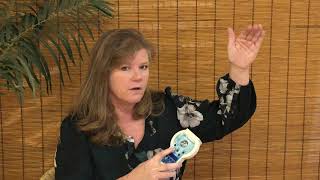
Mary Kostka uses a laser called Quantum Reflex Integration to help children and adults release primitive reflexes that didn't integrate properly. The device stimulates mitochondria to support nerve development. Sessions take 10 to 20 seconds on specific body points, available in-clinic or at home.
Questions this video answers
About 17.
10 to 20 seconds.
Six years.
Bonnie Brand.
A level four cold laser (used for tissue healing/reducing swelling and pain).
Aloha, magnificent moms and dads. This is Mary with Ohana ot. In this video I'm going to talk about one of the most exciting things that we have to offer at our clinic. And that is the quantum reflex integration laser, QRI laser. So if you're not currently going to our clinic, if you're somewhere else out in the world, this is available actually worldwide. And you'll be able to access this on your own as well. I'm just going to talk a little bit about it. So we have primitive reflexes, about 17 of them, that are these pre programmed movement patterns that typically go into the background after the first year of life. So they're not dominating, they're not happening reflexively anymore. We have control of our body. So most people are familiar with like grasping or rooting or stepping, but there's a whole bunch of them and they really impact our ability to develop. And a number of them have to do with just which way our head is moving and then that makes our arms and legs move a certain way. And a lot of these things interfere when they're retained, when they're especially the moral reflex puts us into fight, flight, freeze, shut down. And so we have these reflexes that often end up sticking around in our kids that are struggling with their development, their attention, their behavior, their learning. And so the QRI laser is this amazing tool that we have that we are able to very quickly integrate the reflexes and the kids don't have to really do anything but sit there and play and have it done to them. And whereas the exercises and different things that we have available to us, they have to be able to cooperate, they have to be able to go home and do the homework. And it's just a lot more time consuming. So we have done the QRI laser that Bonnie Brand's developed. We've done it for six years and we've really had success with every single person that's done it, whether they've been adults or kids. So in this video I'm just gonna explain a little bit how it works to help you understand. So this is the same kind of laser, a level four cold laser that would be used, that would be used for tissue healing, reducing swelling, that sort of thing, and it's reducing pain. And there's thousands of studies showing its effectiveness for that sort of thing. And also that there is no side effects and there's just a few precautions, like we wouldn't want to shine it directly into our eyes and that sort of thing. The QRI laser also has the cmt, which we call it the beeper. And it goes through all the different frequencies that we hear. And we can put that on so that you can hear it, or we can just put it on really, really low. And usually most of the kids will have it on kind of low. And that helps the laser work even better. I've even integrated the Moro reflex with just the CMT alone. Anyway, back to the laser itself. How does it work? So these photons penetrate down a couple inches down into the tissue, and what they do is they go through the cell membrane, into the mitochondria, and then they stimulate the ATP and the ATP gent is responsible for of the activity in the cell. So in essence, it's basically energizing the cell. And in the case of nerve tissue, it actually helps with helps develop the myelin sheath. And what that does is it makes the messages go faster through the nervous system. So essentially what we see is it's basically maturing the nervous system. And what it looks like for the kids is there's just different points on the body and certain patterns, and it's just being held there for 10 to 20 seconds. These points used to have to be rubbed for two to three minutes. And as you can imagine, that's pretty labor intensive compared to just holding it there for 10 to 20 seconds. So it just gets moved around the body different places. And that's pretty much it. It's pretty simple. And Bonnie actually made this available directly to parents, so you can actually order it and learn to do it at home. It's easier to do when the child's sleeping, so that's an option. We do it in our clinic as an elective service. And we're also developing an intensive form, four day intensive, where you can do this along with sensory integration, occupational therapy, a number of other things to speed up results. But we absolutely love it. We call it our fast track program. It works amazingly well and we're really excited that we have this to offer. There aren't a lot of clinics in the country that are offering this. And so for us to be able to have this tool is pretty special and we're very happy to show it.
To you.
And provide it as a service to help your child progress. All right, thanks.
Hi again. I am so glad that you took the time to watch this video and I'm really proud of you because I know you're busy and it takes time to sit down and focus and learn something new and just really proud of you. Give yourself a pat on the back. You're gonna see this after each video. Cause I just wanna reinforce you and just let you know I'm proud of you. And change isn't easy. Some of these things, you hear the idea and then implementing it. We're all habitual, so it's not always easy to do. So just do your best to make little baby steps forward and make little.