Sensory Integration Triangle
Mary Kostka explains how primitive reflexes, vestibular function, and core strength form the foundation for attention, behavior, and learning in children. She walks through specific reflexes like the Moro and ATNR, vestibular tests that measure balance responses, and why tactile sensitivity matters for development.
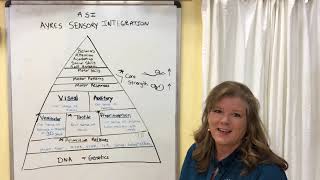
Hi, Mary Koska here with Ohana ot and welcome to our pep talks, our parent empowerment program. And this topic is going to be what I usually explain on our second visit after you've read the evaluation. And if you're not somebody who comes to our clinic, this will still be beneficial because I'm going to explain basically our whole approach here at Ohana. So it's the ASI AIR sensory integration triangle. So the concerns that parents have that make them want to get some help have to do in the areas of behaviors, attention, academics, social skills and self esteem. And as you can see, those are at the very top of the triangle. And we have all of these foundational skills that make it so that our kids can thrive in these areas. And so the evaluation that we do looks at all of these different areas. The kids are just wired the way they're wired. DNA, genetics, that's not something that we're going to change. We evaluate primitive reflexes. Some really common ones that, that we see with our kids are the Moro fear paralysis, atnr, stnr, tlr, and the spinal gland and the pres. So those probably all seem like unfamiliar terms. I'll explain a little bit. So primitive reflexes, most people, most parents can relate to them thinking about like the grasping reflex or the stepping reflex, the rooting reflex, the there's a stimulus and then there's a response. Well, there's actually about 17 primitive reflexes. And when they don't get fully integrated, meaning there's still a stimulus, response, type of reaction versus having total voluntary control of your body, they really interfere with development. For example, the Moro reflex, it's wired to all the different senses. So there's a reaction, an inhalation and external extensor tone and then go into exhalation and flexion. And the way we see that, when I test it, the person's lying down, I can put my fingers behind their neck, I lift up and I immediately can feel that extensor tone kick in. And that would be the moral reflex and the fear paralysis reflex. You can see that in a child. Just if they lay down and close their eyes, you'll see if you touch tap on their chest, you'll see the eyelashes fluttering and that's showing the fear paralysis reflex. These reflexes, the atnr, stnr, tlr, they are tonic neck reflexes. So when the head moves in a direction, there's overflow movement into the body. And they cause a lot of problems with sitting and paying attention and with focusing. For example, the 18R is the one where you turn your head and one side straightens and the other side bends. And you would see it in a little infant, very naturally moving like that. They call it the fencing one. And it can cause problems, for example, like very tight grasp, like a death grip on the, on the pencil. Because subconsciously the child is trying to stabilize when they turn their head, their arm wants to move. And it's been the most amazing thing, actually for me to see a change in handwriting when that reflex gets integrated. Another big one that's a problem is the stnr. And when that, that one changes the arms and legs when you have your head down and up. So that one actually causes the hips to open up when the head's down. And so the bottom slides out of the chair, so it makes it very hard to sit. And the spinal glut and Perez can cause problems because they're stimulated from sensation on the back. So they can cause problems with making the child be wiggly in the chair from their back touching the chair, and also causes toileting problems. So as you can imagine, this is really an important area to address to help kids do better. Another area that we look at is the vestibular sense, which is our sense of balance and movement in 3D space. There's a number of tests that we do. For example, standing on one foot, stand on one foot with eyes closed. The posterotory nystagmus test, which is. We call it the spinny test. 10 slow turns, 2 second turns, and then we stop and we watch their eyes jiggle, which is, that's the length of time that they're actually feeling that sensation and they're feeling dizzy. And typically, 7 to 14 seconds would be a kind of a normal response. And a lot of kids won't feel it at all, or their eyes will just move a couple beats. And that's an under responsive response to the test. And kids that are under responsive, couple things you might see often they're the ones that never stop moving. They're just go, go, go, go, go, go. They're just moving, rolling, jumping, moving all around. Other kids, they'll be like, they haven't figured out that if I move a lot, then I can rev up that sense. And. And they look, they're very sluggish, and they look like gravity's sucking them to the ground. They can be also unresponsive. Over responsive is pretty easy to see because they're the kids that are. You can't get them on any. You can't get them on any equipment. They're very fearful, they get car sick a lot. Kids can also be a little more complicated and flip back and forth between, between being over and under responsive to. It's not always real clear cut. And another area important area is the tactile sense. And most of the kids that we see are extremely sensitive where the nerve endings are really concentrated. So brushing teeth, so anything in the mouth, picky eaters, nail clipping, hair washing, those types of things are just, you know, they're acting like you're trying to kill them. They're just so, it's so distressing to them. And yet you'll also see them do things you think that had to have hurt. And they act like they don't even feel it. So the tactile sense is often pretty all over the place with a lot of the kids having a really solid foundation here really impacts the auditory and the visual sense. The vast majority of kids we see are very, very sensitive to sound. They just have supersonic hearing. They hear things that none of us would even notice, like the fluorescent lighting or just hums and buzzes and just things that you would just not even notice. They're very, very, very hypersensitive, most of the kids and also can be very visually overstimulated. And today's classrooms are typically really over decorated. There's like really no place to rest your eyes, not even on the ceiling. And so it's not surprising that kids are really getting kind of triggered into their fight flight response in the school setting because these two senses are really being overstimulated. And then you need all of this to have really good motor skills. You also need really good core strength. And what we see is that even though the kids can climb and jump and appear really strong when you specifically test their core muscles in a suitable superman type of position on the tummy, arms, legs, nice and straight off the ground. For example, an eight year old should be able to hold that for good strong 30 seconds. You will see that they can sometimes not even get into the position, much less hold it. And this is like a sustained crunch, curling up, not wrapping the hands around the knees, but just curling up with head and shoulders off the ground. And they should be able to hold that for a nice long time depending on their age. But an 8 year old should be able to hold it for 108 seconds which is nice long time. And you will see that kids are very weak here. And if you do not have a good core, you are not going to be able to focus and be still because it takes A lot of core strength to sit at a desk. You'll also see them just supporting themselves on their arms if they don't have a good core. So these that I starred. The core, vestibular, tactile, proprioceptive, and the primitive reflexes are really, really the most essential things to have mature and solid, to get everything that you want to see. And the really great thing about working with your occupational therapist, all the ways to help these things mature are really fun. The kids just think they're training for the next ninja warrior show, and it just makes it so much more fun and easy. And they are able to improve these senses and then it's just like magic that they're behaving. They're happy, they're paying attention, they're doing well in school, they're confident. All these wonderful things just. They just blossom when you have this good, solid foundation. So that is, in a nutshell, our approach to helping kids here at Ohana. Hi again. I am so glad that you took the time to watch this video and I'm really proud of you because I know you're busy and it takes time to. To sit down and focus and learn something new and just really proud of you. Give yourself a pat on the back. You're going to see this after each video because I just want. I just want to reinforce you and just let you know I'm proud of you. And change isn't easy. Some of these things. You hear the idea and then implementing it. You know, we're all habitual, so it's not always easy to do. So just do your best to make little baby steps forward and make little changes that are positive and keep watching. See you in the next video. Aloha.










