Stop Meltdowns - Mary Kostka
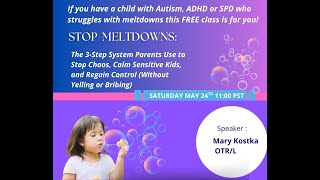
Mary Kostka, an occupational therapist, explains how to tell tantrums from sensory meltdowns and stop them using the 3-C framework: calm yourself first, then the environment, then the child. She covers common triggers like lights, noise, and transitions, plus practical tools like weighted items, headphones, and deep pressure.
Welcome, welcome, everybody. I see everybody popping on here. If you can put in the chat where you are from, that would be great. Where you're watching from. Here we go. All right. All right, we have Mississippi, Maryland, Georgia. Let's see. Coming in so fast. I gotta see. Louisiana, Texas, Massachusetts, Mississippi, Wenatchee, Myrtle Beach, Texas, Wenatchee. Hey, Anita, one of my employees is on here. California, Texas. Oh, great. This is so awesome. All over the country. Maybe we'll have every state represented here. Colorado, New Jersey, Oklahoma, Lakewood, Washington, Georgia, Texas. That is awesome. All right, well, welcome everybody. Keep putting in where you're from as you're hopping on. I am so glad that you're here. And let's stop meltdowns and have some more fun. So do you have a child in your life that has autism, ADHD behavior, or sensory struggles? Just type in yes in the chat. If you have somebody in your life and if you want to say what they have, you can, but that doesn't matter. But just, I just want you guys to realize you're not alone. Yeah, we have lots and lots of people and you know, sometimes they don't have a diagnosis, but you just think, well, they're just a little different. And gosh, my regular parenting techniques are just not working. Yep. So we have parents on here. Therapists actually you could put on here, put in the chat if you're the therapist, a parent or teacher. Because even though I, I set this up for parents, I. It's also, I said it was great for teachers and therapists and so it's nice to see who all's on here. Oh, and para educator. That's awesome. Great. So we have a nice mix of people on here. That's awesome. Okay, so do you want to help them feel peace and empowerment? I know you're on here because the answer is yes, but just type in yes or peace for that. Well, I'll tell you what. I am here to help you become your child's hero. I like to call, call you the sensory hero. That is what I am here to help you with. And so the strategies that I'm going to show you, they're going to elevate your parenting success. Teaching, success, therapy, success, all of it. Whoops. Why did I go backwards? There we go. And so our main objective today is I want to help you increase your detective skills and your solution skills for meltdowns. Does that sound good? Oh, a training and curriculum specialist. Interesting. Monique and I want you to gain confidence in helping your child. And one thing I really want you to know is that it's not your fault that you don't know this stuff. It's not common knowledge. Although when you learn it, you'll think, why didn't I know that? That seems kind of simple. But the truth is it's not common knowledge. Not even amongst therapist. So I'll have therapists that come to work for me that have 20 years experience in pediatrics. And a lot of this stuff they don't come in knowing. So as a parent, you know, it's just not common knowledge. So you want to give yourself a break about that and something I know you guys are going to have questions along the way. So what I want you to do is there's a separate section for. Oops, there's a separate section for Q A. And what that'll do is it'll put all the questions in one spot and then at the end I'll just look in there because if you. As you can see, they'll get buried in the chat. So go ahead and put your questions in the Q A as you think of them and then I'll stay on as long as we need to at the end to answer every single question you guys have. And also I have a free gift for you that you're really going to like. It's a really nice chart that helps you understand the difference between meltdown and tantrum. And something you can even just like have on your fridge is super handy and it has a video to go with it. So I will give the link to that at the end of the Q A. So stay on for that. So I've definitely been where you are unsure but determined, determined to figure this out and, you know, seeing kids struggle and become distressed and really, for me, as an occupational therapist, learning a new approach made all the difference. My clinic, which is Ohana Occupational Therapy, has literally treated thousands of kids over the past 16 years. And we consistently see children thriving and parents feeling relieved. And, you know, when I said it's not your fault, I would say, like, that's the number one thing when we do an eval that when the parents realize there's an underlying reason for their child's behavior and it's not, it's not parenting. Because I know you get the dagger eyes from people when you're. When your child's having a struggle out in public and it really isolates parents because then they don't want to go out in public, but it's not, it's not your fault for sure. They consistently feel their confidence boosted and help we help meet their milestones and we get our outcomes very quickly. So for those of you that don't know me already, just a quick little intro. I'm Mary Koska and I live in Washington State. And I am the owner of Ohana occupational therapy. Been OT for 36 years. I. My passion is just to help elevate others. My favorite words are I did it. And so I loved teaching therapists, teaching my staff, parents, the kids, everything. And so these pictures are just a few different things of me doing retreats with my staff, with. With other OTs, speaking at events, that sort of thing. Oh, and I should mention the other thing. I wanted to. Whoopsie. The other thing. The reason the countries are listed there is that I have a group where I help. There's 12,000 therapists in 60 countries that I have a. A therapy activity group that, that I mentor and help people in, so that these are the top countries that are in that group. Australia, besides us, Australia, Philippines, Canada, the uk, South Africa, India, Puerto Rico and UAE and Ireland. It's really, really fun to. I keep going backwards. I apologize. I gotta hit the arrow instead of the other thing. Here we go. This is my family. I have. I'm really fortunate that I have a really, really supportive family. The top left is actually the first Ohana OT client. This is Reni, and she is the reason that I started my clinic, because I was working for birth to three center and they closed, so. And I have two adult sons. They're 20, 27 and almost 29. My husband Pete on the lower left, and my awesome mom, and they all are really supportive and help me with my private practice. So the first in pediatrics, first I did rehab and all that for a few years. But my first 17 years in PEDs was on schools. And I just got more and more curious. I felt like something wasn't right. I didn't know something. And then the last 16 years in private practice, I've been able to do it right. And a lot of that is the training. So what changed is I. I got specialized in the air sensory integration training. So I just dug deep and really learned a lot more on how to treat the foundational problems, but also just having control over my environment, having the parents there, having the right tools to do my job. In schools, you're just working crazy places. Everything from the electrical closet to the hallway to the stage or just you're just, you know, you never just like, have a space that's really dedicated and consistently yours. So with Ohana, I was Able to really, really apply the principles of sensory integration really well. And that is when I really started seeing changes like 10 times faster. And so we're going to get started on how to stop meltdowns, which is what you're here for. Go ahead and put the question. I won't be able to answer it right now. Jennifer, put it in the Q and A and we'll talk about it at the end. Okay, so first I want to talk about the meltdown and the tantrum. They both can look the same. Just to just the average person. You might see screaming, shouting, swearing, biting, throwing, kicking, hitting, stomping, just all of that kind of like outward aggressive type behavior can be any of those things. But it could be a tantrum and meltdown. So first I'm going to talk to talk about what a meltdown is not. So first. It's not just a tantrum. Tantrums are driven by a want or a need. So think of like the I want a cookie. And you say no. And then they go ballistic. I can think of a really long tantrum my son did when he was little that he wanted to watch. We watched Jungle Book and he wanted to watch it again. I said, no, we're going to watch it just one time. And he pitched a pretty long one. He was, it was probably like 40 minutes of screaming and yelling and I just waited it out and he, he didn't do it again because I didn't give into it. But that was a clear tantrum driven by a want or a need. With a tantrum, they're checking to see if you're paying attention. Without an audience, they won't do it. That's a really good clue. And if it's just a tantrum, they can stop it abruptly once they get what they want. So the classic I want a cookie and then you hand them the cookie. All's good. That, that is the tantrum, not a meltdown and a tantrum. So a tantrum needs an audience. There's no autonomic nervous system signs and they can literally just pull it back together and be right back to normal within five minutes. I can think of this little kid the other day that he looked kind of like a full on meltdown. He, I didn't know him really well so I wasn't sure which it was. And then he went and he hid behind something but then he poked his head out to look at me like, are you paying attention? I'm like, oh, clearly a tantrum. So a sensory meltdown is. It's a Reaction to overload or feeling overwhelmed. So it's a reaction. The child doesn't care if anyone's paying attention in this picture. I was just kind of imagining that maybe the child's having like tactile sensitivity and they're just freaking out because their hands touch the ground. Just made that up. But when I looked at that picture that's kind of what went through my mind. So reaction to something, they don't care if you're paying attention or not. It'll continue without an audience and there's no goal. They're not trying to get something. It'll continue until they have calmed down or loved one has helped them regain control. So they're going to have some autonomic nervous system signs that, that are going to appear. They're, they're not under the control of the child. So there's some things you can look for is sometimes their ears will get really red at the tops, might just start sweating. Flatulence is farting. Flatulence hiccups are also signs of autonomic nervous system. The body being in distress. Their pupils will dilate and it can take up to an hour for them to like regain composure because their body just went into full on fight flight. A little caveat. It can start as a tantrum and they work, they overstimulate themselves from the tantrum and they turn it into a meltdown. That can happen too, but that's a really big difference. So again put the questions in the Q and A section because they'll get lost in the chat and I'm going to answer them at the end. So, so, so what we do is this 3C calm formula. This, it takes really all three things usually to help with the meltdown. So once you've ascertained that you're dealing with a meltdown, you want to think about these three three Cs. So the first thing is you have to calm yourself because as soon as the kids are, are doing their thing it, our mirror neurons are starting to heighten as well. And so it's really, really hard because now you're feeling stress, especially when they're getting really loud. So you can do something as simple as putting on some headphones so that you're not getting triggered by the high pitch sound. You can. I used to take one of my sons outside because he had such a high pitch scream that I would just say we need, you're too loud for the house. We need to go sit on the porch to calm down. And then I could, I could stay Calm because it, it wasn't hurting my ears. Um, knowing what I know now, I would have just put some headphones on. Doing your own breathing, just doing things that just really keep you centered. You really want to pay attention to your own nervous system first because we have mirror neurons and so they're going to feed off of us. So if we're feeding off of them and we're getting heightened, then they're going to feed off of us and it's just going to go up. So somebody. So you have to co regulate and you have to really work hard to staying calm. Another really good thing is you look around the environment and figure out what can you do to calm the environment. So in the clinic, probably the first thing that happens is we turn the lights down. The nervous system has a way of just thinking, oh, it's time to go to bed. I don't know, it just like, just immediately will calm it down. If you turn the lights down, you may not be in that situation. Maybe you're at the grocery store and the child's in the cart freaking out. Well, maybe you can make a tent out of your coat or something to lower the, lower the bright lights. You can remove the child from the stimulation. So noises, noise and visual, visual busyness are the two big triggers that happen a lot. So like one parent, the child was at a birthday party and she could see him starting to escalate. So they're, they just went and sat in the car for like five minutes. She prevented the meltdown because she knew the sign, she could see it building and so she just. They're like, let's take a little break in the car. So they just sat in the car for like five minutes and then they were able to return to the party. And I can think of when I was at my son's swim meet, it was like being in this giant tin can and everybody shouting. And I was getting auditorily really overwhelmed because literally hundreds of people screaming inside a giant tin can basically. And I would keep going outside just to give my ears a break and then I feel better and go back in. Finally I like I should just run to the clinic and get my headphones. So I went and got the headphones or ear muffs, they're really called. I came back and I put them on and I felt my whole nervous system just go. And I could still hear the event numbers. But I thought man, this must be what it feels like for the kids. But getting that little bit of relief even when I would go outside for just a Minute or two and then come back in. Made it so that I could continue. So you just want to figure out how you can calm the environment if you can't do something to fix the environment that you're in. If you can remove the child from that overstimulated environment for a few minutes before you come back in, that can make a huge difference. Okay. And these are some really common triggers. And it was late at night, and I'm like, trigger Tigger. So I put two around here. I was getting a little goofy. But like I said, lights, I would say, are the number one. Bright lights. The kids especially are very sensitive to fluorescent lighting. Visual clutter. And there's a lot of movement, a lot of things going on in their eyes can really overwhelm them. Sounds are a big one. Things like, like, say, being in the cafeteria can be really overwhelming. Restaurants are very noisy. I had one parent that they couldn't take their child out to eat at all. And so we basically just did two things, made sure they had a fidget and brought headphones in, and that's all they needed. And they were able to do the restaurant after that. Smells can be really overwhelming to some kids. Different. Being touched unexpectedly is a big trigger. Textures, these are all, like, really, really common triggers. Can you put in the chat if this makes you think of anything in your child? Like, what might be their trigger that you're thinking? As you're thinking about when they have these meltdowns, what do you notice? Or what are you thinking might be one of the triggers? Go ahead and put that in the chat. Oh, yeah. The word now. Yes. We got visual clutter, bright lights, unexpected touch. The word no before going to bed. Too much stimulation. Tone of voice. Places with a lot of people. Sentence structure, interesting. Overwhelm, command, transition. Yeah. Before going to bed is a big one too. For sure. Transitions are big. Any kind of change? Yeah. I'll tell you later about a resource that I made. The app that I have a whole section in there about the word no. No is a very big trigger. But I can tell you some things that help just off the top of my head, saying not yet or yes, when can help avoid the word no. When. No. The word actual no is the trigger. Okay, moving on. So the number one mistake that parents make and therapists and teachers, everybody that can guarantee the. The meltdown that's starting or. Or that you're in it, that it's going to just make it worse and go full blown is adding stimulation. And we do it all the time because we start talking instead of reducing the stimulation. So you know, just telling them to stop or take a deep breath or you know, we're just blah, blah, blah, blah, blah. Sometimes they just need some quiet. Remove them from the situation. But adding, adding, adding a lot of noise. This is going to make it worse. Have you experienced that? Yes. The. I see somebody noting the. If they're hungry, getting hangry, that is the big one. Making sure that they have had something to eat or drink. Definitely. Technology is making kids a lot. We're getting a lot of meltdowns over because they're so addictive. The more you can avoid technology, the better. In the morning mostly when I ask them to do something he doesn't want to do. Yeah. When they're tired and they're kind of waking up or slowing or, or going, getting ready for bed. Okay. So the third C is calming the child. So there's, there's a lot of different ways tools to help calm the child. But some of the ones that really work the best. Surprisingly something as simple as bubbles is our favorite, favorite, favorite tools. My first go to. So like I said, if somebody's having a meltdown in the clinic, we'll turn off the lights, we'll put on the galaxy light. So we change the environment. If we blow bubbles, then we're keeping our nervous system really calm. And it also creates a little bit of a reptilian brain destruction. Like their brain can't help it to notice the bubbles. It's kind of like fly. They just, it creates a shift to get them kind of out of it. And the bubbles are slow and just moving around a little. And then if we can get them to do three belows, it only takes three slow long breaths to completely change the nervous system, to calm it down, to activate the vagus nerve and just completely reset them. So usually they won't do it just like they're melting down know try to get them to blow bubbles. That doesn't work. So usually we'll start blowing them and then after a little while I might not even ask them. They'll just want to do it because they'll, it'll, it'll kind of pull them out of it. But bubbles is our number one. Weighted blankets can be really helpful. Like I said, if it's noise, even just if you have your hands to cover their ears or show them how to do it or the head. Headphones. Auditory is a big one and just depending on the child that a lot of times they just need a really, really tight squeeze and there's a technique that I teach that's joint compressions. That's really calming. But a lot of times, just like a. Like a firm squeeze hug. Those are really helpful. One thing that we really like for bubbles also is bubble mountain. And this is a main go to in the clinic. You just put about this much water in a bowl, squirt a liquid soap, any kind of liquid soap, and a straw, and they just blow, blow and blow and blow. And it just. You can create these huge bubble mountains, and you get really long, slow breaths. But that one definitely is a quick one to get a nervous system reset. And they typically love it. And again, they don't want to do it right away. That's fine. You just model it. You just do it, and it keeps your nervous system calm. Blow out the candles and blow up the balloon. Yep. I love that. Yes, bubbles are magic. They are. I love that. I'm just reading some of the. Oh, power outage. Had a recent power outage. And at the time without the iPad or TV or YouTube seemed to work wonders for their kids. Emotional stability. Yeah, I. I completely agree. And it's good for us too. I'm camping right now. Well, not right now. I came back to my mom's house to do this, but I'm camping and I don't have reception, and so I feel my whole nervous system completely shifting, being away from the tech as well. So let's see. And going outside, it's a good segue. Just going outside. Nature. Just be around nature. That is a great one. So here's a little summary of the three Cs. You want to calm yourself, calm the environment, and calm the child. You need all three. So we talked about the exact signs to know the difference between a tantrum and a meltdown and how to not make it worse. And understanding that difference is a game changer. So you also have the trigger spotter checklist, so you can have your trigger antennas up to. To realize what might be triggering them. And you know the number one mistake to avoid so you don't make it worse, which is don't add stimulation in the midst of it. And you learn the three C's. So I'm curious if this was valuable to you and what your biggest takeaway was so far? Yes, I agree. Diet is a big thing. Food dies are a big thing. I'm so grateful that they're taking those out. Perfectionism. Yep. So let me know, like, was this valuable to you and what is your biggest takeaway so far? Good. I am glad that you Found it helpful. Yeah. Aba. You know, it's interesting. ABA is a completely different thing. They're not looking at, like, I'm always looking at what's causing the behavior and try to help that. Oh, good. The three Cs were helpful and never thought about the way bubbles help. Awesome. Thanks, Jessica. Dawn. Yes. Tantrums. They can over stimulate themselves and turn it into a meltdown, which is the tricky thing not to add stimulation. Yay, Griselda. I'm so glad. Let's see. Demi. Yes. We're nearing the end. I'm going to do Q A, but you'll get sent the replay, so you'll be able to to watch it. And if you have any questions, I'm going to answer them. Just put them in the key Q and A and I'll answer them. Let's see. Where was I? Yes. Oh, I'm so glad you guys are getting a lot out of this. That's awesome. Yeah, I think the three Cs are key, and I'm always thinking about the three Cs because if it's not working, I'm like, which of the three am I not doing? Awesome. I'm so glad you found it helpful. Well, obviously, this is just the tip of the iceberg. This is a quick, you know, a quick webinar, and there's only so much I can cover in it. And I'm actually on a mission to help 100,000 kids and parents by 2029. And I've always said I want to help as many kids as I can. I was laying in the hammock one day. I'm like, I need a number. I need a goal. And the calling was 100,000. I'm like, that's a really big number, but. And in 2029, Ohana will be 21, and we're 16 now, so. So, yeah, you know, with doing things online that I could definitely help a lot more people. Debbie, it's fine. You'll be able to watch the replay. Oh, finger massages. I like that, Ashley. Okay, so obviously there's so much more I would love to teach you guys, and I really want to be able to accelerate your progress helping your child. And so something very exciting that I worked on a good chunk of last year was that I actually made an app, and I initially made it for the 160 people on our wait list to get into Ohana because I just don't want them to wait for. For. I just don't want people to feel like they have to wait for help. But we can only see so many, even though we've, you know, we keep doubling and doubling in our size. But the need is great. So what I did is I made an app that is a web based app and it's the Sensory Hero app. So it has all the good stuff that we teach our parents. And Brittany is one of the ones that did it recently and she said it's great and been so helpful. And so it makes it so you don't just roll the dice, you have some tools in your toolbox and so you can actually go through this and intentionally increase your skills as parent and get more rapid results and like Diana. So Diana, she's actually a friend of mine and her, she had three, raised three kids that were all like introverts and super mellow. And then she started being a homeschool teacher at a farm to three to five year olds and voila, she started dealing with like tantrums and meltdowns. So she's like, I want to do your app. And so I just want to tell you a little story about her experience. So in the very beginning, like the, just the first few lessons in, in the app, it completely changed the situation for her. She had this little guy that was really struggling to behave and everything. And he had made a comment to her, I feel like there's angry monkeys in my brain. And she looked at the situation and she remembered what she had learned and she thought, I think he's going into a meltdown. She, she thinks it's, she was thinking, he's getting overstimulated. So she took him aside to a picnic table alone and just helped him do some breathing and, and was able to kind of keep him from getting into all the behaviors that he would do before. Well, the next time when it started happening again, he actually came up to her and said, I need some help. I need you. That thing again. I think she just helped him with breathing, but it was really cool because she's like, without learning this stuff, I would have had no idea. I would have thought he was just misbehaving. So you are in invited to join our Sensory Hero community if you want to take the fast track to becoming, you know, a highly skilled, effective parent. And really learning this stuff will put you in the 1% whether you're a teacher, a parent or a therapist. When you know this stuff, there's just not a lot of people that have this stuff down and it makes a huge impact. Like I said, I spent the first 17 years not doing it right, so I encourage you to check it out and if you would like to hear more about it, let me know and I will give you a little more info. So put in. Yes. If you'd like to hear a little more about it and I'm going to read these last few comments here. Yeah, I'm just angry monkeys are wonderful way to discover how the chimp. I know. Isn't it amazing that he was able to say that? It was so cool. All right, great. I will tell you a little more about it. Okay, so the, the first thing that I've done in this app right now there's one thing in the app and, and if you know there's a good response and everything, we'll put more things in the app. But right now what we've done is we've made a 30 day get sensory confident challenge. And what I did is I talked to my current families and I said what are the things that we could put in a video that people could learn before they even came into therapy that helped you? And so they basically, the parents basically told me what to put in it and then they also told me how to structure it. So they said to do like I was going to do like a six week challenge and they said no, 30 days, that's all I could commit to. And under 15 minutes a day, if it was under 15 minutes a day for 30 days I could do that. So that's how it's structured. Under 15 minutes a day for 30 days. But you literally can binge watch it or skip days. But that was the structure that they recommended the parents that we have recommended. So in under 15 minutes a day you can get some peace in your home and learn how to stop them before they starts. And although I originally made it for our our people waiting the parents. When I went to, I went to a practice owner workshop, there were like hundreds of of conference hundreds of practice owners there and I was talking about this and all of these practice owners wanted it, the therapists wanted it. And so when I did my we just completed our beta like maybe like a month ago. So in the beta I had OTS teachers and parents and they all loved it. And so I think that's great. Like I said, you know, just because you're a therapist doesn't mean you know all this stuff. You only know it if you've learned it. And the other thing is people really want a community. Like a lot of people don't feel comfortable in the social media groups. Even though they say they're private, they don't really Feel comfortable sharing in there. So in the, the way I built the app, there's a private community, so you can share your wins or ask questions in it and I can answer. So there's a private community. It looks kind of like a Facebook community, but it's just within the app. And the big thing that the parents said is what they really liked about what we would teach them at the clinic is we explained the why to everything. Why does it work? Just like I was saying, like the slow blowing for the bubbles activates the vagus nerve and that's what's resetting the nervous system. So really just understanding the why behind it. And so in the app there are. There's two, two ways you can do it. You can get the. The. It's like 29amonth. The first free, three are free, three lessons are free. And then it's 29amonth. Cancel anytime. And there's. I believe it's like 197 is the lifetime. But I wanted to do something special for the people watching this. And so I decided to have a really special bonus for anybody who gets. For the first 10 people that get the lifetime access one, I'm going to give you something really special. So right now this is only available in our clinic. I made these Sensory Hero kits and it's just makes it so you don't have to go out and find everything. It's a lot of the tools are in there. So we sell this in the clinic for 75. So it's a pretty special bonus for the first 10 people that get the app. And so I encourage you to act now, obviously, so you can get the bonus. And it's a rare opportunity. Right now I don't even have. Have those on online or anything. So in just 30 days, your confidence will dramatically in increase and you know, you're going to have just some amazing results with your child and feel really successful helping your child so you can be your child sensory hero, which is what I, I would like. So thanks for attending. This is the QR code to get the app and I'm also going to put the link in. I have to hang on a sec here. I'm going to put the link in. I forgot to copy it. I got to grab it in the chat for you as well. I gotta get to it. One thing I forgot to do before I got on was get the link in my. In my. There we go. So I will put that in the chat for you. All right, I'm getting back there. Sorry for the confusion there okay, I'm back. I can put it in the chat. Sorry, I'm just trying to get to the chat. There it is. Okay. The app right now is not in the app store. It will be in the future, but I just put the link in the, in the chat. So you can get it through the QR code or you can get it through the link. It will be later in the app stores. They actually take a third, which I only recently learned, but I will be putting it in there. But it's just the process that you have to go through to get it in there. So right now it's a web based app and what you do is you just save it to your home screen and which is pretty easy to do in Android. There's three little dots and you just click on that and save it to the home screen. And it's a little turtle that says Sensory Tools on it. If you have an iPhone, it's just the share, the regular share, you know, the square with the arrow. And if you scroll down, you just save it to your home screen. Yep, I did put it in the chat. I'll put it in again. Do you see it? And that is the link for it. Oh, it's not going to the whole group. Sorry. Okay, hang on. I see the problem. I gotta get to everyone. All right, there. Do you see it now? Yeah. The less expensive version is it's $29. They could, they could do it for $29 in one month and cancel it. So that is very inexpensive. And the first in the first three lessons are free. I have over half my clients have Medicaid and it's very affordable. Okay. So if you are one of the ones of the 10, the first 10 that are getting it like right now or Whoever the first 10 are, I will need to know your address so I can send this to you. And I need to know your child's age because of the body sock, they're different sizes and so if I know the age, I'll know what size to send. The easiest way is if you can Facebook message me the info and you can also email me. I'll put my email in here, but Facebook message is probably the best because it won't get buried. All right, now I'm going to stay on for Q and A and let me find the Q and A's. And then after the Q and A, I have the gift for you guys. Let's see, where's Q A at? 12 questions. All right. All right, so I'm going to go through these Questions now. Could. Could a child whose behavioral function is driven by attention still not be motivated by attention in the meltdown phase? Let's see. I gotta figure out, I gotta try to understand this question better. Okay, so. So they're wanting attention, but they're not motivated by attention in the meltdown? That's a confusing question to me. I think if they're wanting. It sounds like maybe they wanted attention in the beginning of it, but then maybe they went into a full meltdown and, and then they're not motivated AF by the attention after. Sorry, you might give me a little more information on that. It was a little bit confusing question to me. If my child is having a tantrum and hits himself, what should I do? I feel like he wants attention. Well, the first thing that I would do, usually when kids are hitting themselves, they, they're in a lot of distress that they're. I would really look at, try to look at the triggers, try to see what is causing him to feel so distressed. So you first got to kind of figure out is it a meltdown or a tantrum. But in my experience, kids that hit themselves are usually feeling really overwhelmed. And so then I would do those strategies that we talked about, trying to figure out how you can calm the environment, stay calm with him, and, and figure out, you know, use one of the tools, give him some squeezes, some, some deep pressure bubbles, that sort of thing. Could children whose behavior is attention driven still not be motivated by attention in the meltdown mode? That's kind of the same. Oh, that's kind of the same one as before. Okay. Meltdowns stem from tantrums, but they can skip the tantrum and go straight into the meltdown. Yeah, the. Typically it's either a tantrum or a meltdown. I just said that sometimes they in the tantrum can overstimulate themselves and turn it into a meltdown because of the stimulation. But typically it's one or the other. They look the same, but it's typically one or the other. So melt. You can just go right into meltdown. I mean, we see it all the time in the clinic. The other day, one of the kids, they came in and they, they, you could tell the kid was already having a meltdown in the lobby from feeling over stimulated. Something that had happened in the day, I don't know, but they didn't usually come in that way. And you could just tell. And they're pretty new client. And so as soon as they came in, we lowered the lights, put on the galaxy light, did the bubbles Got some kinetic sand out, and he was able to re. He was able to regain composure and get out of that meltdown mode within, like, a couple minutes. And his mom was blown away because when he would get like that, that would go for like an hour. Yes. Change in. Change in routine is a big trigger. And you know what? Every big transition, like starting school, ending school, vacation, starting vacation, any vacation, how much light, light is that? Just a lot of times we'll hear, I don't know why, my kids just acting up lately. And we'll hear it over and over and over. And it'll be when the day is shortening or when the day is getting longer. My son gets really upset by his sister. She triggers him a lot. How can I teach her about all of this in a way where it doesn't come off as an excuse for his behavior? She's older than him and is consistently annoyed by him. Well, I think just sharing, maybe have her watch the replay and help help just educate her. And then maybe she can kind of be more of the solution. And she could be thinking, like, how can we help. Help him be more calm. If it starts as a tantrum, how do you prevent it from becoming a meltdown when you won't give in? Well, I think consistency is the big thing, because the thing with tantrums is I always say it's like gambling, like a slot machine. So say the cookie example. If you said no this time and this time, and this time, but Cha Ching, you said yes this time. Well, intermittent reinforcement is stronger than consistent. It's gambling. And so consistency is the biggest thing. So what happens is with consistent, then you won't get the tantrums because they're not trying to gamble for the reaction. So sometimes you're desperate, you're tired, you give in, and then you're like, I gave in. So here's the thing I would back up is, is do you really need to say no in the first place? Because what happens is sometimes you say no, and then they get really upset, and then you think, oh, it's not really that big a deal, and then you change your mind. So I would be careful about saying no in the first place and just think about it. Say, give me a minute to think about it and just actually think about it. Do I actually need to say no? Or, you know, can I say not yet? Or yes, when you put away this, then you can do this. So I think that's part of the problem, is we jump to no too quick and then change our mind and Then we re reinforce that behavior. I hope that helped. What if a school isn't allowing these calm down methods? Well, I think that that's kind of a loaded question because like legally, if they're in, if they have a 504 then, then they have to provide accommodations. So I would look at, if you, if they're not on an IEP or have a 504, I would look at, you know, if they need to be. And more and more schools are actually having kind of. Because I mean the statistics of kids that have sensory processing problems is, you know, you got one or two in every single classroom. So a lot of schools now compared to when I worked in the schools actually are having like sensory rooms and you know, calming down environments or a little calm down station in the classroom. So I would just kind of find out why and look into it a little bit more. Let's see. How do you redirect aggression towards self, sibling or parent when it stems from a tantrum or sensory meltdown? So one thing, once they start hitting, it's kind of tricky because if they're, if they're in the hitting mode when they're like being really aggressive, it kind of depends on how aggressive they're being. So what I do, if there's just like a little bit of hitting, I will take the hand and, and say, you know, touch Mary. Nice. This is how you. I'll just redirect it and show them what to do if they're just full on losing it. You want to give them something soft to hit, grab a pillow or a cushion and just anything soft. Because sometimes like once they start hitting, they, they just have to keep going to get it out. So you just want to give them something safe to hit. Oftentimes I have parents share. Their child has tantrums that often become sensory meltdowns or overload. So their child will be resistant to support for sensory needs from their parent to calm their nervous system because it is the parent that made them upset in the first place. Do you have any suggestions on how to respond? Yeah. So what we do is we kind of establish what are good calming tools for that child that the child likes. Like we try different ones when they're not upset and we make like a little toolbox and toolbox are pictures. So there might be six pictures and it, and it'll be things the child has chosen that. Yeah, these are the things that I like. I like bubbles, I like squeezes, I like, I like my body sock or just. And so the best thing is to give them a sense of control. So instead of the parent saying, and I know exactly what you're talking about, because we deal with this all the time, that the parents, you know, maybe getting the bubbles out and they're like, so what they can do is they can just show them their choices and then they can choose one. And then that way they're empowered the parent isn't choosing it for them. And that works pretty well. If I start with only one month, will that be deducted from the lifetime if I choose that leader option? I don't think I have a way to do that. But that's something to think about. My son, when he gets upset, he's sometimes mean to. Oh, mean to animals. And he's been stealing a lot lately. I've been really having bad behaviors with them. They are mostly at night time. Any advice? Also, does this mean the in the future he could be your serial killer or someone to go to prison? I know it's so scary when you see serious things like that. It doesn't mean that he's going to necessarily be a serial killer or go to prison. So. But it is something that, you know, definitely want to nip in the bud. It. I had this, we had this one, one kiddo that he had some kind of reptile that they're feeding crickets to. And, and he was adopted, an adopted kiddo. And he was pulling the legs off the cricket every night. And then later we found out, when we talked to him more about it, we found out it was so they couldn't make noise at night, something like that. So it's kind of interesting. It again, it, it actually in that case it was that he was being overstimulated by the noise of the crickets. So it's good to kind of try to dig in and find out what is bothering them, why are they doing it. I hope that helped. Can't literally see any questions in Q and A. I'm not sure what that means. Is yelling and threatening part of the tantrum stage? It can be both tantrum or meltdown. They literally look the same. And when I get done with these questions, I'll show you this chart to help you. It's a nice visual that you guys can download and, and kind of sort through it. The question was about motivation of attention. Does the child have a new motivation in the meltdown phase or is it still attention driven? No, once they're in the meltdown phase, it's just an autonomic nervous system reaction. They don't have any Control. They're not thinking about anything. They're not thinking about attention. They are just in a reaction phase. My nephew, when he plays with toys, he likes to throw them and then he likes to also hit all the time when he gets really excited. What can I do about both of these kids do go through a throwing phase. And what I like to do is if it's redirect it to getting like a laundry basket and toys that are okay to throw like, like Beanie Babies or something and then have them throw them into that. If they're, if they're in a. We didn't talk about this, but you know, tantrum and meltdown. If they're, if they're having that kind of behavior where they're grabbing things and throwing them and they're being dangerous. You have to make the environment safer too. So you want to quickly remove anything that is going to get pitched and hurt somebody. You have to make the environment safe. And like I said with hitting, it depends on the stage of hitting you're in. But if they're just kind of like, kind of a little bit, I'll take their hand. I'll say, need to touch me nice. Touch me soft. But if they're just like, they've lost it, I just try to get them something soft to hit while I'm trying to calm them down. I've worked with a kid who has received very inconsistent reinforcement of boundaries at home, school, babysitting, etc. It's been difficult to figure out whether or not this child is avoidant of demands or overwhelmed, but have often noticed when a demand or boundary is placed, they will become resistant or act out and work themselves up into a meltdown. And I'm not sure how to navigate the situation and support their parent. You know, it's so, it's so interesting when there's a lot of inconsistencies, Kids are just looking for boundaries. All I can say is like for you to be as consistent as you can and, and educate about that. And that slot machine example is my favorite example because parents get it. And then also helping them think about like, do they need to be as strict in every situation? You know, where can the kid have some leeway? Save the nose for when it's really critical. Okay, I think there's maybe a little bit more here. Oh, okay. Melissa already signed up. Great. Remember to message me or address and child of the child's age. I'm going to put the link in here one more time. Messaging me on Facebook is the easiest way to get a Hold of me. But I'll give you my email too, in case you can't find it. The slot machine example. It's the example I like to give when. When people are inconsistent. So say the T with the tantrum, the cookie. Like, you say no, and you don't give in. You say no, you don't give in. Then this time you're, like, really tired, and you're just like, you said no, but then you're like, oh, well, it's just one cookie. Okay, here you go. Well, in the kid's mind, they're just like, cha Ching. It's like they got the jackpot. So it's worth trying and trying and trying and trying and trying. Because sometimes Cha Ching. I'll get the jackpot. So when I explain it to parents like that, and intermittent reinforcement is stronger, they suddenly get it. And that's why I say you have to kind of really think, does it need to be a no? Because if you're like, no, and then you give in, then you're just. Then you're just. Then they're get. Then they're just winning the gamble. So being consistent's really important. Okay, here's a couple more questions. I'm just getting the ones in the bottom of the chat. If they're ones that I didn't get to. That you put in the chat, put them in the Q and A, because it'll just be buried and I won't see it. But I'll get these ones that are at the bottom. What if a child is triggered with the loud shouts of her classmates? Whenever she hears or sees her, she bites her hand and bangs her head. How do you address the situation? I would probably get some auditory, you know, something for the sound. Like. Like earmuffs. Depending on the age of the child and what they'll tolerate. There's something that my staff, they really love these. They're called flare, F, L, A, R, E. And they are like. They're not earplugs, but they're. They look like silicone funnels that you put in your ear. And it cuts down the pitch so you still hear everything, but it. It's not as loud. Kind of depends on the child. The other thing is you can just also teach her to plug her ears when things are lo. And the biting and the head banging. They're typically seeking out intense proprioception, which is calming to the nervous system. So you can teach them to do something else instead, like push their hands together really hard or pull their hands like this, just for Some quick proprioception. So when they're, when they're biting, that's kind of what they're getting. They're getting deep pro in their hand and in their jaw and it's just kind of what they figured out to do. Schools are challenging for sure. Every school situation is different and all I can say is just educate. And if it's in their 504 or in their IEP and they're not following it, then usually have to get an advocate or, you know, it ends up getting legal if they, if they just were refusing. How do you say your name? Nedesa. Oh, good, you signed up for it too. Excellent. Yay. I gave the slot machine example. Yes. This is being recorded and as long as everything works out right, we are sending the replay out a lot of times being tuned into what the demands are in school and what would trigger them at home. I talk about this now, but that's something else I want to point out real quick about home and school. You can have a kid that's like super well behaved all day at school and then they come home and they melt down for an hour. I had one of those. They can hold it together, but it's like shaking up the pop bottle and just by the end of the day and he's, he's. He was like, didn't want to embarrass himself. He could hold it together enough to not show what he was feeling. As soon as he was in a safe place, it all could come out. Other situations, you'll have kids that are acting out at school, but they're absolutely fine at home. So it's baffling to the parent because they're just like, they're fine at home, but home is like maybe really calm and quiet and they're being overstimulated at school. So kids are really different in different environments. And in our clinic, we have really noticed how different they are in different environments. So we have small rooms, medium rooms, big rooms, and the kids are actually really different in different size rooms. It's very fascinating. Oh, musician earplugs. Interesting. Yeah, the, the ones that my staff really like, they're called fl. Yeah, they work great. Yeah. If I was going to pick one trigger, that's the most common trigger. It's noise for sure. Okay. Wow. I think I answered all the questions. So here is your free gift and you can download this. It is a visual for the difference between the tantrum and the meltdown. And it's pretty much everything that we just talked about. A nice summary and there's a QR code with a video that has me explaining the difference. Oh, you're welcome. You're welcome, you guys. Thank you. Let's see. Oh, I see something else on here. The way my 11 year old, when she went to public school for one year and she's been homeschooling again for two years, then she had a hard time communicating her feelings and needs and meltdowns all the time during our homeschool. So she doing better in homeschool or public school. I don't have the specific link for this other than the QR codes. So when you get the replay, you could do it that way. Oh, interesting. She was better at public school meltdown. It might have been structure because there's just so many variables. You just never know. But definitely, kids can be definitely different in different environments. For sure. Okay, did everybody get this? All right? Yeah, the loop ones are more like plugs. Yeah, exactly. You know, you got to make sure they don't eat them. Oh, good point. So Jennifer, if you're talking about the, the QR code, you just use your phone to. If you're on your phone watching this, I realize that you can't do the QR code if you're watching it. So I would just look at the replay on a computer and then you can do it that way. And you know what, in a, in our follow up email, one of our emails, I'll make sure that. I'll see if we can put this in there. I'll check. Ah, good idea. Take a screenshot. Okay. Are we good? Thank you so much, everybody. All right, I think we're done and pretty much right on time. Thank you so much. I'm, I'm glad that you're able to get some out of it. I know it's not simple. I know it. I know it's complex. But now hopefully you'll have some new, new lenses to look through to figure it out. And like Diana, she just had barely started the app and then she, she, it already made her start thinking differently and she was able to help that little kid that had the angry monkeys in his brain. So thank you so much for sharing some of your holiday weekend with me. I appreciate it. I literally didn't realize it was MEM weekend because in my mind it's always at the end of the month. But I should have looked at the calendar. So I'm gonna go back to camping. You can see where I'm at on Facebook. It's the most beautiful, beautiful, beautiful, beautiful place. I love it. Yeah, I goofed. But that's all right. At least people that couldn't come will be able to watch it on the replay, so I will. I just hate to guarantee it, though, because, man, you just never know with technology what's going to happen. Okay, I'm gonna hop off. You all have a wonderful, wonderful weekend. I appreciate you all, and I hope that you got at least something out of this that can help. So there's so much to share. And in the app. Oh, I didn't mention it on the app. There's. There's also. Well, there's a walkthrough. When you click on that link, there's a. There's a video that has a walkthrough, so you can actually see what's in it a little bit more. Okay. All right. Take care, everybody. Thank you. It.










