AI, Automation, and Outsourcing: A Deep Dive into the Latest Payroll Industry Trends
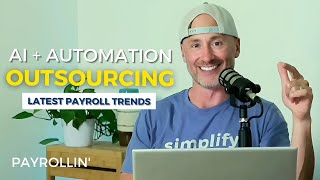
In this solo episode of the Payrollin' podcast, host Matt Vaadi covers a range of timely topics for payroll service providers. He announces the launch of Outsource Scale, an offshore virtual‑assistant staffing agency built on his recruiting background, and explains how the team trains assistants to use AI tools like ChatGPT as research, automation, and “sparring” partners. Vaadi then reviews recent industry moves: ADP’s integration of generative AI into its Run platform (answering payroll queries, drafting documents, flagging compliance risks) and Justworks’ debut of a standalone payroll product, which he sees as a potential back‑door threat to partner brokers. He shares his current reading list—Alex Hormozi’s $100 Million Leads and John Warrillow’s Built to Sell—and extracts leadership lessons about systematizing a business for scalability. A substantial portion of the episode is devoted to positioning payroll, PEO, and bureau services during a down economy, drawing on his personal experience at ADP during the 2008‑2012 recession. He stresses shifting messaging from “expense” to “ROI,” leveraging outsourcing and automation buzzwords, and using hard‑dollar case studies to demonstrate value. The episode closes with a faith‑based quote of the week, a call to serve others, and a plug for a new industry‑focused newsletter.
Chapters
Welcome back to Payrollin'. In today's episode, I'm going to talk about some of the latest launches from ADP and Justworks. I'm going to talk about our latest business enterprise inside of our portfolio where we were scratching one of our own itches. I'm going to share what we're doing to change up our messaging during a down economy and how this helped me during the 2008 to 2012 financial crisis and much more. So thank you so much for joining me at Payrollin'. Let's get get started. Welcome to Payrollin', the show where you will learn how to operate and grow your payroll business from the most dynamic minds in the business. If your company offers payroll services, this is the podcast for you. And now, here's your host, Matt Vadie. Let's go! All right, so where are we kicking off here? Well, let's talk about what we've got going on new here at Guru or inside of our portfolio of companies as things continue to change and evolve. But something that recently happened is we launched another business called Outsource Scale. So if you've listened to Payrollin' for a while, you know I'm a big fan of using remote staff, a global staff around the world, particularly when it comes to some more of the admin-related tasks tasks or marketing-related pieces of the equation. Heck, we even have tax and finance people overseas. We don't do anything client-facing at this point with overseas staff, but I would never say that we never will just because we have great teammates that we treat exactly like that as teammates anywhere in the world. And if they're capable, then we'll let them do their thing. But we launched Outsource Scale because we've been using agencies for years to fulfill these roles. And recently we kind of had some issues where, you know, my assistant left, and we couldn't quite get that job filled fast enough. And so I really wanted to make sure that we were in a position to get this role filled because it was my assistant. It was obviously critical to me. And after a little bit of back and forth with the agency that we were working with, quickly realized that they're probably not going to be a long-term fit. It was just taking too long to get the job filled. They actually filled it with somebody, then they pulled the person off the job because they were paying them the wrong rate. And, you know, it, it just, I had been training this person for a month. I realized it was probably time to go ahead and, and take some ownership of this process. Being that I came from the recruiting industry before I got in the payroll industry, we've recruited a lot of offshore talent in the past. We had some process built out around it, went ahead and just said, great, here's an opportunity for us to fulfill our own needs first. So we were able to— for those of you not as familiar, we have Guru, which is our payroll HR PEO company. We have Underdog Digital, which is our marketing agency, and now Outsource Scale, which is our offshore virtual assistant staffing agency. But the biggest thing that we're also doing error that I've, you know, even just today I was working with the team on it is training these people up on what they need to know to be more efficient. So yesterday was a good example. Spent about 30 minutes putting together a video for how to create a ChatGPT project for your client if you are a teammate at Outsource Scale. So let's say you were a virtual assistant in the Philippines at Outsource Scale and you're serving Matt Vadie as your customer, your client, then they should have a folder created for me where they're asking ChatGPT questions, constantly having dialog back and forth. ChatGPT is getting to learn my responses, their expertise, all the things, and help to be AI-powered humans. That's what we're going for there is making sure that they're using AI not only as their automation partner, as their research partner, but as their sparring partner when they don't know what to do or they're looking for, uh, to be a proactive helper as it relates to better serving the entrepreneurs and the executives that they serve. And that's been awesome because basically I took all the same stuff I was already training my assistants to do when they came to work for me here at Guru, and we've started training everybody we're replacing with that, and we're seeing immediate returns on that. So pretty cool, we were able to get that business live and live in revenue in like a week and a half, which if you're out there right now and you're— I've talked to a bunch of people over the last month that are thinking about starting a payroll company, leaving their current job, and asking me advice because they listen to the podcast. And that's awesome, I love taking those calls. Uh, just emailed a guy back this morning. My advice to him was to go do 25 discovery calls to try to find that niche, try to find that angle, try to figure out what the, the real pains and problems he can solve if starts a payroll bureau are and just wanted to follow up and make sure he stayed on that. And because I do think that getting started, we overcomplicate it when in fact it's quite simple. You just have to have a bias for action. And when I made the decision that we were going to start this agency, you know, there wasn't 3 months of planning, there wasn't a whole bunch of hemming and hawing about it. It was, hey, who are our first customers? What do we need to fulfill their orders? How do we get this going now? Um, and so I think you've got to have that bias for action if you're going to survive. So if you've been thinking about starting something. Hopefully that will help you as you think about that. You need a bank account, an EIN. Basically you need a product, a way to sell it, a way to fulfill it, and a way, a place to take money and how to take money, and then to have an EIN and get any licensing you need based on what you're doing. But all those things happen a lot faster than most people think. So that's the latest over here. So you'll certainly be hearing more about Outsource Scale over the next few months. It's a huge deal for us. That thing is up and rolling. We've put a CEO in place, we put an operations manager in place. We're staffing people almost every day now. Demand is very high for offshore virtual assistants, and we've got a really good process for not only finding them, but training them once they come on board to make sure that they're using technology to be as efficient as humanly possible. And that's been awesome thus far, and I expect big things from that group as we continue to move forward. Next up, let's talk about industry news, what's happening in the payroll industry. So ADP recently launched some generative AI in the Run platform. This is interesting. So their AI is going to be able to do things like answer payroll questions in plain English, like how much overtime did John log June, draft off documents like offer letters using prior data and templates. It's going to flag compliance risks before they become problems. Kind of interesting. Not really surprising, right? Everybody's bringing generative AI in some way, shape, or form into their apps. Being able to, you know, I just saw BambooHR's release recently and it was, I've got to say, very unimpressive with what it can do. It can query the data inside of the system and not even really all that well. It's a little bit more general. It's almost like a support bot, unless I was missing something, but I played with it for a little while. This one seems a little more promising from ADP, something that, you know, they're trying to give it like a ChatGPT feel. This is actually where we're moving inside of our platform is, you know, V1 is, hey, what is happening inside the system or what's happened in the past? So that PTO example is a good one. How much PTO do I have? Like there's something very obvious. It's a little bit more complicated on the engineering side because you have to, you know, there's so many different data points that it needs to be able to search and it needs to know who the user is and all that fun stuff. But I like where we're all going with this in the more generative fashion of, you know, using historical information to create analytical forecasting prediction, being able to create actions inside of a prompt box. So if you go to Zapier's website right now, Z-A-P-I-E-R, you'll see a really good example of this where you can create a zap by a prompt in their system now. So if you said, hey, I want every time I click on the send button in my CRM, I want that information to go to Google Drive and Dropbox. Well, then it will actually create the Zap format for you in there. So it's prompt into an action. And I think we're going to start to see more of that. So example here might be instead of just saying, how much PTO do I have in the chatbot? I can say, please go ahead and submit a PTO request for me on June 3rd. And that's the next iteration of this. And I think it's kind of a race for all of us to bring that to market. It looks like ADP, as you'd expect with their huge pocketbooks, are going to be bringing that to market as quick as anyone. Next up, Justworks launching a standalone payroll. So this is kind of interesting because, you know, it's funny, I've had two calls just today. Many of you know we are a PEO and that is kind of our bell cow offering. I've talked about it on the podcast before. Last year, our PEO grew 200%. It is certainly something we're getting a ton of traction for a multitude of reasons. But it's interesting because today I had two conversations with brokers who partner with Justworks and actually one payroll company, one broker. And I know the promise to the payroll company has been, you know, similar to the promise we have in that, hey, we're not going to compete with you. Well, now they're going ahead and they're launching a payroll product direct into market. And then they're just going to be another, you know, ADP, Paychex in terms of like, yeah, we could backdoor you at any given time because our small business payroll team is probably not really going to care if this is your client in western Pennsylvania that they're calling on. They're not going to be marked in the CRM. So you can expect more of what the industry same is in that, you know, hey, they're going to start backdooring their partners. Partners. They're, they're a bloated animal at this point. You know, they're, they're an interesting company in that I've never seen a company with such a high percentage of the workforce being in business development. Uh, they— if you run the reports on their team and LinkedIn, they are predominantly a biz dev team because of how much money they've raised. They've got really aggressive metrics they're trying to hit, and I'm a little surprised by this move. Not really, but it does kind of water down that partnership model for them. So I'll be interested to see where that goes, um, and how they continue to hit or miss the numbers that they're putting in front of their investors for the really large valuation. I have to say, Justworks is maybe one of the most interesting companies ever in that they somehow convinced Silicon Valley that a PEO was a novel concept. They built out a PEO platform that does nothing different than any other PEO platform and raised $130, $140 million to do it. Don't really fully understand that, but hey, good for them. Hopefully they don't end up like Bench.co. All right, next up, what am I reading at the moment? Well, I'm reading two books as usual, and I think one of them I might have talked about in here before,, but I'm rereading it. We're about to reread it as a leadership team. Now that we, leadership team continues to expand, but $100 Million Leads by Alex Hormozi, just a really good book on business development. You know, like many of the books, I would consider this to be a summary of some of the best of. So he's taken stuff from guys like Russell Brunson, guys, you know, some old school sales stuff, kind of just repackaged it in his own wording, but he does something really well. I mean, he's a little bit of a bro dude in that, you know, guy wears like a tank top in all of his videos and he's got an interesting business model, but does a very good job of simplifying things, putting them into acronyms that are easy to remember, making it, you know, where it's easy to consume if you're a non-biz dev person, which is why we're reading it as an entire leadership team. Business development should be top of mind for everybody, whether you're CS, whether you're engineering, whether you're finance. Like, you know, nothing happens until somebody sells something. And so we all need to have a piece in driving the number for the business. And so I do think it's important that everybody at least understands where do leads come from? How do you create the opportunities for new business inside of a small business, whether that's an apparel company, a virtual agent staffing company, or a digital marketing agency. They are all slightly different, but all the same at the same time. We also just finished up with our leadership team book club. We finished Built to Sell. So Built to Sell, John Warrillow, great book, a parable. One I highly recommend if you're an owner or a leader in an organization. It's one of these books that's very much along the line of The E-Myth Revisited. So if you've ever read E-Myth myth. It's the same exact concept. You build your business like a franchise prototype so that not only, you know, if one day you were looking to sell your business, it would be very easy because you've got systems, processes that you can plug people in and out of. You've built a moat because you're very focused, you're niched. But also it just gives you the opportunity— like, it's not about selling the business, it's about having a business that's easy to run. And that's what I think we all want, right? Is something that it's easy to run the company, it's not a nightmare every day when you come in because you're not doing everything custom. Everything's not from scratch every time a new customer comes on board. You've got your 5-step process, you follow it, you can train more people on it. It's a repeatable process and it's not something that we have to try to figure out every single time a new customer comes on board. We're not completely behooven to our customers every single whim and need. And now there's a fine line here. We have to talk about it internally all the time, especially on the PEO. So if a 40-employee group comes to us on the PEO, they're probably going to expect us to do some custom things. Some of it could simply be a workflow thing in terms of who's helping with payroll, who's doing, you know, what in onboarding. Sometimes it's custom reporting or custom needs inside the technology. So there is a fine line, right? Like we've got a standardized onboarding process for our clients. We've got standardized benefits packages that we offer, but that allows us the freedom and creativity to then switch things up as needed to customize their experience so that it's the best possible experience for them. And that's the one piece I caution people on is like, it's easy once you have your sort of 5 5-step process in place, say, wait a minute, no, no, no, no, no, we never skip step 3. Well, that's fine, but you need to know if there's ever an occasion you should skip step 3, and if so, what? So then you know. And then what do we do when that happens? Uh, very important piece of this. So Built to Sell, great book. $100 Million Leads, great book. If you've read them before and enjoy them, drop me a note. I'd love to hear more about your feedback, some of your biggest takeaways there. All right, finally, let's talk about positioning your payroll service, PEO, bureau, what have you, in a down economy. So we in a very unique spot here. And now we've gotten— I mean, depending on who you ask, what day, and what their political affiliation is, we're either in the worst or best economy of your lifetime. Beauty is in the eye of the beholder, as they say. Also, you know, I've always loved the quote, if you want to solve all of the world's problems, eliminate world hunger, and stop every war, just turn off your phone. And I think some of y'all listening to this probably need to turn off your phone and, uh, your news channel of choice when you get home at night, because you're going to give yourself an early grave worrying about a bunch of crap that's outside your control. But that's my commercial for mental health for the show. So positioning in a down economy, I'll take you back. So 2008, I started at ADP. The year I started, as I was coming in, they were finishing up the previous fiscal year. The entire team made President's Club right after I started. The economic downturn occurs, the 2008 to 2012 downturn. That next year, I'm the only person to make President's Club in that entire office, broke the sales record in a, what was a dud of a territory, won Rookie of the Year, District Manager of the Year, President's Club. It was all very simple why. I was not married to the old messaging. I was not married to what they were all saying to get deals the year before because now the landscape had changed and the biggest change was, okay, hey, we are not adding any new expenses because the economy is crumbling around us and we're trying everywhere to eliminate expenses and your service, sir, is an expense. Well, what does that expense have tied with it? A return on its investment. And so how you position and how you discuss that return on investment and what it is, is going to be the primary differentiator on whether you succeed or fail in any down economy. Now, don't get me wrong, this is not a huge difference than how we position during a good economy, but it's subtle and it matters. And so again, if you rewind back to 2008, 2009, for those of you old enough to do so, this was a time when the words outsource— outsourcing in people's mind meant that you were offshore. Outsourcing. It was a very strange time. If you heard the word outsource, that meant you're sending this to India. We're not, we're definitely not going to have any of that happening. Well, the world has changed. People are, the world has become flatter. People enjoy global organizations of all sizes. Even if it was going offshore, I don't think as many people would have an issue with it, but that's not even what it meant, right? We weren't offshoring anything. We were outsourcing your payroll and people would stay away from the word outsourcing at all costs on the sales team because they didn't want the negative connotation that came with the word outsourcing. Outsourcing. Nowadays, if you come to my door and you say, hey Matt, I can outsource XYZ task for you for a fraction of what it would cost your team to do it, I'm all ears, man. It's a different economy. Outsourcing, automation, offshoring, all these things are in vogue right now as ways to create operational efficiency, drive down costs, and create more profitability inside of an organization, or simply batten down the hatches to survive an economic downturn, which is what some companies are going to be doing. And so you have to make sure you're adjusting your messaging to meet the needs of the industries that you're calling on. And so for example, if you're, you know, working predominantly in the manufacturing industry and they're scared to death of all these tariffs, you need to make sure you're addressing how you can help them to drive costs out of their processes, talking about your return on investment information, sharing case studies of companies like theirs that were able to prove out your concept instead of positioning it almost as a purchase that's a net new on top of something. And I'm not saying anybody ever intentionally positions it that is expensive expense on top of what they're having. But what you're pitching versus what people are reacting to and how they're feeling about it can be very different. And so outsourcing, automation, these are all words we want to be using. For example, we've been having a great deal of success. I mean, on average, we save people 15% on their health insurance. For even a small company, that comes out to be about $25,000 a year. And so we've been having a ton of success simply just going out, hey, we're gonna save you money. That's like it's not like a fake, like, hey, we could save you some, some imaginary money. These are hard dollars that are going to go back to your bottom line that you can repurpose, reinvest other places in the organization. So having those case studies where you've got customers that can talk about where you save them time and money, pushing those to the top of your marketing material is really going to help you in a situation like this. I know a lot of you out there are cringing right now talking about, man, I want to sell based on value. I want to sell based on value. Yeah, your value is how much more efficient you can make the organization, how much time you're going to save their team, where are you going to drive physical dollars out of their processes, not just this, you know, hey, you know, I'm a strategic workforce management consultant. I'm going to come in and help you figure out how to be more operationally efficient. Like, stop using garbage words. If you're a 24-year-old ADP rep listening to this and you're calling yourself a workforce management consultant because that's the title they gave you, well, like me, when I in the same exact seat as you, the people on the other line are laughing because real consultants don't make a bunch of cold calls every day begging for your payroll business. Real consultants go in. I remember being at a party once and a guy asked me like, hey, what do you do? And I told him I was a workforce management consultant and he thought I worked at like McKinsey or Deloitte or somewhere like this. And, you know, after I started getting into it, he's like, oh, so you're in sales. I was like, yeah, man, I'm in sales. The only consulting I do all leads to one road and that's buy my product from me. There's no other real consulting happening in there. So just, just be conscious of that too. If you're, you know, again, I, I took the title, like, great. It was a better title than being a salesperson. So I had some pride in the title, as I'm sure you do. But in reality, people see right through it. It's kind of like, you know, what's an account executive? A salesperson. But now is not the time to play defense. It's the time to gain ground, to get more aggressive with your sales, your marketing efforts, get more outbound, just tweak your messaging and don't be too proud. I've talked about this on here before. Paycom, you know, 15 years ago, go, every customer would forward me their emails and their postcards that they were getting in the mail. And all they said was, we'll save you 20 to 30% on your ADP invoice. To some people that matters, man. To some people that matters. Now, conversely, you have to know who it matters to and who it doesn't. I remember having a CEO of one of our clients, they were a 150-employee company. And he goes, Matt, these guys send me a postcard, an email, a phone call about saving 20% on our payroll costs. He goes, what the heck do we even pay you guys? To like $500, $600, $700, $800 a month. I don't know. He's like, dude, I own and run a 150-person company. How much do you think I care about $200 a month? I don't. I don't care about $200 a month. Know who you're talking to, know your audience, know what messaging is going to resonate, and don't be scared to talk about the transformation, the results. People want to see results, and those results come in terms of hard dollar and soft dollar cost savings, return on investment, opportunities to drive automation forward. Like, you know, the best thing that we all want for our companies right now is to automate things so that it's set it and forget it. I don't have to keep doing the same thing when the next person comes in or when we change in 2 years or whatever. So don't be scared of what your real value proposition is in the outsourcing and automation world. All right. Segment 5, quote of the week. So this is my life verse and I probably shared it on here before, but I'm going to right now because I think it's an easy segue into some things that we can have as good takeaways here. But just as the Son of Man did not come to be served, but to serve. Matthew 20:28. So in business, it's easy to chase authority, recognition, control. Uh, you know, Jesus washed the feet of his disciples. He came to serve. He came to give his life as a ransom for many. And I do think that we can follow his example in terms of how we look to serve every single day. You know, again, just like those small things of, hey, was somebody asking you advice last week and you have an opportunity to reach back out to them and just see how it's going? Is there somebody who's begging for your time and you're just like, man, I don't have any time? And, and really they are just need to pick your brain or just need a few minutes, or one of your teammates is just overwhelmed and you could pick up, you know, a small project off their desk. Like, what can we do to be of service to those around us? Build that trust with one another and really create the opportunity for, you know, one of the things we've talked ad nauseam on here about Guru being a mission-first organization. Well, one of the most positive things we can do as a mission-first organization is positively influence others by serving them. And then hopefully that creates a ripple effect where they go on and serve. I know it did for me early in my career. I didn't know anything about philanthropy. I didn't know anything about volunteering. I didn't know anything about service. And I just had people around me that I saw doing it that were modeling the behavior, and I learned from it, and I continue to build on it. I'm a fraction still of what a lot of people are, but I try every day to find a way to serve others, serve my community, and give back. And I hope that you will do the same. I'm So if you're listening to this and you're not on our email list, drop me a note. You can reach me anytime at matt@guru.co. That's Matt, M-A-T-T, at G-U-H-R-O-O.co. We are launching a new newsletter where I'm going to start sending out more of this industry information every week. So, you know, this one going out this week has some updates on ADP, Gusto, Paychex, Justworks, like just what's going on in the industry with the large players, with some of the more regional players. What are they developing? What are they pushing out? It's just going to be a little bit of an aggregator along with some quick growth tips and some other things that you can build on from there. I think you're going to really like it, and I'd love your feedback as well of how we can make it more valuable. I've seen other things in other industries that were really helpful to me, and I hope this is helpful to you. Thank you so much for tuning in today. We hope you enjoyed this episode of Payrollin', and have a blessed day.










