From $500k to $8M How Lori Brown has led PayNW to Explosive Growth
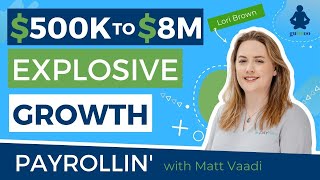
In this interview, host Matt Vaadi talks with Lori Brown, CEO of Pay Northwest (PayNW), about the company’s 12‑year evolution from a niche payroll provider serving around 100 clients to a $8 million revenue business with roughly 1,000 clients across the United States. Lori explains PayNW’s market positioning between small CPA shops and large national firms, its specialization in the senior‑living vertical, and its reliance on the UKG (formerly Kronos/SaaS HR) platform. The conversation covers how the firm leveraged agility to capture the Employee Retention Credit (ERC) opportunity ($85 M in credits for 2021), transitioned to a fully remote workforce, and instituted intentional remote‑work policies (camera‑on, dress code, ergonomic setup). Lori details continuous‑improvement practices such as daily huddles, weekly “in‑cahoots” cross‑team meetings, and mandatory UKG training for all staff. Hiring strategies now prioritize candidates with UKG experience, enabling rapid onboarding and geographic flexibility while maintaining a Western‑time‑zone focus. The discussion also touches on outsourcing HR for confidentiality, the need for a new remote‑focused HR role, and the company’s plan to relinquish its office lease while maintaining a distribution hub for paper checks. Lori shares her personal leadership journey from Paychex to PayNW, advocates for female and mother‑returner talent, and promotes the Independent Payroll Providers Association (IPPA) as a collaborative forum for industry best practices. The interview concludes with future event highlights (IPPA conference, a themed prom) and contact information.
Chapters
I do know that you'll just talk, Lori, which is what makes me so excited to have this conversation. Um, so Lori Brown, thank you so much for joining us today on Payroll. And I'd love to hear, to get started, tell us a little bit about Pay Northwest. Tell us a little bit about the history of the business, what verticals you guys specialize in, if any, and kind of what your value proposition is to the market.
Yeah. So Pay Northwest is based out of Seattle, Washington. We've been around for about 12 years, was founded by Mike Anderson and still solely owned by, by Mike Anderson. And he really set out to do something that he saw was missing, kind of an in-between the small mom-and-pop and CPA shops and the big national firms. So really trying to focus on those $50K and above clients. And serve them in a space kind of bringing the same level of service that kind of a CPA or a small shop would bring to these bigger clients that need the systems that are more sophisticated like a bigger shop might do. So we kind of try to fit right there in the middle of those two, two areas. And I don't think we set out at that time. I was— I've been here for 10 years, so the first couple of years I'm a little bit foggy on, but I don't think we set out at that time to specialize in a specific vertical. Um, but what we found is that we really do well in the senior living space. So over time, we've actually specialized in senior living, and about 25% of our clients are in the senior living space. Actually, more than that, um, more like 30 or 35% of our clients are in the senior living space. And then we've got a couple of other smaller verticals, like private schools is something that we work with a lot here in Washington, and banks. Um, but other than that, we just kind of spread out. And over time, over the last 10 years that I've been here, we've grown from about 100 clients to right around 1,000 clients. So we now serve 1,000 clients. Most of them are kind of headquartered in the, in the Northwest, but they actually have employees. We pay employees in every single state.
So did you guys start in that over-50 market, or did you follow that sort of natural progression that a lot of payroll companies go where they cut their teeth in the less than 50 employees, they figure out their processes, they quickly realize like, oh hey, if we're going to scale and grow, we need to start selling some bigger accounts and bigger deals. Like, was it that progression or did they have that vision from the start of, hey, look, there's this niche in that kind of mid-market, $50 to $250, $50 to $500, where we can really fit and swim?
Yeah, we started out with that intent. I do think that at the beginning they kind of took whatever they could get. So I think that we started out with not quite, quite being at that space. And we also started out with a software that didn't quite meet the needs of those 50+ folks. So right when I joined the team in 2010, they had just signed a contract with what was then SaaS HR, turned into Kronos, now UKG. So once we were able to fully get our arms around that product, we were really able to go upmarket. The product that we were on previously just didn't serve that market as well.
So you guys have been on Kronos, UKG, SaaS HR for over 10 years.
Yeah, yeah, we're one of the original full suite partners of SaaS HR, like the original 10 or 12 partners. Yeah.
I think we need to do a whole episode on the technology platforms. It's one thing we haven't really touched on yet is there's a lot, there's sort of a myriad of these different white label options out there. And that is the, we talked about it though, you and I, I think in another group recently where there's, there's only a handful once you want to start going over 50 or over 500 employees that really give you that flexibility. And while I don't want to give them all big long commercials on why to use or not use their platforms, I do think there are a lot of folks out there that are doing that thing where, you know, that once again going, all right, I don't want to stack 500 more 2-employee units. Like, I really need to figure out how I can start accommodating the 100 life groups and what that looks like. So maybe we'll put a pin in that. But one of the things that jumped out at me in preparing for this and just kind of getting to know you over the last few months here, In your bio on LinkedIn, which I'll link to in the comments, you talk about continuous improvement in every department at Pay Northwest. What does that look like and how does that manifest on a daily basis?
Yeah, so it kind of goes back to our core values. And one of our core values at Pay Northwest is being agile, and that means being willing to change as, as needed. And that means that we can jump on opportunities that come up really quickly. And that we empower the managers and the directors to really look at their processes and improve them as needed. Right. We don't have a philosophy of we should do this because we've always done this. We have a philosophy of let's figure out what the right way to do it is. And if it needs to change, that's great. I fortunately or unfortunately kind of am cut from the cloth that I love change. If I, if I stay in the same place for, for too long, then I get really antsy. And so I say that having only had 2 jobs and working at PNorthwest for 10 years, right? So it's not that I jump jobs ever, but I do look at my surroundings often. I've been known to like move the furniture around in my office every 18 months just because I need change. So I'm not afraid of it. And I think that it can get even better. And I think learning every, every month that you go by and every year end or every quarter end or You know, every big lost client, it's like, okay, what can we learn from that and what can we change from that? So that's kind of what we look for. And there's been no time has ever in history been like the last 2 years, right? So the amount of change that the company has got, that Pay Northwest has gone through and that I've gone through, I'm sitting in my sewing room at home talking to you, right? And this is where I've been for 2 years now, which is awesome, by the way. And I think we might get into that a little bit later. But all of that kind of mindset of being agile and being committed to serving our clients the best way possible doesn't leave a lot of room for this is how we've been doing it. That's why we're doing it this way.
What are some examples that you can think of when you talk about being agile and taking advantage of opportunities? I realize this might be a total softball with to your point, everything happening in the last 2 years, but what are some manifestations of that?
Yeah, so the biggest one, which anybody who knows me is going to be shocked that it took me 6 minutes to say ERC, but ERC was probably the biggest thing that we've been— that we've benefited from in the last 2 years. And as far as being agile, right, we identified an opportunity in 2020 a little bit. There was a little bit of an opportunity there. We maybe did 6 clients. Just because of the rules. But then when everything changed in December, that last January of 2021, we really jumped on that and we were able to actually, um, our total at the end of last year, which there's still more coming, was $85 million of ERC funds that we got back for like, I don't know the exact number of clients, but like 200 clients or something. I mean, we were getting some big checks back for some clients and some smaller checks back from clients that were probably more impactful, right? Those, those clients that were getting $30,000 or $50,000 are probably more impacted by that than the clients that were getting a couple of million. But so that's one thing that we just saw an opportunity and jumped on it. The whole idea of remote work is another thing that we jumped on and is another example of the agility because you know, in March of 2020, we're like, okay, everybody go home, take your computer, take a monitor. You're going to be there for 6 weeks, right? And then it's like, oh no, you're going to be there till July. So we're coming back in July. So come back to the office and get 2 monitors because if you're going to be there for 4 months, you need to be— you need to be somewhat comfortable, right? But it's still temporary. And then come July, we're like, well, who knows when we're going to be back? So come get an office chair, get everything you need for ergonomics and like, let's actually set up a good workspace. And then we surveyed our employees. So as we were looking towards coming back to the office, we surveyed our employees and they overwhelmingly said they wanted to continue working from home. And there was a lot of benefits that we had reaped from working at home. A way higher productivity level, a lot less overtime. And we can get into some of that now if you want, or we can hold on that. But Our employees said they wanted to work from home, so we decided to make that work. And I was one of them. I was one of the employees that said I wanted to work from home. So I understand kind of the benefits in that, but it was all about being intentional. So that's the biggest kind of probably shift that we've made, right? And our need to be agile because not only were we shifting and doing things differently, but it's kind of a whole new world. With technology and, and that kind of stuff that we had to figure out as we went. And there was things that we did that didn't, didn't work and things that we did that did work. And so being able to not be tied or, or married to any specific thing, um, to figure out the best way was really important through that process.
Yeah, and I want to come back to that because I think there are a lot of— you kind of touched on it right there at the end— there's a lot of limiting beliefs, or we've always done it this way, or this was my vision for the company when I started it and I just can't imagine us going remote, it's going to kill our culture. And there's a lot of those things that I think are really going to prohibit people's growth over the long term because they're just— they just won't change. And sometimes that, you know, you can't get out of your own way. But other folks, I mean, look, you got to do what's right for you. And if you just have, you know, you just desire an in-office business and want to have everybody there, I mean, you know, nobody's here to change your mind. But I want to touch on two things before we come back to that. So ERC, first and foremost, Employee Retention Tax Credits. So are you guys seeing that opportunity persist in the respect that obviously we still have plenty more time to file these amendments for folks? I know we're still seeing pretty good inbound for people looking for help with these, although I do think there was a lot of, you know, there's a lot of these ads and people were running where it's like, get it now before December 31st, that I think fooled a lot of people into thinking that like it's over and I can't get these credits anymore. Are you guys still seeing good activity there and a lot of runway?
We are seeing, we are seeing activity there. It's nothing compared to what we saw last year, right? I mean, my personal goal is to get to $100 million. So I got $85 million of credit last year. I think it's going to be a stretch for me to get to $15 million this year. But that's, like I said, my goal. Where we're seeing it now is more through our sales organization. It's— we've kind of hit all of our current clients pretty much as hard as we can. Like we, we gave them all sorts of opportunities to learn about it and not only in, you know, email marketing and webinars, but also in just personal reach out to some that we knew were going to, you know, qualify. So where we're seeing the opportunity now is when our sales reps are talking to clients who maybe didn't hear about it. And that's been a huge competitive advantage for us as well because it's kind of like, well, why didn't your provider tell you about this? You should have known about this. And so that's a pretty easy, easy communication path and it's a way to show value right up front. We also do a thing where we don't charge them a setup fee. We just charge them the ERC processing fees, which we don't charge until they actually get the money back, right? So it's a way for them to come on board with us. We delay when we get a setup fee, which is totally okay by me, and they, they delay when they have to pay that. So they're actually able to switch providers without paying a setup fee up front, and then we get what ends up being a way larger fee than we would have gotten by processing ERC for them.
So if a new client comes to you and they're going to use you for ERC, you're going to waive their setup and you guys aren't collecting your fees until they get their credits?
Exactly.
Nice. Yeah, I don't have that level of gall on the— we get a lot of pushback on the, okay, I got to pay you, but I don't have the credits yet. Like, how do I manage cash flow, especially in the smaller— our predominant market is 100 employees and below. We almost exclusively serve small businesses. We have outliers like everybody, but yeah, that's the one thing we're running into is over and over again, especially if they're not an existing client. And so that's the challenge for both of us is like, okay, I don't know when you get this money. I have no way to monitor that. So I don't know when you're going to pay us and you don't know us. So you don't trust us because we don't have that existing relationship. And so that song and dance is It's challenging, but we've overcome it in a lot of different ways. How are you guys handling that? Like, okay, we just tell— how are you contractually obligating them to pay you that money when they get it?
Yeah, so we— that's part of the, part of the contract that we haven't signed. So we have a special ERC agreement, um, that outlines the payment terms and the price. Um, we charge a percentage of the credit, and then we, we track it all, and we run— we've been running transcripts every Monday for for months now, right? So that doesn't help us with the clients that we don't have RAAs on, but it does give us a ballpark, right? We're processing enough of these so that if it's a non-client and we sent the amendment in March, they likely have their check, right? Um, and so that's, that's how we're doing that. So we're waiting till we see the clients that we sent around them come through, maybe giving them 2 or 3 weeks and then saying, hey, you should have gotten the check in the last month. Talk to me about that. And we haven't had anybody yet that has questioned that or who hasn't paid, but it's, it's early because in this process, because like I said, most of the clients that have processed that we sent in March and April are just now over the last couple months have started getting their checks, but nobody past April. So we're looking at a 10, a 10-month cycle here, and I'm hopeful that that gets a little bit shorter here in 2022, but Who knows? My finance team doesn't love me on that one, by the way, the fact that they're having to chase down clients, but they're pretty big numbers, so it works out.
Yeah, that's a rub for us. We're so, the greatest thing about being in this industry is the fact that we don't have any accounts receivable because we have everybody's bank accounts and we just pull money when it's due, right? Here's your invoice, we're going to take it in the next 3 to 5 business days. There's your opportunity to dispute it. And that's where ERC throws a little bit of a, fly in the ointment when it comes into like, you know, now we're battling with people over, oh, I don't want to sign an ACH agreement because I don't know you and I don't want you accessing my bank account because you don't do my payroll already. And, you know, and we're going, well, we don't know when you're going to get this money and we're going to pull it at X date regardless of if you have it yet. And to your point, yeah, it's been anywhere from 12 weeks to, you know, 8 months on the ones that we've been submitting. So it's a little bit of a challenge, but I don't want to spend all day talking about ERC, even though I'm, I'm sure that we've got a bastion of folks out here that would prefer we did, but we're going to move on. Uh, I want to talk about one other thing. So we talked about being agile, we talked about taking advantage of market opportunities, but what does it look like from a people development side when you talk about continuous improvement? How do you guys monitor and how do you approach employee development and helping to make sure that your people continue to get better?
Yeah, so we utilize kind of a bunch of different tools for the, for the support staff and stuff. We actually utilize the UKG trainings, getting them trained up in the different modules. So even CSRs who have been with us for a couple of years, if they hadn't, we just started doing that about 18 months ago. And so we put all CSRs, even CSRs who had been with us for 10 years, we put through the UKG trainings. Just because there's different things about the system that they might have not know, right? Because they don't do it on a daily basis. So we felt like that was important. We have daily huddles on all teams. So that's part of being remote and part of kind of employee development, engagement, and culture and kind of goes into all of the categories. But within our daily huddles, within your specific team, there's different training topics and then there's a once weekly we call it in-cahoots meeting. So all operational staff get on a 45-minute call and it's a way to kind of build bridges between different teams and spotlight different people to provide training opportunities in those weekly in-cahoots meetings.
So we kind of do it that way. I love that. I love the name in-cahoots and I love, you know, especially as you grow, you find that these walls just as much as you don't want them to exist with the walls between sales and implementation and finance, and they just organically create themselves as hard as you try to keep them down. That's a, that's a really good way to help to break that down. So let's go back to the remote thing. So you guys moved to 100% remote. Is that right?
That's where we are today, uh, except for distribution. But it's— we didn't necessarily do that at first blush. So let me kind of tell you how that came to be. The end result is the spoiler is that we are pretty much 100% remote. So we surveyed our employees and we had out of 40 employees, we had like 5 that wanted a hybrid schedule. We had 2 that wanted in the office full time. One was our distribution person. He knew he didn't have an option, right? You can't be printing checks from home. So he had to come into the office. And then our CFO, he just— I always say that he doesn't like his wife enough to work in a one-bedroom condo with her. So he comes into the office. And I hope she doesn't ever see this because that's probably inappropriate. But that's just the deal. So our CFO has been in the office since day one. Those two people. And then we had about 4 or 5 people that wanted hybrid roles. So we offered them that. We told them they needed to create kind of schedules on when they were going to be in the office and those kind of things. And as of today, those folks who wanted that hybrid option have all left Pay Northwest because what they were looking for was a full office environment, right? But they would come into the office, there's 30 cubicles and there's 2 of them in there. So they weren't actually getting the environment that they were craving. And we couldn't provide that. So that's the idea. So we really thought, I really thought that I was doing something empowering by having this like, you can choose. I called it workplace agnostic philosophy, right? Work location agnostic philosophy. You can choose where you want to work. If you want to work in the office, that's great. If you want to work at home, that's great. You just need to be intentional about it and decide and have some setup. And we have all these rules. But what we found is not enough people wanted to be in the office that they actually had an office-like environment. So, there was no difference for them working at home versus in the office. And all of their meetings were still on Zoom. So, they didn't— we weren't able to serve their needs. And I think that in the end, I'm okay with that. Like, I'm not happy that we lost those people, but I respect that that's what they wanted. And I'm glad that they were able to go find jobs where that's the environment that they could be in, we would have lost way more people than that had we made everybody come back to the office. And so that's kind of how I look at that. But that's one of the biggest lessons that I learned in going remote is that for us, because of the amount of people that wanted to stay remote, the hybrid option, while it's still there for people and there's still an office that people can go into, it doesn't give you that feeling if what you really want is an office. So that was an interesting kind of lesson in trying to please everybody and then not doing it very well, right? Through no fault of our own, it just is how it shook out. So that's one thing that I would say is the biggest thing is being intentional about it. So making sure that whatever you do, there's intention behind it. So we allow people to work from home. But we have a like a work— working from home policy that they have to sign. And there's things around who can use the personal computer. There's things about that you have to have a specific setup that is the same every day. Like you come to a place and it's preferably not your dining room table. It's absolutely not your couch, right? It has to be like a desk. You have to have the room for two monitors to be set up because I don't want a CSR trying to work off of a laptop. That's just not efficient.. And they might think it's efficient, but it's not. So we have kind of those types of rules. We actually have a dress code even though people are working from home because we have a cameras-on policy. So cameras-on is another thing that I, from day one, have been super kind of passionate and insistent on. And a lot of CEOs and companies that I talk to are like, oh, my staff wouldn't go on camera. I'm sorry. If you're showing up at work, you need to be ready to see people. Like, that's not— you can't go to work in an office and then only call people and call into a meeting in the conference room. Like, you can't do that. So you need to be camera ready at all times. And so there's actually rules. We had a dress code when we were in the office and it was casual, like we could wear jeans and that kind of thing, but we weren't allowed to wear logo shirts or those types of things. So we have that same dress code for remote work. No logo shirts. You can wear t-shirts that are plain or, you know, maybe a little Nike swoosh on it or something like that, but we don't need a political t-shirt or a band t-shirt or something like that. And people really stick to it. That being said, the dress code only applies to things that you can see on camera, right? So that's the whole point. So right now I'm wearing my Seahawks pants and my nice dress shirt, and that's totally cool. Never am I wearing socks or shoes. That's cool too. So really it's just about creating a professional image. And we also have rules about our background. So you have to have a neat and tidy background or use a virtual background. Virtual backgrounds are just fine, but I don't want to see an unmade bed behind you because your desk's in your bedroom, right? I don't want to see a pile of laundry behind you or any of those kind of things. So that's— those are some of the rules that we put into place around working remotely, and those have worked really well for us.
I love that, and it is one of my biggest pet peeves when company-wide you can tell people do not have any policy or any guidance on having their camera on. You know, I think about some of our vendors when we'll have multiple, you know, people from their team on a Zoom call and they're all, you know, blacked out, and I'm just like, come on, like, this is so impersonal. It's 2022. We've been dealing with this for a couple years, not to mention We've been doing Zoom since day one, 7+ years ago, and we've had a cameras-on policy ever since. I mean, it just, it gives you the opportunity to your point. I mean, we're in 30+ states and it's like, how do we make it more personal for our clients? Well, we see them and even if they can only see us, it's so much better. It creates a relationship. It creates that, we always like to say, hey, look, we're a national company with a boutique local feel. So whether you're in California or wherever, you're going to get to know us, we're going to get to know you, and we're going to give you that normal vibe. And you can't do that when everybody's got their cameras turned off or it's all over the phone and whatever. And I know we've all got a whole lot of Zoom fatigue, so I'm not going to get into the Zoom rules too deep. But, but now that's exciting. So where do you guys see this going? I mean, what's the long-term vision or what guidance have you given to your team as far as where remote is going to fit into the overarching strategy 2, 3 years down the road?
Yeah. So to bring us forward to today and into the future, We are likely going to be giving up our office space in September when our lease is over. Like, this is, this is where we're going because we— I failed so miserably at the, like, creating a hybrid option for people. I've realized that, that we should just be 100% remote. We will hopefully not, but for the near future, need a distribution room. The distribution room is not going away. We still print about half of the checks, maybe 40% of the checks that we processors still printed. I do have a goal of kind of moving that to being zero over the next 2 or 3 years.
Wait, let me stop you there. Half of all the checks, or 40% of all the checks you guys produce for your clients, are physical?
No, they, they are— they require paper checks. So whether it's a direct deposit stub or it's an actual signed paper check. Yes, we still do a percentage. Yeah, we still do a lot of paper.
Jeez. Yeah. So you—
distribution—
distribution guy is going to need a space one way or the other then.
Yes. Yes, he needs a space. And there's certain tax checks that we print, right? We don't print many. Most of that's electronic. But every week there's a couple to some state agency that we haven't gotten a client on the electronic thing for. And we can't have people printing checks at home, whether it's 5 a week or whether it's you know, thousands. So we're going to need some sort of a space and we will have some sort of a space for those activities. And our CFO still doesn't want to work from home, which I get. So we'll either have just a distribution room and rent some WeWork space for the CFO, or we're looking at different options of moving into just a really small kind of one office suite at our current building. So we're looking at that. But our plan is to be 100% remote going forward. And that has been awesome. And we have hired 3 people in the last 6 months and they're in 3 different states and they all have UKG Ready experience. And it is such a different experience bringing somebody on with UKG Ready experience than bringing somebody on off the street, which I never really liked that term, but it seems to be the term that's used. So that's my, my plan. My plan is to diversify. We're in 12 states. Today. We had quite a few employees from Seattle move during COVID because Seattle is not the cheapest place to live. So we've had some people move to some lower-cost locations and do find success in a way that they could not have found in Seattle. So that's what we want to continue. That being said, another thing that I learned with this whole remote thing is we had an HR generalist for a lot of years. And when we went remote, she was really bored because she was doing things before like organizing potlucks and chili cook-offs and updating the board in the break room. And she was doing payroll and onboarding and offboarding and that kind of stuff as well. But all of that like employee engagement stuff went away. So she was working like half of the day. And I was happy to continue paying her for working half of the day. But that was really boring to her. And so she actually left for another opportunity. And we decided at that time— this was in, I think, July or August of 2020 when she left— we decided to outsource our HR and just get an HR consulting firm that can do the payroll and the onboarding and offboarding and benefits and any HR issues, right? Because we don't really have that many HR needs. But what we— what I found is that we actually do need an HR person, but I need an HR person that's used to this remote environment. So we've actually got a position open right now for an HR generalist that's had some experience in the remote environment. We have a strategic account manager that protects our top 30 clients, right? That's that person's job. They're not their service rep. They're not their implementation person. Their job is 100% to protect our top 30 clients and make sure they're getting what they need. And I've realized that I need an HR person to focus on protecting our employees and to focus on employee engagement in this new remote world. And that's a different HR role than we've ever had before and that most HR professionals have ever done before. So that's, that's one of the things that I've found that we need moving forward to really keep engagement across all all employees in this big spread out world that we now live in.
Well, you're right. You have to be so much more intentional with your culture and how you're going to approach it when you start going remote or hybrid. Hybrid for us, you know, we, we had this conversation not too long ago. I think you were on the call where it's like hybrid is harder in some respects because it's like we've got this in-office culture for a batch of people, but then we've got these other people that we're trying to loop into it and You know, today is a great example for us. The people that are here in Columbia are going to go serve lunch at the local homeless shelter together as a team. Now we've got to try to go, all right, guys, you know, is there a food bank in Rochester you can go serve at every first Monday of the month by yourself? Like, are you even comfortable doing that? Do you even care? Like, and so, so trying to do some of those things, it's just a very different process. And one of the things I want to hear about is how, how it's changed so far, your hiring, or how you think it will. But I have another random question. Do you guys offer any HR services at all, or are most of your offerings just tech-enabled, you know, traditional timekeeping, payroll, HR online kind of thing?
Just tech-enabled stuff. We do not offer any HR services. Yeah.
Yeah, it's funny. Some people out there listening are probably going, what, you outsource your HR and payroll to another company? But it's funny because we serve a bunch of payroll companies like we did. So there, people kind of get a chuckle out of that when they come here and they go, wait a minute, aren't they a payroll company? Why do they use us for their payroll and HR? It's like, well, you know, checks and balances and getting things out of house and getting expertise that they don't have internally. And it's just, it's just different sometimes.
And confidentiality, right? I don't need people within my organization to be able to see what our payroll numbers are. And I know you can block people from being able to see certain clients and that kind of stuff. But the tax team who sends the tax file is always going to know what everybody's direct deposit is, is always going to be able to see the Schedule B or not Schedule B. This is how long it's been since I filed taxes. Whatever the thing you attach to the SUI return is and that kind of stuff. So yeah, we outsource that for confidentiality reasons. And then the HR stuff, I really didn't think we had a huge need, but I realized that that was short-sighted.
Well, it's funny. We've recently gone in the other direction where at some point, to your point, you kind of have to throw your hands up and go, if they want to figure it out, they're going to figure it out. Like no matter how many different ways I change everybody's permissions or, you know, try to block them from this. Like, if you really care what other people here make, you can figure it out internally, just because we are so lean and mean. And it's like, all right, if you're not mature enough to deal with that, it is what it is. Like, we, we just— we're gonna have to move on. And, and, you know, for at least for this stage of the game, and say, yeah, if you're—
if you're—
if you care enough to know what everybody else makes, by all means, figure it out, go on with your thing. But, um, so All right, let's go remote. You guys are going to stick that route for a while. That, that's interesting. I'll be curious to, to check back in in a couple years and see how has that changed your hiring process, or has it yet?
Yeah, I mean, it's enabled us to be— to only hire people with UKG experience. That's— and that's been huge, right? Because we don't care where you— well, We want you to be in Mountain Standard Time or Pacific Time, not because I care where you are, but it just, it doesn't, it's not fun working East Coast or West Coast hours on the East Coast, right? It's actually pretty cool working East Coast hours on the West Coast because you can get up early and then you're done with your day. But, you know, nobody wants to be working till 8 o'clock at night, and that's what you have to do on the East Coast. So we do try to stick to the Western western half of time zones. But beyond that, we can kind of go anywhere. And that's been huge. And we figured out how to kind of train and onboard. There's been less need for training and onboarding because we've hired with UKG experience. But I've also found that training over Zoom— you mentioned earlier Zoom fatigue, and I get it. I've heard that term, but I don't get it. I mean, I'm literally on Zoom meetings 6 hours a day, and I, I've just adapted to that, and I love it. I like talking to people and seeing people's faces. I hate talking on the phone now. Like, the only person I talk on the phone to is my dad because he's old and technology is not his friend. But everybody else, like, I FaceTime them, or we have a conversation, or we schedule a time to meet on Zoom, because I just don't like talking on the— I don't like talking on the phone. I like being able to see people's faces and engage in that way. But training over Zoom is, in my opinion, more effective than training sitting next to each other. So the one thing that you lose training over Zoom is the ability to like listen to somebody doing their work and correct them when you're doing your work over here, right? I remember when I was a CSR in North Carolina years ago, I would be sitting here doing my work and my mentee would be next to me and they'd be on the phone with a client and I'd be able to like correct what they were saying. And that's, that's the one thing you miss. I'm not going to pretend like you can do that virtually. But what we used to do for training then is I'd be sitting at my computer doing things, and this person would be sitting over here trying to squint to look at what I was doing. And then we would switch seats, and then I would be squinting. Where on Zoom, everybody's right there, everybody can see the screen, you can move control, you can stop sharing and then reshare. And I found that the Zoom training is just as effective, if not more effective, than in-person training. So that's what we've done from a training perspective. From an onboarding and culture perspective, that's tough. And that's a little bit of why we're bringing on an HR person that can spend more time on that. But the way we do it, I mentioned before, is our daily huddles. So every morning you start your day or within the first hour or hour and a half of your day, you're meeting with your entire team and you're seeing their faces and you know everybody's there. They're engaged. So it's not like these people on their first day, even though they're remote, are sitting in their house somewhere going, okay, now I need to read the employee handbook and now I need to read this and I haven't seen anybody today. I would be— I would say, I mean, I see 6 to 7 people every day on Zoom that I'm working. And I would say that most of my staff, when you consider the huddles and the Incahoots, I mean, they see everybody on their team every day and everybody in the company at least twice a week. So they're really engaging with people in a way that's different than they did when they were at home. The other benefit that I see to remote work is the productivity that I spoke about earlier. You know, when I'm in the office and then I go to the lunchroom to fill up my water cup, but there's somebody in there and I want to talk to them about their weekend and all of that kind of stuff. Now, I've been away from my desk for 15 minutes, and it's not that I want to tie people to their desks because that's not the point, but they're able to get through a lot more work. So they're able to take their lunches or they're able to take their 15 or 20-minute walk around the block. And come back. The other thing that I see is that when, when we were in the office and somebody was mad about something, right? Because that's going to happen. Whether they're mad about a client that just called or whether they're mad about feedback they just got from their manager, they're going to come back to their little cubicle pod grumpy and everybody's going to be like, oh, what's wrong? And then they're going to share all of that. You have to be really mad to call somebody on Zoom to complain. You don't have to be very mad to tell somebody that you just got a paper cut and you're mad about it in the office. So that's the other thing. I think the overall morale has improved because not only is it hard— you have to, it reaches, you have to reach another level to actually reach out to somebody on Zoom and complain to them, but you have to be really wanting to listen to that to answer that Zoom call when you know that's what it is. You kind of get stuck in the office listening to people's bitching. I don't know if I'm allowed to say that here, but whereas on Zoom, you, you don't— you know the people that might think about doing that, and you can just kind of be like, oh, I'm busy right now, do you have a quick question, or can I call you back? Right? Like, there's ways to avoid that. So I think that some of the spiraling that teams sometimes do when one person's upset has gone down.
Well, and it's funny, I talk a lot about You have to now force— we joke about how it used to be, oh man, I wish that they would stop chit-chatting and get back to work. And like, yeah, this person is distracting 5 people. And now we've got to find a way to force that collision so that people do have some of those more personal conversations from time to time because it's like, you know, it's a whole different set of challenges. And I want to touch on one thing before we move forward, but you talked about recruiting. So there is that obvious of, hey, I post a job on Indeed now, and if I post it locally and I post it remote, I get 10x the applicants remote and they tend to be more qualified because they're, they're sitting anywhere. And there are a lot of companies that are pulling their people all back into the office and they don't want to go back to the office. And so this is a great time to be recruiting and a great opportunity to have a win-win there. But you mentioned something that's really important. And while the platform we use doesn't necessarily always have a huge user forum base like maybe a UKG would, going into these user forums as a recruiting place is a really underutilized technique by people that go like, hey, look at the most active people in there that are asking educated questions, that are working for people that are in our space, that maybe, you know, maybe you got some inside info and hey, they did go back to the office and this person was where, you know, those user forums are ripe for recruiting opportunities. And to your point, you can get people that know your systems, know the industry, know how you do things or, and can even bring some competitive intel with them on occasion that can help to advance the business. So I love that. I love to hear you getting folks that are, yeah, because there's nothing, you know, that's the thing, right? It's like you hire a payroll specialist especially, and it's like one thing to know payroll, but it really, learning the systems is where the rubber meets the road, and that still takes a long time.
Yeah.
Yeah.
I have too many friends to go to the user groups though.
Yeah. I actually never thought about that until you just said that and I, I, that makes me nervous. You gotta be very careful in there. Yeah. To, to your point, like what—
if I don't have a friend in there.
Well, one of the cool things about this industry, and we'll talk about IPPA and the upcoming conference and all that in just a moment, but like is just how giving and how willing so many people are because, you know, the reality is you and I aren't going to be fighting over deals. We're not going to run into each other in the street. Like the fact that we can jump on the phone and go, hey, what are you guys charging for ERC? Like, oh yeah, like this is what we're charging. How are you are you getting pushback on that? Like, sharing, that's one of the main reasons that IPPA is so great. Uh, but yeah, to your point, what you don't want to do is burn bridges with your, your peers because you're coaching their people. But, but, you know, there's, there's ways you can do that without, um, burning said bridges. And, and, you know, um, some bridges are okay to burn too. So, uh, um, fortune favors the bold, as they say. So All right, so you are— let's, let's point out something very obvious here, Lori. You are a female and you are the CEO of Fey Northwest, and obviously we all want to see more of that. Talk to us a little bit about your journey into your leadership position there and what we can all do to help to get more people, whether that be females, people of color, into leadership roles in the industry, because it's a, it's a gap right now in most industries, but pretty starkly in our industry, one where there are a lot of folks in what I would say the, the ranking file that, but less so in the leadership roles. And so talk to us a little bit about your own personal journey and how you got to where you are and what we can all do to help to move these things forward.
Yeah, so I spent the first 10 years of my career at Paychex. I started there when I was 19 as a payroll specialist. And worked my way up into the management ranks at Paychex. Then we moved to Seattle, and when we started a family, my husband and I moved back home. And Paychex was really a place that I had— in order to continue growing my career, I would have had to continue moving. And we wanted to stay in Washington. We wanted to kind of be done moving. I had worked there in 3 different states for Paychex and knew I could continue growing my career there if I continued to move. But that wasn't something that we were interested in. So I started looking for my next role once we got here to Seattle. And one of the biggest things is— so I would answer this kind of twofold. If I'm speaking to the females out there who want to be in leadership roles and who we need in those leadership roles, you need to find a company that looks like you. Not necessarily that the CEO looks like you, but that the CEO values female representation, right? Because when I worked at Paychex, there was nobody in the top 10 employees that was female. And I don't remember honestly if there was anybody in that rank as a person of color. So I don't want to state either way on that. But it was pretty clear that that wasn't the case. But when I interviewed at Pay Northwest, it was very clear to me that Mike Anderson did not feel that females were any different than anybody else. He had a CFO at the time that was female. And so, it's like I see somebody in the exact level, one of the founding members of the company that is female. And so, that gives me some sense. So, for talking about talking to females, don't waste your time at a company where you even sense that that is going to be a barrier for you. Because you need to find the companies that will appreciate and grow your talents and allow you to emerge in those leadership roles. To owners who might not be in a situation of having somebody that is female within their business or within their leadership roles, they need to seek that out, right? Because this is a two-way street. So seek out leaders that are female, that are people of color, And starting with one person then gives you an opportunity to grow from there, right? But if you are sitting in a service bureau and all of your management team is male, and all of your kind of executive— executives are white males, then you need to start there. And then once you start there, you will start attracting more leaders. And I would even further say that you should start there and look for I think the biggest untapped female resource is mothers who took some time off to raise their kiddos, right? That is something that has not been appreciated. I didn't do that because we wouldn't have all survived. I'm not built for that. It takes a special sort of woman to stay home with the kids and a special sort of man, right? Like, I get that men do that too.. But that is a management job. Staying home with kids is a management job. So a mom who has been home with their kids for 5 years and now their kids are in school, they've been managing the crap out of their household for 5 years and they can be an amazing service manager, amazing implementation manager, amazing admin manager. Like start bringing those people into, into the fold so that people see and represent that, and then you will get stronger leaders applying. Because the advice that I just gave females is going to limit you, right, until you start getting people into your organization in those roles.
Well, you're right. I mean, one of the things that, that struck me at one point in my career, and I won't throw the company under the bus, but it was, you know, it's like, hey, look, if you keep hiring a bunch of sales reps out of college, you know, white males, collegiate athletes that are, you know, this age from this area, and like, it's just the same batch of us huddled around the table nonstop. There's no diversity of thought. There's no change in how we operate. And we're gonna, you know, even if the results are good and you keep getting the same results, I mean, how do you ever know? How can you innovate? How can you take a step forward if you just keep getting more and more of the same? And so, yeah, I think it's really important and I think it's critical. And I think it's just something, like I said, I was a little bit surprised. We'll use that as kind of a jumping point into IPPA because we're on this planning committee. You're on the board of IPPA, the Independent Payroll Providers Association, the sexiest thing that there ever was, uh, right? Like, get excited, people. Um, and as I mentioned on here before, but if you're new listening, you know, we for years did not join the IPPA intentionally. We said, hey, look, that's for all— that's for all the other lemmings who want to be exactly like every other local payroll company in the country. That's not us. We're innovators. We built our software. We lead with ASO. We, you know, have since started a PEO. We're HR first. We're just different. And I cannot, you know, cannot share enough what a big mistake that was that we didn't join earlier and how huge it was. The first conference that we went to and what an eye-opener it was, how giving people were, how, you know, how forward they were with the information. And just even just benchmark data of knowing how other people are doing things and how to learn from that is critical. But So you're on the board. We've got the conference coming up here shortly. If, if you've got a minute to say, hey, why should somebody attend or join the IPPA? What's your pitch? Why would I want to join the IPPA?
Yeah, I think that the idea that us service bureaus are competitors is, is a false, a false idea in my mind, right? I'm not worried that you and I are going to be up against the same client. And even if we are up against the same client, they're going to pick one of us, and then we'll go after the next client, and they'll pick— they might pick you the first time, and the next client will pick me, right? Like, I'm just really not worried about that. I'm not losing clients to other independent service bureaus, and I don't think any of us really are. We're losing clients to the big guys. So that being said, if I tell you how I do my tax filing, you might gain some efficiencies, or I might gain some efficiencies, but nobody loses. Right? Nobody loses. So why would you try to invent that wheel on your own? And that's the kind of thing that the IPPA allows you to do, is to build those connections in the industry so that everybody wins. So why it's important to go to the conference is you're going to be in a room of people that are— have the same business challenges that you have, that are doing the same thing as you're doing. And if you share with them how you send ACH files at the end of the day, and they share with you how you process taxes, and each of you shave 5 minutes a day off of your processes, everybody wins. Nobody loses. I don't get more clients from you because I now do your tax process, right? If I assign clients to my CSRs the same way that you do, that doesn't cause me to get more business from you. That does— you don't lose anything by sharing that with me. And that is the spirit behind the IPPA. And those are the things that you can gain. People are just— all of us service bureaus are kind of sitting in these independent ways. And like you said, you, you want to be different. That's, that's cute. But there's no need to be different, right? You might be different in the way you service or your culture, but in the base layer of what you do, why reinvent how to send ACH files, right? Why reinvent how to print and distribute checks? Like, what check stock do you use? If I share with you my check stock vendor and you save $0.02 a paper, I don't lose anything by sharing that, right? Like, you win. And so that's the idea and the spirit behind it. And you can really only get that by being in a room with people and having conversations independent of those types of conversations that kind of happen organically when you're in a room with that many people that do the same thing you do. There's some amazing content being delivered both on the sales side and on an operations side, we're facilitating some of those conversations so you don't have to go up to strangers and say, hey, how do you— what CRM do you use? Right. There's some facilitated conversations around that. And another big thing that we're going to be talking about at the conference is the upcoming regulations and the tax movement or the money movement state by state. So Michael Young is going to be doing a— sorry, doing a presentation on that compliance thing, and that's information you're not going to get anywhere else.
Well, success leaves clues. So if you're looking to be successful, you can follow, to your point, the roadmap that others have laid out for you. There's no reason to reinvent the wheel on 80% of this stuff. Yes, can you still have the 20% that's your special sauce you need to be protective of? Great, that's all wonderful. But to your point, there's a ton of ways that you can learn and get tremendous value from others that have been there and done that.
Okay, I'm good.
So we've been on a planning committee together. So you have seen every session that's going to occur in great detail at the IPPA. Which one are you most excited about?
Super bonus points if it's mine, but so, um, I really am excited for the general session with Dean. He is bringing an idea of change, right? We talked a little bit about change and being agile, and we know how much I like change. And so he's actually going to be talking about how to convince other people to like or accept change as well. So I'm really excited for that session. He's then doing a follow-up with just the sales reps because that's a big thing for the sales reps, right, is to understand how to get clients or businesses to change. And close second to that is going to be the Thursday night prom. So we are doing a throwback prom and encouraging dress. We're going to have awards for best dressed and that kind of thing. So I have an '80s dress that I'm all ready to debut with a bow that is bigger than my head, which is awesome, right? What says '80s more than that? So I will be dressed up and I hope that you, Matt, will be dressed up and that Everybody will be dressed up at that prom. So that's going to be a super fun event.
I'm excited to see the hair. I'm excited to see what the women pull out for the '80s and '90s hair. I think that's going to be the most exciting part of the prom thing. So, well, that's awesome. Thank you so much for your time. If somebody is looking to connect with you or find you, where can they find you on the interwebs?
Yeah, so I'm on LinkedIn is probably the best, best place. I do also have an Instagram page if you want to check out my quilting. You can see a sewing machine behind me. So that's a big, a big thing that I do in my spare time. And that's LGB206. So I'd love that. Or you can just shoot me an email at laurie@pnw.com. laurieb@pnw.com. Happy to talk to anybody because like I said before, nobody loses if I give you some tips or if you give me some tips on how to be more efficient operationally.
Thank you so much for being so open with us today, and we really appreciate your time.
Yeah, absolutely. Have a great one.
You too.










