How Do You Motivate Employees?
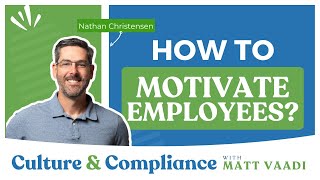
Nathan argues that true motivation comes from purpose, not perks. He recommends placing disengaged staff near customers so they see their work's impact, and says great leaders coach by asking questions rather than dictating, letting people experiment and own the outcomes.
Chapters
Nathan, thanks for joining me. I've got this question a couple different ways over the last few weeks, but ultimately it boils down to this, and that's How do I motivate my employees? Now I'll say it's been asked this way a couple of different times though, is how do I get people to take accountability? How do I get them to take ownership? How do I get them to put themselves on that partner track if I want them to be more, do more with the company down the road? But ultimately it all stems back to that first question of how do I motivate them? What are your initial thoughts when I asked that question?
Yeah, so Matt, I'm a follower of Daniel Pink, and he's got a nice framework out there. If folks haven't seen it, you should. He has sort of the 3 keys to motivation. But for me, it comes down to one really, really simple thing, and it's the purpose imperative. People get motivation from the purpose of what they do, and that's more and more, you know, so it's more and more true every day. And I think that there is this myth out there, and I've seen both the myth and I've seen when it goes south, that the way you motivate people, it's all about what the employees get from the company. You pay them a ton, you give them great benefits, you put a Michelin-starred chef in the kitchen making them lunch every day. I mean, I have a friend that works for Dropbox that hasn't walked their dog in 5 years because Dropbox sends somebody out to walk their dog every day. And, you know, perks like that are sexy and they're exciting and No doubt that it's really important that people feel like it's a win-win, like they're getting paid well and getting a fair benefit. But true motivation, I think, is actually the opposite of the myth. You know, like I said, the myth is motivation comes from, you know, what employees get from a company. True motivation comes from not what employees get from a company, but from what employees can give to the company. And what I've seen motivate people, and this is true in our business, but I, because of our business, I watch a lot of businesses and I meet with them and I meet with executives and I hear about these things. People are motivated when they feel like they have a platform for impact on a mission that they care about. And that is the number one way to get people motivated behind what they're doing.
That's fantastic. You touched on something and you said it a different way. I love the purpose imperative. I've heard it said that in order to have motivation, you have to have motive. And it's a really interesting way to think about it because too often, you know, we're not concerned about what that teammate's motive is. We've got our business motives and we're trying to determine how to motivate them to achieve those motives, right, which don't really matter to them at the end of the day, unless we find a way to tie them together. And I think that's the big miss, right? And it was interesting to— one of the people who asked me recently was, you know, trying to get this gentleman onto a partner track. And I said, does he want to be a partner? Oh, I'm not sure. Does he know that he could be a partner? Oh, well, you know, you have to assume, right? We're a CPA for— well, come on, you got to connect the dots for them in some ways and at least provide them with some opportunities. So compensation, not always a good motivator. Fear, also a motivator that people try to use all the time, which is obviously a poor motivator. And we're starting to see go a little bit more to the wayside. What are some of the ways that you help to empower and involve your team over there so that they can be motivated both personally and professionally?
Yeah, so if we have a quote-unquote disengaged employee who we think has high potential, you know, what we do is very simple. We put them near the customer. We find a way to get them to touch the customer, hear from the customer, sit next to somebody who's talking to customers, Because, you know, ultimately what we find is, you know, we can engage our people, particularly those who have high potential, when they can see the positive impact, the positive difference that our company is making, you know, on the customers. And, you know, high-potential employees will find their path. They will think, "Huh, you know, if I accomplish this, then I can move to this next level." And, you know, they'll figure out that path and they need some coaching. But the number one thing— I love what you just said— is that they feel the motive to do to do so. They feel energized around what the company can offer and why a path at that company is important. Because, I mean, let's face it, for talented folks, you know, they have lots of options for jobs. And why they pick one company or one job over another, something has to stand out. And, you know, in my view, that thing that has to stand out is feeling like they're doing something positive. I think that's been amplified even more in the COVID-19 situation that we're in. As people see, you know, the country hurting, their communities affected, you know, frankly, globally, the disruption has caused people's desire to make a positive difference, do good, is at an all-time high. And so setting up, you know, the situation where an employee doesn't have to choose between I'm going to go out and I'm going to do something I feel good about or I'm going to go out and do my work, where they can bring those two together and see, I'm going to do my work and feel really good about the contribution that's making, you know, to me is the answer there.
Yeah, that's awesome. Getting people closer to the customer, seeing the net result of what they do every day. Sometimes we get our heads so down in the weeds that we don't realize that what we're doing actually has a positive impact, not just on our customer, not just on our partners, not just on our teammates, but possibly on the community. We talk about all the time at ERG, there's this, there's this ripple effect of like, if you call over to our office and you're having a lousy day, and then Olivia answers the phone and she's as chipper as can be, and she's super nice to you, and she's doing all the things that ERG does, right? We give you that warm welcome, we give you that fond farewell, it's part of what we do. You know, we learned that from the Four Seasons of the world, but that could have a ripple effect that changes the course of that individual's day, that then when they get home, they're not as upset with their spouse, and their spouse is nicer to their kids, and their kids go to school and they have a better day with somebody else. We will not minimize the possibilities that happen from a small interaction with another human. And I think when you're talking about the development of your team, you can't either. You know, that inclusion and collaboration are really key elements of this whole thing. But one of the things that I think a big mistake I always see from leaders, especially folks that have been leaders for an extended period of time, is they kind of have a one-size-fits-all approach, right? I'm going to lead everybody on the team the same way because that's just how I am. And they need to adapt their style to me. So how do you teach somebody to be that situational leader when they're trying to motivate people who are all motivated differently?
Yeah, you know, it's really simple. It's the word listen. You know, we reiterate that over and over again. You got to listen and take your cues from the team. And leaders need to have in their mind where they're trying to take the team to, but they've got to listen to figure out the way to do that. And, you know, it's often said that good leaders get people to believe in them, you know, to believe in the leader, and great leaders get people to believe in themselves. And you can't do that if you're trying to conform everybody to your idea of what success looks like. You really got to understand where your people are coming from, and I agree 100%. Maybe it's not always, you know, individualized, but at least it's tailored to, you know, an individual.
Yeah, that's fantastic. And it's interesting because it brings me back to employee coaching. It's something, one of the first things that we have to coach up leaders at our clients at all the time is coaching. Because people think coaching, I'm here in South Carolina, we've got a football coach in town, Will Muschamp, that is like famous for being on a meme of just like, you know, vein bursting out of his forehead, screaming at people, just like the angriest face you can imagine. And they think of a coach and they think of somebody like that, right, who just imposes the game plan upon the team. Whereas Coaching in reality is asking questions with the understanding that that individual has the answers inside of them and helping them to draw and tease that information out. And sometimes we have to do that all the way back to getting to what is the motivation? What is the motive? How do we understand what actually can motivate this person? You can't do it without listening to your point, but also being really good at asking questions. So that's fantastic.
Yeah. Yeah, Norris, I was just going to add that, you know, Once upon a time, I was a 4th grade teacher. I taught in Atlanta public schools, and it's still one of the most profound experiences I've had. And I read a book before I taught that was called Teaching with the Brain in Mind, and it changed my life because one of the, one of the key things that the book demonstrated was just how the brain works under stress versus when the brain is sort of working opportunistically. And your comments on sort of the football coach, I think is exactly right. I've seen the same thing in our business. When people are under threat, when people are under stress, they might kind of nail the specific task ahead because they're fearful of the results if they don't, but they're not really using their full creativity to do that. And they're certainly not getting bought in overall. And asking questions, really understanding the people that you're trying to lead, I think is really key to figuring out what's going to make them tick and what opportunities they're excited about.
Yeah, it's a real-world example that happens to me all the time, and you probably come across this all the time as well. Somebody who's newer to the team comes in with this great idea of how to do this thing that we've already got an established process around, and we've tried that way 16 times, and we already know all the reasons why it's not going to work. And so we bat that idea down, right? It's like, ah, no, we already know why it's not going to work. When sometimes you just got to let them go and fail and try that way. And learn from it because you're not going to motivate them by declining every idea they bring to the table. You have to have a focus on— and this to me is the biggest component of this, and I'd love to hear your feedback on it— you have to be focused on developing your people, not motivating them, because you cannot motivate anyone. Somebody can only motivate themselves.
Yeah. So it's funny you mentioned that story, Matt, because one of my mentors who was a CEO of a publicly held company at one point in his career. I was speaking with him one day and telling him about a plan that one of my executives was bringing to me that I just didn't think was going to succeed. And after hearing all of this, you know, I expected this mentor of mine to tell me how to kind of reel this person back in and kind of reform their plan. And instead he said, Nathan, the most challenging thing you're going to do this year is going to be to stand by and watch as your executive implements that plan and cheerlead them as they do. And he said, you know, this is not a make-or-break plan. You know, it's one thing if it's going to torpedo the company. It's not at that scale. This is a plan. It has a chance of working. You don't think it's a big chance, but it has a chance. And the most important thing is for that executive to own it, and to see it through and learn from, you know, learn from consequences. And that always stuck with me. So I really agree with what you said.
Yeah, it's awesome. Your kids don't come out of the womb and just start walking around the house, right? They got to fall down a few times, and it's no different with our teammates and everybody else around us. So, well, look, this has been awesome. Great tips on how to help motivate teammates and how to let people learn from their mistakes and also to coach them along the way. Nathan, I really appreciate your time, and thank you for joining us today.
Thanks, Matt. Always great to be with you.










