How to create a marketing strategy + How to onboard remote employees | The Monday Marketing Meeting
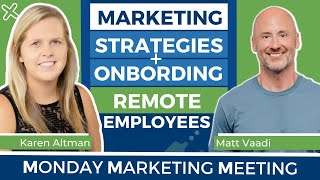
In this episode of the Monday Marketing Meeting, host Matt Vaadi and guest Karen Altman discuss two core challenges faced by small businesses: building a practical, sustainable marketing strategy and onboarding new employees remotely. For marketing, they stress starting with a few clear goals, breaking them into monthly, achievable posting targets, and gradually scaling up. They recommend tapping into existing employee talent for content creation, repurposing customer interactions (FAQs, photos) into marketing assets, and using free automation tools and templates to schedule and publish content. Regular monthly reviews help adjust goals based on what worked. For remote onboarding, they outline a 90‑day framework that separates tasks (paperwork), training, and socialization. Key tactics include shipping equipment and swag before day‑one, creating detailed checklists, assigning buddies/mentors, holding daily stand‑ups with icebreaker questions, and recording short screencasts for reusable training. They highlight the importance of consistent communication, small‑group interactions, and aligning onboarding with company values to boost engagement, retention, and productivity. The conversation is informal, experience‑driven, and packed with concrete, actionable advice for founders and HR leaders.
Chapters
Hey, thanks for joining us. Today's Monday marketing meeting was a lot of fun. Karen asked me about my favorite topic, and that's how to improve employee onboarding while doing it remotely. Well, it's not always my favorite topic to do it remotely. It is my favorite topic to talk about, and that's employee onboarding. And I asked Karen about how small business owners can create and stick with a marketing strategy. I know it's a big struggle for us in the early days before we had internal marketing folks was how to create a strategy and stick with it. So I think you're going to really enjoy this conversation. Thanks so much for joining us. Check it out. Welcome, everybody, to the Monday Marketing Meeting. I'm Matt Vady and this is Karen Altman. In our Monday Marketing Meeting, we ask each other one question. Karen asked me a question about HR. I ask her a question about marketing and we share some nuggets of wisdom with you that hopefully are gonna bring you value to grow your business and help your team to be a more well-suited organization for some of the HR challenges and marketing challenges happening in today's environment. How are you doing today, Karen?
I'm good. How are you?
I'm doing awesome. I'm just coming back from vacation, so I'm well rested. I'm tan. I'm all the things you should be when you get back from vacation.
We all need a vacation every now and then.
Yeah, well, it was, it was, it was wonderful. And you know, we're lucky here, as you know, in South Carolina South Carolina, where I actually drove through your town on my way to the beach. Like, the best thing is you're always like so close to the beach. It's awesome. But Karen, I've got a really simple question for you today. I'm going to ask you— this is something I personally struggled with for a long time as a business owner, and that is how to create a marketing strategy and actually stick with it if you're a small business. And so when you are bringing on a new client and they've, you know, been in business for a few years, what are they doing to either create that strategy or what are you doing to help them? What are some of the best practices and what are some of the mistakes you see them make?
So I have to say, I absolutely love this question and it's such a broad topic, I think, for many different companies. And I really, I think we need to hit on more today, talk about companies that struggle with this the most. And that's these small businesses, especially like startups, companies that have about 10 or less employees. That don't necessarily have an in-house marketing position or person, or they're not outsourcing their marketing to an agency. You know, they hear, I think everyone hears the term of marketing strategy and they think of this overarching big plan that it's almost impossible in their head. How am I going to accomplish this? Yes, of course I want to hit $1 million in sales this year. Of course I want to grow my business to be You know, huge. And that's great to have, but I think a lot of people take it where they think it has to be this huge, complex marketing plan when really it doesn't have to be, and everyone's capable of doing it.
So I'm smiling so big because I remember back to writing our business plan, and the marketing plan was a big part of that, and the marketing strategy. And I remember creating this big PowerPoint deck and all these nuances and I followed these templates and all these things. And then it went right with the business plan after we started and it just collected dust in a file somewhere on my computer.
You probably didn't stick to it. You probably didn't do anything because it's this long-term plan. It's these huge goals that you have. Well, how are you going to get there? And these specific companies, I think struggle the most because they're thinking that way when in reality I think you need to pick 3 different top, you know, different goals that you want to achieve. So I'll just use one for an example. Say your competitors are killing the game on social media and you're like, well, I haven't posted in 2 months. Like I need to improve my social media strategy. And that's a big part of my marketing plan. I want to be better on social. Well, so that's your overarching goal. Well then instead of looking at it over the next year, take it month by month. Make specific plans for yourself that you can do rather than saying, I just need to grow my social presence. That means I need to be posting every single day and I need to be doing this and I don't know where to start, but that's just what I need to be doing. So instead, look at the month ahead and say, I haven't posted in probably 2 months. So let me start by doing 2 posts a week, one on Tuesday, one on Thursday. And that's how I'm going to do the plan for the month. That is feasible. I'm able to do 2 posts a week. I'm able to, you know, I'm giving myself a deadline of Tuesday and Thursday. Thinking in that mindset, you're getting to your marketing goal, but you're achieving it. You're sticking with it month by month. So after the, you know, the month, the following month, you're like, I was able to do that. I did the 2 posts per month. Now let's move on. Let's do 3. Now don't go and jump to 6. 7. You know, I hear you have to post every single day. My competitors are posting almost every day. I need to get to there. Do it gradual. So start small and grow. Grow your marketing plan. Grow to get to your goals. So then say 3 posts. I'm going to do Monday, Wednesday, Friday. Now when you reevaluate, if you're noticing that you missed 2 weeks, you got 3, but 2 weeks you only got 2, don't go the next month and say I need to do 5 this month. You didn't hit it, stick with the 3 and get it. You know, set these smaller goals. So as a small business, when you don't have the marketing, you know, person there, agency, you need to make these goals feasible for you. And that's just growing, you know, you're going to get there, but you're putting the steps in place and it's going against your marketing goal. So that would be kind of my first tip is just start simple and grow it. Secondly is marketing has this term, I think most people think you have to be an expert in marketing. Well, everyone has different skill sets that pertain to marketing. So use your employees. If you have some younger employees who are always scrolling on Facebook, who are always, you know, on there, why not ask them to help with it? It's, they're not technically marketers, but they know your business, they know your brand, and they know all about the social media platforms. So bring your employees in. Use them. That makes it more feasible for you to achieve your marketing goals and put, keep this plan in place rather than you just trying to take it all on yourself. And they're probably going to like it. They're going to love doing it because they know if you have someone who's really good at writing, like they are just, they're excellent. Ask them to write a blog post for you every month that puts a blog up on your website that gets, you know, you're hitting your content goals if that's one of your goals and you're not struggling to write it. So use your employees. They'll be more than willing, most likely, to help. It's what they like to do. You know, if you hit a skill set that they have, you really, you have a marketing team right there under you and you don't even know it. So that would kind of be my second tip.
Well, just real quick on that, I think that that goes back into something we talked about last week, and that's the don't also forget, even if your employees don't have the bandwidth or the wherewithal or the desire to get involved in creating marketing content, put the content in front of them first so they can engage and interact with it, whether That's just liking, sharing, providing feedback and making sure that the content is strong. Don't overlook even when it's just 1 person, 2 people, 3 people. But you hit on something that's really important there, right? This is like one of those little things. I remember when we were interviewing you, you said to me at one point during the interview process, you said, "You're a marketer." And I just remember like so many people, it's something that people want to do and like to do and it's got an intrigue about it and a lot of folks will want to get involved. Plus there's also that repurposing of answers and information that you're already providing to customers or photos that you're taking of your products or whatever it is that can then be used on the marketing side as well. So great point.
Absolutely. And employees, when you're trying to put together your marketing plan for the month, bring them in. They know, you know, everyone has good ideas. Marketing isn't this just one, you know, job title. It's, it's everything that you're doing for your company is basically marketing. So don't overthink a lot of your marketing plan. Put it together like these are what you need to do and this is how I can put it in place. This is how I can incorporate so-and-so, you know, make it feasible for your company to stick to it and your goals will start being hit because they're not just a broad, I just need to be on social media. Well, that's great. And I, you know, put it out there, put specifics. Like if you're now getting in and you've hit your number of posts you want to hit a month and that, you know, you're starting to hit that goal. Well now, You want more followers. Well, how are we going to do that? Put in specifics. So just making it more specific to your company makes these goals more achievable.
Awesome. To that end, you're, you're hitting on something that's super important. What are the top 5 questions your clients always ask you? Like, this is how we always think about how we're going to create content. What did somebody pick up the phone and call us about yesterday? Oh, has that question been asked more than once? Cool. We can now answer it for a customer and create a piece of marketing content at the same exact time. So that repurposing It's as easy as that.
It's really just like I said a million times already, just don't overthink it. It's easier than what you think. The other thing is, so now you've set it and you are using your employees and you're using your, you know, the skills that you have in. There's also tons of marketing programs out there that are free and automation platforms. So automation is the other key. So when you get into automation, It allows you to put this content out. It allows you to, you know, from email marketing to social scheduling, there's something there that can help you get this content out and market your company where you don't have to be worried about it. So if you have this schedule, you know, if you know you have a post going out on Tuesday, Thursday, your one awesome millennial employee already created it for you. Use, you know, find the platform that works right for you and schedule it. Then you don't even have worry about it. I think a lot of people put so much time into putting this plan together, putting everything together, and then they don't execute it because they run out of time. Well, if it's scheduled or it's automated, use a template. Use, you know, it's out there. If you Google a template for something, you're going to find one, fill it in and use it. So it's just making it more, like I said, it's feasible. And it makes these, you know, your business is just going to grow from that. And it At the end of the day, that's what marketing is. You want to grow your business, you want to grow your sales, you want to grow, you know, your profits, and you're hitting that. So those kind of main 3 things of just simplifying, you know, having your 3 main goals, simplify them, use your employees, look, you know, use the platforms and the programs that are available and then reevaluate. So after every month when you're going to go through and do the next month's See what worked, see what didn't. Your plan doesn't have to be, I'm going to evaluate at the end of the year. It can be do it month by month. You're going to get a lot more of your goals achieved because you're setting these points into place for your plan. So I just think not hitting that long-term plan in that broad spectrum and making it very specific can help these small businesses who don't necessarily have that marketing person or agency in place. To create a marketing plan.
So that's fantastic. Some great points there. Starting simple, for me, I know that was big in just like blocking out some time to get it done and then having that mindset also of, you know, there's a point in time as a small business where you're like, oh, if we give away all of our secrets, why would anybody want to work with us? And if we give away all the great information and content, why would they want to work for us? Well, they can't apply it always on their own. And I think that was a mindset for us. It's kind of funny, there came a point in time where I saw all the templates and information that we give away for for free on our website for sale on one of our competitors' website. They literally had a store set up that they were charging for the same templates. And I was like, oh man, like that's just such a cash grab. Whereas in reality, we see more people coming back because our website gets so much traffic from people coming 'cause they know it's a source of great information. And then we're there when they're thinking about possibly making a change in their systems. And so it's fantastic. Getting the team involved, great points there. That's something that can be hard. It's not always as easy as you hope. You kind of hit on something that is like the one myth I think everybody has, and that's like, oh, if they're a millennial and they're spending time on social media, they can do all this for me. Well, they need to understand what creates value and helping them, giving them the information to create nuggets to distribute and all that. And then automation, tons of great tools, and we'll link to some. If you have any questions, don't hesitate to ping us with some of those. And I'll just put in that general disclaimer, any questions that you guys have, please don't hesitate to put them in the comments section so we can answer you. And even just as the general overall question, the one question, you can put them in the comments section. We will ask. So anything else you want to add on the marketing strategy for small businesses, Karen?
I'm good. I love— I could go on for hours about it, but yeah, I know my question for you today you could go on for hours about because this is one of your biggest passions. But with everything with COVID-19, I know this has been a big topic of ours, is just how companies can improve their remote onboarding.
Process.
So now, you know, I think these employers are, you know, everything's kind of new to them right now, and especially bringing on new employees not in the office, having to do it all remotely. So what are some tips? What are some ways you can, you know, better their experience during it?
Yeah, so great question. And you're right, this is— I've often said, like, if I can hang this up and I can only focus on one sliver of human resources, just the one piece of the puzzle, it's onboarding. But it's interesting because a lot of people think of onboarding and they think of that first day and getting the new hire documentation done, getting the orientation, learning where the bathrooms are, getting your keys, all that stuff. Onboarding should be a minimum of 90 days, and some folks say a year to 2 years down the road. And so there are those sort of more tactical pieces, the box-checking that has to occur over the course of the first day, week, month. But we want to look at, you know, ERG, name of our company, stands for Engage, Retain, Grow. What are the things that we can do that are going to create more engagement, more employee retention, and more growth and development of our employees. And onboarding is the access point for all of that. So changing it to remote creates some real challenges, particularly for that engagement piece, right? So if you're not traditionally a remote company and now you've got people that you're hiring to work from home, and whether that's going to be a full-time work from home or a temporary thing also changes some of this, but I think the first and foremost, when you look at that, you have to section this off into— we've got different pieces of onboarding. We've got the tasks, those documents, those things that you have to get done, just sort of box-checking. You've got the training. That's how do we get people up to speed on how to do their job and do it exceptionally well. And we've got the socialization, which is one of the hardest parts when we go to this more virtual environment, is how do we properly socialize our teammates? And so The tasks and all that, I think some companies are starting to get exposed now in that they've kind of lagged behind technologically and they've said, okay, well, you know, we'll just, we'll continue to have them fill out this 2-inch thick stack of paperwork when they come in on their first day and we'll save it all till then because it's just the way we've always done it. It's too complicated to roll out an HR system or whatever, but you have to get that as automated as possible. You have to have checklists in place and you have to just simplify that whole thing. It's kind of interesting. Twitter says from the time somebody says yes until they hit a desk— so Twitter the company, not just getting online and tweeting about things, but when you actually go there to work— there are 75 steps in their onboarding process just from the time somebody says yes until they actually put their butt in a seat. And so while you might not have 75 steps in your company, I guarantee you probably have 25 that you're not even thinking about all time. So making sure you've just got checklists that you can easily pull off the shelf and each manager can use. I remember one of our clients a couple years ago, you know, these people would show up and I would talk to them and they would say, you know, I was in the conference room for 3 weeks before I even had a desk because they just weren't ready for me. They didn't have their laptop. I never met the people out front, all that. So think about how that gets more complicated in a remote environment. So making sure that you've got your checklist and your blocking and tackling done first and foremost is great. And a big part of that is the actual physical component of it where we used to know, all right, Karen needs a laptop, a keyboard, a mouse, a second monitor, mics, lights, all this new stuff that we need, right? So getting your technology checklist in place and making sure that's at that person's house well before their first day so they're ready and set up and feel comfortable on their first day the same way they would in your office. Right? So we just, we just brought on a new hire since all this started, and she, it was kind of interesting. We were sharing the vision of how many employees we plan on adding over the next 3 years, and she was like, wow, I was really doubting that until I saw the box of stuff come and how, you know, I had my swag, I had my computer, I had all my stuff, and I had my desk set up, and you asked what we needed and what I didn't need. And so just being prepared the same way you would if they set foot in the office, you'd have their desk set up, you'd have all their things ordered, you've had it all lined up. Having it ordered and sent to them prior to day 1, so it's not a cluster on day 1. And then that socialization piece, it kind of keeps going back into something. It's going to become a bit of a recurring theme, and that's the communication, uh, talking about the velocity, frequency, engagement on the communication side. We want to make sure that you're talking to someone, you know, more than daily, especially in the early days, and that you've got a buddy assigned to them who they can go to besides just their direct supervisor for when they have those questions on Oh, there was something that's missing from the box. Where do I get that? How do I do this? Who do I talk to about that? Making sure that they've got, you know, buddies and mentors that can help them with that. And so, and that also gets into the training side. So how do we administer virtual training? Well, Zoom obviously has been very practical in being able to share and see how things are done. One of the tools, you and I are just talking about it as part of our Monday marketing meeting before we got on the recorded version of Monday marketing meeting, is like Recording screencasts and sharing that information so that people have reusable resources. I've been preaching this for years. Every time I record something for 15 minutes that someone else can either watch and/or do, I don't have to do it the next 20 times, right? And so if I record something that's very simple, it says, hey, on your first day, you need to do X, Y, and Z, reviewing these things, then it saves me that time in the future. But, but ultimately all of this is to be said when we go back to the beginning of this, the first day after that person parks their butt in the desk. Don't spend that time going, hey, here's where this system is and here's how you get to the bathroom. Here's how you— this is a very emotional moment in somebody's life. You can only get this one chance to really capture the heart and mind of a teammate. And so make sure that you're, you're sharing the vision, the values, the future, where you're going, where you could see them being as a part of the organization and how the team has grown over time, your history, really getting them involved and not being like, okay, great. Here's that thing we hired you to do. Now get to work on it because we need somebody in there ASAP. And that's easy to do, but people are going to develop at the same rate either way. So the more rushed you make it feel at the beginning and the harder you make the first 90 days and the throw them to the wolves mentality is It's not good for the new teammate.
You hit on so something in just— so I work mainly remotely, and I do come into the office every now and then, and I at least know everyone face to face. What is the biggest challenge you've seen with all of our teammates who work together in the office with these, you know, with us remote employees coming in? You know, a big part is that socialization and that training. Do they need additional training to start understanding, you know, I need to make sure I'm taking this time out to help them because not necessarily they're walking into my office asking for help, but, you know, that whole teammate mentality of not being in the office, helping employees who aren't physically there with them.
Right. And you hit on something, kind of a softball, thank you, where we had to develop some more internal training and pull together the resources on how do you work remote. And you train the people that aren't going to work remote all the time on how to work remote. So if they need to work remote, they can. And then they understand what it's like to try to communicate effectively with a teammate who's not in the office all the time. They understand what it's like to be working from their bedroom or from wherever in their house that they need to work. And the, the whole thing around all this, it's always going to be at the crux of all solving all business issues is proper communication. And so, you know, one of the biggest challenges we had, and you know this, we hired somebody, her first day we found out that we were going to be forced home the next, within a couple of days. And so, you know, she's fresh out of college, first real job, and it's like, okay, great, go work from home for who knows how long. And so we had to try to find new ways to increase communication, increase opportunities for observation, observations, for opportunities for training. And I think one of the things that really exposed for us is that while we always have a nice 30, 60, 90-day calendar for training, sometimes it needs to be adapted and adjusted, and we need to make sure you need to be consistent with the application of it. And so just having that list of, hey, look, this is an exercise I do with people all the time. I go, if, if at 1 year this person was an absolute rock star, what is that one thing they would have had done at 1 year? So is it You know, for us it's be able to, to manage 50 payroll accounts independently for a payroll specialist. Okay, great. So at 6 months, what will they have to know to be able to do that at 1 year? Well, they'll have to know how to do this in the system, that in the system, manage this many accounts. And we can kind of create those 3 things that they'll need to be able to do at 6 months. Now I can back that into 90 days. I can say, oh great, now here's what I trained them on for 90 days. Now I can back that into 30 days. Now I can back that into a week. And I'm looking at what does a rock star look like in the future? How do I get them there? Because the data proves it out for us that companies with a formalized onboarding program, their employees are 200%, 200% more productive in year 2 than companies that don't have a formalized onboarding program. So all you need to do is take what you're doing now in the same way you've adapted all your other business processes for remote, make sure that your onboarding is not lagging. Behind.
I do have to give you a little pat on the back because this has been— I know during this time, and I'm used to working from home, but now having other people who are directly working from home, you have put into place— we have a Monday team meeting every Monday morning where we all, you know, if we work remotely, we Zoom in. But now every morning you put in that, you know, our little short 15-minute meeting starts our day off. We all see each other, we all talk, we have an icebreaker question, and it's made it so much more comfortable to where, you know, we see each other every day. So it's, you know, if I need to reach out to the other remote employee, I've never met her in person, but I feel like I know her because I see her every morning. It's not just a one time a week. And I think that that's something that you've done that really improves this whole remote process, you know, from day one, she has seen us every single day. That's helped her, you know, she has questions and she, she asked them directly on our calls and it's made her feel more comfortable. You can just tell she's comfortable with the team. So I do have to say that that's one thing, you know, I've seen, you know, from a remote employee myself that, you know, a new employee on, having them involved every single day, taking 15 minutes, if that. Some days it's a 5-minute meeting. Just having those people see the whole team, I think, has really— it makes you have this comfort level that makes you more comfortable to ask questions, to get your work done, and overall increases productivity.
Yeah, that's great. Thank you for saying that. But I think my favorite part, you just kind of— you touched on it real quick, but the icebreaker question during the monthly or the morning standup meeting has been awesome. Where it's just learning a little bit about somebody every day. You know, first it was, you know, have you ever had a nickname and why? And if you know, if you— what was the name of your first car? And we've just gone through, we just searched out this list of icebreaker questions online. And every morning, everybody on the team call. And, you know, as your teams get bigger, you break off into smaller teams and you don't have to do it 40, 50, 100 people at a time. You should never be managing more than 7 people at a time anyways, right? So these, these morning stand-up meetings should It should be packs of 5 to 10 people at a time and then breaking up from there. But so that's just been a great way. And that's one of those things going into onboarding as well as how do you get these people socialized into the team? We get the team to share. People don't just always voluntarily share. We have people on our team that you'd never know anything about them if we didn't ask them to share. Right. So not everybody's like me and they're just going to yak your ear off all day.
Personality.
Yeah. Well, this has been awesome. Great. Any parting thoughts, Karen?
I just, you know, I just hope that this is helping everyone else out there, these questions. And like Matt said earlier, if you have any question that you want us to talk about, let us know. We'll be happy to talk about it. You know, this, you know, just having these conversations, it sparks different ideas for both of us even during it. So definitely bring up any topics, and we're excited to talk to you next week.
Thanks so much, and please don't forget to like and share this video if it's been helpful to you. Thank you, and we'll talk to you very— smash that like button, bro! The, uh, all right, y'all have a great day. Thank you so much.










