How to Lead A Remote Team | Virtual HR Tips for Small Businesses | Leadership during COVID-19
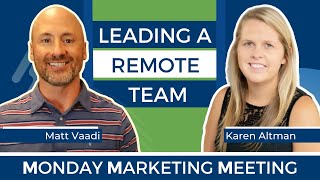
Matt Vaadi and Karen Altman break down remote HR for small businesses across hiring, training, and performance management. They recommend a "desk-in-a-box" onboarding kit, scheduled weekly team training sessions, and monthly check-ins decoupled from pay to keep remote employees connected and accountable.
Chapters
How are your HR processes changing and adapting for the better in this new post-COVID environment that we're currently walking into? That was our big topic for today. We talked about the 3 most important elements of being a world-class employer. That's hiring, training your people, and managing the performance of your team. The companies that do those 3 things really well are the top-performing organizations. So we gave a few tips and tricks on how you can maintain your best practices and elevate them to the next level on today's Monday Marketing Meeting. Thanks for joining us. So I was on a call with a group of small business owners last week, and one of the things that kept coming up in different ways was just the concern around how productive are my people being now that they're all working from home. And so there, that's one of many concerns that employers have now that we're shifting to a lot of remote work, and whether that be as a just direct result of the pandemic or more of a business shift, we're seeing a lot more companies work that way. But what we like to talk about today are 3 of the best habits that all high-performing organizations do.
Wrote about this in the book.
Um, every company that has an awesome culture does 3 things really well. They hire really well, they train their people really well, and they manage their performance really well. So we're going to talk about that today and how some of those things changed in the COVID-19 future that we're all walking into. And I'm joined today by Karen Altman from our marketing team. How you doing today, Karen?
Good, how are you?
Doing awesome. Good, good.
Well, thanks for joining us and share with me a couple of your thoughts just generally before we dive into each topic.
So I do think this is very important. Like you said, I've had people who have approached me about this and part of it is sticking to a process. And I think we're going to talk a lot more about processes today. And you know, there's a process in place, make sure you're sticking to it even more now because it tends to fall off. Especially during that first hiring stage. And once that process falls off, then you're not getting as qualified of candidates that fit your company culture. You're letting one slide in that maybe you want to have before when you're meeting in person. So definitely doing that. It goes the same with training, holding your employees accountable for their training. Also, as leadership, making sure the foundation is set for remote training. And we're going to go over some ways that training can be done remotely. And then that whole performance review, don't skip over it, keep it going, have the same conversations if it's on a monthly basis or quarterly basis, however you have it planned out. But keep the process, modify the process if it needs to be for remote, and then work through it through there. So I think a lot of what we're going to talk about today is sticking with the process and how to better it for remote work.
Yeah, let's talk about the hiring process. So one of the things I see, the biggest mistake I see a lot of companies make, particularly small businesses, is that the process changes depending on the role and how hot the seat is, right? We need to get somebody in here tomorrow. So instead of our normal 4 interviews, reference check, and personality assessment, we're doing 2 interviews, you know, maybe we're checking one of the references and then we're doing this, you know, so that's first and foremost. I think one of the things that we've seen over time, not only with our clients, but with our internal hires is just the more thorough and consistent your process is, the better result you're gonna have. So, it seems like a pretty obvious thing to say about almost anything, but when it comes to hiring, I feel like small business owners tend to—
I've even seen a lot of folks that are having one interview and making a hire.
There's a great quote I heard a long time ago, and that's that even a donkey can act like a thoroughbred for 3 interviews. And so, that's one of those things we wanna make sure that we're taking people through a phone screen an in-person, a second in-person, a team interview, an assessment, you know, whatever your process is, whatever your cadence is, give enough time to get to know the person, but also don't ask new questions every time, right? I can't ask you one set of questions, then ask a different candidate a different set of questions in a different format and have an objective way to assess the two of you side by side. So if I ask the same questions of every candidate and then I use the same scoring system of every candidate, then I can come up with results that are based—
that we can tweak and change over time to make make sure that we're getting the right people on our team.
So when you think about it in a remote environment, probably the biggest thing that's obviously changed is this right here, right? So one of the things that I'm doing to prepare people for with interviews ahead of time is I'm saying, hey, it's going to be on Zoom. Make sure you have a camera ready, make sure you have good audio, and make sure you have somewhere that you can be, you know, private while we have this conversation.
So just preparing the candidate is one small thing in there as well.
Yeah, the whole interview process for anyone is nerve-wracking in general. And then putting it now remotely when they're not used to doing it remotely adds in that whole different aspect. And, you know, the younger generation might be a little bit more accustomed to being on video chat, using that. The older ones may not. So, you know, adapting to that. But I think another part that is a big one, and I know it's a big part of our process, is when we have a candidate coming through you always have one of the employees interview them as well. I think that that's one of the things that maybe even modified to having two employees go through and interview them either separately or with management, just because it's sometimes harder over a computer and virtually to get someone's real, you know, personality, your gut feeling on them. You know, you add in the additional nerves. So if you have more employees hop in, take an interview, give your— give their feedback, it can help as well on these candidate selections. So I do think that that's another way of— a good way to— example of modifying a process to adhere better to remote work. So doing that, and then like I said, trying to make them as comfortable as possible. It's just a whole different scenario when you're looking at a computer, you don't know where to look at, you don't know if I should be looking at myself, I don't know if I should be looking at you, I'm looking up at the screen, I'm looking here. So just, you know, talking through, doing icebreaker questions, getting, putting more effort into really getting that conversation going and not just straight into the interview questions. Yes, ask the same questions, but just, you know, each person's personality is different. So trying to, you know, get them comfortable for the first couple minutes can really ease in and show their real true side rather than that nervous side that they're on an interview for the first time, maybe ever, on Zoom. So those would be kind of like two little tricks there.
Yeah, so one of the things I like to be conscious of when we're doing interviews, I treat them like— there's this old adage with doing a presentation where you say, tell them what you're going to tell them. Tell them, and then tell them what you told them. Uh, in an interview it's not quite the same, but it's similar in that I always want to set the table with, hey, here's what we're going to talk about today, and here's where— what you talked about last time.
Here's what the rest of the process looks like should we move forward.
Um, and then at the end of the conversation, same sort of thing.
Hey, here's what we've done, and here's what the rest of the process looks like if we move forward, just so people know where they're at in the process.
I think that's one of the biggest questions that we always get from candidates is, you know, what's next? So just get proactive out in front of that and make sure people understand.
And once again, just because you're going to be changing up your process a little bit because of the virtual component doesn't mean that you need to get completely thrown off your game.
Now, one other thing I'll throw in here, and I know we've taken advantage of this and I'm starting to see more and more, obviously big companies and small alike, but I think small companies, we've had this mindset for a long time, and that's that we can't have remote teams. You know, in a 10, 20, 30-man company, sometimes it's more challenging. You feel like to have people spread out all over the place. Well, I think we've proven collectively as a community and nation that you can work remote and be productive.
And so don't be hamstrung by your local talent if you are looking for people that you might have a bigger talent pool nationwide or even just in your time zone or whatever it might be.
You and I just got off a call. With a new teammate who's in California. And, you know, he's a higher level of talent than what we were able to find here locally when we posted the job locally.
So it was really exciting to just see the energy and the perspective that he brings to the table that we just didn't find here in our area.
So it actually presents opportunities.
Who would have ever thought that?
Absolutely.
Absolutely. Great opportunity, great opportunities for hiring, not only to improve your processes, not only improve the types of folks you're bringing on, but just to evaluate, you know, You brought it up in the pre-call, you know, your, your actual documentation policies and procedures. We've updated so many handbooks just to make sure that they're reflective of what the new work-from-home policies are, what the technology policies are, all that stuff.
You want to make sure that it's, it's up to date, it's up to speed with what, where you're at and where you're going.
And I think one thing I was thinking about it, and I'll let you, you kind of put the cap on the hiring thing. I think we touched on it with onboarding a couple of weeks ago, but one of the things that we've done now is we basically created a desk in a box. And so, I'll walk up to somebody's desk and we'll make sure we've got everything that's at that desk, put it in one box and send it to the new hire so that they're not getting a computer one day, a mouse the next day, this the other day. And when everything comes at once with the ERG swag and all the stuff and they're just open it up and they can unpack it, put their desk out and be ready to roll along with a checklist on, hey, do you need this, this, this, this, this, or this?
We'll send those too if you don't have them so that you have them for your home office.
That's another great example of not letting a process fall through and letting it, you know, just modifying it to accommodate what's going on. Awesome way to do it.
Awesome.
So let's talk about training. So training is something that is really important for us. So at ERG, we probably take it a little too seriously. We mandate 52 hours a year of training. It's one of the KPIs that we track on our Monday morning team calls.
And I know that's anomalous, but something that we take very seriously is that you're going to be better when when you leave here, right? And not just because you do your job better, but because you're going to learn, you're going to grow as a professional.
So what are some of the things you're seeing organizations do as it relates to training?
So I'm going to say exactly what we've done, just an example of what's worked for us, is that team trainings. So that's, you know, a lot of times we, when we were in the office, we were training on our own. We have to do an hour of training a week. We can do more, you know, it's all up to us and it's our personal training. Now we're doing more of a team training. This brings the team together, brings the conversation up. It gives us the training, but you're including that team atmosphere that sometimes the feeling can be lost during, you know, working remotely. So this is a great aspect. Schedule an hour each week, go, you know, set a training and it can be employee picks a training, leadership picks a training, or something may have happened last week that we definitely want to do some training on this week. And we go through, have different people do the training. You know, it could be a course. I know we use Lynda a lot, but there's also where you can have employees put together a training session and it gets everyone included and you're learning from it. And it brings up, you know, it changes your routine when you're working from home of just working by yourself, brings that team together. So definitely that's the number one. That I think is such a great opportunity. And then it's also holding everyone accountable because it's a scheduled meeting. They have to be on it. You know, it's not just saying that they've done their training and they haven't, you know, they're getting away without it. It's holding everyone accountable to do that training. So training, we have had so much success from training. And you can see everyone on the team is a better person. And a better team player. And they know the industry because they're doing this training every week. So why make— why let that fall through the cracks? I think it's a big one to really push and make sure it's still getting done, making sure the time's still invested in it and making sure your employees are still getting that training.
Yeah, you hit on something that's really cool in there. If you have a teammate who can lead training, it's incredibly powerful because nothing galvanizes learning more than sharing it with other people. So now you've got a subject matter expert on your team who knows something inside and out and can share that knowledge and make other people better, but they're truly getting better by, by sharing and leading that teaching session. So yeah, that's awesome. And I will say, so one of the things that you got to be careful of, and we've gone astray on this as well with such sort of stringent training requirements, is not training for things that are unnecessary, right? So like doing some sort of an assessment of, hey, here are where our gaps are. And this is what we do during our quarterly meetings to say, hey, what's going on organizationally?
Where are the gaps?
Where do we need to fill things in and then aligning our training with that. And, you know, we spend a lot of time, you know, some of it's just on our internal systems, some of it's on soft skills. Last week we did a training on being an effective team member inside of our learning management system, Learn by ERG.
Shameless plug, you can check it out on our website. The—
so, so yeah, the training is huge. And, you know, we want to make sure also that you're assessing the stickiness of the training down the road and revisiting those things and asking people to share the insights and then even testing and seeing how much of that information stuck, particularly if you do what Karen mentioned and create internal trainings.
And I think it's also a great way that there's a lot of leaders out there, management, who are looking for ways to bring the team together and different, you know, they're always looking for activities and different things to do. And here's an automatic one. That betters your entire company, your process, and your employees each week. You don't have to look for something new and creative. You don't have to find a new, you know, any kind of game or, you know, whatever you're looking for. It's set in stone. It's a team effort. You're getting together, you know, and that always brings a team closer when working remotely. So I think it's just one of those easy things. Get scheduled and start training.
So let's talk about performance management. It was kind of interesting. I remember coming out of the 2008 to 2012 financial crisis, Every organization I would go into in the years after, like, do you guys do performance reviews? We used to before that. And so many people had associated performance reviews with raises that they stopped doing them because they couldn't afford raises for so long. And so this is a pretty common thing we try to coach organizations on, and that's to disassociate my performance reviews with my raise session.
They both are there corollaries there, obviously, but also to have a higher frequency and volume of performance management conversations.
So we have monthly conversations at ERG, we call them plan and review sessions. And then once a quarter, we do more of a formalized performance management conversation. And, you know, the great thing about it, and you've been on and through these many times now, is just there are no surprises when you do them that frequently. When we're grading out 1 through 5 where you align with the core values of the business, they're almost identical every single time and our comments are nearly identical every single time. So what do you see in organizations do to keep up with performance management?
What could they get better at?
So one thing I think from what you said is the naming of it is an idea is an assessment or a performance review can scare an employee, can make an employee a little nervous. You know, this just popped up on my meetings. What's it about? You know, we've never done these, or I haven't done one of these in a year. They've been forgotten about. What's going on? And just like you said, we do— we call it plan and review. It's planning ahead, but also reviewing what's happened. And it's not as intensive name as a quarterly assessment or a monthly assessment. So one of the things working remotely is you want more communication with your employees. You can have weekly check-ins and you can use, you know, creatively put a couple of these questions each week and have that as, you know, goes into your monthly assessment. And they don't even know that they're getting— that this is happening. So they're answering these questions. They're telling how they feel they've improved this week, what they've done to better themselves, you know, what they can do to improve. You know, you're asking these questions. And they're not in that mindset that this is an assessment and they're completely open with you and just being able to give them that open freedom to talk about it, you're probably going to get a little bit better of a response because they're not as— that mindset's not there. This is an assessment. My job is, you know, my job's risking on this, or maybe a pay increase. If I don't answer this right, I'm never going to get a raise. So it could be a good idea, you know, making sure you're doing it. If you're doing a weekly check-in, make sure you do it every week. Don't fall back on it. Follow that process. If you're doing it monthly, it's scheduled out for the next year. Make sure it's on there because if you don't schedule it out, you're probably going to forget about it. And then that's when the process doesn't go through.
Yeah, one of the— it's funny because there's actually also this big percentage of employees that crave the feedback and want to get better. And one of the biggest complaints we get when we walk in as the HR department behind, you know, typically there wasn't an HR department before we come on board, is, oh, I was promised performance-related conversations or the annual performance reviews, and nobody's done that since I've been here, or I haven't heard about it, or there's no process around it.
We frequently get complaints from employees about that and requests to make it more common and make it just happen, period. And I will say one general thing that I think is hard for leaders to do with their top performers is to not give people the 5s across the board.
The, oh, hey, Karen, you're doing great. Just keep up the great work. I'm so pleased with everything you're doing. Or conversely, oh, Karen just screwed something up yesterday.
Now I'm giving her 1s across the board because I'm, I'm just using the recency bias of things that have occurred recently, which is why you have to do them more frequently than annual.
If you're doing an annual standalone performance review, it's the biggest waste of time.
You might as well put it in the trash and set it on fire because you're only reviewing the last couple months anyway.
So Make sure you're spending the time to have these conversations more frequently and make sure you're giving people valuable feedback so they can actually get better. And you're standing true to that commitment that people are going to get better by working alongside you, right?
The job of a leader is to create more leaders, not to just blow smoke up people's behinds. So, um, lots of great things to keep up with the performance review process and improve it.
Any, any parting notes on that?
I think just always do it, you know, don't put it off. Don't, you know, just don't say this isn't a big deal. You know, you're doing great. We can talk next month. That's not going to work. Keep it going. Schedule a quick call, make it happen.
Ah, and it's so easy to just, because it's one of those soft meetings that's on your calendar where you go, ah, Karen's fine. She's busy. I'm busy. We'll just push this. Don't do it.
You're right, Karen.
100%.
Process.
Awesome. That's right, trust the process, folks. We'll end it there. Thank you so much for joining us today. I appreciate your time, Karen.
Same to you.
Have an awesome day.
Bye.










