Marcus Sheridan: How you can become the most trusted voice in your space | They Ask, You Answer
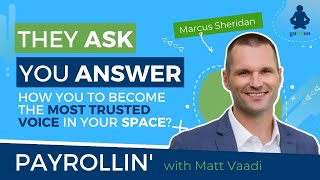
Marcus Sheridan explains how to build trust and grow through content. Start with long-form YouTube videos, then repurpose into short clips. Hire a dedicated writer and videographer, go deep on one platform before expanding, and put your pricing on your website.
Chapters
Marcus, you wrote the amazing book They Ask, You Answer. You've impacted tens of thousands of people's approach to sales and marketing, which is a pretty dang cool thing to say in and of itself. But what is the one piece of advice that you are constantly giving clients or people who come to your events that they just don't follow? I mean, you've literally got to beat them over the head with it.
What is that one thing that, uh, One of the majors when it comes to world-class case studies online, right? We'll start there for a second. Somebody in the organization has to own the content. Somebody's got to own it. And so what happens a lot of times is people say, well, Marcus, you know, you, you, uh, you produced your own content for, you know, those couple of years and, uh, it worked fine for you. And so I'm going to give that a try too. Well, yeah, and I was getting ready to file bankruptcy and I was gonna lose my home and I didn't have a choice. You see what I'm saying? And so because of that, I did things that a lot of people, unless they're incredibly motivated, are not gonna do. And the pattern we've seen of the companies that create the greatest case studies online just become that voice of trust in their space. Somebody owns written content and eventually somebody owns video. Now, if you're a one-man gang, right? If you're just a one-person company, well then that might need to be you at first. But if you're scaling up, which ideally you are as an organization, there's somebody that owns the written word, that in-house journalist, if you will, that in-house storyteller that is meeting with your different subject matter experts and is getting that content, that expertise that's in their head and getting it up on the screen. Same thing when it comes with that videographer. Most companies don't have an in-house videographer. If you want to crush with video in 2023 beyond, get an in-house videographer. It's a game changer.
That's interesting. So you've got somebody that you suggest— somebody controls written content, somebody owns video content as well. Are they one in the same as far as the content they're producing? Are they repurposing each other's? And who's the leader of those two?
Well, you know what's interesting? Lots of times when we work with— we work with a lot of companies that at first they don't even have really a marketing department. And so we'll bring on that, that recent journalist graduate and we'll train that person up on all things marketing. And they're producing some of that written content. They get going, they get moving, and they start to— the business starts to really see the growth. And so now we're ready for another hire, and that person becomes the manager of what is the marketing team. The next hire is generally either a new writer content manager, or it's a videographer, somebody that's really strong with video skills. You can't be a really strong writer and videographer at the same time. It just doesn't really work. You're serving two masters. Um, can you do it okay? Yeah, but just okay. You're not gonna do it in a world-class level in terms of your industry. And so that's usually where I start, Matt. It's like, I would start with like, what do the best do? What do we see? What are the patterns of the ones that just became the voice of their space? Somebody owns it, right? So I would start generally, um, a perfect small marketing team is a head of marketing that is managing the lead writer, the videographer, and that head of marketing is also in charge of HubSpot. Or whatever the tool is that you're using to do all of your marketing automation, to measure all your stuff, that is also your CRM that the sales team is using. Like, in a perfect state, that is like the— if I had just 3 team members, those are the 3 that I'm going to have for a marketing department. It's crazy, there's companies that are massive that have, you know, a marketing department with 20 people and they don't have an in-house PR. What's your—
what's your friend? We both are Alex.
Sure.
Yeah, Alex. Yeah, I've seen that you two with the same last have become friends on LinkedIn. He's a big video production guy. Highly recommended follow for those of you out there listening in. And, uh, check out Alex's stuff. He, he really doubles down on video. And I think, you know, it's funny because how many years in a row now is 2023 the year of video, right?
Like, it's so funny, right? I mean, I say it in, in with total like sarcasm at this point. Um, it's, it's, it's really wild though because most companies still haven't come close to tapping into their potential. And, you know, video is not one of those things you just get overnight. It's like any other skill. You learn how to tell and show a story. You also learn how to be a better subject matter expert. You learn how to be better on camera. I mean, there's all these things that you learn, and that's why the best companies when it comes to video are the ones that are most willing to be imperfect, that know it's not gonna be just right, and they're willing to embrace the messy and the clunky that comes with it, right? So you gotta crawl before you walk and walk before you run. You run. Uh, some companies don't allow that. They think their brand is so pristine or magical— it's freaking BMW— that they're like, ah, you know, that just doesn't meet our standards. They never do anything great with video. And in fact, they probably— if they do video, they outsource it and they spend outrageous amounts of money that they shouldn't be spending because they can't tell stories and show stories in-house.
Well, and I think there's also that fear to your point of like, we're not BMW, but we've gotta have everything uber produced, right? Like sometimes you gotta get comfortable with, you know, I always point to Gary Vee. It's hard not to, he's such a predominant figure in the marketing space and branding space of like, his stuff's never well produced, right? Like, I mean, if you feel like you've gotta have everything perfectly produced, I mean, you're behind before you even start. And I love your point earlier, you know, this term T-shaped marketer is something that's coming up all the time lately is like, look, you're good at a bunch of things, which is the top of the T, but you're really good at one or two things, which is the bottom of the T. And too often people think that they're gonna hire one marketing person and they're gonna be able to do all this stuff. They're gonna be a graphic designer, they're gonna be a content writer, they're gonna manage the content, they're gonna do video, they're gonna do, you know, trade shows, they're gonna do everything. Well, guess what? That person does not exist and they definitely don't exist fresh outta college. So like you're gonna have to get some additional disciplines in there. Even if you just need to supplement with contractors online, you know, both near and abroad are great ways to fill that in.
Yeah, you're right, man. It's like we can do that so much, and it goes back to that if you try to be a jack of all trades, you're going to be a master of none. I'm looking— I, you know, I'm always looking for a master of one. It's just, it's the same thing with, you know, one of the big mistakes that companies make, generally speaking, is, uh, they buy into this idea of be everywhere, uh, which is, it's not realistic. You're much, much better off really leaning into one platform and doing it very, very well So if you said, you know, we're going to become the best in the world at YouTube and that's going to be our thing. Okay, fine. That's great. But don't try to be the best in the world at YouTube and then be the best in the world at 5 other things. It's very, very hard to do. You know, it's like when I started They Ask You Answer with my swimming pool company back in the day, I was like, we're going to be the best in the world with written content on our website. That's what we're going to do. And so that's where we started. And about 6 to 12 months in, I started to integrate video into the mix. The video that I did was mainly just YouTube. I was just really getting good at that. I wasn't paying attention to Facebook at the time. I wasn't doing, you know, I didn't do social media hard with my swimming pool company for quite a few years, but yet we became the most trafficked swimming pool website in the world because we had a really, really clear focus. And it doesn't matter if you could get— it's like the other day I was with a group, an audience, and they said, Marcus, should we be doing Twitter? I was like, no, you shouldn't be doing Twitter. And this was a group of, what they do is roof cleaning, okay? And somebody said, "Yeah, but I've gotten some results with Twitter." I'm like, "Yeah, but if you'd spent that exact same amount of time with a better platform, more focused on it, you'd have gotten more results than you got from Twitter." So Twitter's fine, and could you get leads from Twitter? Yes, but you're not gonna get as many leads from Twitter, at least in that industry, than you would have if you had focused your efforts somewhere else. And so it doesn't— that's what— that's why we hear, oh, that person is getting some leads in. Yeah, but you want to go deep with that particular platform, become great with that platform, own it, crush it. I mean, just really, really be known as the thing there. And then once you've become very known on that platform, then start to work your way out and do some of these, these other platforms or these other mediums.
Yeah, you nailed it. Having 50 followers each on 5 platforms is not a great marketing strategy, right? So, so what— for you, what are the social channels that doubling down on and like currently, and what are you looking to next?
So it all depends on the business. And because I've got multiple businesses, I'll break down each one. So for myself, my personal brand as a speaker that is speaking to lots of companies and certainly lots of B2B organizations, I'm all in on LinkedIn. You really don't find me on— you don't find me on Facebook. You don't find me on Instagram. Uh, you don't find me really on Twitter. Like, I, I use Twitter as a news feed, but I don't really post anything on Twitter. I put all my, like, mental energy into LinkedIn. So that's that. Now, my swimming pool company, we don't use LinkedIn. Doesn't make any sense. My swimming pool company continues to be world-class with written content on the website that's answering customers' questions. And we're very, very strong with YouTube. We do some with social media, but it's not a massive focus. It's just not a massive focus. I mean, we just do some. Let's just do some. I've got a, um, an offshore fishing company and brand. It's called Speechless Sport Fishing, and my entire focus there is just with video. So with Speechless Sport Fishing, we've got a YouTube channel called Saltwater Fishing University, okay? And on that channel, it's all our marketing efforts are just put right there. Now, we do produce short video content, and that short video content gets repurposed and goes on Facebook because fishing does really well with Facebook and We, um, also use it on TikTok, but where the base is, we only produce the videos for YouTube. We produce long and short video. We started with long, we got good with that, then we moved towards short. 2023 is the year of short video. It's just amazing right now. It's amazing the impact that can have. We take that short video, and that short video is the easiest to repurpose and we use it on TikTok, we use it on Facebook. For Facebook, it's Facebook Reels. For TikTok, it's TikTok. For YouTube, it's YouTube Shorts, right? That's how it works. And it's Reels. So that's where, that's where we go, and that's how we're building our community there. We're building it really, really fast. But I'm not doing any written content. I'm not doing They Ask, You Answer over there in terms of written content because I don't have time for it. I'm going to focus on one thing and do it really, really well. I'm doing They Ask, You Answer video content but not written content.
I love that. So you mentioned they ask you to answer several times. Obviously, I mentioned it open up. First of all, amazing book, man. I mean, it was the type of book I just barreled through this thing and, you know, sat down, had pen in hand, was taking notes and just went through the whole thing in about a weekend. So kudos to you for writing such an easy read and something that, you know, wasn't redundant. Didn't feel like we were, you know, oftentimes I feel like I'm just hearing the same point over and over again throughout a book. And I often used to joke, I'm like, look, man, Marcus's book, Look at the title. You got the whole concept right there. They ask, you answer. That's it. That's all you need to know, right? Your customers are asking questions, go online and answer them. And that's the book. I don't need to read this thing. And then I finally sat down and read it after holding onto it for a little while. And it's an awesome book, man. So kudos to that. But it's been about 6 years since you wrote it, as far as I can tell, 2017. I, I found that you wrote it. What would you change if you were rewriting this book in 2023?
Well, what makes me so happy is It was written from a principle-based perspective, right? Centered around how can you become the most trusted voice in your space? And that's never gonna change. You know, if I said to you, is trust gonna be fundamental to your business in 20 years? It doesn't matter what type of business you are, you're gonna say, yeah, of course it is. And so we're in a battle for trust. The question is, how do we generate it? If I said to anybody, is addressing your customer's questions, worries, fears, issues, concerns, Is that going to be important to how much they trust you and their willingness to buy from you in 20 years? You'd say absolutely. And so the question becomes, how do we answer those things, address those things? Where do we do that? That's what evolves. So I'm really, really pleased to say that overall the book has been, from a principle-based perspective, very evergreen. Another edition came out at the end of 2019, and I can see another edition coming out in 2025, uh, 2024 maybe, probably 2025. But that's going to have a lot about AI in it, okay? And we've also seen a ton of success, they ask you answer for recruiting. So it turns out that recruits have tons of questions that are just like buyers. They wanna know the best companies to work for, they wanna learn about salaries, they wanna compare different companies in different industries, things like that. Most companies don't really teach recruits, potential team members on their website like you would teach a prospect for your business. And so really, in a perfect state, you've got two learning centers on your website, one for potential buyers, one for potential team members that are addressing all their questions, worries, fears, issues, concerns. And if you could become the hub where someone learns about getting a job in your industry, you're never going to search for another employee again. They're going to be coming to you. So that's a big untapped that, that wasn't in the initial They Ask, We Answer books. It's going to be in the next edition, definitely. As you know, I'm really, really big into AI and so I'm talking about it. And you know what's interesting about AI is a lot of people think it's going to solve companies' problems, but in many ways it's not so much because you still have to have guts and you have to pay attention to what people want to know and you got to be willing to talk about it. You can have ChatGPT write an article on your website right now for you in 2 seconds about how much does it cost for your product, your service. But most companies still ain't gonna do it because they're afraid to talk about cost and service on their web— cost of their service or product on their website, right? Still to this day, not over 90% of B2B service-based businesses don't address how much does it cost on their website, which is utterly ridiculous if you think about the psychology of the buyer. So even though we have all these tools now that are willing to talk about these things and do them— and I'm not saying that ChatGPT is a standalone product, it's not, it needs guidance, It needs additional content that you put into it. But the point is, they're still not going to do it because they're not obsessed with the buyer. They're trying to protect the old way, the way they've always been doing it, which is ridiculous. And that's how you get left behind.
And I know everybody listening right now, that's really resonating. So we're in the payroll space. Name of the podcast is Payroll, and we're going to talk about the IPPA Summit here in just a moment. But the two biggest players in our space will never ever have the pricing on their website.
Oh, they will.
They will.
Sales model. They will, though, man.
Or the pavement. All right, I've been waiting 20 years.
They will, because here's what happens eventually, and I've seen this. Let me give you an example. 6, 7 years ago, I started teaching the manufacturers in the boating space, you're going to need to talk about pricing on your website. They're like, well, we don't set the end price. Yeah, but you have MSRP. And you're going to be forced to do it or you're going to be left behind. And I was with 20 of the top boating manufacturers in the world giving the owners a talk, and I had multiple say you're wrong. And over 50% of the people in that room today have pricing on their website. 50% build and price your boat. And trust me, the chips are falling and the others are going to have it too. So what happens in every industry is chip falls, chip falls, and then the marketplace starts to say, wait, wait, wait, wait, wait, you mean there are people that are willing to talk about this? And so if they're not and they are, well then I'm gonna start to call them. And so it's just a matter of losing market share. It's kind of like, you know, there's this famous quote by Henry Ford which I think is a stupid quote Yeah, it gets quoted all the time and it's dumb. It says with the Model T, "You can have every color you want as long as it's black." Well, that's the quote that almost drove Ford out of business initially. After they gained all the market share and started dominating, Henry didn't really want to change things up. He's like, "Hey, had the fat happy syndrome. We've been doing it this way, been doing it this way for a long time. I'm not going to change it. You can have any color you want as long as it's black, right? Hahaha, real funny." Okay, so you almost lose the business because of it. You gave the opportunity for everybody else. The two behemoths eventually are going to talk about cost and price. Now, they might not list their exact price, but they're going to talk a lot about it, and they're going to teach a lot about it eventually, or they too will be left behind. I will guarantee you that it's going to happen, and I'll give them less than 7 years, probably less than 5 years before it happens.
Well, I don't know if you're right or wrong, but I can tell you that there's going to be immense pressure one way or the other because there has been sort of a, you know, a third or fourth place person who's coming up. They've got pricing, they're inbound. They're more focused. You got a lot of folks like us, independent regional providers that are putting their pricing on their site, applying that pressure. And really just, you nailed it in the book, in the conversation here today of like creating that trust. Like we've got nothing to hide. We also don't discount, which is the biggest thing. Like, hey, why don't they put their pricing on their website? Because their current clients are going to see that they've taken 10 price increases over the last 10 years and they're now paying 150% of book rates. So that's going to be the bigger problem is they're not going to put the pricing on the website because they're too worried about the fact that soon as they have to go make cost adjustments for all those million existing clients, they're going to drop significant market share price. And so that's a concern. I don't know.
Let me tell you, let me tell you something really controversial.
Yeah, go ahead.
Okay. And this will just make people say, I don't know about this guy. If I was in the payroll space and I had those two behemoths, I would create two different pieces of content, both addressing how much their product and service costs. In other words, me as their competitor. Now, I don't have to say exactly how much they cost because this is the thing that people miss. The perfect title of the book would have been "They Ask, You Address It Really, Really Well." But you see, that's not catchy. It's "They Ask, You Answer." We get caught up in the answer. You can't always give an exact answer, but you can address the thing well. And so, for example, If you have this behemoth that people are constantly searching about, well, how much does their stuff cost? I guarantee you, if we— if I went to Google right now without even know that company's name and I searched that company's name and then I saw what came next, price would be one of the first ones that shows up in Google Suggest. I guarantee it. And because of that, I could draft off of that momentum I could openly talk about that and teach people the factors that we have learned, because if you've been in the game, you have a sense for what they cost. So you could talk about what their pricing model looks like without giving exact prices. And then now all of a sudden you're getting all that traffic to your website, and you can say, and oh, by the way, we are willing to tell you roughly what we cost. Here's how much we cost, or here's a sense for what you would spend with us. Here's some different examples of what you might spend. And because of that, you've just gotten all the traffic from the behemoths. And that's how digital Davids beat Goliath every day online.
Well, it's interesting. I Googled that while you were talking just to see what popped up. And the first article was a Forbes article addressing their pricing, not their own articles, and then a couple of theirs. And then, you know, there's, there's certainly some land grab there because I'm sure if I took the time to put in keywords everywhere and see how many searches there were per month for this, it's probably substantial. Matter of fact, one of the, the competitor I mentioned that does have their pricing is running ads against that search term that pop up first as soon as you, uh, search that. So sure, very good. Uh, couple of things you can do there. But, um, let's talk, uh, let's go back to that piece about your personal brand. So you've obviously done an amazing job building a personal brand for yourself. I know a lot of people in this space trying to do similar things. So if for people that are trying to follow that course, trying to develop a great personal brand for themselves that, that cascades into the business, helps them to grow, what are the suggestions you have?
I think one of the skills that a lot of people struggle with, and you can absolutely develop it, is the art of storytelling. I told the Riverpool story over and over, thousands of times by this point. People even apologize to me sometimes on podcasts or in interviews and they'll say, Marcus, you know, I know you've answered this a million times, but would you be willing to talk about the Riverpool story? And that always surprises me that they're so afraid to ask that because I love the Riverpool story. It is foundational to my life. I tell it well, especially from a stage, right? When I come out to the conference, I mean, it's going to be a very cool story, but a story that relates to everybody in the room because they're going to be able to put their arms around it and they're going to say, you know what? This isn't that complicated. This is so easy. He's not that smart. Look, if he did it, why can't we? And by the way, that is the idea. I went to number 2 to building your brand. Once you become a great storyteller, you also want to learn to, you know, somebody once told me the phrase, Matt, it's dumb not to dumb it down. And at first I was like, huh? I was like, yeah, because too often especially when you, when you have this, you know, persona that you're trying to put across online, you don't even realize it, but you're trying to sound smart. Why are we trying to sound smart? Because we're trying to prove ourselves to the audience. Like, hey, I belong in this room or on the stage or whatever it might be. That manifests itself to your audience without you even realizing it. And it turns them off. Comes across as insincere. And so if you let go of trying to sound smart, then suddenly you become so relatable and understood. You've achieved this thing called communion, right? And so that's why somebody reads The Astral Answerer, like, dude, I just like blew through the book. It was like, I felt like I was just like talking with you. It's like, and it's just so easy to read. There's nothing about it that's complex. I don't use fancy words, fancy phrases, anything like that. It's just easy to understand. It's a duh book. That is great. When I get off the stage and somebody says to me, this is so obvious, that's a win. But a lot of people would be hurt if they were told, well, this is so obvious. I feel awesome about that because it means in their eyes it's attainable for them too.
I love that. Well, as, as a dumb guy, that's actually the easiest part for me is just to dumb it. I've got nowhere else to go but dumb. Uh, but, but the other piece is, you know, you mentioned it and this is really, really hard and people underestimate it, is saying the same thing, being comfortable saying the same thing over and over and over and realizing that 99% of those people haven't heard that message. Or, you know, the old mustard seed parable. It just hasn't hit and grown yet. And so, you know, making sure that we are comfortable telling— I remember hearing Tim Ferriss years ago tell the same story on like 3 different outlets. And I was like, man, he just tells the same stories over and over again. And I was like, oh yeah, he just tells the same stories over and over again. That's not a bad thing. Like you've got your great stories that resonate, that provide a ton of value and get the point across. Tell the same stories over and over and over again and don't be uncomfortable comfortable with it. It's wildly uncomfortable at first. We used to create new, you know, presentations, new things all the time where it was like, whoa, let's just double down on the stuff that actually hits every time. It's like, you know, you wouldn't pull all the jokes out of your routine that were getting laughs on stage. They continue to tell the jokes, right? Um, all right, so let's, let's pivot real quick into the IPPA Summit coming up here next month in Las Vegas. What should the attendees expect from you on stage?
Well, they're gonna, they're gonna have a really, really fun, educational, and takeaway-driven experience. That's, that's my promise.
Fun, educational, and takeaway-driven.
Yeah, that's right, that's right. And you're gonna find there's a lot of interactivity to it. I'm gonna have a conversation with you, which is always like, this guy really talking to us? Yep, we're gonna have a conversation, which makes different, it feels different, it's gonna be different energy in the room, but you're gonna see a framework, learn a framework that you can immediately apply to your business to generate dramatically more trust, traffic, leads, and sales. I promise you that. I promise you that. And it's not gonna be hard to do. It's gonna be utterly simple. What's really cool is most your peers won't do it. Which puts you in that perfect place to gain significant, significant market share. So if trust matters to you and you want to be that voice of trust while attracting dramatically more traffic, leads, and sales to your business, well then you're going to enjoy the keynote. If that doesn't align with you, then I would suggest you just go catch up with a friend. Either way, you won.
Listen, we are in the payroll space. What could matter more than trust, right? We are literally We are paying your number one asset. We have to be trusted. And to your point, not everybody in the room is going to execute. So be prepared, be ready, have your notebooks ready, take those notes and be ready to come back and execute on the things that you learn. But what about those folks? So we've got you on the sales and marketing track. We've got a couple of different tracks at the event, but we're also going to be in sort of a general keynote time. What about the people that are not sales and marketing? Should they attend this? What will they get out of it if they do?
Well, 100%, because you're also— if you look at what trust is, it's a principle, right? And so what's great about this is we have a ton of HR teams that are using the principles of They Ask, You Answer to dramatically improve how they hire and how they communicate. If you're a leader, you absolutely want to be in the room because this is really going to shake you up in terms of, you know, what you felt like was transparency. We're going to really show you what transparency actually looks like. Today, what today's buyer wants. And that's really what we're looking at too. We're looking at the psychology of us as buyers, as consumers, as decision makers, what drives us to take action. And what's so interesting about it is we don't treat our customers oftentimes, especially from a sales and marketing standpoint, as we ourselves would want to be treated. And that can happen with the customer service side, customer experience side of things, and just goes across the support. So my promise to you is, regardless of, of what, uh, position you hold at the company, if you come to that keynote, you're going to be fed and you're going to be flooded with ideas for yourself personally and professionally. That's my promise to you. I really, really mean that. And, uh, I can't wait to, uh, if you're listening to this, I can't wait to meet you in person, shake your hand at the event. Um, heck, it's Vegas, y'all. Let's have a good time.
And I can attest to that. I've got pages of notes from reading your book, and I know that we're going to get even more value and be poured into and person. Really looking forward to seeing you out there in a few weeks. Where can people find you if they want to connect with you and follow you online, Marcus?
Definitely LinkedIn, as we talked about earlier. That's the place, uh, so find me there. I usually post once a day and, uh, give my best content there. So hope to see you on LinkedIn. You can reach out to me personally, Marcus@MarcusSheridan.com. It's my personal email, Marcus@MarcusSheridan.com, if you have a question. For me, like, hey man, I don't know about what you said on that such and such. I don't know about that, Marcus. Hey, just email me, let's talk about it.
All right, I'd be remiss if I didn't hit Visual Sale as well. The Visual Sale, your most recent book. Um, first I gotta ask a question, right? As a, as a, as a guy who's read dozens and dozens of sales books, why write another sales book, Marcus? What's different about The Visual Sale?
Well, this is a book all about video. And just integrating video into the sales process. Love it, right? And so a lot of sales teams don't do that. You got to be great with visually selling today, whether that's meeting with them in person, uh, or meeting with them on camera. There's a lot of nuances what that looks like. Like I said earlier, you got to be a great visual storyteller, and all affects your sales game, your sales process. And so It was more than just a sales book, uh, but it really was a book about becoming world-class with video to increase sales. And, um, it's done well too. It's done well. A lot of, once again, a lot of takeaways, simply written. Uh, my co-author was Tyler, Tyler Lessard from, uh, Vidyard. And so yeah, check it out.
I will. Yeah, I'm sold. I'm gonna crank it back before we hook up out here in a couple weeks, but Appreciate your time, man. Looking forward to seeing the keynote. Looking forward to learning through the workshop. Once again, check them out at the IPPA Spring Summit happening in March 2023. We'll put links in the show notes to be able to get your registration there. I've been talking to a bunch of y'all that are on the fence. Are you going to Vegas? I don't know. Maybe we'll see. Just go buy the ticket. Let's go. Let's connect. Let's learn from each other. A rising tide lifts all boats. We're going to have Marcus there dropping some serious knowledge on us. So I'm really looking forward to it. Thank you so much for your time, man. Marcus, you got it, buddy.










