Three Biggest Social Media Mistakes + Employee Expecations after COVID-19 | Monday Marketing Meeting
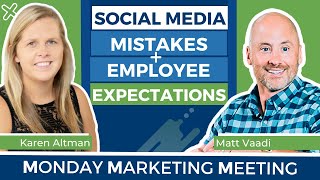
In this unscripted Monday Marketing Meeting, Karen Altman (Marketing Director at ERG) and Matt Vaadi (CEO of ERG) discuss two main themes. First, they explore how the COVID‑19 pandemic has reshaped employee expectations around remote work. They examine the tension between employees wanting to work from anywhere (e.g., while on vacation or during a home‑repair) and employers needing to balance exempt vs. non‑exempt classifications, salary obligations, and realistic productivity expectations. The hosts stress that clear communication, flexible but realistic agreements, and proper use of paid‑time‑off are essential. They also note a broader industry shift toward fully remote or hybrid models, with some companies eliminating physical offices and using coworking spaces only for client meetings. Second, Karen shares the three most common social‑media mistakes she sees among ERG’s marketing clients: (1) not posting at all or posting too infrequently, (2) failing to connect content to current events or timely relevance, and (3) over‑thinking posts and relying on polished, generic assets instead of authentic, real‑time content. She advises simple, regular posting, tying messages to what’s happening in the world (even small things like weather), and using genuine, on‑the‑fly visuals. Matt reinforces these points, linking them to broader marketing principles such as “always be valuable” and the importance of consistent brand “deposits.” The conversation ends with an invitation for listeners to submit future HR or marketing questions.
Chapters
You might want to just wait like 10 seconds. There we go, we're recording.
Okay. Hello, I am Karen Altman and I am the marketing director for the ERG companies. We have ERG Payroll and HR, Grow by ERG, and Guru. And then this is Matt Vadie. He's the CEO of ERG and all the other companies. But we have a weekly meeting every week and we talk about topics that are going on and we're just like, maybe these can be helpful for people listening in, our clients, you know, anyone out there. And you know, if we're talking about it, then probably you're talking about it too. So we just want to get on every week. We're going to have 2 simple questions that we answer, we ask each other, and then just talk through kind of what's going on. So today we're going to start with, you know, we're kind of more in the HR marketing world. So most of the time our questions are going to be revolved around there. But if you ever have any other questions, feel free to reach out to Matt or I and we can definitely, you know, talk about these on our next show next week. So this week, you know, Matt, I had an interesting conversation over the weekend with a friend. Who lives up in Maryland and she works in a very corporate company, has for years, and it's kind of just been always the corporate culture. And during the coronavirus, she's obviously been working from home and she's got this little different mindset now. And it's funny to talk to her this weekend because she's like, we've never had the opportunity to work from home before. We work from home right now. We're going back to the office next week., but we've proven that we can work from home and it's never been addressed before and it's never come up and it's never been allowed. So she wants to take a vacation in August to go visit her parents and take her kids there. And she's like, I want to work from there. I don't want to take my vacation days. I've proven that I can do this. So I'm sitting here listening to her and I'm like, this mindset that these employees have now is that I can work from home and my work can be done, but how do employers approach this, you know, when they have this mindset that this is the way the company's always been, but now it's a little bit different after the coronavirus?
That's interesting. So one of the things Karen and I wanted to do with this was make sure that we didn't have any time to script this out. There's a million, like, nuggets of wisdom on LinkedIn and YouTube and everywhere else right now. So Karen told me the question about 2 minutes before we jumped on And I started thinking about it, and while I tend to agree we have all proven that we can work from anywhere, uh, we haven't all proven— so next week my family and I are going to Pawleys Island. We go there every year. It's an amazing trip. We get in a condo with the in-laws, and, um, you know, that extends over multiple condos, and it turns into this thing where you're going out to the pool, you're going to the beach, you're going here, you're going there, and Do I work on there? Absolutely. I get up in the morning, I get a little bit of work done in the afternoon. I get a little bit more work done. Once the kids go down, I get a little bit more work done. Could I work all day from there? Definitely not. I could not. So the challenge becomes, is this an exempt employee or a non-exempt employee? Right. If it's somebody who's hourly and they're saying, yeah, I want to work while I'm at my mom's house and I can, you know, just get paid for the hours I work. Great. That to me as an employer and as an HR professional, it seems like a pretty fair thing to do. But if I'm exempt and the expectation is I'm going to draw my full salary while I'm kind of half in and half out with my family buzzing all around my kids and my mom. And I guess to your point, you're kind of hitting on something that's interesting too, right? Is I've proven I can watch my kids and work full time. And, you know, some would debate if you've proven that and that's really happening. And, you know, is that a long-term solution? I don't think anybody's given up childcare or school if not forced to in the near future, right? And saying, I'll just work from home full-time with my kids buzzing all over behind me. I don't think that's going to be part of this going forward. So I think to that end, as an employer, you want to be flexible and talk through with people, but get realistic too. And just say, look, Karen, are you going to be able to put in a full 40 or whatever your expectation is while you're out there? Great. Well, if not, hey, why don't you just take a day off, take 2 days off? You know, the problem with an exempted employee is if they're a presenting themselves as available for work, as an employer, this puts you in a really weird spot in that if they're available, they need to be paid their salary. And so this is going to put a lot of employers in a strange conundrum. And I think it's going to come down to what it always comes down to. It's sort of the boilerplate answer for all things working remote and culture is communication and setting proper expectations. And I just, you know, for me, Once again, I would probably encourage her, look, you're going there to take time off, go take some time off. I know you want to work, that's great. But we want you— we give you time off to take it, to recharge, to be with your family, to be present, to enjoy that time. And that's what I want to do that personally, I don't want to go to Polly's next week and work. I don't want to talk to y'all. I want to go there and get away and spend some time with my family. I mean, I'm excited about that. So trying to generate some excitement and help them to think through that is Definitely. And you can certainly— you're well within your right if you're both in agreement on, hey, look, if you're going to work 3 days, we'll pay for 3 days. You're going to take these 2 days off and we can work it out that way.
So what if it's— what do you think if someone is like, I have a plumber coming tomorrow and I would never have asked to work from home before because it's never been allowed from us. We would just have to take a day off. Now we have this work from home mindset. Do I ask to work from home now after the coronavirus? Because it's kind of more— it's happened. Or do I go back to, I have to take a vacation day to stay at home with the plumber tomorrow? Like, do you think companies will change? Do you think that they'll go right back to where it was?
Here's what I think has happened for us, and I can speak to us and many other employers that we work with, and that's that I think those people are going to be more comfortable saying 'Can I work from home tomorrow?' than maybe they would have been in the past. We would have always allowed that, but I don't know that many people were very comfortable coming in and going, 'Oh, hey, you know, the plumber's coming tomorrow. I really want to work from home.' And so they would have been more likely to probably approach it and, you know, like you would with your parents and be like, 'Hey, the plumber's coming. I'm going to take a day off.' And, you know, hope that somebody would be like, 'No, no, no, just work from home. It'd be fine.' Whereas now it's probably like, 'I want to work from home tomorrow because the plumber's commerce coming, just wanted to let you know. And, you know, I'm sitting in an empty office right now. We're working. It's totally optional to come into the office right now. And today, guess what? Everybody opted out. Last Monday or two Mondays ago, everybody was here. And so, you know, and probably something to do with the fact that cases in South Carolina are going through the roof. It's June 15th, 2020. So we're seeing a second resurgence. And I don't mean to make light of it, but it probably has something to do with why folks are opting which, you know what, I'm totally fine with. And I think we're going to see more, um, you know, I've got a good friend, uh, who owns a business who said, you know, they went from, hey, we're trying to find a much nicer, better office in 2020, to we're good, we're going all in on remote. We might get rid of our current office altogether. Yeah, we just need somewhere to meet up with our clients. They're possibly even looking at co-working spaces just for client meeting opportunities, and that's it. So it's changed a lot of people's look on things.
Times are changing.
They are, that's for sure. All right, all right. So I had a question for you. I feel like, um, so Karen, for those of you that don't know her, is a social media magician. So she manages a lot of social media accounts, learns a lot of things about not only just what works and what doesn't work, what to post and when, sort of the, the mechanics behind it all, but also different industries and how people react. So I'm, I'm curious, I was thinking about this over the weekend, like we're seeing more clients coming into our marketing business Grow by ERG. And so you're probably picking up on some of their mistakes. Like what are those 3 common mistakes that clients are making when we take over their social media marketing?
Number 1, and most of the time this is why clients are coming to us anyway, is they're just not posting. They're not utilizing the social platforms they have. If you think about it, this is just thinking of, you know, how often do you scroll on LinkedIn? Every day. You're constantly on there. Like you're constantly, I know I'm more on Facebook. I'm on Instagram. I know you're on LinkedIn. It's just, it's such a platform to use your voice and get your brand out there. And if you're doing it the right way, it works. It converts, it gets people knowing you, and it lets you really put your brand right there in front of the people easier than any other possible way of marketing right now. And just people who aren't posting at all, that's the biggest mistake. I mean, even if you're going once a week, that's better than nothing. But most, you know, we see clients come in and they haven't posted since 2017. They're not utilizing it. And it's kind of like, why? You know, everyone's on there, take a minute. And it's just putting your thoughts out there, doing whatever you need to do, but put something out there, get your brand known on there. So I would say that's the number one biggest one is just not posting anything, not doing anything on it. Number two, I would say, I know current events, it's a big part of what's going on right now and it's a little fine line of, you know, how you use your company to, you know, voice what's going on and We'll use the coronavirus for an example. Every company had something to do with the coronavirus. There was some impact that your company did. There's some impact, there's something that was going on that you could have been putting information out there on social media to connect with your, your people. And I just, it's hard when you see all these brands who are taking advantage of that and that's how they're getting You know, they might not even have their doors open, but they're still communicating and they're still putting, you know, what's going on and how they're benefiting during this time and what they're doing. And it's connecting with people because other people are going through that. So if you relate to what other people are going through, that's how you create that engagement that people are looking for on social media. You know, a lot of people work so hard to get this engagement and it's just by putting out there what's what's going on with other people. So I think that's a number 2 mistake is just not putting with what's going on. And this can be, you know, it can be as simple as it's raining outside. And if your company relates, you know, with the weather and it's, you know, it's an outdoor company and you're putting out there that it's just, you know, when it rains, it pours, we don't really get the business we want to, and other people are going to connect with that. So that's another big one, you know, just not always doing your sales posts and your branded posts. Put out there what's relevant. And I would say the third is people overthink their posts. Posts don't have to be hard. And it can be— the more real it is, the more you relate. Think about when you're scrolling through LinkedIn. And you see a post that's very salesy and generated and it, you know, someone thought through that, you can tell that that's more of a sales. And then you have another brand who puts out there, "Hey, it's Monday. I need 14 cups of coffee this morning. Here's my picture of my full mug of coffee, chugging it." People like that. It brings out what's going on. And I think a lot of people overthink it. Put out the real content. Don't use a stock image. Take a picture on your phone and post it right on there. You know, having these devices and having everything, anything is social worthy. You just have to put it on there. So I think, you know, those top 3 are just not posting whatsoever. That's never going to help you. Number 2, not relating to what's going on currently, like the current events. And number 3 is just putting too much effort into it, not making it as real as people want to see. Use as much real content as you can to put up there. So, and I know it's easier said than done to most people, and I think it's harder trying to not be a social media expert and trying to be on there like really thinking it through, but it's just you got to think what you like on social media and what engages you, and that's what you want to be putting out for your brand too. So I think that's kind of what's going on there.
I think that's a testament to what a great marketer you are in that you just created a listicle right on the spot, right? Like, we just came up with 3 great things you should be doing on social media with no prep. There you go. Um, but that— I'm guilty of that 9 times out of 10. It's just overthinking. Like, if I'm gonna put something out, it has to be produced or it has to be, you know, well thought through. But, but it's interesting, I— you hit on something in there that I see a lot, and that's like Marketing and sales are very different, right? So creating a marketing message is about creating a brand and about creating awareness. I've heard it talked about one time where if you— you don't just go to the bank and walk in and take out money. You have to make deposits, right? You go in and you make deposits first and you keep making deposits and then you can take out money. And so even just outside of those things you talked about, like providing some legitimate value on social media, on your blog, on your website, like, you know, it's nice to have all these posts that are off the cuff and that keep people top of mind. But like, you know, you did a fantastic job with this for us. And we have been so fortunate as COVID-19 came in, like we provided so much amazing content that people could use, free templates, everything we had that we were giving to our clients, we were giving away for free to the, to the public so that people could be in a better place and, you know, get their people back to work and maintain compliance and all that good stuff. So, so don't You know, I think it was just in our conversation earlier. Did you say ABC before we got on here? Always be closing. Yeah, I always tell people ABV, always be valuable, right? So like the more valuable you are, the more valuable you are. Sage words there.
So. But it's just like this video that we're doing. You know, Matt and I talked about, we talk about this stuff on our normal call every Monday. Why not put it out there? It's nothing different that we're doing right now. You know, and each week when we talk about this stuff, why not give it to you guys? Why not put it out for everyone else to use? So that's just the mindset to always have is what can I be putting on social? What can I be doing that is gonna help them? Gonna help someone else, so.
Awesome. Well, with that said, thank you for your time, Karen, and thank you for those helpful social media hints. Tips. If anybody has a question they would like us to answer next week, I will not tell Karen the question until right before, and she will not tell me either. So if you have anything HR, marketing, business related, just let us know. We'll be happy to answer them in real time here, and we'll distribute these throughout the week. But thanks for your time, bud. Appreciate it.
Bye.










