CEO Series: Matt Paulson, founder of MarketBeat
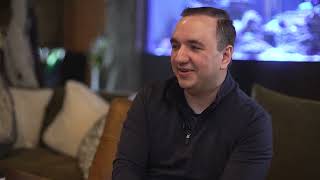
Interview with Matt Paulson (CEO/founder of MarketBeat) covering his early interest in computers and coding, college freelance writing and computer science education, gradual founding and growth of MarketBeat (started ~2007; slow early growth, first seven-figure year ~2014, first eight-figure year 2020, reached ~$25M annual revenue by 2022), technical approaches (natural language generation for earnings/dividends, distribution into Google/Bing/Yahoo Finance portals), business model (≈80% advertising, premium subscriptions), team size (first hire 2013; ~13 employees), and community involvement in Sioux Falls (donated $1M to renovate a building for Startup Sioux Falls; other local initiatives).
Chapters
With nearly 3 million subscribers and between 10 and 15 million monthly page views, one of the industry's largest sources of financial news and information comes out of this office in downtown Sioux Falls. For founder and CEO Matt Paulson, the success of MarketBeat represents years of combining tech know how with an entrepreneurial mindset. So I believe you got your first computer in fourth grade.
I did get my first computer in fourth grade. It was a Packard Bell 133 MHz penny one PC.
And that should be enough to tell you Matt Paulson was never an ordinary kid with a computer.
94, 95, mid-90s. Yeah.
Computers were not super common in Mitchell.
No. And neither was cable Internet. And we were one of the first families to get cable Internet in Mitchell in 2000. We were like one of the beta families that got it. So we had fast Internet before anybody else did, and that was fantastic.
Early adopter. From an early age, you could say.
Yeah, my dad was super into the stuff. And once cable was available, he got it as soon as he could.
By age 10, he'd begun learning to code in HTML. By middle school, he'd turned his ability into his first business built around The Computer Games, SimCity 2000 and similar games.
So I built a little website that had cheat codes and saved games and screenshots, and anybody that somebody who would play those games might want to have access to to make their experience more fun.
But you actually made a little money on this.
Yeah. So there is advertising network called SafeAudit back in the day, and you could put up banners for free website hosting. If somebody would sign up for a free web hosting account from your website, you'd get like $1.50. So I grew it to the point where I think I was making between $25 and $50 a month. That paid for a lot of popping candy in middle school and into high school. And that was a lot of fun.
So, Matt, in high school, trying to think about the future, what did you picture yourself doing?
I kind of thought I would end up getting like a business degree and maybe working at a bank or something like that. Thankfully, by the time I got to Dakota State, I realized, oh, there's a lot of money in computers. I should get a computer science degree.
At Dakota State, he learned to build websites, work with databases and web programming.
It was really kind of those fundamental skills that helped build MarketBeat. And also at the same time, I was kind of doing some personal doing some blogging and freelance writing online. This was like 2005, so people were paying me, 15 or $20 an article as a college student with really no meaningful experience to write about personal finance. So kind of the mix of the freelance writing experience and the programming skills kind of came together to build MarketBeat over time.
Did you have an interest in personal finance or how did that happen?
Yeah, I did. I was like super into Dave Ramsey and Clark Howard and some of those personal finance experts at the time and thought, oh, this stuff is not super complicated. I could write about it in a way that's not totally garbage and had fun doing that and made a little bit of money doing it too.
So nod to Dave Ramsey then, probably because you had a goal to graduate college debt free.
I did. First year I had, you know, not a lot of money. I was working at McDonald's, had to take out the max of student loans. And I kind of realized during the summer between my freshman and sophomore year, like this is not a good plan. I need to figure out how to make some more money. And you know, I signed up to do a bunch of different jobs on campus my sophomore year, started doing the freelance writing stuff. And I think my sophomore year I ended up making like $60,000 while being a full time college student. And it really just kind of went up from there.
So I'm guessing you made your goal.
Oh, yeah. Graduated debt free, paid for grad school and seminary debt free as well. And that was good.
After college, he spent nearly five years working for a peer based web development firm before leaving in 2012 to work on MarketBeat full time after building it as a side business for years. You know, I think sometimes people have this perception that MarketBeat took a really linear straight path.
Yeah.
As far as growth goes, it's. It wasn't really like that, was it?
No. It's the kind of overnight success story 10 years later. Right. Once people realize like you've achieved something, all of a sudden you went from something to nothing. But it was 17,000 my first year, 58,000 the second year, 60,000 the third year. It was just this very slow climb. It wasn't until 2014, seven years into it, that we had our first seven figure year. And then I think 20. Yeah, it was 2020. That was her first eight figure year. So it's taken 2007 to 2022 to get to the 25 million a year in revenue we're at now. It's 15 years into it.
And I feel like you experimented with other businesses too.
Yeah, so I had like a press release distribution service we had with a couple partners. I Had a business that helped animal shelters do online fundraisers. I had some different kind of personal finance products. I had this website about audio books. And eventually I kind of figured on the one thing that worked and really focused on that.
But it tells me you weren't afraid to start something and stop.
Yeah, I mean, that's kind of the key is like know when something this isn't going to work. I got to stop and refocus on something else. And eventually, you know, I had kind of two or three different things going on. MarketBeat made 80% of the revenue and took out 50% of the time. So I thought, okay, I should sell some of this other stuff and focus all my time on MarketBeat, because that just makes a lot of sense.
What was it that made MarketBeat really take off?
So we figured out a couple things that nobody else figured out. The first thing was how to do natural language generation technology with financial content. So say Raven or any publicly traded company announces their quarterly earnings. We were able to take that structure, you know, the structured data of their earnings report and turn it into kind of a 400 word article that we could publish on our website. So all of a sudden we could write these kind of AI type articles.
So say you're not even writing them, right? This is AI, this is artificial intelligence. Yes.
So we could do one of those for every publicly traded company, whenever they announce earnings or a dividend or there's like an insider transaction, anything like that, we could produce an article. The other thing we figured out was really how to growth hack into Google Finance and Bing Finance, MSN Money, Yahoo Finance, kind of those vertical news portals for finance. We figured out how to get our content into those and get people back to our website so they could sign up for our newsletter, click on ads, sign up for premium subscriptions. And those two things together eventually created the snowball that just keeps rolling down the hill.
Now he hired his first employee in 2013 and now has a team of 13. But don't use that metric to judge the business's success. It's small, but the margins are massive.
Yeah, so we had a call with competitor about an hour ago. They have 75 million in revenue and 300 employees and we're at 25 million with 13 employees. So you can definitely tell just the level of automation that comes into play with MarketBeat and just how streamlined our processes are.
Advertising makes up about 80% of the revenue. The rest comes from premium subscriptions.
But we drive about a million and a half ad clicks a month to our Advertisers and these are like publicly traded companies looking for exposure. These are financial newsletter publishers, they're stockbrokers, they're fintech providers that have some new piece of, you know, financial technology they want people to use. It's kind of a mix of anything that touches money.
Paulson still is very much involved day to day in the business, largely leading marketing and growth related work.
So when we do, you know, buy a paid ad campaign for Market B to get people to sign up, I, you know, I make that deal, I set it up, I oversee the performance. So kind of all the other growth elements is really where my time goes these days.
Well, your time goes a lot of directions.
Sure.
Beyond just the company, you have become clearly a leader in the startup community, in the entrepreneurial community. What made you do that? You could have just stayed here, hunkered down, working on your own business?
Yeah. So really started in about 2013. I had been working for myself for about a year and you know, I, I don't think I want to build a business in my basement my entire life. And I want to find everyone else who's doing something, anything close to similar and seeing who I can meet and what I can learn and what friendships and relationships I can build. So I got involved with startup community stuff and over time that's really snowballed into a bunch of different initiatives like Falls Angel Fund and Startups who Falls and now Homegrown Capital. I've just had a lot of fun meeting with people, seeing what they're working on. Maybe there's a way I can help them and point them in the right direction. I really enjoy doing that.
He sees the right elements in the city now for a startup ecosystem centered around Startup Sioux Falls, which is moving downtown and where Paulson has donated $1 million to renovate a historic building for its headquarters.
I think we're kind of finally coalescing around a strategy with startups who falls being downtown and having kind of a founders community that's both in person and online, but in addition to that, having kind of a mentor network of seasoned business leaders that can point people in the right direction. But also venture capital resources where, you know, there's, there's mentorship, there's capital and there's community all kind of working together to help people kind of start their thing.
If you could rewind in your business journey and do something differently, is there something that comes to mind?
Yeah, I think I moved pretty slowly early on, relatively speaking. Like I was very hesitant to quit my full time job I was very hesitant to hire and very hesitant to try some different things because it was, you know, I had a good thing going. I didn't want to screw it up. And I think if I just really went for it all in like earlier, I think MarketBeat could have seen some of the success that it has now, you know, five, three, four years before it did.
At MarketBeat, he's built a unique culture. From Market Reef, an impressive custom aquarium, to local art throughout the office and regular trips to neighboring Queen City Bakery. Paulson says he wants people to have a good time at work.
There are so many office jobs that are just kind of, I don't say mind numbing, but very draining and we want people to look forward to coming into the office every day.
As for where he sees the company going, MarketBeat continually is working on new tech tools and potential partnerships. But Paulson isn't in the market to sell his business.
It makes too much money and we probably wouldn't get a great valuation for it because it doesn't make sense in anybody else's universe.
Right.
Media companies don't get high valuations. They tend not to anyway. And I don't need the money from a sale. And then I would just have a boss that I don't really want to work with anyway. So there's not a lot of benefit from me selling Markbeat at 36.
Is there more that you would like to do within the community? I mean, you're still very early in your career here. I feel like there is so much that you can.
Yeah, there's, there's kind of a. I got a mental list of projects that I want to see get done. The first thing is the startups who falls building downtown. I would love to see the Butterfly House get their big aquarium built. That's gone a lot slower than people had hoped and I'd love to see that get done. And I haven't dove into it with it yet, but that's something I'd like to see get done. Want to build a permanent home for my church on the west side of town. Thinking about how to get that done. And, you know, those are kind of, I think, projects that will keep me busy for the next five, 10 years.
What do you do when you're not working?
I go on a lot of walks. Walk my dog, walk my kid, play with my kids a lot. Every Saturday we're out doing something. Every Sunday we're out doing something. Watch a lot of YouTube at night. I need some good mindless entertainment and watch old wrestling Videos or, you know, video game streamers and stuff. We can. Will he not think for a while?
Turn the brain off? Yeah, I don't feel like that happens very often, though.
No, I mean, that's like 9pm at night after working for doing stuff for all day. You know, I think a lot of people wait and try to, like, ask permission for somebody. Like, they want somebody to validate their idea or tell them it's a good idea or, like, encourage them or give them money. Like, don't. Don't wait for somebody else's permission. Just go build something and see what people think of it. I think that stops a lot of people. I think money stops a lot of people. You can build so much online now for almost no money at all. You know, don't, don't, don't. You know, there are people that will be gatekeepers in the world if you let them, and just don't let them be gatekeepers. Like, don't ask permission. Just go do it.
Anything else that you think would be good for people to know about you? Because I'm sure sometimes people, you know, they see the public Persona, right, and they're like, what's this guy really all about?
You know, I think there are some people that think in town that I'm intimidating. And the people that know me know that's, you know, not shouldn't be the case. I'm very approachable. So if you see me in the community and you want to say hi, feel free to say hi. Like, I won't bite you, I promise.
I would agree with that. Well, thank you. And thank you for sponsoring the CEO series. That's just one more example of how you're giving back to the community.
Yeah, it's been great to see all the interviews and get deeper kind of insight into what's going on in Sioux Falls. And can't wait to see the ones coming up next month and the following.
And we would, of course, like to thank MarketBeat for sponsoring the CEO series. Stay tuned for more conversations with CEOs making news throughout the year. And for all your latest business news, head over to www.siouxfalls.com.








