How Peter Chamberlain Aims to Prevent Senior Falls and Reduce Healthcare Spending
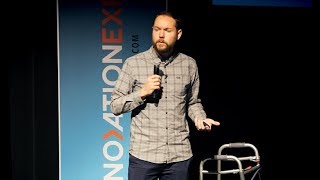
Peter Chamberlain built Walkwise, a smart walker attachment that detects falls and monitors activity. Senior falls cost the U.S. about $60 billion yearly and often lead to hospitalization. His product is already in pilot deployments at senior living facilities and has backing from Falls Angel Fund and Techstars with UnitedHealthcare.
Chapters
Foreign.
Thank you, everyone.
Thank you.
Thank you, everyone. It's great to be back in Sioux Falls at the the Innovation Expo. I've got a lot of things in my hand, so I'll try to juggle all this. This is Walkwise. This is the world's first smart walker attachment. It detects falls, engages families, does fitness and activity tracking, and can even help prevent falls by increasing walker use adherence. But I'll talk more about that later. This is what it looked like two years ago. Very different 3D printed, lots of different ideas floating around how to do this. This is what the app looked like. It's made a lot of improvements. So that leads me to answer the question, look, why am I here? Why am I in Sioux Falls? Why am I up on the stage? It's because I went to a group of individuals at Zeel called Falls Angel Fund two years ago, and they believed in the problem that I was solving, and they. They didn't much care about what it looked like, but they saw that I had a passion for solving this very serious problem of falls among the senior population and that I had the skills to potentially be able to do this. And then the other reason I'm here is because when I needed funding to grow the company, I went back to Falls Angel Fund, but I went to also Hub City Capital in Aberdeen, who ended up leading my last funding round. So I'm very, very happy to be here in Sioux Falls to give back and to try to educate, because I've gotten a lot from this state, a lot from this community, and so just want to express my gratitude on that point. So why am I doing this? Specifically with walkers, I obviously don't need one right now. I had three grandparents that were all using a walker at the same time. And one story in particular is worth telling. My Grandma Kathleen, who's 93 years old, lives by herself independently on the family farm, had been a walker for many years, a walker user for many years. About two years ago, three years ago, she was walking around her house without her walker and without her life alert pendant, and she fell. And we don't know how long she was on the floor. The gardener actually found her looking in the window, so. So she could have been there all day for all we know. And she had a broken leg. She had to be flown to Billings for emergency surgery. Spent three months in a rehabilitation unit. Very easily could have ended her life. Right. It's the leading cause of fatal injury for older adults. Falls are. And we spent $60 billion paying for these every single year, but great. She's back home now. She's doing fantastic. I can track her motion, make sure that she's doing okay. But it got me thinking. How is it in today's day of connected devices that we didn't know she was on the ground? It just seems unfathomable that we are relying on her to wear a bulky pendant 247 and being able to press the button when she needs help. So I knew I could solve that problem. And the second one was, why did she fall in the first place? Why was she needing help? And it was pretty obvious for us as a family, because she wasn't using her walker. Right. One just like this. And so I got to thinking, how can we flip the script around the walker? It's something that people maybe think makes them feel old. It's associated with old age. But if we can reframe this as the tool that is keeping folks independent, keeping them out of the hospital, out of the nursing home, keeping them at home where they want to be, we can make a real impact on not only healthcare spending, but quality of life. So that's why I'm doing this. These sorts of things you can do with Walkwise. Now, we would know if she didn't move her walker in four hours, if the walker were to tip over. I'm about to get a phone call here from my system, so I'll try to play that through the speaker. But we would know about it, right? And then, let's see. But we also want to make it positive, right? If, like, she reaches her daily walking goal, we want to congratulate that. Right? The Internet sucks back here, so that's why I'm not getting it. So who loses when a fall occurs? Right? We have seniors, we have their families, we have senior living communities because they lose out on their customers, they lose revenue. You have insurance companies that obviously have to pay for it, and then you have healthcare providers who get dinged on their reimbursement when someone leaves the hospital but then has to come back because they've fallen. I'm going to talk about two of these industries really fast before moving on. Senior living is a really tough industry to sell into, but it's really growing fast, and it has a huge ability to improve quality of life. There's so many seniors that are aging that need to be in a different setting than home. There's low barriers, there's high competition, which means it's driven by free market economies. And then there's a huge opportunity to reduce healthcare spending, which is A major problem in this country. And most of our healthcare spending happens on the later stages of life. So senior living, having access to so many seniors, has a huge potential to reverse this trend for them. We're providing them an instant wellness program. Right. Wellness is what sells nowadays. You walk into a place with your loved ones and you're trying to figure out where you want your loved one to live and you want them to be well, you want them to care about wellness. And so this is what we do. We provide paper handouts to the seniors themselves. If they don't use a smartphone, families can access from the Walkwise app so they can see how much activity their loved ones are getting. Encourage that walker use, reduce hospitalizations. We're able to actually help screen for infections based on nighttime walker usage. Decreases in walker use can be signs of depression, illness, injury, all sorts of things. But ultimately, free market economics, it helps them with their marketing and sales. Right. If, as I said, families really respond to this because they want access to the app, it's unprecedented that they would have this much information about their loved ones. But it makes for a really good selling tool. Now I want to switch gears and talk about health insurance. And this is not something that a couple months ago I thought I would be talking about. But the reason I'm able to talk about it is because we have had the amazing opportunity to participate in a Techstars program in Minneapolis in partnership with UnitedHealthcare. So Techstars is the world's largest seed stage investment firm. And what they do is they run accelerators all over the country, 10 companies, each usually with a corporate partner. That makes it so it's a very industry focused event. And so the healthcare accelerator for the world is in Minneapolis and we got to participate in that. So it's a fantastic opportunity. They now have almost 2,000 companies in their portfolio with a combined market cap of $22 billion. And Walkwise is one of those in that statistic. And then UnitedHealthcare, which is the partner in this program, they are the largest healthcare company in the world. That's a fact. And they're based just down the road. And so having these conversations with them about, okay, if we actually do want to reduce healthcare spending, which is in their financial interest, how do we do that? Well, we cut into the amount that we spend on infections and falls for the senior population and the amount of money that we're spending when we're not able to detect that someone's quality of life has changed and they end up in the ER with something we could have prevented three months ago if we had known about it. So these are the conversations we're having and it's really powerful. And it's all because I had the momentum of my latest funding round led by Hub City and Falls Angel Fund. Right. Like, that's the reason that I was able to get into this program. So these are the other companies in the program. As you can see, there's only one other regional one in Minnesota, and the rest are from Chicago, Texas or Silicon Valley. So this is my team. Nick and Jordan would be here today, but they're actually in Minneapolis at a pitch event with a bunch of big companies like Mayo and UHG and, you know, all of these different major players in the city. So it's really fun. I have a great board. Kathy Cochran, Greg Taveen and Travis Kiefer, who represents Hub City Capital. So now I just want to take some time to provide some thoughts and perspective on the last couple years as an entrepreneur and being at a lot of events like this and being in IT and talking to a lot of different companies. These are not guaranteed to be correct, but they're thoughts for investors, for entrepreneurs themselves, but also, as Cody was talking, for families, because they're an important piece to this. This is more for investors. And as you make hires, demand product capabilities. There's so many people I've talked to that have fantastic ideas, but if they don't have the technical skills to be able to turn those into a reality and turn their idea into a reality, it's going to be really, really hard to gain traction. Especially here in the Midwest, you might be able to raise money on idea in Silicon Valley, but here people want to see that you've actually built something, even if it's just a dog dumb 3D printed model that's on the leg of the Walker. Invest in problems we're solving. So this is for investors and for entrepreneurs, because you're investing way more than your money. You're investing your life. It takes a lot of things go wrong often. And so if you're not passionate about the problem you're solving or you don't feel proud when you talk about it, it's gonna be really, really hard to make it through the tough times. So on the flip side, invest in problems we're solving, but invest in things that are ugly. It doesn't really matter what it looks like today, as long as the problems we're solving, as long as you have the capabilities on your team to make it a reality, expect failures and Everyone says this, but I just want to reiterate this. The flip side of failures is expect pivots, right? What you start is not going to be what you end up with. What you invest in today is not what you're going to have an investment in tomorrow. And you have to expect that, but you have to trust that the team has a process for figuring out what works and what doesn't. Which is what Thomas was saying earlier, right? He was saying that do a bunch of little tests and if something works out, go with it, and if it doesn't, don't do that anymore, right? And this is what startup companies are able to do that big companies cannot. And this is where all of the value and all the economic value comes from. Startups is about being able to pivot very, very quickly. But that usually become comes about because you failed at something, which is fine. So the last point I want to leave you with is for everyone who is in business in this room, so can you raise your hand if you have any sort of decision making power at a business whatsoever? Okay, that's like almost everyone in the room, right? I'm not telling you to be a customer, to be selfish, sort of, but you should really think about it from your perspective, right? It's not an altruistic thing to do business with startups. Why do you think UnitedHealthcare, the largest healthcare company in the world, paid millions of dollars to, to bring in 10 startup companies like mine to Minneapolis for three months? Right? It's not because they're altruistic about it, right? It's because they understand all of these things that startups can do that they cannot. But even if you're not UnitedHealth Group, think about it. You're in a leadership position in a company and you have entrepreneurs coming to you that essentially wanna do free consulting for you, right? They're coming to you and saying, hey, how can we build a better product for you for free? Right? If I have a meeting with someone in healthcare or in senior living and they're like, oh, I need this feature, right? That you can do within your system. I'm like, great, I'm gonna go build that. I'm not gonna charge them to go build that. I'm gonna go build it and then I'm gonna come back to them with a better product that better fits their needs, right? So it's not altruistic at all, it's kind of selfish. But use startups to your advantage and it'll help the startups as well. So the next Time you have an entrepreneur email you or call you asking for 30 minutes of your time, just do it. Really just do it. Because we know that the communities and the organizations that support startups are the ones that are best suited for success in the 21st century. That's a fact. And. And we need to really take that to heart because this today is fantastic. But it's startup theater, right? And I'm up here, I'm talking about, like, what I'm doing. If we don't take anything from this room, that's not gonna have actually made a difference. So this is what I want you to take from this room is be a customer, even if it's a free customer, provide feedback, meet with entrepreneurs, support them, and we'll drive a lot of economic value for the region and for the entrepreneurs in this region. So. So those are my thoughts. Thank you so much for having me. It's great to be here. And I'll take any questions. Awesome.
Thank you very much, Peter. Again, if you have any questions, just raise your hand. I'll track you down. Hey.
I can hear you. I can kind of repeat. Here we go.
Can we hear this?
Yeah, we're good.
All right, so what you guys don't know about Pete is he's a hustler. We had dinner when he was at 1 million cups the night before. And we walk out of dinner and he sees an old lady with a walker. And I'm not kidding you, introduces himself, pitches the product and made a sale on the spot.
And so I didn't get that sale, but.
All right, well, you've still the guy. The guy's got drive. So what I want to know, Pete is obviously falls angel fund has believed in you, They've given you funding. What has been the result of that funding? How are sales doing? How's adoption with all the activity that you've had going on?
Yeah, so the first time they invested, as I said, was two years ago. And that was really kind of in the idea stage. Right. It's like I have this idea of this problem I'm going to solve, and this is the solution. It's a smart walker attachment. It does X and Y. And then what I was able to do is sell some people on that. Right. Some people in the industry. Right. I was able to go to a couple senior living communities and some other types of places, like Ann Carlson center, for example, and say, hey, wouldn't this be great for you guys? And they said, yes, here's a contract for, you know, a couple hundred bucks a Month. Right. And I was able to use that momentum as well as actually installing it and actually learning from those customers. Right. Was super valuable. And that's where I got Feature Z. As I said, I had XY before and then I added Feature Z. And so I was able to go back to investors and say, here's the progress I've made. Not only is it an idea now, I've actually made it, I've sold it and I have Feature Z. Right. So it's going in the right direction. And so right now what we're trying to do is expand our reach nationally. So that's why I hired Jordan. He's literally making calls all over the country, getting us in touch with innovative senior living communities, making maybe 30 to 60 calls a day, which is something that I just can't do as an individual while I'm running a business, which goes back to Thomas's point about hire as soon as you can. But we have contracts in the workflow in Florida, in Washington, we have a new customer out in Michigan, there's another one in Michigan that we're working on. And then working with United Healthcare potentially. There's all of these things that just momentum is number one. Right. And Thomas was saying that too. He was saying sell your company when it's growing. Right. Which also is the equivalent to you can raise money when you have momentum and when you're growing.
We have time for one more question. If someone else has a question for Peter. So I actually have one for you. Quick. One of the things I hear frequently from startups or from entrepreneurs is kind of that elevator pitch, explaining a complex product or what you're doing in an easy way. What are maybe some thoughts on kind of your journey and what you were able to find with that and kind of explain to somebody quickly what walk wise is.
You don't want me to give the elevator pitch, presumably, because I already just talked about it. So you have to. So this is like the, literally the first day of techstars, they said you need to have your elevator pitch down and it needs to be 20 seconds long and you need to have that down pat. And you would not believe the number of people who got up there and talked for 120 seconds, two minutes. Right. You have to be very self aware, realize that people's attention spans are not long. They're going to lose interest, even if it's the best thing in the world. I don't think you could pitch Google and I think if you pitch Google In 120 seconds, people would be bored, right? But if you pitch it in 20 seconds, they're all more interested. And you also need to have pitches for different people you're talking to, right? You have a totally different pitch as you're talking to the general public as opposed to if you're talking to investors, as opposed if you're talking to customers, as opposed to if you're talking to people you might want to hire. They're completely different, right? And one of the really successful founders that's in our cohort, and this is his umpteenth company, he said that the job of an entrepreneur is to be a storyteller, right? You have to frame your story. He doesn't mean lying. He means including the relevant details and framing the story in the way that's most interesting, the person you're talking to. So I hope I've done that today. I don't know, but that's the advice they gave me. So thank you, everyone. It's been a pleasure.










